Class 9 Math Notes and Solutions PDF

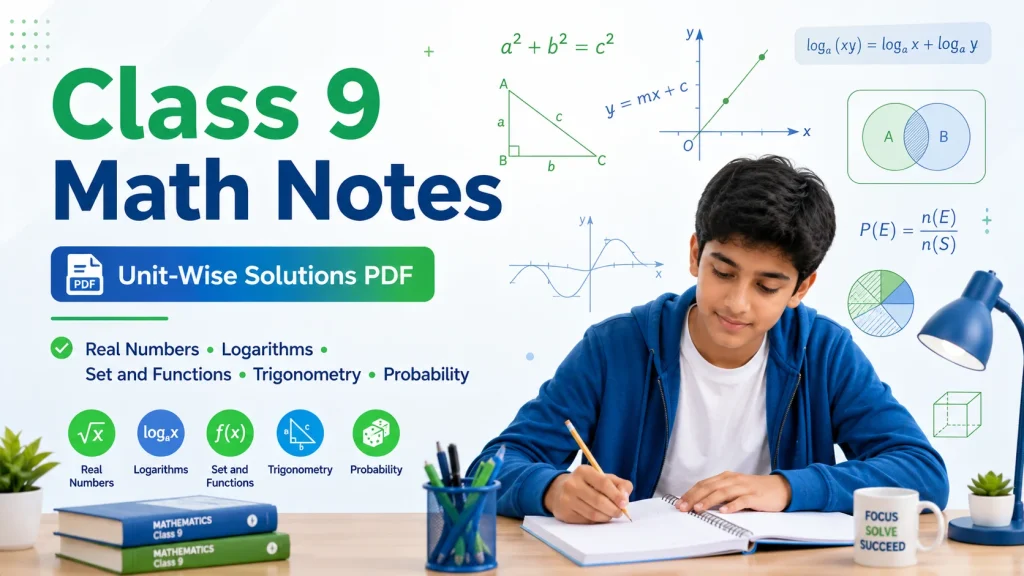
Class 9 Math Notes and Solutions are available here in easy PDF format. These notes are prepared for students who want clear and step-by-step solutions of the latest Class 9 Mathematics book.

On this page, students can access unit-wise Class 9 Math solutions. Each unit page includes exercise-wise PDF solutions, important formulas, main concepts, common mistakes, and useful exam preparation guidance.

These Class 9 Math Notes are helpful for homework, class tests, self-study, annual examinations, board exam preparation, and quick revision. Published units can be opened from the links below, while the remaining units will be added as their solutions are completed.

Unit Wise Class 9 Math Notes and Solutions

Class 9 Mathematics introduces students to important concepts from numbers, algebra, functions, geometry, trigonometry, logic, statistics, and probability. Many of these topics are used again in Classes 10, 11, and 12.

Class 9 math notes and solutions for the new book of 2026

The unit-wise overview below explains what students will study in each chapter. Students can read the overview first and then open the complete exercise-wise solutions of the required unit.

Unit 1 Class 9 Math Notes – Real Numbers

Unit 1 introduces the real number system. Students learn about natural numbers, whole numbers, integers, rational numbers, irrational numbers, and real numbers.

The unit explains how different types of numbers are related and how they can be represented on a number line. Students also study the properties of real numbers, including closure, commutative, associative, distributive, identity, and inverse properties.

This unit also covers laws of exponents, radical expressions, simplification of surds, and rationalization of denominators. Students should practise each exponent rule carefully because these rules are used throughout algebra.

Real Numbers form the foundation of many later units. A strong understanding of exponents, radicals, and algebraic simplification will help students in factorization, equations, trigonometry, and coordinate geometry.

Unit 2 Class 9 Math Notes – Logarithms

Unit 2 is about scientific notation and logarithms. Students learn how very large and very small numbers can be written in standard form.

A logarithm is another way of writing an exponent. For example: \(a^x=b\)

can be written in logarithmic form as: \(\log_a b=x\)

Students learn the product law, quotient law, and power law of logarithms. These laws make multiplication, division, powers, and roots easier to handle.

The unit also explains common logarithms, characteristic, mantissa, and the use of logarithm tables or calculators where required. Students should understand how exponential and logarithmic forms are connected instead of only memorizing the rules.

Logarithms are useful in mathematics, science, engineering, astronomy, sound measurement, and calculations involving very large or very small quantities.

Unit 3 Class 9 Math Notes – Sets and Functions

Unit 3 introduces sets, relations, and functions. A set is a well-defined collection of objects. Students learn how sets are written in roster form and set-builder form.

The unit covers finite sets, infinite sets, empty sets, universal sets, subsets, proper subsets, and power sets. Students also study operations on sets, including union, intersection, difference, and complement.

Venn diagrams are used to show relationships between sets. Students should draw these diagrams neatly and place each element in the correct region.

The second part of the unit introduces relations and functions. Students learn about domain, codomain, range, ordered pairs, Cartesian products, and different ways of representing a function.

A function connects each input with a particular output. Functions are important because they are used again in graphs, algebra, trigonometry, calculus, and many real-life mathematical models.

Unit 4 Class 9 Math Notes – Factorization and Algebraic Manipulation

Unit 4 develops important algebraic skills. Students learn how to factorize algebraic expressions by taking common factors, grouping terms, and applying algebraic identities.

Some commonly used identities include:

\[
a^2-b^2=(a-b)(a+b)
\]

\[
a^2+2ab+b^2=(a+b)^2
\]

\[
a^2-2ab+b^2=(a-b)^2
\]

Students also learn the factorization of quadratic expressions, the sum and difference of cubes, and expressions that require rearrangement before factorization.

The unit may include the HCF and LCM of algebraic expressions, simplification of algebraic fractions, and operations involving rational expressions.

Factorization is one of the most important algebraic skills in Class 9. It is used in equations, functions, fractions, graphs, and higher mathematics. Students should always check a factorized answer by multiplying the factors again.

Unit 5 Class 9 Math Notes – Linear Equations and Inequalities

Unit 5 explains linear equations and inequalities. A linear equation in one variable can generally be written as:

\[
ax+b=0
\]

where \(a\neq 0\).

Students learn how to simplify both sides of an equation, collect like terms, isolate the variable, and check the final answer by substitution.

The unit also covers linear inequalities. Students learn the meaning of the symbols:

\[
<,\quad >,\quad \leq,\quad \geq
\]

An important rule is that the direction of an inequality is reversed when both sides are multiplied or divided by a negative number.

Students may also represent solutions on a number line and solve equations or inequalities involving fractions, brackets, and word problems.

This unit helps students convert practical situations into mathematical equations. Students should read word problems carefully, define the unknown quantity, form the correct equation, and then solve it step by step.

Unit 6 Class 9 Math Notes – Trigonometry

Unit 6 introduces trigonometry and the relationship between the sides and angles of a right-angled triangle.

Students learn the basic trigonometric ratios:

\[
\sin\theta=\frac{\text{Perpendicular}}{\text{Hypotenuse}}
\]

\[
\cos\theta=\frac{\text{Base}}{\text{Hypotenuse}}
\]

\[
\tan\theta=\frac{\text{Perpendicular}}{\text{Base}}
\]

The reciprocal ratios cosecant, secant, and cotangent may also be introduced. Students learn how to identify the perpendicular, base, and hypotenuse with respect to a given angle.

The unit explains how trigonometric ratios can be used to find unknown sides and angles. Students may also study standard angle values, basic identities, angles of elevation, and angles of depression.

Trigonometry is used in surveying, navigation, construction, engineering, astronomy, and physics. Students should draw a labelled triangle before applying any trigonometric ratio.

Unit 7 Class 9 Math Notes – Coordinate Geometry

Unit 7 introduces coordinate geometry. Students learn how points are represented on the Cartesian plane using ordered pairs.

An ordered pair is written as: \((x,y)\)

The horizontal axis is called the \(x\)-axis, while the vertical axis is called the \(y\)-axis. The point where both axes meet is called the origin.

Students study the four quadrants and learn how the signs of coordinates change in each quadrant. They also learn how to plot points correctly on graph paper.

The unit may include the distance between two points, midpoint of a line segment, slope, area of a triangle using coordinates, and equations connected with straight lines.

Coordinate geometry connects algebra with geometry. Students should use a proper scale, draw neat axes, label points clearly, and check the signs of coordinates carefully.

Unit 8 Class 9 Math Notes – Logic

Unit 8 introduces mathematical logic and reasoning. Students learn what a statement is and how to decide whether a statement is true or false.

The unit explains simple statements, compound statements, truth values, negation, conjunction, disjunction, conditional statements, and biconditional statements.

Common logical symbols may include:

\[
\neg p,\quad p\land q,\quad p\lor q,\quad p\Rightarrow q
\]

Students also learn how to construct and interpret truth tables. A truth table shows the truth value of a compound statement for all possible combinations.

Logic helps students understand mathematical arguments and make correct conclusions. It is also important in computer science, programming, digital electronics, and problem-solving.

Students should read each statement carefully because small words such as “and,” “or,” “not,” and “if” can change its logical meaning.

Unit 9 Class 9 Math Notes – Similar Figures

Unit 9 explains similar figures. Two figures are similar when they have the same shape, although their sizes may be different.

In similar figures, corresponding angles are equal and corresponding sides are proportional. Students learn how to identify corresponding sides and calculate an unknown length using ratios.

For similar triangles:

\[\frac{\text{First side}}{\text{Corresponding side}} = \frac{\text{Second side}}{\text{Corresponding side}}\]

The unit may also explain the scale factor and the relationship between the perimeters and areas of similar figures.

Similar figures are used in maps, models, photography, architecture, construction, and measurement. Students should write corresponding vertices in the correct order before forming proportions.

This unit connects geometry with ratio, proportion, coordinate geometry, and trigonometry.

Unit 10 Class 9 Math Notes – Graphs of Functions

Unit 10 explains how functions can be represented through graphs. Students learn how an algebraic rule produces ordered pairs that can be plotted on a coordinate plane.

A function may be written as: \(y=f(x)\)

Students learn how to make a table of values, choose suitable values of \(x\), calculate the corresponding values of \(y\), and plot the resulting points.

The unit covers important graph features such as \(x\)-intercepts, \(y\)-intercepts, increasing and decreasing behaviour, domain, and range.

Students may study graphs of linear functions and other simple functions. They also learn how graphs can represent real-life situations involving distance, time, cost, temperature, and change.

Graphs should be drawn using a proper scale. Axes must be labelled, points should be plotted accurately, and the graph should be joined according to the nature of the function.

Unit 11 Class 9 Math Notes – Loci and Construction

Unit 11 introduces loci and geometrical constructions. A locus is a path or set of points that satisfy a particular condition.

Students learn common loci, such as:

  • Points at a fixed distance from a given point.
  • Points at an equal distance from two fixed points.
  • Points at an equal distance from two intersecting lines.
  • Points at a fixed distance from a given line.

The unit also includes geometrical constructions using a ruler and compass. Students may construct perpendicular bisectors, angle bisectors, triangles, and other figures according to given conditions.

Construction questions require accurate measurements and a clear sequence of steps. Students should keep construction arcs visible unless the question instructs otherwise.

This unit improves geometrical reasoning, drawing accuracy, and the ability to convert written conditions into a correct geometrical figure.

Unit 12 Class 9 Math Notes – Information Handling

Unit 12 is about collecting, organizing, presenting, and interpreting information. Students learn how raw data can be arranged in a useful form.

The unit may cover frequency distributions, grouped and ungrouped data, tables, bar graphs, histograms, pie charts, and other graphical representations.

Students also learn measures of central tendency, including:

\[
\text{Mean}=\frac{\text{Sum of observations}}{\text{Number of observations}}
\]

The median is the middle value of arranged data, while the mode is the value that occurs most frequently.

Information handling is used in education, business, science, sports, surveys, economics, and everyday decision-making.

Students should arrange data carefully, check totals, use the correct scale in graphs, and show all calculations when finding mean, median, or mode.

Unit 13 Class 9 Math Notes – Probability

Unit 13 introduces probability. Probability tells us how likely an event is to occur.

Students learn about experiments, outcomes, sample spaces, events, favourable outcomes, and total possible outcomes.

For equally likely outcomes:

\[
P(E)=\frac{\text{Number of favourable outcomes}}{\text{Total number of possible outcomes}}
\]

The value of probability always lies between \(0\) and \(1\):

\[
0\leq P(E)\leq 1
\]

A probability of \(0\) represents an impossible event, while a probability of \(1\) represents a certain event.

Students solve questions involving coins, dice, cards, numbers, and other simple experiments. They may also compare theoretical probability with experimental probability.

Students should write the complete sample space before counting favourable outcomes. This reduces the chance of missing or repeating an outcome.

What Is Included in These Class 9 Math Notes?

These Class 9 Math Notes are arranged unit-wise and exercise-wise so students can quickly find the material they need.

Each unit page may include:

  • Exercise-wise PDF solutions.
  • Complete statements of textbook questions.
  • Detailed step-by-step calculations.
  • Important formulas and definitions.
  • Explanations of difficult concepts.
  • Common mistakes students should avoid.
  • Review exercise solutions.
  • Final answers written clearly.
  • Exam preparation tips.
  • Related Class 9 study resources.
  • Frequently asked questions.

The main purpose of these notes is to explain how each answer is obtained. Students should read the complete working instead of copying only the final answer.

Class 9 Math New Book Solutions

The latest Class 9 Mathematics book contains 13 units covering numbers, logarithms, sets, algebra, equations, trigonometry, coordinate geometry, logic, similar figures, graphs, construction, statistics, and probability.

The first few units build the algebraic foundation required for later chapters. Real Numbers and Logarithms improve numerical skills. Sets and Functions introduce mathematical relationships. Factorization and Linear Equations develop algebraic problem-solving.

Trigonometry and Coordinate Geometry connect algebra with geometry. Logic develops reasoning skills, while Information Handling and Probability introduce students to data and uncertainty.

These Class 9 Math solutions are written in a student-friendly style. Calculations are divided into small steps so students can understand the complete method without becoming confused.

Why These Class 9 Math Notes Are Helpful

Mathematics becomes difficult when students skip basic concepts or perform too many calculations in one step. These notes divide solutions into clear and manageable stages.

The Class 9 Math Notes are helpful for:

  • Understanding textbook exercises.
  • Completing daily homework.
  • Preparing for class tests.
  • Checking answers after attempting questions.
  • Learning methods missed during class.
  • Revising important formulas.
  • Preparing short and long questions.
  • Practising board-style questions.
  • Studying independently at home.
  • Reviewing difficult exercises before examinations.

The notes are written in simple English so students can follow the solution method easily. They are especially helpful when a textbook answer provides only the final result without showing the complete calculation.

How to Use These Class 9 Math Notes

First, open the unit that you are studying. Select the required exercise or review exercise from the unit page.

Read each question carefully and try to solve it yourself before opening the solution. Even a partial attempt will help you understand the provided method more effectively.

When you become stuck, compare your work with the step-by-step solution. Identify the exact step where your method changed or where a calculation mistake occurred.

For algebraic questions, write one operation at a time. For geometry and trigonometry, draw and label the figure. For graph questions, use a proper scale and label both axes.

After completing an exercise, close the solution and attempt a few questions again without help. This will show whether you have understood the method or only followed the written steps.

Use the PDF solutions for learning, checking, and revision. Do not use them only for copying homework.

Study Tips for Class 9 Math

Revise important formulas regularly instead of trying to memorize all of them before an examination.

Practise mathematics daily. A short daily practice session is usually more effective than studying the whole chapter in one day.

Do not skip steps in algebraic calculations. Clear working helps you identify mistakes and may also earn method marks in an examination.

Check positive and negative signs carefully. Sign mistakes are common in algebra, equations, inequalities, coordinate geometry, and graphs.

Draw neat diagrams for geometry and trigonometry questions. Mark all known lengths, angles, and points before starting the solution.

Use graph paper where required. Choose a suitable scale and label the axes clearly.

Learn definitions from the textbook. Definitions, properties, and theorem statements may appear in multiple-choice and short questions.

After completing each unit, solve its review exercise without looking at the solutions. Use the notes only to check mistakes afterward.

Practise similar questions after studying a solved example. Understanding one example is not enough unless you can apply the same method independently.

Important Topics in Class 9 Math

Class 9 Mathematics contains several important topics that form the base for higher classes. Students should give proper attention to every unit.

Important topics include:

  • Rational and irrational numbers.
  • Laws of exponents.
  • Radical expressions and rationalization.
  • Scientific notation.
  • Laws of logarithms.
  • Set operations and Venn diagrams.
  • Relations, domain, and range.
  • Algebraic identities.
  • Factorization of quadratic expressions.
  • Linear equations and inequalities.
  • Trigonometric ratios.
  • Coordinate points and graphs.
  • Logical statements and truth tables.
  • Similar triangles and scale factors.
  • Graphs of functions.
  • Geometrical loci and constructions.
  • Mean, median, and mode.
  • Sample spaces and probability.

Students should not leave an entire unit unprepared. Later topics often depend on concepts studied in earlier chapters.

Related Class 9 Math Resources

Students may also use the following resources with these notes:

9th Class Math Textbook PDF

Download the latest Class 9 Mathematics textbook and use it with the exercise-wise solutions.

Class 10 Math New Book Notes

Continue your preparation with unit-wise Class 10 Math notes and solved exercises.

Important Mathematics Formulas

Revise commonly used mathematical formulas before attempting exercises and examination questions.

Free Math Games

Practise mathematical concepts through interactive games covering algebra, fractions, trigonometry, and other skills.

Math Calculators

Use the available mathematics calculators to check calculations and understand different solution methods.

FAQs About Class 9 Math Notes

What is this Class 9 Math Notes page about?

This page is the main hub for unit-wise Class 9 Math Notes and exercise-wise PDF solutions.

Are these Class 9 Math Notes based on the new book?

Yes, these notes follow the latest Class 9 Mathematics book and its 13-unit structure.

How many units are included in Class 9 Mathematics?

Class 9 Mathematics includes 13 units. The book starts with Real Numbers and ends with Probability.

Are the Class 9 Math solutions available exercise-wise?

Yes. Each published unit page contains separate exercise-wise solutions and review exercise solutions where available.

Are the solutions available in PDF format?

Yes. The exercise solutions are provided in PDF format so students can read them online or save them for offline study.

Do these notes show complete steps?

Yes. The solutions are written step by step to help students understand the complete method.

Are these notes useful for weak students?

Yes. The solutions use simple language and divide calculations into smaller steps. This makes them helpful for students who need more explanation.

Can these notes be used for board exam preparation?

Yes. Students can use these notes for exercise practice, formula revision, class tests, annual examinations, and board exam preparation.

Which Class 9 Math units are available?

Published units can be opened through the unit links at the top of this page. Additional unit links will be activated as their solutions are completed.

Should students attempt questions before reading the solutions?

Yes. Students should first attempt each question themselves. The solution should be used to understand difficult steps, identify mistakes, and check the final answer.

Can students study only from these notes?

Students should use these notes along with their mathematics textbook and their teacher’s instructions. The textbook explains the official syllabus, while the notes provide additional support and detailed solutions.

Are the review exercises also solved?

Review exercise solutions are added to the relevant unit pages along with the regular textbook exercises.

Disclaimer

These Class 9 Math Notes are prepared for educational support. Students should also study their official textbook and follow the instructions of their school and mathematics teacher for complete examination preparation.

Although every effort is made to provide accurate solutions, students should compare important results with the official answer given in the book.

Final Words

Class 9 Math Notes on Notes of Math are designed to help students study mathematics step by step. This page works as the central hub for all unit-wise and exercise-wise Class 9 Math solutions.

Students can select any published unit from the links above, open the required exercise, and study its complete PDF solution. Additional unit links will be added as more Class 9 Math solutions are completed.

For better results, read the textbook concept first, attempt the exercise yourself, and then use the detailed solutions to understand difficult steps and correct mistakes.