
Scientific Notation, Percentage & Fraction Calculator
Whether you need to convert a number into scientific notation, figure out a percentage change, or simplify a fraction in seconds, this free math calculator handles all three. No switching between tabs, no searching for a separate tool — the scientific notation converter, percentage calculator, and fraction simplifier are all built into one page. Use the calculator above, then read on for a plain-English guide to how each one works.
🧮 Math Calculator
Scientific Notation · Percentages · Fractions
Scientific Notation Calculator
What Is Scientific Notation?
Scientific notation is a compact method for writing numbers that are either very large or very small. Instead of writing out every digit, you express the number as a value between 1 and 10 multiplied by a power of ten.
The standard format is:
a × 10ⁿ
where a is a number satisfying 1 ≤ |a| < 10, and n is any integer (positive or negative).
For example:
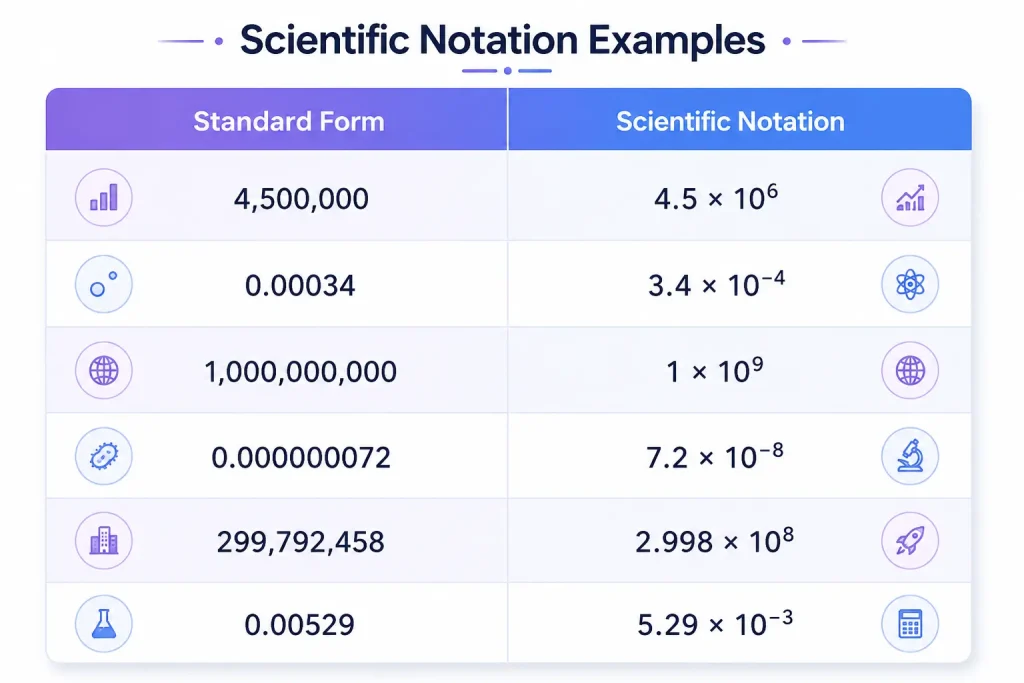
- 4,500,000 becomes 4.5 × 10⁶
- 0.00034 becomes 3.4 × 10⁻⁴
Scientists, engineers, and students working in physics, chemistry, and astronomy use scientific notation constantly because it eliminates ambiguity about the number of significant figures and keeps calculations manageable when dealing with values like the speed of light (2.998 × 10⁸ m/s) or the mass of a proton (1.673 × 10⁻²⁷ kg).
How to Convert Standard Form to Scientific Notation
Converting a regular number to scientific notation follows a consistent pattern:
- Identify the decimal point. In a whole number like 75,000, the decimal is implied after the last zero.
- Move the decimal until you have a number between 1 and 10. For 75,000, you move the decimal four places to the left to get 7.5.
- Count the moves. Each place you moved the decimal becomes the exponent on the 10. Moving left gives a positive exponent; moving right gives a negative exponent.
- Write the result. 75,000 = 7.5 × 10⁴
For small decimals, the process is identical but in reverse. Starting with 0.0052:
- Move the decimal three places to the right to get 5.2.
- Because you moved right, the exponent is negative.
- Result: 5.2 × 10⁻³
How to Convert Scientific Notation to a Standard Number (Decimal)
To go from scientific notation back to a regular number, simply reverse the process:
- If the exponent is positive, move the decimal point to the right by that many places. For 6.02 × 10²³, move the decimal 23 places to the right — this is Avogadro’s number, roughly 602,000,000,000,000,000,000,000.
- If the exponent is negative, move the decimal point to the left. For 9.1 × 10⁻³¹ (the mass of an electron in kilograms), move the decimal 31 places to the left.
Use the scientific notation calculator above to handle either direction instantly. Type a standard number and it converts to scientific notation; type a value in scientific notation (using × 10^ or E notation, such as 4.5e6) and it converts back.
Scientific Notation Examples
What Is E Notation?
E notation (also called exponential notation) is the scientific notation format used by calculators, spreadsheets, and programming languages. Instead of writing × 10^, the letter E is used.
- 4.5 × 10⁶ → 4.5E6 or 4.5e6
- 3.4 × 10⁻⁴ → 3.4E-4 or 3.4e-4
The two formats express identical values — E notation is simply a text-friendly version.
Where Is Scientific Notation Used?
Scientific notation shows up in everyday situations beyond the science classroom:
- Finance: National debt figures and GDP values (the US GDP is approximately $2.77 × 10¹³)
- Astronomy: Distances to stars and galaxies are so large that standard notation becomes unreadable
- Computing: File sizes at the terabyte and petabyte scale
- Medicine: Drug dosages involving microscopic quantities measured in nanograms or picograms
- Physics and chemistry: Atomic masses, wavelengths, and physical constants
Percentage Calculator
A percentage expresses a number as a fraction of 100. The word itself comes from the Latin per centum, meaning “by the hundred.” Three types of percentage questions come up repeatedly in school, work, and daily life — and each has its own formula. This percentage calculator handles all three through the mode selector.
What Is X% of Y?
Use this when: You know a percentage rate and a total, and you want to find the actual amount.
Real-world examples:
- What is 20% of $85? (calculating a tip)
- What is 15% of 240? (finding a discount off a price)
- What is 8.5% of $1,200? (calculating sales tax)
Formula:
Result = (X ÷ 100) × Y
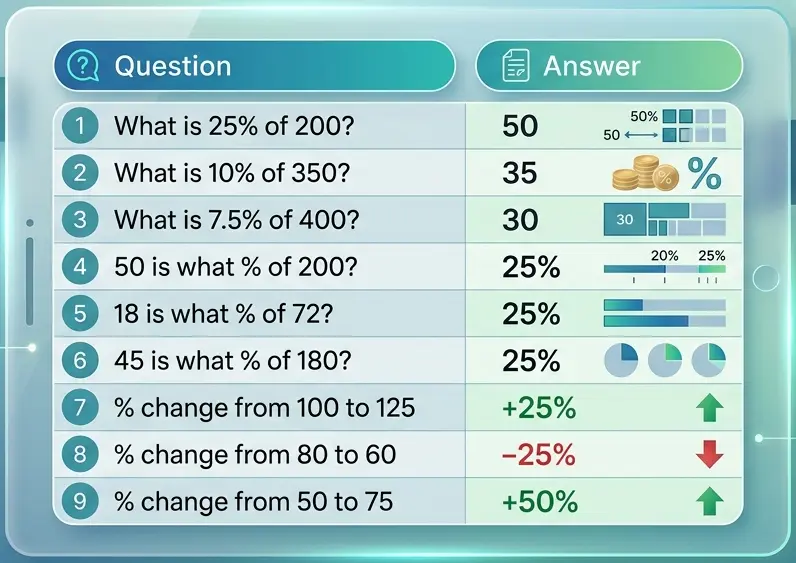
Worked example: What is 25% of 200?
25 ÷ 100 = 0.25
0.25 × 200 = 50
So 25% of 200 is 50.
X Is What Percent of Y?
Use this when: You have two numbers and want to express one as a percentage of the other.
Real-world examples:
- 45 is what percent of 180? (finding a test score percentage)
- 12 is what percent of 96? (calculating what fraction of a budget was spent)
- 30 is what percent of 120? (comparing a sample size to a population)
Formula:
Percentage = (X ÷ Y) × 100
Worked example: 50 is what percent of 200?
50 ÷ 200 = 0.25
0.25 × 100 = 25%
So 50 is 25% of 200.
Percentage Change from X to Y
Use this when: You have a starting value and an ending value, and you want to know how much it changed in percentage terms. A positive result is a percentage increase; a negative result is a percentage decrease.
Real-world examples:
- A product costs $80 and rises to $96 — what is the percentage increase?
- A stock was $150 and drops to $120 — what is the percentage decrease?
- A population was 50,000 and grows to 62,500 — what is the percentage growth?
Formula:
Percentage Change = ((Y − X) ÷ |X|) × 100
Worked example: Percentage change from 100 to 125
(125 − 100) ÷ 100 = 0.25
0.25 × 100 = +25%
This is a 25% increase.
Worked example: Percentage change from 200 to 150
(150 − 200) ÷ 200 = −0.25
−0.25 × 100 = −25%
This is a 25% decrease.
Percentage Examples Reference Table
Fraction Calculator
What Are Numerators and Denominators?
A fraction represents a part of a whole. It is written as two numbers separated by a division line:
Numerator / Denominator
- The numerator (top number) tells you how many parts you have.
- The denominator (bottom number) tells you how many equal parts the whole is divided into.
In the fraction 3/8:
- 3 is the numerator — you have 3 parts.
- 8 is the denominator — the whole is split into 8 equal parts.
How to Convert a Fraction to a Decimal
Dividing the numerator by the denominator converts any fraction to its decimal equivalent.
Formula:
Decimal = Numerator ÷ Denominator
| Fraction | Decimal | Percentage |
|---|---|---|
| 1/2 | 0.5 | 50% |
| 1/4 | 0.25 | 25% |
| 3/4 | 0.75 | 75% |
| 1/3 | 0.3333… | 33.33% |
| 3/8 | 0.375 | 37.5% |
| 5/6 | 0.8333… | 83.33% |
How to Simplify (Reduce) a Fraction
Simplifying a fraction means reducing it to its lowest terms — the smallest equivalent fraction with the same value. You do this by dividing both the numerator and denominator by their Greatest Common Factor (GCF), which is the largest number that divides evenly into both.
Step-by-step method:
- Find the GCF of the numerator and denominator.
- Divide both numbers by the GCF.
- The result is the fraction in its simplest form.
Worked example: Simplify 12/18
Factors of 12: 1, 2, 3, 4, 6, 12
Factors of 18: 1, 2, 3, 6, 9, 18
GCF = 6
12 ÷ 6 = 2, 18 ÷ 6 = 3
Simplified: 2/3
Worked example: Simplify 24/36
GCF of 24 and 36 = 12
24 ÷ 12 = 2, 36 ÷ 12 = 3
Simplified: 2/3
A fraction is fully simplified (in its lowest terms) when the only number that divides evenly into both the numerator and denominator is 1.
Fraction Examples
| Original Fraction | Simplified | Decimal | As a Percentage |
|---|---|---|---|
| 3/8 | 3/8 (already simplified) | 0.375 | 37.5% |
| 12/18 | 2/3 | 0.6667 | 66.67% |
| 6/24 | 1/4 | 0.25 | 25% |
| 15/20 | 3/4 | 0.75 | 75% |
| 9/12 | 3/4 | 0.75 | 75% |
| 8/10 | 4/5 | 0.8 | 80% |
Worked Examples: All Three Calculators
Scientific Notation Examples
Example 1: Convert 4,500,000 to scientific notation.
- Move the decimal 6 places to the left → 4.5
- Exponent: 6 (positive, because we moved left)
- Answer: 4.5 × 10⁶
Example 2: Convert 0.00034 to scientific notation.
- Move the decimal 4 places to the right → 3.4
- Exponent: −4 (negative, because we moved right)
- Answer: 3.4 × 10⁻⁴
Example 3: Convert 6.02 × 10²³ to standard form.
- Move the decimal 23 places to the right
- Answer: 602,000,000,000,000,000,000,000
Percentage Examples
Example 1: What is 20% of $450?
- (20 ÷ 100) × 450 = $90
Example 2: 36 is what percent of 144?
- (36 ÷ 144) × 100 = 25%
Example 3: Percentage change from 80 to 96?
- ((96 − 80) ÷ 80) × 100 = (16 ÷ 80) × 100 = +20%
Fraction Examples
Example 1: 3/8 as a decimal
- 3 ÷ 8 = 0.375
Example 2: Simplify 12/18
- GCF = 6 → 12/18 = 2/3
Example 3: Convert 5/8 to a percentage
- 5 ÷ 8 = 0.625 → 0.625 × 100 = 62.5%
Frequently Asked Questions
What is scientific notation?
Scientific notation is a way of expressing very large or very small numbers as a product of a decimal number (between 1 and 10) and a power of ten. The general form is a × 10ⁿ. For example, 3,000,000 is written as 3 × 10⁶, and 0.000045 is written as 4.5 × 10⁻⁵. It is the standard format used in science, engineering, and any field that regularly handles numbers at extreme scales.
How do I convert scientific notation to a normal number?
Look at the exponent (the power of ten). If the exponent is positive, move the decimal point to the right by that many places. If the exponent is negative, move the decimal point to the left. For 3.7 × 10⁴, move the decimal four places right to get 37,000. For 3.7 × 10⁻⁴, move it four places left to get 0.00037.
What is the difference between scientific notation and standard form?
In the UK and many other countries, “standard form” is the term used for what Americans call scientific notation — both refer to the same a × 10ⁿ format. In the United States, “standard form” sometimes means the opposite: the normal decimal way of writing a number. This calculator works in both directions regardless of which term you use.
How do I calculate percentage change?
Subtract the original value from the new value, divide by the original value (use the absolute value if the original could be negative), and multiply by 100. The formula is: ((New − Original) ÷ |Original|) × 100. A positive result means an increase; a negative result means a decrease.
What is the percentage difference vs. percentage change?
Percentage change measures how much a value has changed relative to its starting point — the direction matters (increase vs. decrease). Percentage difference, by contrast, measures the absolute gap between two values relative to their average, so there is no “starting” value and no direction. Use percentage change when comparing before and after; use percentage difference when comparing two unrelated values.
What is a numerator and denominator?
In any fraction, the numerator is the top number — it counts how many parts you have. The denominator is the bottom number — it defines how many equal parts the whole is divided into. In 7/12, the numerator is 7 and the denominator is 12.
How do I simplify a fraction?
Find the Greatest Common Factor (GCF) of the numerator and denominator — the largest number that divides evenly into both. Then divide both the numerator and the denominator by that GCF. For 18/24: the GCF is 6, so 18 ÷ 6 = 3 and 24 ÷ 6 = 4, giving the simplified fraction 3/4. A fraction is fully simplified when no number other than 1 divides evenly into both parts.
How do I convert a fraction to a decimal?
Divide the numerator by the denominator. For 3/8: 3 ÷ 8 = 0.375. For 1/3: 1 ÷ 3 = 0.3333… (a repeating decimal). To then convert that decimal to a percentage, multiply by 100 — so 3/8 = 37.5%.
Can I use this calculator for school exams?
This calculator is designed for learning and checking your work. For understanding the concepts, working through the examples on this page will help you build the skills to solve these problems by hand. Always check your exam rules before relying on any online tool during a test.
Why is scientific notation useful in everyday life?
Beyond science class, scientific notation appears in financial news (national debt, GDP), tech specs (memory in bytes), astronomy, and medicine. Any time you encounter a number with many zeros — a billion-dollar company valuation, a nanometer-scale measurement — scientific notation makes it far easier to read, compare, and work with.
More Free Math Calculators
Looking for other math tools? These calculators cover geometry, algebra, and more:
- Circle Calculator — calculate area, circumference, diameter, and radius
- Right Triangle Calculator — find sides and angles using the Pythagorean theorem
- Quadratic Equation Solver — solve ax² + bx + c = 0 with step-by-step results
- Simultaneous Equations Solver — solve two-variable linear equation systems instantly
- Matrix Calculator — add, subtract, multiply, and find determinants of matrices