Class 12 Math Textbook 2026-27 (FSc/ICS Part 2) — PDF Download & Study Plan
Looking for the official new Class 12 Math Textbook for 2026-2027? This guide covers the full unit-wise breakdown, worked examples, and a study plan for FSc/ICS Part 2 students.
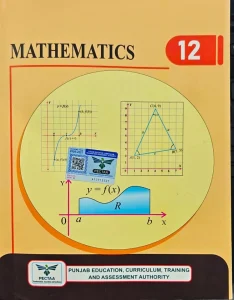
Download New Text Book of Class 12 Mathematics PECTA
Text Book of class 12 math for the year 2026-2027 is now available to download for Punjab Board Students. Download the 12th class math book PDF below.
- 🏛️ Board: Punjab Textbook Board
- 📐 Group: FSc / ICS
- 🌐 Language: English
- 📑 PDF, about 60 MB
Disclaimer: This textbook is hosted for educational purposes. All content is copyrighted by the Punjab Curriculum & Textbook Board.
Punjab Curriculum & Textbook Board (PCTB/PECTAA) — Updated for the current session
If you finished Class 11 and are now staring Class 12 math textbook wondering how much harder it actually gets — the honest answer is: not harder, just faster. Part 2 assumes you already know functions, basic trigonometry, and the algebra from Part 1, and it spends almost no time re-teaching. Every unit here builds directly on something you covered last year, which is exactly why students who found Class 11 shaky tend to struggle in the first two months of Class 12 — not because the new material is conceptually harder, but because the gaps from last year finally catch up with them.
This guide is built around that problem. Instead of just listing what’s in each unit, it shows you how Class 12 topics connect back to Class 11, gives you a worked example per unit so you can gauge where you actually stand, and lays out a realistic month-by-month plan for covering all 11 units before your board exam.
What’s in the Class 12 Math Textbook (and How It Builds on Class 11)
The new book has 11 units; the old book had 7. This table shows where each unit comes from and which earlier topic it builds on.
| Unit in the new book | In the old book | Builds on |
|---|---|---|
| 1. Graphical Representation of Functions | Unit 1: Functions and Limits (reorganized) | Functions and Graphs (Class 11) |
| 2. Further Differentiation | Unit 2: Differentiation (expanded) | Limit and Continuity, Differentiation (Class 11) |
| 3. Integration | Unit 3: Integration (expanded) | Unit 2 of this book, Partial Fractions (Class 11) |
| 4. Differential Equations | New standalone unit | Unit 3 of this book |
| 5. Analytical Geometry | Unit 4: Introduction to Analytic Geometry | Coordinate geometry from Class 9-10 |
| 6. Conic Section | Unit 6: Conic Sections | Unit 5 of this book |
| 7. Kinematics | New standalone unit | Units 2 and 3 of this book |
| 8. Numerical Solutions of Nonlinear Equations | New standalone unit | Functions and derivatives |
| 9. Inverse Trigonometric Functions and Their Graphs | New standalone unit | Trigonometric Functions and their Graphs (Class 11) |
| 10. Solution of Trigonometric Equations | New standalone unit | Trigonometric Identities (Class 11) |
| 11. Vector Valued Functions and Their Differentiations | Unit 7: Vectors (expanded) | Vectors in Space (Class 11) |
Old Unit 5 (Linear Inequalities and Linear Programming) is not a separate unit in the new book. If you’re weak on any topic in the last column, spend a day revisiting it — you’ll move through the matching Class 12 unit noticeably faster.
Class 12 Math New Book: Unit-wise Guide
Open a unit to see its core topics, a worked example and where students lose marks.
Unit 1: Graphical Representation of Functions
The new book opens with graphs. Before any calculus, you learn to read a function from its picture: where it cuts the axes, where it turns, and how it moves when the equation changes.
Core topics: graphs of quadratic functions by factorization, algebraic and transcendental functions, exponential, logarithmic and hyperbolic functions, inverse functions, transformations of graphs (shifts, stretching and compression), exponential and logarithmic equations and inequalities, growth and decay problems.
Worked example: Sketch the graph of y = 3(x + 1)(x − 1).
x-intercepts: x + 1 = 0 and x − 1 = 0 give (−1, 0) and (1, 0)
Vertex: x = (−1 + 1)/2 = 0 and y = 3(1)(−1) = −3
So the vertex is (0, −3), and since a = 3 is positive the parabola opens upward.
Where students lose marks: shifting a graph the wrong way. f(x − 2) moves the graph 2 units to the right, not to the left.
Unit 2: Further Differentiation
Differentiation measures rate of change, and it’s the unit that decides how comfortable the rest of your year feels — integration, optimization problems, and even parts of vectors lean on differentiation fluency.
Core topics: derivatives of trigonometric, exponential and logarithmic functions, chain rule, parametric and implicit differentiation, tangent and normal, higher order derivatives, increasing and decreasing functions, maxima and minima, linear approximation and differentials.
Worked example: Differentiate: y = x² sin x
Using the product rule: d/dx(uv) = u’v + uv’ Here u = x², v = sin x → u’ = 2x, v’ = cos x
dy/dx = 2x·sin x + x²·cos x
Where students lose marks: applying the chain rule inside a product or quotient and forgetting one of the two derivatives — always write out u, v, u’, v’ separately before combining, rather than doing it in your head.
Unit 3: Integration
Integration reverses differentiation, and the biggest shift here is that there’s no single formula to memorize — you have to recognize which of several methods a given integral needs.
Core topics: indefinite integrals, integration by substitution, by parts and by partial fractions, definite integrals and their properties, area of plane regions, consumer’s and producer’s surplus, volumes of solids of revolution, moment of inertia.
Worked example: Evaluate: ∫ 2x cos(x²) dx
Let u = x², so du = 2x dx — which is exactly what’s sitting in the integral.
∫ cos(u) du = sin(u) + C = sin(x²) + C
Where students lose marks: trying integration by parts on something that’s really a substitution problem (or vice versa). Quick test: if you can spot a function and its derivative sitting together in the integral, try substitution first.
Unit 4: Differential Equations
A differential equation contains a derivative of an unknown function. It is a full unit in the new book, and it is where integration starts doing real work: growth, decay, cooling and electric circuits.
Core topics: order and degree of a differential equation, forming differential equations, separable equations, homogeneous equations, initial value problems, applications to growth and decay, cooling, RL and RC circuits.
Worked example: Solve dy/dx = ex − y.
Separate the variables: ey dy = ex dx
Integrate both sides: ey = ex + C
So y = ln(ex + C).
Where students lose marks: forgetting the constant of integration, or adding it after taking the logarithm instead of before.
Unit 5: Analytical Geometry
This is where algebra and geometry merge — every line and circle becomes an equation you can manipulate.
Core topics: altitudes, medians and right bisectors of a triangle, forms of the equation of a line, family of lines, concurrent lines, angle between two lines, area of a triangle, pair of straight lines through the origin.
Worked example: Find the equation of the line through (2, 3) with slope 4.
Point-slope form: y − y₁ = m(x − x₁) y − 3 = 4(x − 2) y − 3
= 4x − 8 4x − y − 5 = 0
Where students lose marks: mixing up point-slope and slope-intercept forms under exam pressure — pick one form, memorize it cold, and derive the other from it if needed.
Unit 6: Conic Section
The circle, parabola, ellipse, and hyperbola — all four are really the same idea (a plane slicing a cone) written as four different-looking equations.
Core topics: equation of a circle, tangent and normal to a circle, parabola, ellipse, hyperbola, and applications of conics.
Worked example: Identify: x² + y² − 4x + 6y − 12 = 0
Complete the square: (x² − 4x + 4) + (y² + 6y + 9) =
12 + 4 + 9 (x − 2)² + (y + 3)² = 25
This is a circle, center (2, −3), radius 5.
Where students lose marks: arithmetic slips while completing the square — always double-check by expanding your answer back out.
Unit 7: Kinematics
Kinematics is the mathematics of motion: position, velocity, acceleration and time. It overlaps with Physics, so the same practice helps in both subjects.
Core topics: displacement–time and velocity–time graphs, equations of uniformly accelerated motion, vertical motion under gravity, velocity and acceleration using differentiation and integration.
Worked example: A car moving at 36 km/h is stopped by its brakes in 10 seconds. Find the retardation and the distance covered.
36 km/h = 10 m/s, so u = 10, v = 0 and t = 10
a = (v − u)/t = (0 − 10)/10 = −1 m/s²
s = ut + ½at² = 100 − 50 = 50 m
The retardation is 1 m/s² and the car covers 50 m.
Where students lose marks: mixing units. Convert km/h to m/s before using any formula.
Unit 8: Numerical Solutions of Nonlinear Equations
Some equations cannot be solved exactly. This unit teaches step-by-step methods that get as close to the answer as you need.
Core topics: graphical method, bisection method, Regula-Falsi method, Newton-Raphson method, the trapezoidal rule for definite integrals, and applied problems.
Worked example: Apply two steps of the bisection method to x² − 2 = 0 on [1, 2].
f(1) = −1 and f(2) = 2, so a root lies between 1 and 2
Midpoint 1.5: f(1.5) = 0.25, which is positive, so the root lies in [1, 1.5]
Midpoint 1.25: f(1.25) = −0.4375, which is negative, so the root lies in [1.25, 1.5]
Each step halves the interval. The exact root is √2 ≈ 1.414.
Where students lose marks: rounding too early. Keep extra decimal places during the steps and round only the final answer.
Unit 9: Inverse Trigonometric Functions and Their Graphs
An inverse trigonometric function answers the question: which angle has this ratio? The catch is that each one gives its answer only from a fixed range.
Core topics: domains and ranges, principal values, graphs of inverse trigonometric functions, sum and difference formulas, and proofs of identities.
Worked example: Find the principal value of sin⁻¹(−1/2).
sin(π/6) = 1/2, so sin(−π/6) = −1/2
The range of sin⁻¹ is [−π/2, π/2], and −π/6 lies in it
So sin⁻¹(−1/2) = −π/6.
Where students lose marks: giving an angle outside the principal range, such as 7π/6 in this example.
Unit 10: Solution of Trigonometric Equations
A trigonometric equation usually has infinitely many solutions, because the functions repeat. This unit shows how to write all of them.
Core topics: general solutions of equations in sine, cosine and tangent, equations reducible to quadratic form, use of identities and double angles, graphical solutions, and applied problems.
Worked example: Solve sin x = 1/√2.
The reference angle is π/4, and sine is positive in the first and second quadrants
In [0, 2π]: x = π/4 or x = 3π/4
General solution: x = π/4 + 2nπ or x = 3π/4 + 2nπ, where n is an integer.
Where students lose marks: dividing both sides by sin x or cos x, which loses the solutions where that factor is zero. Factorize instead.
Unit 11: Vector Valued Functions and Their Differentiations
The last unit joins vectors with calculus. A vector valued function gives a vector for each value of t, which is how the path of a moving point is described.
Core topics: vector valued functions, differentiating them component by component, rules of differentiation for vector functions, velocity and acceleration of a moving point.
Worked example: Differentiate r(t) = t² i + sin t j.
Differentiate each component: d/dt(t²) = 2t and d/dt(sin t) = cos t
So r′(t) = 2t i + cos t j.
Where students lose marks: differentiating only one component, or dropping the unit vectors i and j from the final answer.
A Realistic Study Plan for the Year
Trying to cover all 11 units evenly in the final month before exams is how most students run out of time on the later units. A more realistic split, assuming a ~9-month academic year:
- Month 1: Unit 1 (Graphical Representation of Functions) — don’t rush this, the graphs are used all year
- Months 2-3: Unit 2 (Further Differentiation) — the heaviest unit, budget extra time
- Months 4-5: Unit 3 (Integration) and Unit 4 (Differential Equations) — Unit 4 uses integration directly
- Month 6: Units 5 & 6 together (Analytical Geometry + Conic Section — they share the same coordinate-geometry tools)
- Month 7: Unit 7 (Kinematics) and Unit 8 (Numerical Solutions of Nonlinear Equations)
- Month 8: Units 9 & 10 (Inverse Trigonometric Functions + Trigonometric Equations), then Unit 11 (Vector Valued Functions)
- Month 9: Full-syllabus revision and model papers
Check your board’s official pairing scheme for the current session before finalizing which chapters to prioritize for MCQs vs. long questions — pairing schemes are released by paper-setters, not PCTB directly, and can shift slightly year to year.
📁 Bonus Resources
To enhance your learning experience, check out the following:
- 🔗 Class 12 Math Solutions (New Book) — solved exercises of every unit
- 🔗 Class 11 Math Book PDF — Build your foundation
- 🔗 Class 10 Math Book PDF
- 🔗 Class 9 Math Book PDF
- 📊 Graphing Tools: Desmos, GeoGebra — Visualize problems easily
✅ Conclusion: Master Math and Secure Your Future
The Class 12 Math Book 2026–27 is more than a textbook. It’s a toolkit for solving real-world problems, understanding the world mathematically, and preparing for university-level math.
Whether you’re aiming to top board exams, crack entry tests, or pursue fields like engineering, data science, or architecture, this book equips you with the skills you need.
📅 Download the PDF now and start mastering math today!
📖 Visit NotesOfMath.com regularly for updates, solved notes, and quizzes.
Disclaimer and Copyright Notice:
The Class 12 Mathematics textbook provided on this page is copyrighted by the Punjab Curriculum & Textbook Board. It is hosted here solely for educational purposes to support student learning. We do not claim ownership of the material, and we recommend that users refer to the official PCTB website for the most current and authoritative version. All content is provided as-is, and we encourage students to verify information independently.
FAQs
Is Class 12 math harder than Class 11? Conceptually, no — it’s more that Class 12 assumes Class 11 fluency and moves faster. Students who were solid on Class 11 functions and trigonometry generally find Class 12 differentiation and integration manageable.
How many units are in the Class 12 math textbook? Eleven: Graphical Representation of Functions, Further Differentiation, Integration, Differential Equations, Analytical Geometry, Conic Section, Kinematics, Numerical Solutions of Nonlinear Equations, Inverse Trigonometric Functions and Their Graphs, Solution of Trigonometric Equations, and Vector Valued Functions and Their Differentiations.
Which unit carries the most weight in board exams? Differentiation and Integration together typically carry the largest share of marks since later units (optimization problems, area under curves) draw on both. Always confirm against the current year’s official pairing scheme rather than relying on past patterns alone.
Do I need Class 11 concepts to understand Class 12 math textbook? Yes — particularly functions, trigonometric identities, and the introduction to vectors. If those feel shaky, a quick review before starting Class 12 pays off across multiple units, not just one.