
10th Class Maths Book PDF Download 2026–27 | Punjab & Sindh Boards
Mathematics is an important subject for 10th class students because it builds the base for higher studies and board exam preparation. On this page, you can download the 10th Class Maths Book PDF for Punjab Board and Sindh Board.
This page includes the new Punjab Board Class 10 Mathematics book for the 2026–27 academic session, the old Punjab Board maths book, and the Sindh Board maths book. If you want to revise previous class topics, you can also download the Class 9 Maths Book PDF from our website.
Important Update: Punjab Board has introduced a new Class 10 Mathematics book for the 2026–27 academic session. This new book has a different syllabus and unit structure from the old Punjab textbook. Students following the new syllabus should download the new Punjab book first.
New Punjab Board 10th Class Maths Book 2026–27
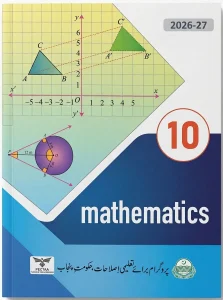
Download the new Class 10 Mathematics textbook for Punjab Board for the 2026–27 academic session.
Subject: Mathematics
Publisher: PECTAA / PCTB
Board: Punjab Board
File Type: PDF
File Size: 86 MB
Note: This PDF file is large. Use Wi-Fi or a stable internet connection for faster download.
Download – 10th Class Maths Book PDF

📚Punjab Text Book of Math

📚Sindh Text Book of Math
📱 Mobile Users
Now that you have your 10th class maths book downloaded, let’s dive deep into what each unit covers, key concepts, and how both provincial curricula compare. Both 10 class text book pdf files work perfectly on smartphones and tablets. Use any PDF reader app for optimal viewing.
New Punjab Board Class 10 Maths Book 2026–27 – Unit Guide
The new Punjab Board Class 10 Mathematics book for the 2026–27 academic session has 12 units. This new book is different from the old Punjab textbook, so students should carefully check the updated unit list before starting preparation.
Below is a simple unit-wise guide to help students understand what they will study in the new Class 10 maths book.
Unit 1: Complex Numbers
Unit 1 starts with complex numbers. In this unit, students learn about numbers that include the imaginary number i, where i² = −1. Complex numbers are written in the form a + bi, where a is the real part and b is the imaginary part.
This unit helps students understand a new type of number system beyond real numbers. Students may study basic operations on complex numbers, such as addition, subtraction, multiplication, and division. This unit is important because complex numbers are used in higher mathematics, physics, engineering, and advanced problem-solving.
Unit 2: Quadratic Equations and Inequalities
This unit covers quadratic equations and quadratic inequalities. A quadratic equation is usually written in the form ax² + bx + c = 0. Students learn different methods for solving quadratic equations, such as factorization, completing the square, and using the quadratic formula.
The unit also introduces inequalities involving quadratic expressions. Students learn how to find solution sets and represent answers correctly. This unit is very important for board exam preparation because quadratic equations are commonly used in algebra and word problems.
Unit 3: Matrices and Determinants
Unit 3 introduces matrices and determinants. A matrix is a rectangular arrangement of numbers in rows and columns. Students learn how to identify the order of a matrix and perform basic operations such as addition, subtraction, and multiplication of matrices.
Determinants are also introduced in this unit. They help in solving systems of linear equations and are useful in higher mathematics. This unit builds a strong foundation for algebra, computer science, physics, and engineering-related topics.
Unit 4: Functions and Graphs
This unit explains functions and their graphs. A function shows a relationship between input and output values. Students learn how to understand function notation, domain, range, and the graphical representation of functions.
Graphs help students see mathematical relationships visually. This unit is useful because many topics in mathematics, science, economics, and technology use functions and graphs to represent real-life situations.
Unit 5: Algebraic Fractions
Unit 5 focuses on algebraic fractions. These are fractions that contain algebraic expressions in the numerator, denominator, or both. Students learn how to simplify algebraic fractions and perform operations such as addition, subtraction, multiplication, and division.
This unit improves algebraic manipulation skills. It also helps students prepare for advanced algebra topics where expressions must be simplified carefully before solving equations.
Unit 6: Vectors in Plane
This unit introduces vectors in a plane. A vector has both magnitude and direction. Students learn how vectors can be represented graphically and algebraically.
Vectors are useful in geometry, physics, and real-life situations involving direction and movement. For example, displacement, velocity, and force are often represented using vectors. This unit helps students understand how mathematics can describe movement and direction.
Unit 7: Trigonometry
Unit 7 covers trigonometry. Trigonometry deals with the relationship between angles and sides of triangles. Students learn about trigonometric ratios such as sine, cosine, and tangent.
This unit is important for solving problems related to heights, distances, angles, and right-angled triangles. Trigonometry is also used in physics, engineering, architecture, navigation, and many practical fields.
Unit 8: Chords and Arcs of a Circle
This unit starts the circle geometry part of the book. Students learn about chords and arcs of a circle. A chord is a line segment joining two points on a circle, while an arc is a part of the circumference of a circle.
The unit helps students understand important circle properties and theorems. It also improves logical reasoning because geometry questions often require students to prove results step by step.
Unit 9: Tangent and Angles of a Circle
Unit 9 continues circle geometry with tangents and angles. A tangent is a line that touches a circle at exactly one point. Students learn important properties of tangents and their relationship with the radius of a circle.
This unit also covers angles related to circles. It helps students solve geometry problems by using circle theorems and correct reasoning. This topic is important for both objective and long questions in board exams.
Unit 10: Practical Geometry of Circles
This unit focuses on practical geometry related to circles. Students learn how to make accurate geometric constructions using a compass, ruler, and pencil.
Practical geometry improves drawing accuracy and understanding of circle properties. Students should practice these constructions carefully because small mistakes in measurement or drawing can affect the final answer.
Unit 11: Information Handling
Unit 11 is about information handling. In this unit, students learn how to organize, represent, and understand data. This may include tables, graphs, charts, and other ways of presenting information.
This unit is useful in daily life because data is used in schools, businesses, science, surveys, and many real-world situations. It helps students read information correctly and make simple conclusions from data.
Unit 12: Probability
The last unit of the new Class 10 maths book is Probability. Probability is the study of chance. It helps students understand how likely an event is to happen.
Students learn basic probability ideas through simple examples such as coins, dice, cards, and real-life situations. This unit is useful because probability is used in statistics, science, games, weather reports, decision-making, and many modern fields.
This new unit structure shows that the latest Punjab Board Class 10 maths book gives importance to algebra, graphs, vectors, trigonometry, circle geometry, data handling, and probability. Students following the 2026–27 syllabus should use this new book for preparation.
Sindh Board Curriculum (14 Units) – Comprehensive Analysis
Units 17-30: Extended Mathematical Coverage
Unit 17: Sets and Functions
Enhanced Coverage vs Punjab:
- More detailed set theory applications
- Advanced function composition
- Comprehensive domain and range problems
- Extended Venn diagram applications
Why Sindh Goes Deeper: The Sindh curriculum provides more foundational preparation for higher mathematics by spending more time on set theory fundamentals.
Unit 18: Variations
Extended Treatment:
- Graphical representations of variations
- Complex combined variation problems
- More real-world application examples
- Detailed mathematical modeling
Unit 19: Matrices and Determinants
🎯 UNIQUE TO SINDH BOARD
Matrix Operations:
- Addition and subtraction of matrices
- Scalar multiplication
- Matrix multiplication (row × column method)
- Types: square, diagonal, identity, zero matrices
Determinant Calculations:
- 2×2 determinants: |A| = ad – bc
- 3×3 determinants using cofactor expansion
- Properties of determinants
- Applications in solving systems of equations
Why This Matters: Matrices are crucial for advanced mathematics, computer science, and engineering. Sindh students get a significant head start.
Unit 20: Theory of Quadratic Equations
Comprehensive Treatment:
- More extensive coverage than Punjab’s Units 1-2 combined
- Graphical analysis of parabolas
- Vertex form and transformations
- Applications in optimization problems
Unit 21: Partial Fractions
Similar to Punjab Unit 4 but with more complex examples and applications.
Unit 22: Basic Statistics
Extended Statistical Analysis:
- More comprehensive than Punjab Unit 6
- Introduction to probability concepts
- Advanced data presentation techniques
- Correlation and regression basics
Unit 23: Pythagoras’ Theorem
🎯 UNIQUE TO SINDH BOARD
Comprehensive Coverage:
- Theorem proof and verification
- Applications in 2D and 3D geometry
- Distance formula derivation
- Real-world applications in construction and navigation
Historical Context: Unlike Punjab, Sindh includes the historical development and significance of this fundamental theorem.
Unit 24: Ratio and Proportion
🎯 UNIQUE TO SINDH BOARD
Advanced Ratio Concepts:
- Complex ratio problems
- Proportional relationships in geometry
- Applications in similar triangles
- Scale factor calculations
Why Separate Coverage: Sindh recognizes that ratio and proportion deserve focused attention due to their applications across multiple mathematical areas.
Units 25-29: Circle Geometry
Five Dedicated Units:
- Unit 25: Chords of a Circle
- Unit 26: Tangents of a Circle
- Unit 27: Chords and Arcs
- Unit 28: Angle in a Segment of a Circle
- Unit 29: Practical Geometry-Circles
More Comprehensive Than Punjab: While Punjab covers similar topics in Units 9-13, Sindh provides more detailed treatment with additional theorems and applications.
Unit 30: Introduction to Trigonometry
Extended Coverage:
- More comprehensive than Punjab Unit 7
- Additional trigonometric identities
- More complex applications
- Preparation for advanced trigonometry
Punjab and Sindh Board Maths Books – Curriculum Comparison
Punjab Board and Sindh Board Class 10 maths books have different unit structures. The latest Punjab Board book for the 2026–27 academic session has been changed, so students should make sure they download the correct book according to their board and syllabus.
Content Volume Analysis
| Aspect | New Punjab Board Book | Sindh Board Book |
|---|---|---|
| Total Units | 12 units | 14 units |
| Current Status | New 2026–27 book introduced | Existing Sindh textbook structure |
| First Unit | Complex Numbers | Sets and Functions |
| Algebra Topics | Complex numbers, quadratic equations, matrices, functions, algebraic fractions | Sets and functions, variations, matrices, quadratic equations, partial fractions |
| Geometry Topics | Chords, arcs, tangents, angles, and practical geometry of circles | Pythagoras theorem, ratio and proportion, chords, arcs, tangents, angles, and practical geometry |
| Data Topics | Information Handling and Probability | Basic Statistics |
| Main Difference | Punjab’s new book includes updated topics like complex numbers, vectors, information handling, and probability | Sindh book keeps a broader traditional structure with 14 units |
The new Punjab Board maths book gives more focus to updated algebra, vectors, graphs, data handling, and probability. The Sindh Board book follows a different structure and includes topics such as sets and functions, variations, matrices, statistics, Pythagoras theorem, ratio and proportion, and circle geometry.
Students should not mix the two books. Punjab Board students should use the new Punjab book if their school is following the 2026–27 syllabus. Sindh Board students should use the Sindh Board mathematics textbook.
Key Differences Between Punjab and Sindh Board Maths Books
The Punjab Board and Sindh Board Class 10 maths books are both useful, but they follow different unit arrangements. Students should choose the book according to their own board and school syllabus.
The new Punjab Board book includes updated topics such as complex numbers, matrices and determinants, functions and graphs, vectors, information handling, and probability. It has 12 units and follows the latest 2026–27 Punjab syllabus.
The Sindh Board maths book has a different structure. It includes topics such as sets and functions, variations, matrices and determinants, theory of quadratic equations, partial fractions, basic statistics, Pythagoras theorem, ratio and proportion, and circle geometry.
Both books help students build important mathematical skills. Punjab Board students should use the Punjab Board book, and Sindh Board students should use the Sindh Board book. Students should not mix the two books because the chapter order, topics, and exercise structure are different.
How to Use the 10th Class Maths Book PDF for Study
After downloading the 10th Class Maths Book PDF, students should not only read the chapters. They should also solve examples, practice exercises, revise formulas, and check their mistakes regularly. A good study plan can help students prepare better for board exams.
Step 1: Start with the Correct Book
First, make sure you are using the correct maths book according to your board.
Punjab Board students following the 2026–27 syllabus should use the new Punjab Board Class 10 Mathematics book. Sindh Board students should use the Sindh Board Class 10 Mathematics book. Students following the previous Punjab syllabus can use the old Punjab Board book.
Using the wrong book can create confusion because the chapter order, topics, and exercises are different.
Step 2: Read the Chapter Explanation First
Before solving exercises, read the chapter explanation carefully. Pay attention to definitions, formulas, rules, theorems, and solved examples. In mathematics, examples are very important because they show how a method is used step by step.
Do not skip solved examples. Many exercise questions are based on the same methods shown in the examples.
Step 3: Solve Easy Questions Before Difficult Questions
Start with simple questions first. After understanding the basic method, move to longer and more difficult questions. This helps build confidence and reduces mistakes.
For algebra units, practice simplification and solving steps carefully. For geometry units, focus on diagrams, given information, reasons, and proper theorem use. For trigonometry, revise ratios and identities again and again.
Step 4: Make a Formula and Theorem List
Keep a separate notebook for formulas, definitions, and theorems. Revise this notebook regularly, especially before tests and exams.
Important areas for revision include algebraic formulas, quadratic equations, trigonometric ratios, circle theorems, statistics/data handling, and probability.
Step 5: Practice Board-Style Questions
After completing each unit, solve board-style questions. Practice both short questions and long questions. Also try MCQs, because they help you check your concept quickly.
Students should also practice time management. Try solving a full exercise or sample paper within a fixed time.
Step 6: Revise Weak Units More Often
Every student has some weak topics. Make a list of units where you make more mistakes. Revise those units more often instead of only reading the chapters you already understand.
A simple weekly plan can be:
| Days | Study Task |
|---|---|
| Monday to Thursday | Learn concepts and solve textbook exercises |
| Friday | Revise formulas, theorems, and solved examples |
| Saturday | Practice board-style questions |
| Sunday | Check mistakes and revise weak topics |
Regular practice is the best way to improve in mathematics. Students should solve questions by hand and avoid only reading solutions.
Essential Formulas Reference
While studying your 10th class maths book, you’ll encounter numerous important formulas across all units. For quick reference and exam preparation, we’ve compiled all the essential formulas in our comprehensive Important Formulas of 10th Class Mathematics guide.
What You’ll Find in Our Formula Guide:
- Quadratic Equations: All solving formulas and relationships
- Statistics: Mean, median, standard deviation formulas
- Trigonometry: Essential ratios and identities
- Circle Geometry: Arc length, sector area, and chord formulas
- Matrices (Sindh Board): Determinants and operations
- Variations: Direct and inverse variation formulas
Pro Tip: Bookmark the formula page alongside your 10 class text book pdf for efficient study sessions and quick revision.
Board Exam Preparation Strategy
Important Topics (Both Boards)
- Quadratic Equations: Fundamental algebraic concepts
- Circle Geometry: Essential geometric principles
- Trigonometry: Applications and problem-solving
- Statistics: Data analysis and interpretation
Sindh Board Specific Preparation
- Matrices: Master basic operations and determinants
- Pythagoras Applications: Focus on practical geometry problems
- Extended Statistics: Practice data interpretation thoroughly
Punjab Board Specific Preparation
- Integrated Problem Solving: Practice questions combining multiple concepts
- Practical Applications: Focus on word problems and real-world scenarios
- Comprehensive Review: Equal attention to all curriculum units
General Exam Tips
- Check your board’s official website for current paper patterns
- Review past papers from recent years for question trends
- Consult with your mathematics teacher for exam-specific guidance
Career Pathways and Future Relevance
Engineering Preparation
Sindh Advantage: Matrices provide head start for engineering mathematics Punjab Advantage: Strong problem-solving approach builds engineering mindset
Medical Preparation
Both Equal: Statistics and data interpretation crucial for medical research
Computer Science Preparation
Sindh Advantage: Matrices essential for computer graphics and algorithms Punjab Advantage: Strong logical thinking development
Business and Commerce
Punjab Advantage: More practical problem-solving approach Both Valuable: Statistics crucial for business analytics
Conclusion: Your Mathematical Journey Begins
Whether you’ve downloaded the Punjab or Sindh 10th class maths book PDF, you now have access to comprehensive mathematical education that will serve as your foundation for years to come.
Key Takeaways:
- Punjab Curriculum: Streamlined, practical approach with balanced coverage
- Sindh Curriculum: More comprehensive with unique advanced topics
- Both Curricula: Provide excellent preparation for higher studies
- Your Success: Depends on consistent practice and understanding
The 10 class text book pdf you’ve downloaded contains everything needed for mathematical success. Use this guide to navigate your studies effectively, focus on high-impact topics, and build the analytical skills that will benefit you throughout your academic and professional career. Have a look at the new maths book for FSc part 1 to see which concepts you will be learning in next class.
Start your mathematical journey today – your future self will thank you for the strong foundation you’re building now!
This guide covers both Punjab and Sindh 10th class mathematics curricula. Always verify current requirements with your school and respective textbook boards for the most up-to-date information.

Good