Order of Operations Bridge Builder – Free PEMDAS Math Game for Kids
Order of Operations Bridge Builder is a free order of operations game where students solve PEMDAS expressions, build a bridge, and rescue the sheep. Practice brackets, multiplication, division, addition, and subtraction in a fun interactive challenge for grades 4–8.
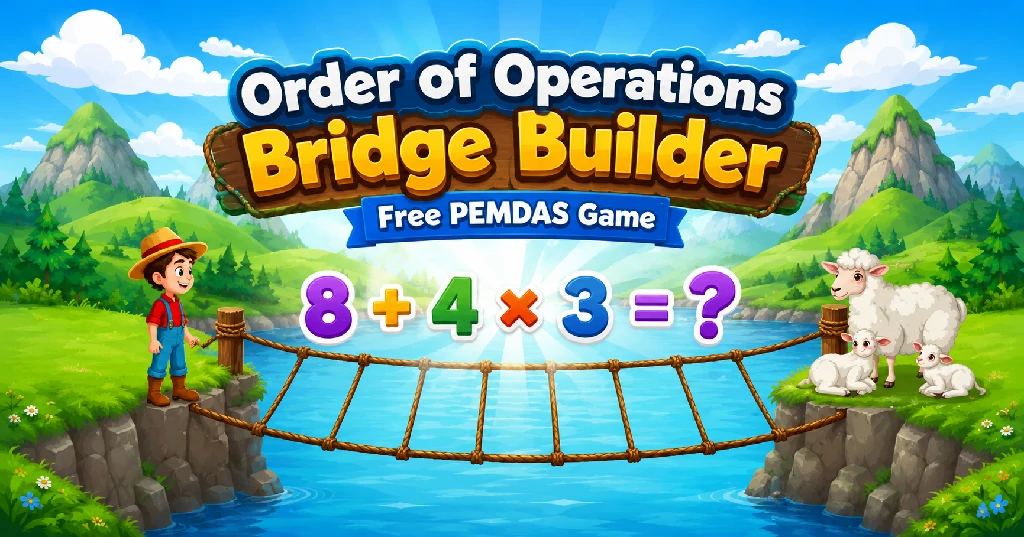
Play Order of Operations Bridge Builder
Game: Order of Operations Bridge Builder
Topic: Order of Operations
Best for: Grades 4, 5, 6, 7, and 8
Skills: PEMDAS, BODMAS, DMAS, brackets, multiplication, division, addition, subtraction, left-to-right rule
Round length: Up to 10 expressions
Goal: Complete 7 bridge logs to rescue the sheep
What Is Order of Operations Bridge Builder?
Order of Operations Bridge Builder is an interactive math game that helps students practice solving expressions in the correct order.
In this game, students do not simply guess the final answer. They must decide which part of the expression should be solved first. This is important because many students make mistakes when they solve addition before multiplication, or when they ignore brackets.
For example, in an expression like:
8 + 4 × 3The multiplication must be solved first:
4 × 3 = 12Then addition is solved:
8 + 12 = 20So the correct answer is:
20This game trains students to think in the correct order before solving the whole expression.
What Math Skill Does This Game Teach?
This game teaches the order of operations, which is one of the most important skills in arithmetic and early algebra.
Students learn that math expressions must be solved in a fixed order.
In many countries, students learn this rule as PEMDAS:
P – Parentheses
E – Exponents
M – Multiplication
D – Division
A – Addition
S – Subtraction
However, this game focuses on:
Parentheses or brackets
Multiplication
Division
Addition
Subtraction
Students also learn one very important rule: multiplication and division have equal priority. If both appear in the same expression, solve them from left to right.
Addition and subtraction also have equal priority, so they are also solved from left to right.
How to Play Order of Operations Bridge Builder
First, choose a difficulty level from the game menu. The game starts with easier expressions and also includes harder levels with brackets and mixed operations.
During the game, students see a math expression on the screen. They must decide which part of the expression should be solved next.
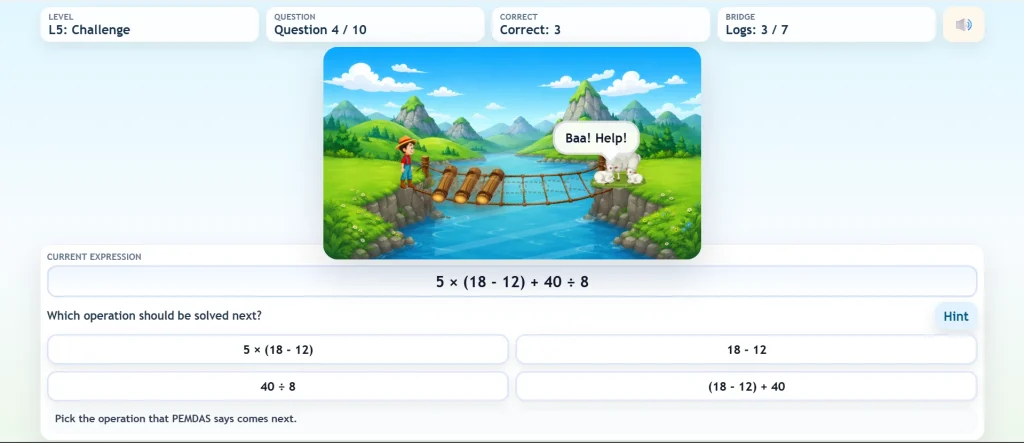
The game then shows multiple answer choices. Students choose the correct result for the next step of the expression.
If the answer is correct, the game continues and the expression becomes simpler. When a full expression is completed correctly, a wooden log is added to the bridge.
Each round gives students up to 10 expressions. Students need to place 7 bridge logs to complete the bridge and rescue the sheep.
If students get stuck, they can use the Hint button to get help with the next step.
The game also tracks the completed solution steps, so students can review how the expression was solved.
Sound effects and background music are included, and students can turn sound on or off using the sound button.
Difficulty Levels in the Game
Order of Operations Bridge Builder includes different difficulty levels, so students can start with easier questions and move toward harder expressions.
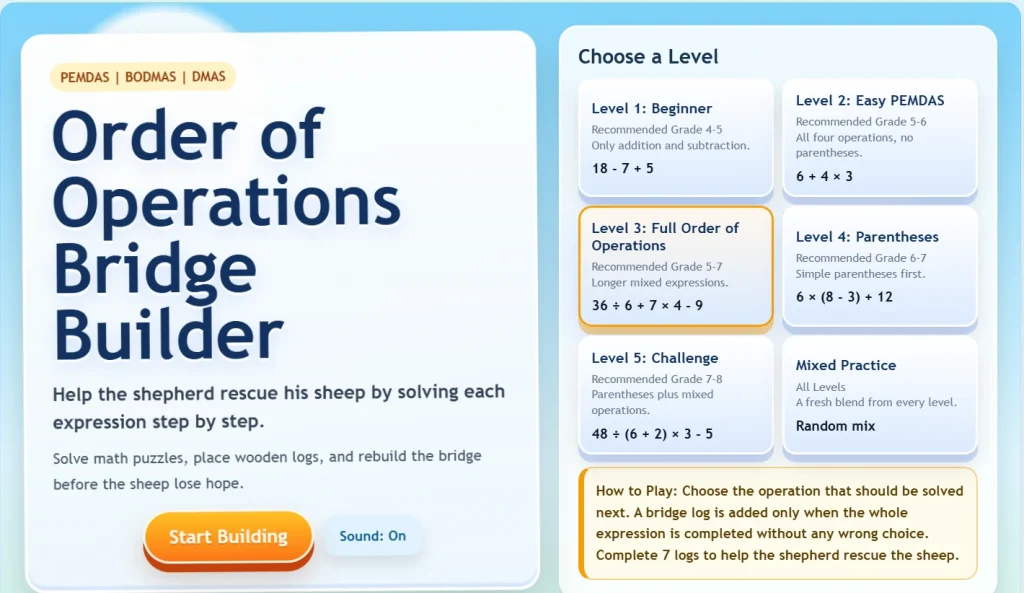
Level 1: Beginner
This level is best for grade 4 and grade 5 students. It focuses on simple addition and subtraction. This is a good warm-up level for students who are not ready for full PEMDAS yet.
Level 2: Easy PEMDAS
This level includes all four basic operations: addition, subtraction, multiplication, and division. It does not use brackets, so students can focus on multiplication and division before addition and subtraction.
Level 3: Full Order of Operations
This level gives longer mixed-operation expressions. Students need to apply the order of operations carefully and solve one step at a time.
Level 4: Parentheses
This level introduces simple brackets or parentheses. Students learn that anything inside brackets must be solved before the rest of the expression.
Level 5: Challenge
This level combines brackets with mixed operations. It is better for students who already understand the basic PEMDAS or BODMAS rule and want harder practice.
Mixed Practice
Mixed Practice gives a random blend of questions from different levels. This is useful for revision because students do not know what type of expression will come next.
Why This Order of Operations Game Helps Students
Many students can add, subtract, multiply, and divide correctly, but they still make mistakes in order-of-operations questions. The problem is often not arithmetic. The problem is choosing the wrong step first.
This game helps students slow down and ask:
Should I solve the brackets first?
Should I multiply or divide before adding?
Should I solve this part from left to right?
Which result is the correct next step?
Because the game uses multiple-choice answers, students can focus on the next step instead of feeling lost in the whole expression.
The step log is also helpful because it records the solution process. This helps students see how a long expression becomes simpler step by step.
The bridge-building story gives students a clear goal. Each correctly completed expression helps build the bridge, and the student keeps working until the sheep are rescued.
Who Should Play This Game?
This order of operations game is useful for students in grades 4–8.
Grade 4 students can start with the Beginner level because it focuses on addition and subtraction.
Grade 5 and grade 6 students can use the Easy PEMDAS and Parentheses levels to practice the main order of operations rules.
Grade 7 and grade 8 students can use the Challenge and Mixed Practice levels for revision before algebra.
The game is also useful for:
- Students learning PEMDAS, BODMAS, or DMAS
- Students who confuse multiplication and division order
- Students who forget to solve brackets first
- Teachers looking for a classroom warm-up activity
- Parents who want free online math practice at home
- Homeschool students who need interactive order of operations practice
Math Topics Covered in This Game
This game gives practice in several important math skills.
Parentheses and Brackets
Students learn that expressions inside parentheses or brackets should be solved first.
Example:
6 × (4 + 2)First solve:
4 + 2 = 6Then solve:
6 × 6 = 36So the answer is:
36Multiplication Before Addition
Students learn that multiplication is solved before addition.
Example:
5 + 3 × 4First solve:
3 × 4 = 12Then solve:
5 + 12 = 17So the answer is:
17Division Before Subtraction
Students learn that division is solved before subtraction.
Example:
20 - 12 ÷ 3First solve:
12 ÷ 3 = 4Then solve:
20 - 4 = 16So the answer is:
16Left-to-Right Rule
This is one of the most common mistakes in order of operations.
Multiplication and division have the same priority. So if both appear together, solve from left to right.
Example:
24 ÷ 6 × 2First solve:
24 ÷ 6 = 4Then solve:
4 × 2 = 8So the answer is:
8Students should not solve multiplication first only because “M” comes before “D” in PEMDAS. Multiplication and division are equal in priority.
The same rule applies to addition and subtraction.
PEMDAS, BODMAS, and DMAS: Are They Different?
Students may see different names for the order of operations.
In the United States, many students learn:
PEMDASIn the United Kingdom and other countries, students may learn:
BODMASIn Pakistan, India, and some other regions, students often learn:
DMASThese names are slightly different, but the main idea is similar. They all teach students to solve a math expression in the correct order.
For this game, students only need to remember:
Brackets or parentheses first
Multiplication and division next
Addition and subtraction last
Solve equal-priority operations from left to right
Common Mistakes Students Make
Solving from left to right every time
Some students solve every expression from left to right without checking the operation.
For example:
2 + 3 × 5Wrong method:
2 + 3 = 5
5 × 5 = 25
Correct method:
3 × 5 = 15
2 + 15 = 17
The correct answer is:
17Thinking multiplication always comes before division
Multiplication does not always come before division. They have the same priority.
Example:
12 ÷ 3 × 2Correct method:
12 ÷ 3 = 4
4 × 2 = 8
The correct answer is:
8Thinking addition always comes before subtraction
Addition and subtraction also have the same priority.
Example:
10 - 4 + 2Correct method:
10 - 4 = 6
6 + 2 = 8
The correct answer is:
8
Why Teachers Can Use This Game in Class
Teachers can use Order of Operations Bridge Builder as a short classroom activity before starting a lesson, after teaching PEMDAS, or as a revision activity.
It works well because students are not only choosing the final answer. They are choosing the next correct step. This helps teachers see whether students truly understand the rule.
The game can be used for:
- Warm-up practice
- Homework activity
- Revision before a test
- Computer lab practice
- Small group activity
- Extra practice for struggling students
Teachers can also ask students to write the full solution in their notebooks after playing the game.
Tips for Students
Before choosing an answer, look carefully at the whole expression.
First, check for brackets or parentheses.
Then check for multiplication and division.
After that, check for addition and subtraction.
If two operations have the same priority, solve from left to right.
If you are stuck, use the Hint button. The hint can help you find the correct next step without guessing.
Also, watch the step log. It shows how the expression is changing after each correct step.
Tips for Parents
Parents can use this game at home to help children practice math in a fun way.
Ask your child to explain why they selected an operation. If they can explain the reason, it means they are building real understanding.
You can ask questions like:
Why did you multiply first?
Why did you solve the bracket first?
Why did you divide before subtracting?
Why did you move from left to right here?
These simple questions can help children improve their math thinking.
Practice Examples
Try solving these order of operations questions before or after playing the game.
Example 1
7 + 6 × 2Solve multiplication first:
6 × 2 = 12Now add:
7 + 12 = 19Answer:
19Example 2
30 ÷ 5 + 4Solve division first:
30 ÷ 5 = 6Now add:
6 + 4 = 10Answer:
10Example 3
9 × (3 + 2)Solve the bracket first:
3 + 2 = 5Now multiply:
9 × 5 = 45Answer:
45Example 4
18 ÷ 3 × 2Division and multiplication have the same priority, so solve from left to right.
18 ÷ 3 = 6Then:
6 × 2 = 12Answer:
12Related Math Games
After playing this order of operations game, browse the complete collection of free math games online for arithmetic, fractions, algebra, trigonometry, and number skills.
Solve for X Hero Rescue
Math Invaders multiplication and Division Game
Pizza Fractions Game
These games help students practice arithmetic, fractions, multiplication, division, and algebra in a more interactive way.
Frequently Asked Questions
What is an order of operations game?
An order of operations game is a math game where students practice solving expressions in the correct order. Students learn when to solve brackets, multiplication, division, addition, and subtraction.
Is this game free?
Yes, Order of Operations Bridge Builder is free to play online.
What grade level is this game for?
This game is best for students in grades 4, 5, 6, 7, and 8. Grade 4 students can start with the Beginner level, while older students can try the PEMDAS, Parentheses, Challenge, and Mixed Practice levels.
How many questions are in one round?
Each round gives students up to 10 expressions. Students need to complete 7 bridge logs to finish the rescue.
Does the game have hints?
Yes. The game includes a Hint button. Students can use it when they are not sure which step should be solved next.
Does the game show solution steps?
Yes. The game includes a step log that records the completed steps, so students can review how the expression was solved.
What does PEMDAS mean?
PEMDAS stands for Parentheses, Exponents, Multiplication, Division, Addition, and Subtraction. It tells students the correct order for solving math expressions.
Is DMAS the same as PEMDAS?
DMAS is a simpler version used for expressions involving division, multiplication, addition, and subtraction. PEMDAS also includes parentheses and exponents. Both help students solve expressions in the correct order.
Why is multiplication not always solved before division?
Multiplication and division have the same priority. When both appear in an expression, students solve them from left to right.
Can teachers use this game in the classroom?
Yes, teachers can use this game for warm-up practice, revision, homework, or classroom math activities.
Does this game help with algebra?
Yes. Understanding the order of operations is very important before learning algebra. Students need PEMDAS when simplifying algebraic expressions and solving equations.
Final Words
Order of Operations Bridge Builder is a fun and useful way to practice PEMDAS, DMAS, and mixed-operation expressions. Students solve each expression step by step, build the bridge, and help complete the rescue.
This game is a good choice for students who want to improve their order of operations skills without using a boring worksheet. It gives practice, feedback, and a clear goal inside one simple math activity.
Play the game above and practice the order of operations until solving expressions feels easy and natural.