
System of Equations Solver (Simultaneous Equations) with Steps
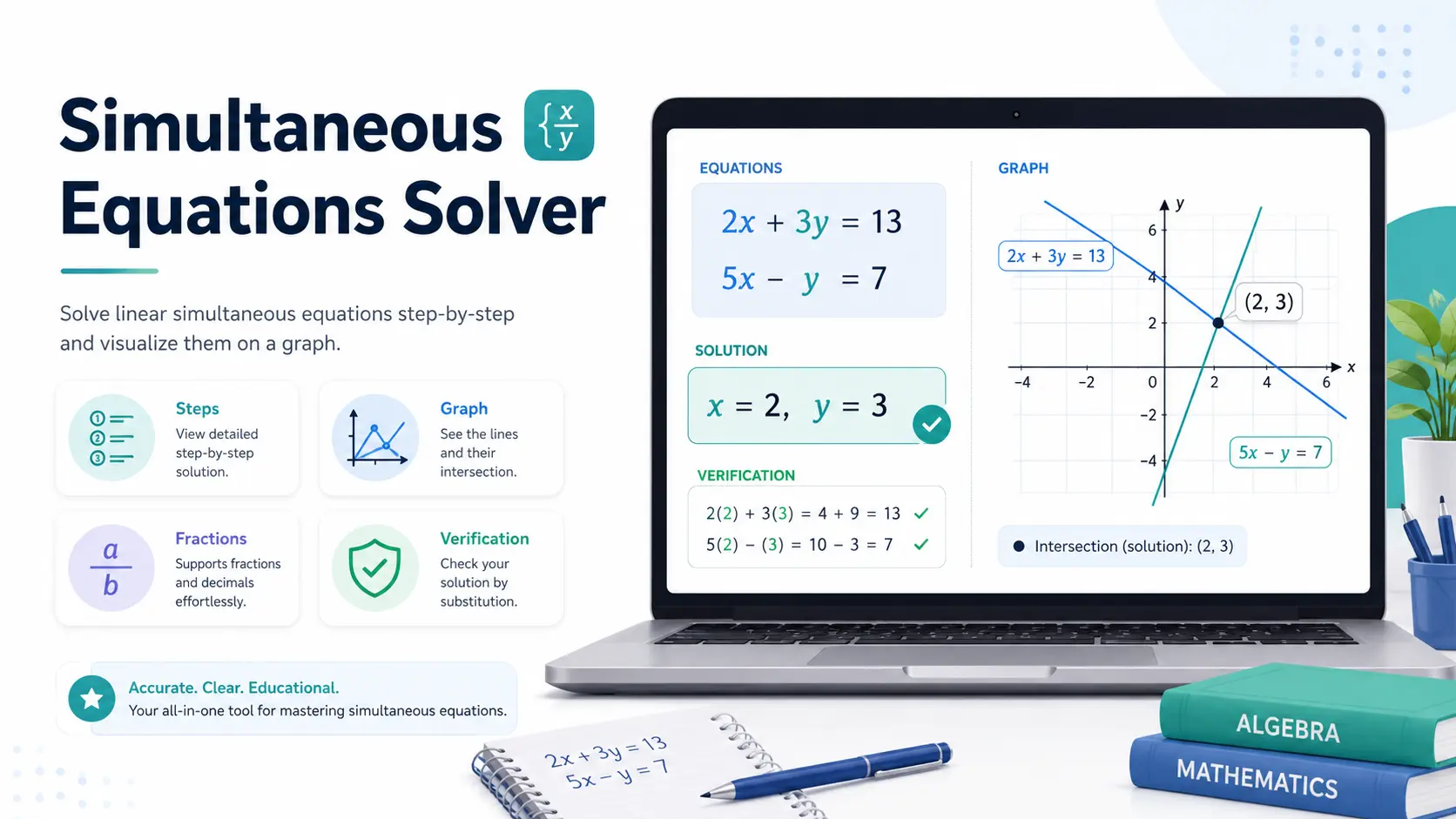
Use this free system of equations solver to solve two linear equations in x and y, with every step of the work shown. You get step-by-step working, a determinant check, answer verification, and a graph.
Simultaneous equations are the same thing under a different name: US courses say “system of equations”, UK and Commonwealth courses say “simultaneous equations”. Whichever term your class uses, this calculator solves it the same way.
a₂x + b₂y = c₂
Use the Simultaneous Equations Solver
Enter the coefficients of your two equations below and press Solve. This is the actual working calculator, not just an example image.
What Are Simultaneous Equations?
Simultaneous equations are two or more equations that contain the same unknowns and must be true at the same time.
For two linear equations, the aim is to find the values of x and y that satisfy both equations together.
x + y = 10 x – y = 2 Solution: x = 6, y = 4Simultaneous Equations vs System of Equations
In the UK, Australia, and GCSE-style courses, this topic is usually called simultaneous equations. In the USA and Canada, it is often called a system of equations or system of linear equations.
The wording is different, but the idea is the same: solve the equations together.
How to Use the Simultaneous Equations Solver
Enter coefficients
Write each equation in standard form:
ax + by = cFor example, 5x − y = 7 means a = 5, b = −1, c = 7.
Choose method
Use Auto mode, or select elimination, substitution, or Cramer’s rule.
Auto mode chooses a suitable method for your entered equations.
Read the result
The solver shows the final answer, determinant, working steps, graph, and verification.
What This System of Equations Calculator Can Handle
Supported
- Two linear equations in x and y
- Integers and negative numbers
- Decimals and fractions like 1/2 or -3/4
- Missing x or y terms
- One solution, no solution, and infinite solutions
- GCSE, Algebra 1, Algebra 2, SAT, and ACT practice
Not Supported
This calculator is focused on two-variable linear systems.
It does not solve three-variable systems or linear-quadratic simultaneous equations.
Supported form: ax + by = cMethods of Solving Simultaneous Equations
Expand each method to learn how it works. Keeping these sections closed makes the page easier to scan, but the full explanation is still available.

Solving a System of Equations by Elimination
The elimination method removes one variable by adding or subtracting equations. It is often the fastest method when both equations are already in standard form.
2x + 3y = 13 5x – y = 7 Multiply the second equation by 3: 15x – 3y = 21 Add: 2x + 3y = 13 15x – 3y = 21 17x = 34 x = 2 Substitute x = 2: 2(2) + 3y = 13 4 + 3y = 13 3y = 9 y = 3 Answer: x = 2, y = 3Elimination is best when coefficients can be matched easily.
Solving a System of Equations by Substitution
The substitution method works by making one variable the subject of one equation, then substituting it into the other equation.
2x + 3y = 13 5x – y = 7 From the second equation: 5x – y = 7 y = 5x – 7 Substitute into the first equation: 2x + 3(5x – 7) = 13 2x + 15x – 21 = 13 17x = 34 x = 2 Now: y = 5(2) – 7 y = 3 Answer: x = 2, y = 3Substitution is best when one variable is already isolated or has coefficient 1.
Cramer’s Rule and the Determinant
Cramer’s rule uses determinants to solve two linear equations directly.
For: a₁x + b₁y = c₁ a₂x + b₂y = c₂ D = a₁b₂ – a₂b₁ Dx = c₁b₂ – c₂b₁ Dy = a₁c₂ – a₂c₁ x = Dx / D y = Dy / D Example: 2x + 3y = 13 5x – y = 7 D = (2)(-1) – (5)(3) = -17 Dx = (13)(-1) – (7)(3) = -34 Dy = (2)(7) – (5)(13) = -51 x = -34 / -17 = 2 y = -51 / -17 = 3Equations with Fractions
Fractions often make simultaneous equations harder because small sign and denominator mistakes can change the final answer. This solver accepts fractions directly.
Example fraction inputs: -3/2 1/3 2/3 Example system: -3/2x + 1/3y = 2 1/2x + 2/3y = 1You can clear denominators manually, or enter the fractions directly into the calculator.
Solving Graphically
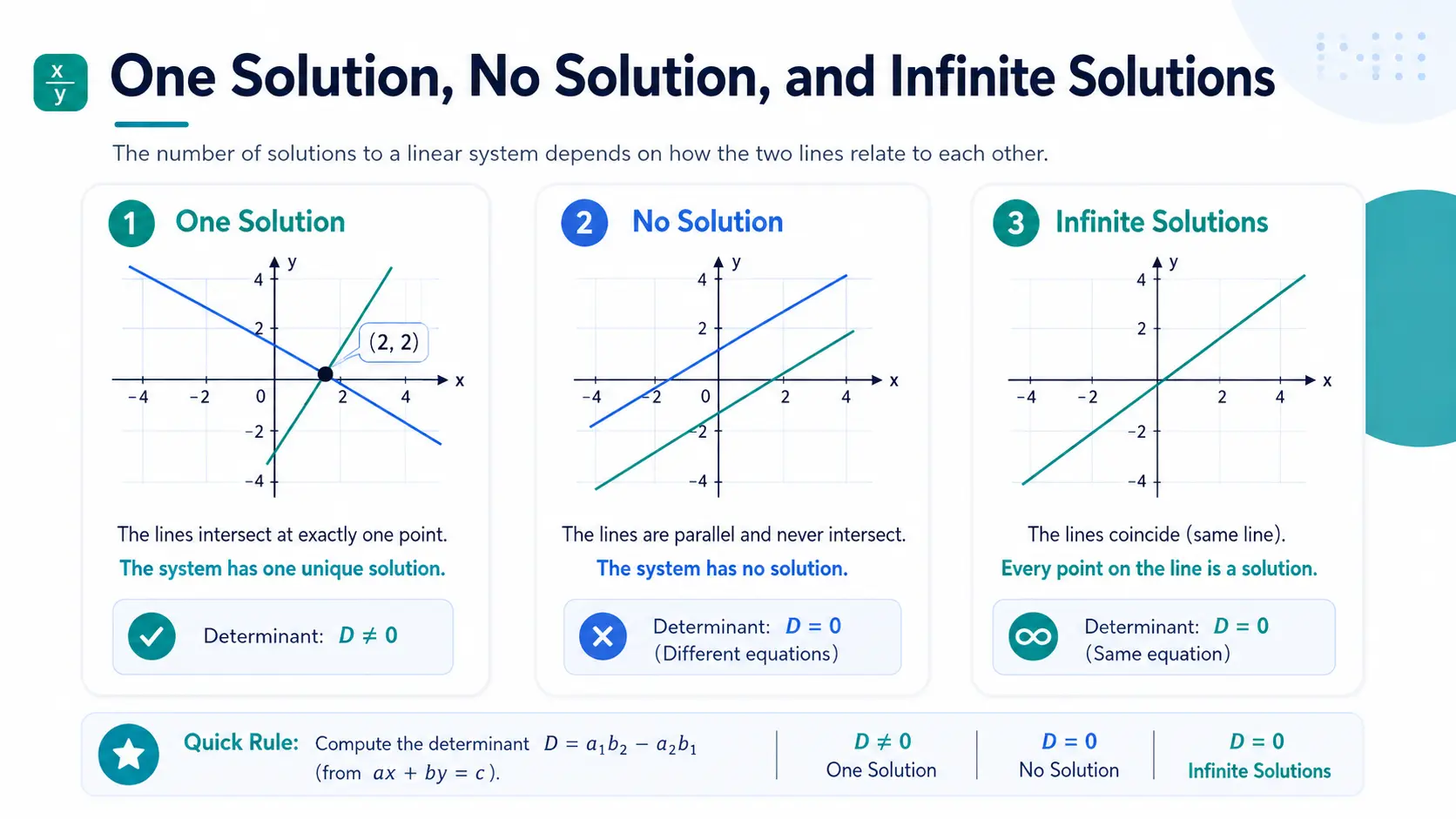
Every linear equation in x and y represents a straight line. Solving simultaneous linear equations means finding where the two lines meet.
- If the lines meet once, there is one solution.
- If the lines are parallel, there is no solution.
- If both equations draw the same line, there are infinitely many solutions.
One Solution, No Solution, and Infinite Solutions
One Solution
The two lines meet at exactly one point. This happens when the determinant is not zero.
D ≠ 0No Solution
The two lines are parallel and never meet. No ordered pair satisfies both equations.
2x + 3y = 6 4x + 6y = 20Infinite Solutions
Both equations represent the same line. Every point on that line is a solution.
2x + 3y = 6 4x + 6y = 12Simultaneous Equations Examples with Answers
Example 1: Simple Elimination
Example 2: Substitution
Example 3: Infinite Solutions
Example 4: No Solution
Simultaneous Equations Word Problems
Simultaneous equations are useful when a problem has two unknown quantities and two conditions.
Ticket Word Problem Example
A shop sells adult tickets and child tickets. Adult tickets cost $5 and child tickets cost $3. A total of 40 tickets are sold for $160. How many adult tickets and child tickets were sold?
Let: x = number of adult tickets y = number of child tickets Equations: x + y = 40 5x + 3y = 160 From the first equation: x = 40 – y Substitute: 5(40 – y) + 3y = 160 200 – 5y + 3y = 160 200 – 2y = 160 -2y = -40 y = 20 Now: x + 20 = 40 x = 20 Answer: 20 adult tickets and 20 child ticketsCommon Mistakes When Solving Simultaneous Equations
Not Rearranging to Standard Form
Before entering values, write the equation as ax + by = c.
3y = 7 – 2x becomes 2x + 3y = 7Dropping Negative Signs
In 5x − y = 7, the coefficient of y is -1, not 1.
5x – y = 7 a = 5, b = -1, c = 7Forgetting to Multiply Every Term
When multiplying an equation, multiply every term including the constant.
2x + 3y = 13 × 4 8x + 12y = 52Checking Only One Equation
The final answer must satisfy both original equations, not just one.
Simultaneous Equations for GCSE, Algebra 1, SAT, and ACT
This topic appears in many school systems. In GCSE Maths, students usually call it simultaneous equations. In Algebra 1 and Algebra 2, it is usually called systems of equations or systems of linear equations.
SAT and ACT questions may ask students to solve a system, interpret a word problem, or identify whether the system has one solution, no solution, or infinitely many solutions.
Frequently Asked Questions
What is a simultaneous equations solver?
A simultaneous equations solver is a calculator that solves equations together. This solver finds x and y for two linear equations and shows steps, graph, determinant, and verification.
Is a system of equations the same as simultaneous equations?
Yes. “Simultaneous equations” is common in the UK and Australia. “System of equations” is common in the USA and Canada.
Can this solver show steps?
Yes. It can show step-by-step working using auto mode, elimination, substitution, or Cramer’s rule.
Can this calculator solve equations with fractions?
Yes. You can enter fractions such as 1/2, -3/4, and 2/3.
Can simultaneous equations have no solution?
Yes. If the two lines are parallel, they never meet. So there is no ordered pair that satisfies both equations.
Can simultaneous equations have infinite solutions?
Yes. If both equations represent the same line, every point on that line is a solution.
What does the determinant mean?
The determinant helps classify the system. If the determinant is not zero, the system has one unique solution. If it is zero, the system may have no solution or infinitely many solutions.
What is the best method for solving simultaneous equations?
Elimination is often fastest when both equations are in standard form. Substitution is useful when one variable is isolated. Cramer’s rule is useful for a determinant-based method.
Can this solver solve three equations with three unknowns?
No. This solver is designed for two linear equations in x and y. Three-variable systems need a different calculator or matrix method.
Can this solver solve quadratic simultaneous equations?
No. This solver handles two linear equations only. Linear-quadratic simultaneous equations usually require substitution followed by solving a quadratic equation.
Related Math Tools and Lessons
If you want to study related topics, these resources may help:
- Matrix Calculator — useful for determinants, inverse matrices, and matrix methods.
- Solving simultaneous linear equations using matrices — helpful for students studying matrices and determinants.
- Quadratic Equation Solver — useful when your equation is quadratic instead of linear.
- Quadratic Equations Guide — learn the basics of quadratic equations before trying harder systems.
- Solve for X Game — practice basic algebra equations before simultaneous equations.
- Class 9 Math Notes — revise basic algebra concepts with step-by-step solutions.
- Scientific Notation, Percentage & Fraction Calculator — convert scientific notation, calculate percentages, and convert fractions to decimals and percentages.
- Right Triangle Calculator — solve right triangles, find missing sides and angles, and verify calculations instantly.
- Circle and Unit Circle Calculator — calculate circle measurements and explore unit circle values for trigonometry.
Final Words
Simultaneous equations are an important part of algebra because they help solve problems with more than one unknown. This simultaneous equations solver gives the answer and also shows the method, graph, determinant, and verification.
Use the calculator above to solve equations, check homework, compare methods, and learn how systems of equations work step by step.