
Class 12 Math Solutions 2026–27
Class 12 Math Solutions for the new book 2026–27 are available here in exercise-wise PDF format for Punjab Board students. Complete solutions including detailed calculations, graphs where required and clearly marked final answers. Select a unit below and open the exercise you want to study.
Solutions of Unit 1: Graphical Representation of Functions
Solutions of Unit 2: Further Differentiation
Solutions of Unit 3: Integration
Solutions of Unit 4: Differential Equations
Solutions of Unit 5: Analytical Geometry
Solutions of Unit 6: Conics
Solutions of Unit 7: Kinematics
Solutions of Unit 8: Numerical Solutions of Nonlinear Equations
Solutions of Unit 9: Inverse Trigonometric Functions and their Graphs
Solutions of Unit 10: Solution of Trigonometric Equations
Solutions of Unit 11: Vector Valued Functions and Their Derivatives
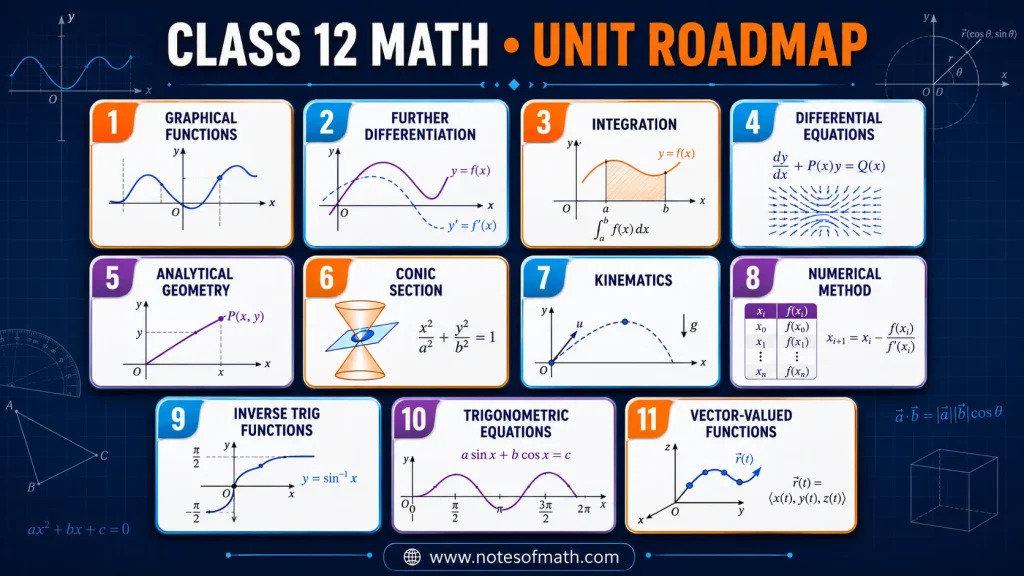
Class 12 Math New Book Unit Guide
The revised Class 12 Mathematics textbook contains 11 units. The following guide provides a general overview of the concepts students will study throughout the book.
Unit 1: Graphical Representation of Functions
This unit studies functions through their graphical representations. Students learn how equations relate to graph shapes, intercepts, domains, ranges and the behaviour of functions.
- Exercise 1.1 (5 questions): sketching quadratic functions by factorization, finding a quadratic function from its graph, and writing its equation from given intercepts, a point or the vertex.
- Exercise 1.2 (6 questions): algebraic and transcendental functions, domain, range and graph of exponential functions, hyperbolic identities and inverse hyperbolic formulae.
- Exercise 1.3 (10 questions): inverse functions and their graphs by reflection in the line y = x, and transformations of graphs (shifts, stretching and compression).
- Exercise 1.4 (2 questions, 12 parts): solving logarithmic and exponential equations and inequalities.
- Exercise 1.5 (12 questions): word problems on exponential growth and decay, sound level in decibels, compound interest and continuous compounding.
Unit 2: Further Differentiation
Unit 2 develops more advanced differentiation skills. Students apply different derivative rules and study how differentiation describes the changing behaviour of functions.
- Exercise 2.1 (16 questions): derivatives of sec x, csc x and cot x, product, quotient and chain rule with trigonometric functions, parametric equations and implicit differentiation.
- Exercise 2.2 (2 multi-part questions): derivatives of exponential and logarithmic functions.
- Exercise 2.3 (6 questions): equations of tangent and normal, points where the tangent is horizontal or vertical, and higher order derivatives.
- Exercise 2.4 (6 questions): increasing and decreasing functions, the Second Derivative Test, local and global extrema.
- Exercise 2.5 (4 questions): local linear approximation of functions and its use in estimating values.
- Exercise 2.6 (5 questions): differentials, approximating Δy with dy, and error problems on the volume of a cube and a sphere.
Unit 3: Integration
Integration introduces antiderivatives, definite integrals and applications of integration. Students calculate areas, volumes, average values, displacement, distance, population growth and moment of inertia.
- Exercise 3.1 (4 questions, 29 parts): antiderivatives and indefinite integrals using the basic rules.
- Exercise 3.2 (2 questions, 26 parts): integration by substitution.
- Exercise 3.3 (24 questions): integration by parts with logarithmic, exponential, trigonometric and inverse trigonometric functions.
- Exercise 3.4 (15 questions): integration by partial fractions.
- Exercise 3.5 (17 questions): definite integrals and their properties, with evaluate, show and prove questions.
- Exercise 3.6 (15 questions): areas of plane regions, consumer’s and producer’s surplus, and volumes of solids of revolution.
- Exercise 3.7 (13 questions): moment of inertia, motion and growth models, average value of a function and drug concentration problems.
Unit 4: Differential Equations
This unit introduces equations that contain derivatives of unknown functions. Differential equations are used to describe quantities whose values change with time or another variable.
- Exercise 4.1 (6 questions): order and degree of a differential equation, and forming differential equations for cooling, radioactive decay, RC and RL circuits.
- Exercise 4.2 (25 questions): checking solutions, separable and homogeneous equations, solving first-order differential equations and initial value problems.
- Exercise 4.3 (10 questions): applications to motion, bacterial growth, half-life, inflation, interest, cooling, RL and RC circuits.
Unit 5: Analytical Geometry
Analytical geometry uses coordinates and algebraic equations to study geometrical relationships. It allows students to solve geometry problems through calculations and equations.
- Exercise 5.1 (13 questions): altitudes, medians and right bisectors of a triangle, forms of the equation of a line, family of lines and concurrent lines.
- Exercise 5.2 (10 questions): angle between two lines, interior angles of triangles and quadrilaterals, area of a triangle and collinear points.
- Exercise 5.3 (12 questions): pair of straight lines through the origin from a homogeneous second-degree equation, the angle between them, and applied problems.
Unit 6: Conic Section
This unit studies important curves such as the parabola, ellipse and hyperbola. Students work with their standard equations, graphical forms and major properties.
- Exercise 6.1 (12 questions): equation of a circle, centre and radius, circles through given points or touching given lines.
- Exercise 6.2 (6 questions): tangent and normal to a circle, tangents parallel to a line or drawn from a point, and parametric equations of a circle.
- Exercise 6.3 (10 questions): parabola: focus, vertex and directrix, equation from given elements, tangent and normal.
- Exercise 6.4 (13 questions): ellipse: equation from given data, centre, foci, eccentricity, vertices and directrices, tangent lines and distance problems.
- Exercise 6.5 (20 questions): hyperbola: equation from given data, foci, eccentricity, latus rectum, asymptotes, tangent and normal.
- Exercise 6.6 (11 questions): applications of conics: orbits, suspension bridges, arches, elliptical tracks and LORAN navigation.
Unit 7: Kinematics
Kinematics applies mathematics to the motion of objects. Students examine the relationships between position, velocity, acceleration and time.
- Exercise 7 (13 questions): displacement–time and velocity–time graphs, equations of uniformly accelerated motion, vertical motion under gravity, and velocity from a given acceleration.
Unit 8: Numerical Method
Numerical methods provide approximate solutions when an exact algebraic answer is difficult to obtain. Students follow systematic procedures to calculate useful approximations.
- Exercise 8.1 (2 multi-part questions): real roots correct to two decimal places by the graphical method.
- Exercise 8.2 (3 multi-part questions): real roots by the bisection, Regula-Falsi and Newton-Raphson methods.
- Exercise 8.3 (10 questions): approximate values of definite integrals and areas by the trapezoidal rule.
- Exercise 8.4 (6 questions): applied problems solved with the Regula-Falsi and Newton-Raphson methods.
Unit 9: Inverse Trigonometric Functions and Their Graphs
This unit studies inverse trigonometric functions and their graphical behaviour. Students learn about their domains, ranges, standard values and important properties.
- Exercise 9.1 (4 multi-part questions): principal values and domains of inverse trigonometric functions, and finding values without a calculator.
- Exercise 9.2 (21 questions): proofs using the sum and difference formulas for inverse trigonometric functions.
Unit 10: Solution of Trigonometric Equations
Unit 10 focuses on solving equations containing trigonometric functions. Students use standard values, identities and suitable intervals to determine possible solutions.
- Exercise 10.1 (24 questions): solving trigonometric equations using standard values, identities, double angles and sums of sines and cosines.
- Exercise 10.2 (8 questions): graphical solution of trigonometric equations, and applied problems on work, heights and angles of elevation.
Unit 11: Vector Valued Functions and Their Differentiations
The final unit studies functions whose outputs are vectors. Students learn how vector-valued functions are represented and differentiated.
- Exercise 11.1 (8 questions): constructing vector-valued functions for circular, parabolic and spiral paths, finding domain and range, and identifying scalar and vector-valued functions.
- Exercise 11.2 (2 questions, 7 parts): first derivatives of vector-valued functions using the product, quotient and chain rules, including derivatives at a given value of t.
- Exercise 11.3 (11 questions): velocity, acceleration, speed and direction of motion from a position vector, and applied problems on projectiles, a comet’s orbit, a robotic arm and a Ferris wheel.
What Is Included in the Class 12 Math Solutions?
The exercise-wise PDFs provide complete working instead of final answers alone. Each question is followed by a detailed solution that shows the formulas, substitutions, calculations and simplifications used to reach the answer.
Graphs, diagrams and shaded regions are included where they are required. Final answers are placed in separate boxes, making it easier for students to compare their results after solving a question independently.
The PDFs are organized by unit and exercise. Students can therefore open only the exercise they need without searching through one large document.
How to Use These Class 12 Math Solutions
Start by selecting the required unit and expanding its accordion. Click the relevant exercise link to open its complete PDF.
Try each question independently before checking the solution. If your answer is incorrect, compare the intermediate steps to find where the calculation changed.
For revision, focus on the formulas, substitutions, graphs and boxed final answers. Difficult questions can be downloaded or bookmarked for additional practice.
Benefits of Exercise-Wise PDF Solutions
Exercise-wise organization makes the material easier to navigate on computers and mobile devices. Students can move directly to a particular exercise instead of scrolling through a complete unit or textbook.
The detailed working is especially useful for integration, differentiation and graph-based questions where a final answer does not explain the complete method. These Class 12 Math Solutions can support homework, classroom learning and examination preparation.
Frequently Asked Questions
Which Class 12 Math units are available here?
Complete exercise-wise solutions are available for all units of the new Class 12 Mathematics book, from Unit 1: Graphical Representation of Functions onwards.
Are the solutions available as PDFs?
Yes. Every exercise has a separate PDF that students can open online or download for later study.
Do the PDFs contain complete calculations?
Yes. The PDFs contain complete question statements, formulas, substitutions, calculations and clearly marked final answers.
Are graphs and diagrams included?
Graphs, region sketches and diagrams are included in questions where a visual representation is required.
Are these solutions useful for Punjab Board students?
Yes. The solutions follow the exercises included in the revised Class 12 Mathematics textbook used by Punjab Board students.
Can these solutions be used for exam preparation?
Yes. Students can use them to understand methods, check homework, revise important calculations and practise difficult exercise questions.
Related Math Notes and Resources
Class 10 Math Notes (New Book)
Class 10 Math Notes (Old Book)
Disclaimer
These Class 12 Mathematics solutions have been prepared independently for educational purposes. Students should use them as a study aid alongside their prescribed textbook and classroom instruction.
Final Words
Class 12 Math Solutions provide organized, exercise-wise support for students studying the revised Punjab Mathematics textbook. Complete PDF solutions for all units are available above, with detailed working, graphs and clearly marked final answers.