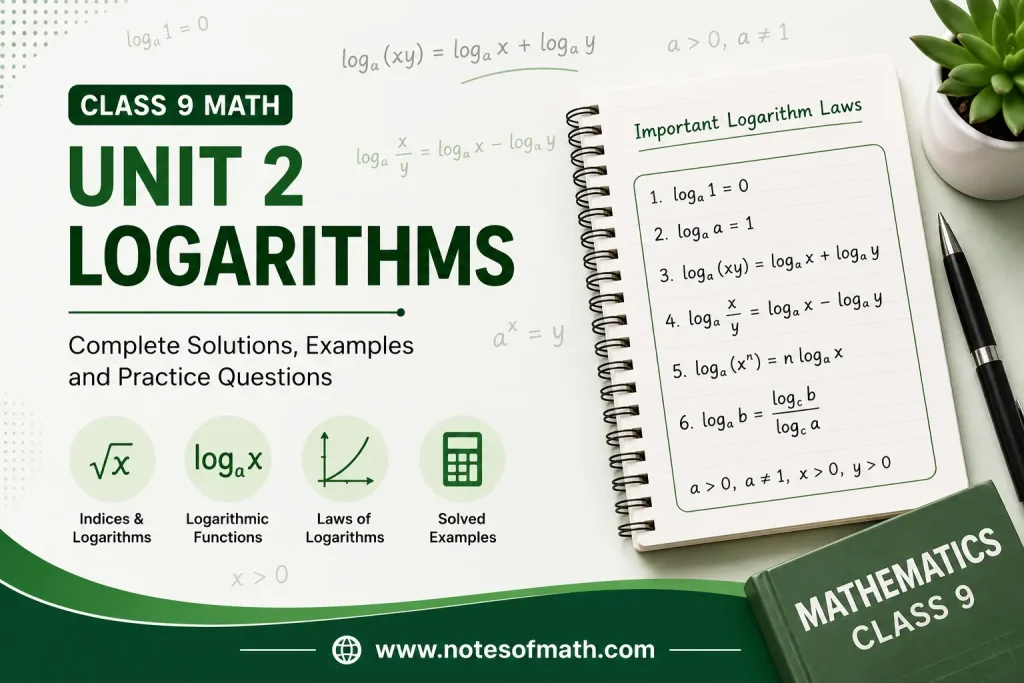
Unit 2 Class 9 Math Solutions – Logarithms
Unit 2 Class 9 Math Solutions contain complete exercise-wise PDF solutions of the chapter Logarithms. Students can find the solutions of Exercise 2.1, Exercise 2.2, Exercise 2.3, Exercise 2.4, and Review Exercise 2 on this page.
This unit begins with scientific notation and then introduces logarithmic and exponential forms, characteristics, mantissas, logarithm tables, antilogarithms, laws of logarithms, equations, and practical applications.
Students can use these notes for homework, class tests, annual examinations, board exam preparation, and revision.
Solutions of Exercise 2.1 Unit 2 Class 9 Math Notes
Exercise 2.1 of Unit 2 Class 9 Math Notes is about scientific notation and ordinary notation. Students learn how to write very large and very small numbers in a compact form using powers of ten.
Scientific Notation
A number written in scientific notation has the following form:
\(a\times10^n\)
The first factor must satisfy:
\(1\leq a<10\)
The exponent \(n\) is an integer. It shows how many places the decimal point has been moved.
Writing Large Numbers in Scientific Notation
For a large number, move the decimal point to the left until only one non-zero digit remains before it. The number of places moved becomes a positive exponent.
For example:
\(2000000=2\times10^6\)
Similarly:
\(48900=4.89\times10^4\)
Writing Small Numbers in Scientific Notation
For a number between zero and one, move the decimal point to the right until the first factor lies between one and ten. The number of places moved becomes a negative exponent.
For example:
\(0.0042=4.2\times10^{-3}\)
Similarly:
\(0.0000009=9\times10^{-7}\)
Converting Scientific Notation into Ordinary Notation
When the exponent is positive, move the decimal point to the right.
For example:
\(8.04\times10^2=804\)
When the exponent is negative, move the decimal point to the left.
For example:
\(1.5\times10^{-2}=0.015\)
Real-Life Examples in Exercise 2.1
Exercise 2.1 also uses scientific notation for real measurements such as the speed of light, the circumference of Earth, and the diameters of Mars and Earth.
These questions help students understand why powers of ten are useful when quantities contain many zeros.
Solutions of Exercise 2.2 Unit 2 Class 9 Math Notes
Exercise 2.2 introduces logarithmic form and exponential form. Students learn that a logarithm represents an exponent.
Exponential and Logarithmic Forms
The basic relationship is:
\(a^x=b\iff\log_a b=x\)
In this relationship, \(a\) is the base, \(b\) is the result or argument, and \(x\) is the exponent.
For example:
\(10^3=1000\)
can be written as:
\(\log_{10}1000=3\)
Similarly:
\(2^8=256\iff\log_2 256=8\)
Negative and Fractional Exponents
Exercise 2.2 also includes negative and fractional exponents.
For example:
\(3^{-3}=\frac{1}{27}\)
can be written as:
\(\log_3\left(\frac{1}{27}\right)=-3\)
A fractional exponent can also be converted into logarithmic form in the same way.
Converting Logarithmic Form into Exponential Form
To convert a logarithmic statement into exponential form, use the base as the base of the power, use the logarithm as the exponent, and use the argument as the result.
For example:
\(\log_5 125=3\iff5^3=125\)
Another example is:
\(\log_2\left(\frac{1}{8}\right)=-3\iff2^{-3}=\frac{1}{8}\)
Finding an Unknown Value
Students also find an unknown base or argument by changing the logarithmic equation into exponential form.
For example, if:
\(\log_x64=3\)
then:
\(x^3=64\)
Therefore:
\(x=4\)
If:
\(\log_{10}x=-3\)
then:
\(x=10^{-3}=\frac{1}{1000}\)
Solutions of Exercise 2.3 Unit 2 Class 9 Math Notes
Exercise 2.3 of Unit 2 Class 9 Math Notes focuses on characteristics, mantissas, logarithm tables, and antilogarithms.
Characteristic of a Logarithm
The characteristic is the integer part of a common logarithm. It indicates the position of the decimal point in the original number.
For a number greater than or equal to one, the characteristic is one less than the number of digits before the decimal point.
For example, 5287 has four digits before the decimal point, so its characteristic is:
\(4-1=3\)
The number can also be written as:
\(5287=5.287\times10^3\)
For a number between zero and one, the characteristic is negative. For example:
\(0.0567=5.67\times10^{-2}\)
Therefore, its characteristic is \(-2\), which may be written in bar notation as \(\overline{2}\).
Mantissa
The mantissa is the decimal part of a common logarithm. It is found from the significant digits of the number by using a logarithm table.
Changing the position of the decimal point changes the characteristic but does not change the mantissa when the significant digits remain the same.
Finding a Logarithm from a Log Table
To find the logarithm of a number, first determine its characteristic. Then find the mantissa from the logarithm table.
For example, the solution uses the table to obtain:
\(\log43\approx1.6335\)
and:
\(\log579\approx2.7627\)
For numbers with more significant digits, students may also use the mean-difference columns of the table.
Logarithms of Numbers Between Zero and One
For numbers smaller than one, the characteristic is negative while the mantissa remains positive in bar notation.
For example:
\(\log0.047\approx\overline{2}.6721\)
The same value may be written as:
\(\log0.047\approx-1.3279\)
Students should not place a negative sign on the mantissa when bar notation is used.
Using a Known Logarithm
Exercise 2.3 also asks students to find new logarithms from a known value by changing the power of ten.
For example, if:
\(\log3.177=0.5019\)
then:
\(\log3177=\log(3.177\times10^3)=3.5019\)
and:
\(\log0.03177=\log(3.177\times10^{-2})=-1.4981\)
Antilogarithms
An antilogarithm is used to find the original number when its logarithm is known.
If:
\(\log x=y\)
then:
\(x=10^y\)
The characteristic determines the position of the decimal point, while the mantissa is used to find the significant digits from the antilogarithm table.
Exercise 2.3 includes positive logarithms, negative logarithms, and negative characteristics written with positive mantissas.
Solutions of Exercise 2.4 Unit 2 Class 9 Math Notes
Exercise 2.4 applies the laws of logarithms. It includes evaluating logarithmic expressions, writing expressions as a single logarithm, expanding logarithms, solving equations, using logarithm tables, and solving practical problems.
Product Law of Logarithms
The logarithm of a product is equal to the sum of the logarithms.
\(\log_a(xy)=\log_a x+\log_a y\)
For example:
\(\log2+\log25=\log(2\times25)\)
Quotient Law of Logarithms
The logarithm of a quotient is equal to the difference of the logarithms.
\(\log_a\left(\frac{x}{y}\right)=\log_a x-\log_a y\)
For example:
\(\log_2 18-\log_2 9=\log_2\left(\frac{18}{9}\right)=1\)
Power Law of Logarithms
An exponent inside a logarithm may be written as a coefficient.
\(\log_a(x^n)=n\log_a x\)
The law can also be used in reverse:
\(n\log_a x=\log_a(x^n)\)
Writing as a Single Logarithm
To combine logarithms, first use the power law to move coefficients into exponents. Then use the product and quotient laws.
For example:
\(2\log_3x+\log_3y=\log_3(x^2y)\)
A difference of logarithms becomes a quotient inside one logarithm.
Expanding Logarithms
To expand a logarithm, apply the product, quotient, and power laws in reverse.
For example:
\(\log(xyz^6)=\log x+\log y+6\log z\)
Roots may be written as fractional exponents before applying the power law.
For example:
\(\log\sqrt{8x^3}=\frac{1}{2}(\log8+3\log x)\)
Solving Logarithmic Equations
Combine the logarithms where necessary and then convert the result into exponential form.
For example:
\(\log2+\log x=1\)
Using the product law:
\(\log(2x)=1\)
Therefore:
\(2x=10\)
and:
\(x=5\)
When a logarithmic equation contains variables inside logarithms, the final answer must make every logarithmic argument positive.
Solving Exponential Equations
Exercise 2.4 also contains exponential equations. When both sides can be written with the same base, compare their exponents.
For example, powers of 81 and 243 can be rewritten as powers of 3 because:
\(81=3^4\)
and:
\(243=3^5\)
Calculations with Logarithm Tables
The exercise uses logarithm and antilogarithm tables to evaluate products, quotients, powers, and roots.
For multiplication, logarithms are added. For division, logarithms are subtracted. For powers, the logarithm is multiplied by the exponent. For roots, it is divided by the index of the root.
Practical Applications of Logarithms
Exercise 2.4 includes practical questions involving earthquake magnitude, compound growth, and temperature change with altitude.
The magnitude of an earthquake is modelled by:
\(M=\log_{10}\left(\frac{A}{A_0}\right)\)
The investment question uses the exponential model:
\(y=100000(1.05)^t\)
The solution shows that the investment doubles after approximately 14.2 years.
The mountain-temperature question uses:
\(T=T_0(0.97)^{h/100}\)
For an initial temperature of \(20^\circ ext{C}\) and an altitude of 500 metres, the calculated temperature is approximately \(17.174^\circ ext{C}\).
Solutions of Review Exercise 2 Unit 2 Class 9 Math Notes
Review Exercise 2 revises the complete unit. It includes multiple-choice questions, scientific and ordinary notation, logarithmic and exponential forms, finding unknown values, combining and expanding logarithms, calculations using logarithm tables, and an exponential population problem.
Students should attempt the review exercise independently before opening the solution. The PDF should be used to check answers and revise topics that need more practice.
Important Rules of Unit 2 Class 9 Math Notes
Scientific Notation
\(N=a\times10^n,\qquad1\leq a<10\)
Logarithmic and Exponential Forms
\(a^x=b\iff\log_a b=x\)
Conditions of a Logarithm
\(a>0,\qquad a\neq1,\qquad x>0\)
Logarithm of One
\(\log_a1=0\)
Logarithm of the Base
\(\log_a a=1\)
Product Law
\(\log_a(xy)=\log_a x+\log_a y\)
Quotient Law
\(\log_a\left(\frac{x}{y}\right)=\log_a x-\log_a y\)
Power Law
\(\log_a(x^n)=n\log_a x\)
Change of Base Formula
\(\log_a x=\frac{\log_b x}{\log_b a}\)
Common Mistakes in Unit 2 Class 9 Math Notes
Many students move the decimal point in the wrong direction while converting a number into scientific notation.
The first factor in scientific notation must be at least one and less than ten. An expression such as \(73 imes10^3\) should be rewritten as \(7.3 imes10^4\).
Students sometimes reverse logarithmic form incorrectly. From \(a^x=b\), the correct form is \(\log_a b=x\).
The base and argument should not be interchanged.
The logarithm of zero and the logarithm of a negative number are undefined in the real number system.
Students may count digits incorrectly while finding the characteristic. For numbers greater than one, the characteristic is one less than the number of digits before the decimal point.
For numbers between zero and one, students often forget that the characteristic is negative.
When bar notation is used, only the characteristic is negative. The mantissa remains positive.
There is no general rule \(\log(x+y)=\log x+\log y\). The product law applies to multiplication, not addition.
When solving logarithmic equations, students should check that all logarithmic arguments are positive.
Exam Preparation Tips for Unit 2 Class 9 Math Notes
Practise converting numbers between scientific and ordinary notation.
Memorize the relationship between logarithmic and exponential forms.
Learn how positive, negative, and fractional exponents appear in logarithmic statements.
Practise finding characteristics without using a calculator.
Use the correct row, column, and mean difference when reading logarithm tables.
Learn the product, quotient, and power laws of logarithms.
Use the power law before combining logarithmic terms.
Convert roots into fractional exponents before expanding them.
Check the domain after solving a logarithmic equation.
Attempt Review Exercise 2 without looking at the PDF solution.
Why Unit 2 Class 9 Math Solutions Are Important
Unit 2 Class 9 Math Solutions are important because logarithms simplify calculations involving multiplication, division, powers, and roots.
This unit also strengthens students’ understanding of exponents, scientific notation, equations, and exponential models.
Logarithms are used in higher mathematics and in practical fields such as physics, chemistry, engineering, astronomy, finance, earthquake measurement, and population modelling.
A strong understanding of this chapter will make later topics involving exponential and logarithmic functions easier.
FAQs About Unit 2 Class 9 Math Solutions
What is the topic of Unit 2 Class 9 Math?
The topic of Unit 2 Class 9 Math is Logarithms.
How many exercises are included in Unit 2?
Unit 2 includes Exercise 2.1, Exercise 2.2, Exercise 2.3, Exercise 2.4, and Review Exercise 2.
What is covered in Exercise 2.1?
Exercise 2.1 covers scientific notation, ordinary notation, and real-life quantities written using powers of ten.
What is covered in Exercise 2.2?
Exercise 2.2 covers conversion between logarithmic and exponential forms and finding unknown values.
What is covered in Exercise 2.3?
Exercise 2.3 covers characteristics, mantissas, logarithm tables, known logarithmic values, and antilogarithms.
What is covered in Exercise 2.4?
Exercise 2.4 covers logarithmic laws, evaluation, combining and expanding logarithms, equations, table-based calculations, and practical applications.
What is the basic definition of a logarithm?
The basic definition is \(a^x=b\iff\log_a b=x\).
What is the base of a common logarithm?
The base of a common logarithm is 10.
What is a characteristic?
The characteristic is the integer part of a common logarithm.
What is a mantissa?
The mantissa is the decimal part of a common logarithm.
Is the logarithm of zero defined?
No. The logarithm of zero is undefined.
Are these Unit 2 Class 9 Math Solutions available in PDF format?
Yes. The complete exercise-wise solutions are available in PDF format on this page.
Are these notes useful for exam preparation?
Yes. These notes are useful for homework, revision, class tests, annual examinations, and board exam preparation.
Disclaimer
These Unit 2 Class 9 Math Solutions are prepared for educational help. Students should use them to understand the solution method and check their work.
Students should also study the official Class 9 Mathematics textbook and follow the method recommended by their teacher.
Final Words
Unit 2 Class 9 Math Solutions help students understand Logarithms in a simple and organized way. This unit covers scientific notation, logarithmic and exponential forms, characteristics, mantissas, logarithm tables, antilogarithms, laws of logarithms, equations, and applications.
Study Exercise 2.1, Exercise 2.2, Exercise 2.3, and Exercise 2.4 in order. After completing these exercises, attempt Review Exercise 2 without looking at the solution.
Regular practice will help students convert forms correctly, use logarithm tables, apply logarithmic laws, solve equations, and avoid common mistakes.
