
Unit 1 Class 9 Math Solutions PDF Download
Unit 1 Class 9 Math Solutions contain complete exercise-wise solutions of the chapter Real Numbers. Students can find the solutions of Exercise 1.1, Exercise 1.2, Exercise 1.3, and Review Exercise 1 on this page.
The solutions are provided in PDF format and explain the required steps clearly. Students can use these notes for homework, class tests, revision, and board exam preparation.
Solutions of Exercise 1.1 Unit 1 Class 9 Math
Exercise 1.1 of Unit 1 Class 9 Math introduces students to different types of real numbers. Students learn about natural numbers, whole numbers, integers, rational numbers, irrational numbers, and real numbers.
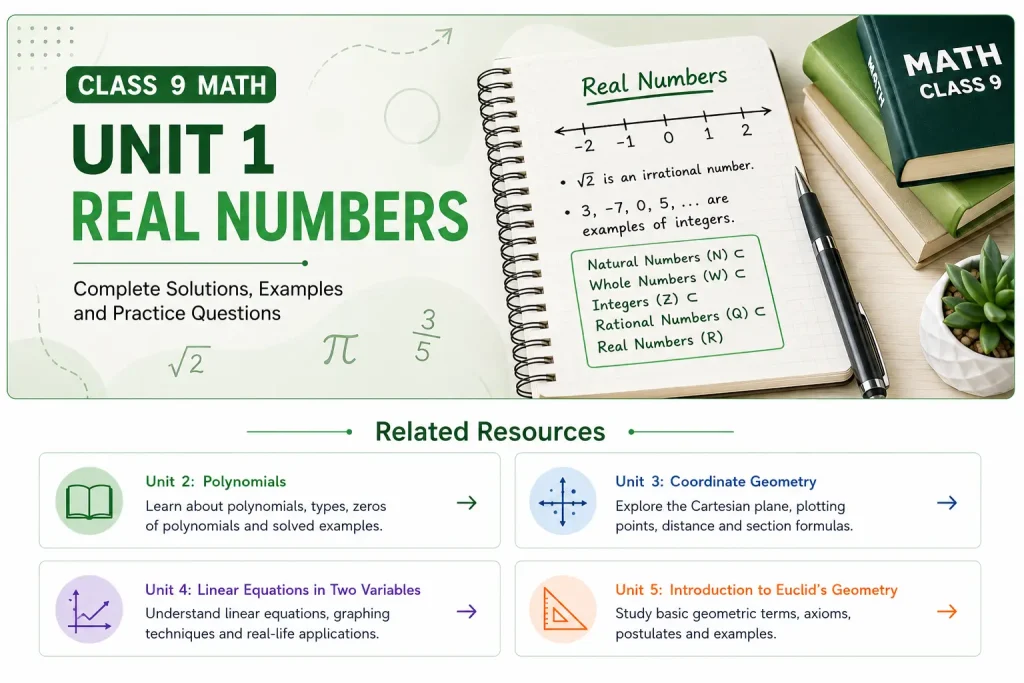
What Is Covered in Exercise 1.1?
A rational number can be written in the form \(\frac{p}{q}\), where \(p\) and \(q\) are integers and \(q\neq0\).
Examples of rational numbers include \(\frac{3}{5}\), \(-2\), \(0.75\), and \(0.333\ldots\).
A terminating decimal is rational. For example:
\(0.75=\frac{3}{4}\)
A recurring decimal is also rational. For example:
\(0.333\ldots=\frac{1}{3}\)
An irrational number cannot be written in the form \(\frac{p}{q}\). Its decimal representation is non-terminating and non-repeating.
Examples of irrational numbers include \(\sqrt{2}\), \(\sqrt{3}\), and \(\pi\).
Rational numbers and irrational numbers together form the set of real numbers.
Types of Numbers in Exercise 1.1
Natural Numbers
The counting numbers beginning from 1 are called natural numbers.
\(\mathbb{N}=\{1,2,3,4,\ldots\}\)
Whole Numbers
Natural numbers together with zero are called whole numbers.
\(\mathbb{W}=\{0,1,2,3,4,\ldots\}\)
Integers
Positive numbers, negative numbers, and zero are called integers.
\(\mathbb{Z}=\{\ldots,-3,-2,-1,0,1,2,3,\ldots\}\)
Rational Numbers
A number that can be expressed as \(\frac{p}{q}\), where \(p\) and \(q\) are integers and \(q\neq0\), is called a rational number.
Every integer is also a rational number because an integer can be written with denominator 1.
For example:
\(5=\frac{5}{1}\)
Irrational Numbers
A number that cannot be expressed as a ratio of two integers is called an irrational number.
Examples include \(\sqrt{2}\), \(\sqrt{3}\), \(\sqrt{5}\), and \(\pi\).
Real Numbers
All rational and irrational numbers are called real numbers. Every real number can be represented by a point on the number line.
Properties of Real Numbers
Exercise 1.1 also introduces important properties of real numbers.
Commutative Property
For addition:
\(a+b=b+a\)
For multiplication:
\(ab=ba\)
Associative Property
For addition:
\((a+b)+c=a+(b+c)\)
For multiplication:
\((ab)c=a(bc)\)
Distributive Property
\(a(b+c)=ab+ac\)
Additive Identity
The additive identity is zero because \(a+0=a\).
Multiplicative Identity
The multiplicative identity is one because \(a\times1=a\).
Additive Inverse
The additive inverse of \(a\) is \(-a\) because \(a+(-a)=0\).
Multiplicative Inverse
The multiplicative inverse of a non-zero number \(a\) is \(\frac{1}{a}\) because \(a\times\frac{1}{a}=1\).
Solutions of Exercise 1.2 Unit 1 Class 9 Math
Exercise 1.2 of Unit 1 Class 9 Math focuses on exponents, radical expressions, surds, and rationalization.
Students learn how to apply exponent laws, simplify radicals, and remove irrational expressions from denominators.
Main Topics Covered in Exercise 1.2
Exercise 1.2 includes laws of exponents, positive and negative exponents, zero exponents, radical expressions, simplification of surds, conjugates, and rationalization of denominators.
Product Law of Exponents
When powers with the same base are multiplied, their exponents are added.
\(a^m\times a^n=a^{m+n}\)
For example:
\(2^3\times2^4=2^7\)
This rule cannot be used when the bases are different. For example, the exponents in \(2^3\times3^4\) cannot be added.
Quotient Law of Exponents
When powers with the same base are divided, their exponents are subtracted.
\(\frac{a^m}{a^n}=a^{m-n}\)
Power of a Power
When a power is raised to another power, the exponents are multiplied.
\((a^m)^n=a^{mn}\)
Power of a Product
\((ab)^n=a^n b^n\)
Power of a Quotient
\(\left(\frac{a}{b}\right)^n=\frac{a^n}{b^n}\)
Zero Exponent
Any non-zero number raised to the power zero is equal to one.
\(a^0=1\)
This rule applies when \(a\neq0\).
Negative Exponent
A negative exponent can be written as a reciprocal.
\(a^{-n}=\frac{1}{a^n}\)
For example:
\(2^{-3}=\frac{1}{2^3}=\frac{1}{8}\)
Surds and Radical Expressions
A surd is an irrational number written in radical form. Examples include \(\sqrt{2}\), \(\sqrt{3}\), and \(\sqrt{7}\).
Some radical expressions can be simplified by separating their perfect-square factors.
For example:
\(\sqrt{12}=\sqrt{4\times3}=2\sqrt{3}\)
Similarly:
\(\sqrt{18}=\sqrt{9\times2}=3\sqrt{2}\)
Like radicals can be added or subtracted. For example:
\(2\sqrt{3}+5\sqrt{3}=7\sqrt{3}\)
Unlike radicals cannot be combined directly. For example, \(\sqrt{3}+\sqrt{5}\) cannot be simplified as \(\sqrt{8}\).
Rationalization of the Denominator
Rationalization means removing a radical expression from the denominator.
Consider:
\(\frac{1}{\sqrt{2}}\)
Multiply the numerator and denominator by \(\sqrt{2}\):
\(\frac{1}{\sqrt{2}}\times\frac{\sqrt{2}}{\sqrt{2}}=\frac{\sqrt{2}}{2}\)
When the denominator contains two terms, its conjugate is used.
The conjugate of \(a+\sqrt{b}\) is \(a-\sqrt{b}\).
The conjugate of \(a-\sqrt{b}\) is \(a+\sqrt{b}\).
This method works because \((a+\sqrt{b})(a-\sqrt{b})=a^2-b\).
Solutions of Exercise 1.3 Unit 1 Class 9 Math
Exercise 1.3 of Unit 1 Class 9 Math applies real numbers to algebraic and practical questions.
Students solve problems involving consecutive integers, geometrical measurements, temperature conversion, profit, loss, tax, and markup.
Main Topics Covered in Exercise 1.3
Exercise 1.3 includes consecutive integers, consecutive even and odd integers, applications of radical expressions, temperature conversion, profit and loss, profit and loss percentages, tax calculations, and markup calculations.
Consecutive Integers
Two consecutive integers may be represented as \(x,x+1\).
Three consecutive integers may be represented as \(x,x+1,x+2\).
Consecutive even integers differ by 2. They may be represented as \(x,x+2\).
Consecutive odd integers also differ by 2. They may be represented as \(x,x+2\).
Students should read the question carefully before deciding whether the numbers are consecutive integers, consecutive even integers, or consecutive odd integers.
Temperature Conversion
The formula for converting Celsius temperature into Fahrenheit is \(F=\frac{9}{5}C+32\).
The formula for converting Fahrenheit temperature into Celsius is \(C=\frac{5}{9}(F-32)\).
Students should place the given temperature in the correct formula and follow the proper order of operations.
Profit and Loss
When the selling price is greater than the cost price, there is a profit.
\(\text{Profit}=\text{Selling Price}-\text{Cost Price}\)
Profit percentage is calculated by:
\(\text{Profit Percentage}=\frac{\text{Profit}}{\text{Cost Price}}\times100\)
When the cost price is greater than the selling price, there is a loss.
\(\text{Loss}=\text{Cost Price}-\text{Selling Price}\)
Loss percentage is calculated by:
\(\text{Loss Percentage}=\frac{\text{Loss}}{\text{Cost Price}}\times100\)
Students should remember that profit and loss percentages are normally calculated using the cost price.
Tax and Markup
Tax may be calculated using \(\text{Tax}=\frac{\text{Tax Rate}}{100}\times\text{Taxable Amount}\).
Markup may be calculated using \(\text{Markup}=\frac{\text{Markup Rate}}{100}\times\text{Original Amount}\).
These questions show how real numbers and percentages are used in shopping, banking, business, and everyday financial calculations.
Solutions of Review Exercise 1 Unit 1 Class 9 Math
Review Exercise 1 revises the important concepts taught in Exercises 1.1, 1.2, and 1.3.
Students should attempt the review exercise after completing all three regular exercises.
Main Topics Covered in Review Exercise 1
Review Exercise 1 may include questions about rational and irrational numbers, classification of numbers, properties of real numbers, number-line representation, laws of exponents, surds and radicals, rationalization, algebraic identities, consecutive integers, temperature conversion, profit and loss, tax, and markup.
Students should attempt the questions independently before opening the PDF solution. The solution should be used to identify mistakes and understand difficult steps.
Important Rules of Unit 1 Class 9 Math
A rational number can be written as \(\frac{p}{q}\), where \(p\) and \(q\) are integers and \(q\neq0\).
The product law of exponents is \(a^m\times a^n=a^{m+n}\).
The quotient law of exponents is \(\frac{a^m}{a^n}=a^{m-n}\).
The power-of-a-power rule is \((a^m)^n=a^{mn}\).
The zero-exponent rule is \(a^0=1\), where \(a\neq0\).
The negative-exponent rule is \(a^{-n}=\frac{1}{a^n}\).
The product-of-radicals rule is \(\sqrt{a}\times\sqrt{b}=\sqrt{ab}\).
The quotient-of-radicals rule is \(\frac{\sqrt{a}}{\sqrt{b}}=\sqrt{\frac{a}{b}}\).
The difference-of-two-squares identity is \(a^2-b^2=(a-b)(a+b)\).
The square-of-a-sum identity is \((a+b)^2=a^2+2ab+b^2\).
The square-of-a-difference identity is \((a-b)^2=a^2-2ab+b^2\).
Common Mistakes in Unit 1 Class 9 Math
Many students treat every non-terminating decimal as irrational. This is incorrect because a recurring decimal is rational. For example, \(0.666\ldots=\frac{2}{3}\).
Students sometimes add unlike radicals incorrectly. For example, \(\sqrt{3}+\sqrt{5}=\sqrt{8}\) is incorrect.
Exponent laws should only be used under the correct conditions. The rule \(a^m\times a^n=a^{m+n}\) applies only when the bases are the same.
Students often forget to simplify radicals completely. For example, \(\sqrt{12}\) should be simplified to \(2\sqrt{3}\).
Another common mistake is using the wrong conjugate. The conjugate of \(a+\sqrt{b}\) is \(a-\sqrt{b}\).
Students may also confuse the identities \((a-b)^2=a^2-2ab+b^2\) and \(a^2-b^2=(a-b)(a+b)\). These identities look similar, but they are used in different situations.
Students should calculate profit and loss percentages using the cost price unless the question gives different instructions.
Exam Preparation Tips for Unit 1 Class 9 Math
Learn the definitions of rational numbers, irrational numbers, real numbers, radicals, surds, conjugates, and rationalization.
Practise classifying numbers because these questions may appear in multiple-choice and short-question sections.
Memorize the important laws of exponents and practise applying them to different expressions.
Factor the number inside a radical before simplifying it.
Use the correct conjugate when rationalizing a denominator containing two terms.
Write every important calculation step clearly and check positive and negative signs carefully.
Practise consecutive-integer questions by defining the first integer as \(x\).
Memorize the temperature-conversion formulas.
Read profit, loss, tax, and markup questions carefully before selecting a formula.
Attempt Review Exercise 1 without looking at the solution. Check the PDF only after completing the exercise.
Why Unit 1 Class 9 Math Solutions Are Important
Unit 1 Class 9 Math Solutions are important because real numbers form the foundation of many later mathematics topics.
Students use exponents, radicals, and algebraic identities again in factorization, equations, coordinate geometry, trigonometry, and functions.
This unit also improves basic calculation skills. Students learn how to simplify expressions, use mathematical properties, rationalize denominators, and apply mathematics to practical situations.
A strong understanding of Unit 1 will make later Class 9 mathematics units easier to study.
FAQs About Unit 1 Class 9 Math Solutions
What is the topic of Unit 1 Class 9 Math?
The topic of Unit 1 Class 9 Math is Real Numbers.
How many exercises are included in Unit 1?
Unit 1 includes Exercise 1.1, Exercise 1.2, Exercise 1.3, and Review Exercise 1.
What is a rational number?
A rational number can be written in the form \(\frac{p}{q}\), where \(p\) and \(q\) are integers and \(q\neq0\).
What is an irrational number?
An irrational number cannot be written as a fraction of two integers. Its decimal representation is non-terminating and non-repeating.
Is a recurring decimal rational?
Yes. A recurring decimal is rational because it can be written as a fraction.
What is a surd?
A surd is an irrational number written in radical form, such as \(\sqrt{2}\) or \(\sqrt{3}\).
What is rationalization?
Rationalization is the process of removing a radical expression from the denominator of a fraction.
What is the conjugate of \(a+\sqrt{b}\)?
The conjugate of \(a+\sqrt{b}\) is \(a-\sqrt{b}\).
What is the product law of exponents?
The product law of exponents is \(a^m\times a^n=a^{m+n}\).
Are these Unit 1 Class 9 Math Solutions available in PDF format?
Yes. The exercise-wise solutions are available in PDF format on this page.
Are these notes useful for exam preparation?
Yes. These solutions are useful for homework, revision, class tests, annual examinations, and board exam preparation.
Should students attempt the exercises before viewing the solutions?
Yes. Students should attempt each question first and use the PDF solution to understand mistakes or difficult steps.
Disclaimer
These Unit 1 Class 9 Math Solutions are prepared for educational help. Students should use them to understand the solution method and check their work.
Students should also study the official Class 9 Mathematics textbook and follow the method recommended by their teacher.
Final Words
Unit 1 Class 9 Math Solutions help students understand Real Numbers in a simple way. This unit covers rational and irrational numbers, properties of real numbers, exponent laws, radicals, surds, rationalization, and practical applications.
Study Exercise 1.1, Exercise 1.2, and Exercise 1.3 in order. After completing these exercises, attempt Review Exercise 1 without looking at the solution.
Regular practice will help students simplify expressions correctly, apply exponent laws, rationalize denominators, and avoid common calculation mistakes.
