
Unit 3 Class 9 Math Solutions – Set and Functions
Unit 3 Class 9 Math Solutions contain complete exercise-wise PDF solutions of the chapter Set and Functions. Students can find the solutions of Exercise 3.1, Exercise 3.2, and Review Exercise 3 on this page.
This unit introduces sets, set notation, subsets, power sets, set operations, Venn diagrams, relations, and functions. The PDFs provide complete step-by-step working for the questions included in the Punjab Board Class 9 Mathematics book.
Students can use these Unit 3 solutions for homework, revision, class tests, annual examinations, and board exam preparation.
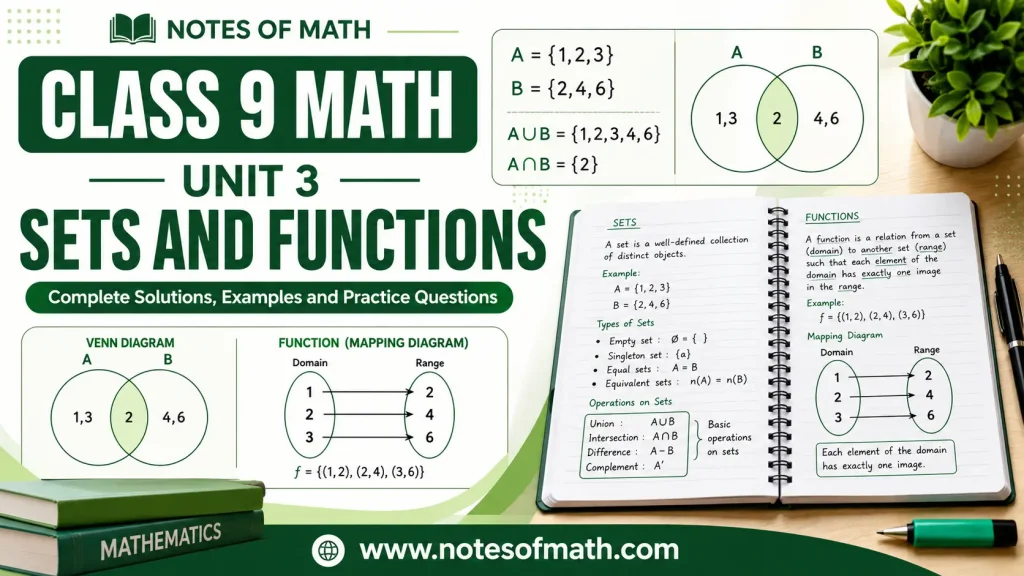
Solutions of Exercise 3.1 Unit 3 Class 9 Math Notes
Exercise 3.1 of Unit 3 Class 9 Math Notes focuses on the basic language of sets. Students convert sets between tabular and set-builder forms, identify proper subsets, distinguish between sets and elements, and work with power sets.
Set-Builder Notation
Set-builder notation describes the elements of a set by stating a condition that every element must satisfy.
A general set-builder form is \(\{x\mid \text{a condition on }x\}\).
For example, the set of the first twenty positive multiples of 5 can be written as:
\(\{x\mid x=5n,\ n\in\mathbb{N},\ 1\leq n\leq20\}\)
Exercise 3.1 includes sets containing perfect squares, powers of 2 and 3, multiples, divisors, integers within given limits, and arithmetic sequences.
Tabular Form of a Set
In tabular form, the elements of a set are written inside braces and separated by commas.
For example, the positive multiples of 3 up to 36 are:
\(\{3,6,9,12,15,18,21,24,27,30,33,36\}\)
Students must solve any condition first and then list only the values that belong to the stated number system.
Empty Set
A set with no element is called an empty set or null set. It is written as:
\(\varnothing\)
For example, the condition \(x\in\mathbb{N}\) and \(x+4=0\) gives \(x=-4\). Since \(-4 otin\mathbb{N}\), the set is empty.
Students should not confuse the empty set \(\varnothing\) with the set \(\{\varnothing\}\). The first has no element, while the second has one element—the empty set itself.
Subsets and Proper Subsets
A set \(B\) is a subset of a set \(A\) when every element of \(B\) also belongs to \(A\).
\(B\subseteq A\)
A proper subset contains elements of the given set but is not equal to the complete set.
For example, if:
\(A=\{a,b,c\}\)
then \(\{a\}\) and \(\{a,b\}\) are proper subsets of \(A\).
The empty set has no proper subset because its only subset is the empty set itself.
Sets Containing Other Sets
A set written inside another set counts as one element.
For example:
\(\{a,b\}\)
has two elements, while:
\(\{\{a,b\}\}\)
has only one element because the inner set \(\{a,b\}\) is treated as a single element.
Power Set
The power set of \(A\), written as \(P(A)\), is the set containing every subset of \(A\).
\(P(A)=\{B\mid B\subseteq A\}\)
If a set has \(n\) elements, its power set contains:
\(|P(A)|=2^n\)
For example, if:
\(A=\{9,11\}\)
then:
\(P(A)=\{\varnothing,\{9\},\{11\},\{9,11\}\}\)
Since \(A\) has two elements, its power set contains \(2^2=4\) subsets.
Exercise 3.1 also asks students to write complete power sets and count their elements when some members are themselves sets.
Solutions of Exercise 3.2 Unit 3 Class 9 Math Notes
Exercise 3.2 of Unit 3 Class 9 Math Notes focuses on set operations and Venn diagrams. Students find unions, intersections, complements, verify set identities, and solve practical problems involving two or three sets.
[Embed the Exercise 3.2 PDF here]
Universal Set
The universal set contains all elements being considered in a particular question. It is usually written as \(U\).
Complements are always found relative to the universal set.
If \(A\subseteq U\), then the complement of \(A\) is:
\(A’=U-A\)
Union of Sets
The union of two sets contains every element that belongs to at least one of the sets.
\(A\cup B=\{x\mid x\in A\text{ or }x\in B\}\)
Repeated elements are written only once.
For example, if:
\(A=\{6,12,18,24,30\}\)
and:
\(B=\{8,16,24\}\)
then 24 is included only once in the union.
Intersection of Sets
The intersection contains only the elements common to both sets.
\(A\cap B=\{x\mid x\in A\text{ and }x\in B\}\)
For the two sets above:
\(A\cap B=\{24\}\)
If two sets have no common element, their intersection is the empty set.
Venn Diagrams
A Venn diagram represents sets by circles inside a rectangle representing the universal set.
For two overlapping sets, common elements are placed in the overlapping region. Elements that belong to only one set are placed in the non-overlapping part of that circle, while elements outside both sets remain in the universal set but outside the circles.
For three sets, the central region represents elements common to all three sets. Pairwise-only regions must exclude the elements already counted in the central region.
Commutative Properties
The order of sets does not change their union or intersection.
\(A\cup B=B\cup A\)
\(A\cap B=B\cap A\)
Exercise 3.2 verifies these properties for finite sets and for familiar number sets such as \(\mathbb{N}\), \(\mathbb{Z}\), and \(\mathbb{R}\).
De Morgan’s Laws
De Morgan’s laws connect complements with unions and intersections.
\((A\cup B)’=A’\cap B’\)
\((A\cap B)’=A’\cup B’\)
Students verify both sides by listing their elements and by using Venn diagrams.
Basic Set Identities
Exercise 3.2 also verifies important identities such as:
\(A\cup A’=U\)
\(A\cap A’=\varnothing\)
\(A\cap U=A\)
\(A\cup\varnothing=A\)
These identities help students simplify more complicated set expressions.
Number of Elements in the Union of Two Sets
For two finite sets:
\(n(A\cup B)=n(A)+n(B)-n(A\cap B)\)
The intersection is subtracted because its elements are counted once in \(A\) and again in \(B\).
For example, if 34 students like cricket, 30 like hockey, and all 55 students like at least one game, then:
\(55=34+30-n(C\cap H)\)
Therefore:
\(n(C\cap H)=9\)
Number of Elements in the Union of Three Sets
For three finite sets:
\(n(A\cup B\cup C)=n(A)+n(B)+n(C)-n(A\cap B)-n(A\cap C)-n(B\cap C)+n(A\cap B\cap C)\)
The triple intersection is added because it is removed too many times when the pairwise intersections are subtracted.
Exercise 3.2 applies this formula to languages, clothing, electronic devices, sports, and food surveys.
Filling a Three-Set Venn Diagram
Begin with the value in the middle, which represents all three sets.
Next, subtract the middle value from each pairwise intersection to obtain the regions belonging to exactly two sets.
Then subtract all known inner regions from each set total to find the values belonging to only one set.
Finally, subtract the total inside the circles from the universal total to find the number outside all sets.
Solutions of Review Exercise 3 Unit 3 Class 9 Math Notes
Review Exercise 3 revises sets, relations, and functions. It combines the ideas of Exercises 3.1 and 3.2 with Cartesian products, function notation, function evaluation, and equations involving functions.
[Embed the Review Exercise 3 PDF here]
Set Operations and Identities
The review exercise includes complements, unions, intersections, differences, double complements, De Morgan’s laws, associative properties, distributive properties, and absorption properties.
An important relationship between difference and complement is:
\(A-B=A\cap B’\)
The absorption identities are:
\(A\cap(A\cup B)=A\)
\(A\cup(A\cap B)=A\)
Cartesian Product
The Cartesian product \(A\times B\) is the set of all ordered pairs whose first component belongs to \(A\) and second component belongs to \(B\).
If \(A\) and \(B\) are finite, then:
\(n(A\times B)=n(A)n(B)\)
For example, if \(A\) has four elements and \(B\) has three elements, then \(A\times B\) has \(4\times3=12\) ordered pairs.
Relations and Functions
A relation from \(A\) to \(B\) is any subset of \(A\times B\). A function is a special relation in which every input has exactly one output.
A function is one-to-one when different inputs have different outputs. It is onto when every element of the codomain is the image of at least one input. A function that is both one-to-one and onto is bijective.
The review exercise includes questions that identify whether a given mapping is injective, surjective, or bijective.
Evaluating Functions
To evaluate a function, replace the variable with the given input and simplify carefully.
For example, if:
\(g(x)=7x-2\)
then:
\(g(0)=7(0)-2=-2\)
If:
\(s(x)=8x^2-3\)
then:
\(s(-9)=8(-9)^2-3=645\)
Brackets are especially important when the input is negative or fractional.
Finding Constants in a Function
Some questions give function values and ask students to find unknown constants.
For a linear function:
\(f(x)=ax+b\)
substitute the given inputs to form two simultaneous equations in \(a\) and \(b\).
For a quadratic expression such as:
\(g(x)=mx^2+n\)
use the given function values to find \(m\) and \(n\) one at a time.
Solving a Function Equation
If a function value is given, replace the function notation with its formula and solve the resulting equation.
For example, if:
\(k(x)=7x-5\)
and:
\(k(x)=100\)
then:
\(7x-5=100\)
which gives:
\(x=15\)
Survey Problems in the Review Exercise
The review exercise applies two-set and three-set formulas to students passing tests and developers using programming languages.
Students calculate the number in at least one set, only one set, none of the sets, and a specific single-only region.
These questions require careful placement of pairwise and triple intersections before the Venn diagram is completed.
Important Rules of Unit 3 Class 9 Math
Set-Builder Form
\(A=\{x\mid \text{a stated condition on }x\}\)
Subset
\(B\subseteq A\)
Power Set
\(P(A)=\{B\mid B\subseteq A\}\)
Number of Elements in a Power Set
\(|P(A)|=2^{n(A)}\)
Set Difference
\(A-B=A\cap B’\)
Two-Set Inclusion-Exclusion Formula
\(n(A\cup B)=n(A)+n(B)-n(A\cap B)\)
Three-Set Inclusion-Exclusion Formula
\(n(A\cup B\cup C)=n(A)+n(B)+n(C)-n(A\cap B)-n(A\cap C)-n(B\cap C)+n(A\cap B\cap C)\)
De Morgan’s First Law
\((A\cup B)’=A’\cap B’\)
De Morgan’s Second Law
\((A\cap B)’=A’\cup B’\)
Cartesian Product
\(n(A\times B)=n(A)n(B)\)
Function Evaluation
\(f(a)\text{ is found by replacing }x\text{ with }a\text{ in }f(x)\)
Common Mistakes in Unit 3 Class 9 Math Notes
Students sometimes write elements without braces. A set must be written inside braces.
In set-builder notation, students may forget to state the number system or the limits of the variable.
The symbols \(\in\) and \(\subseteq\) are not interchangeable. An element belongs to a set, while one set is a subset of another set.
The empty set \(\varnothing\) is different from \(\{\varnothing\}\).
A set inside another set counts as one element. This must be remembered when counting elements or finding a power set.
Students often forget the empty set and the complete set while writing a power set.
In a union, repeated elements must be written only once.
In an intersection, only common elements are included.
A complement cannot be found unless the universal set is known.
In three-set problems, pairwise intersections usually include the triple intersection. The central value must be subtracted before filling the pairwise-only regions.
When evaluating a function at a negative number, the negative value should be placed inside brackets before squaring.
A relation is not automatically a function. Every input must have exactly one output.
Exam Preparation Tips for Unit 3 Class 9 Math Notes
Learn the meanings of element, set, subset, proper subset, universal set, empty set, power set, relation, and function.
Practise converting sets between tabular and set-builder notation.
Memorize the formula for the number of elements in a power set.
Practise union, intersection, difference, and complement using small sets.
Draw Venn diagrams neatly and place the common regions first.
Learn De Morgan’s laws and the basic set identities.
For two-set word problems, write the inclusion-exclusion formula before substituting values.
For three-set questions, begin with the triple intersection and work outward.
When evaluating functions, substitute the input in brackets and simplify one step at a time.
Attempt Review Exercise 3 without viewing the PDF first, and use the solution to check mistakes.
Why Unit 3 Class 9 Math Solutions Are Important
Unit 3 Class 9 Math Solutions are important because sets provide a basic language for organizing mathematical information.
Venn diagrams help students compare groups and solve real-life survey problems. Relations and functions are also used throughout algebra, coordinate geometry, graphs, and higher mathematics.
A clear understanding of this unit will help students work with domains, ranges, equations, mappings, and functions in later classes.
FAQs About Unit 3 Class 9 Math Solutions
What is the official title of Unit 3 Class 9 Math?
The official title of Unit 3 is Set and Functions.
How many exercises are included in Unit 3?
Unit 3 includes Exercise 3.1, Exercise 3.2, and Review Exercise 3.
What is covered in Exercise 3.1?
Exercise 3.1 covers set-builder notation, tabular form, subsets, proper subsets, empty sets, power sets, and the number of elements in power sets.
What is covered in Exercise 3.2?
Exercise 3.2 covers union, intersection, complements, Venn diagrams, De Morgan’s laws, set identities, and two-set and three-set application problems.
What is covered in Review Exercise 3?
Review Exercise 3 revises sets and Venn diagrams and also includes Cartesian products, relations, function evaluation, and equations involving functions.
What is a power set?
The power set of a set is the set containing all its possible subsets.
How many subsets does a set with n elements have?
A set with \(n\) elements has \(2^n\) subsets.
What is the difference between an element and a subset?
An element belongs to a set and is written using \(\in\). A subset is itself a set and is written using \(\subseteq\).
What is the difference between union and intersection?
A union contains elements belonging to at least one set, while an intersection contains only the common elements.
What are De Morgan’s laws?
De Morgan’s laws are \((A\cup B)’=A’\cap B’\) and \((A\cap B)’=A’\cup B’\).
What is a function?
A function is a relation in which every input has exactly one output.
Are these Unit 3 Class 9 Math Solutions available in PDF format?
Yes. The complete solutions of Exercise 3.1, Exercise 3.2, and Review Exercise 3 are available in PDF format on this page.
Are these notes useful for exam preparation?
Yes. Students can use these notes for homework, revision, class tests, annual examinations, and board exam preparation.
Disclaimer
These Unit 3 Class 9 Math Solutions are prepared for educational help. Students should use them to understand the solution method and check their work.
Students should also study the official Class 9 Mathematics textbook and follow the method recommended by their teacher.
Final Words
Unit 3 Class 9 Math Solutions help students understand Set and Functions in a clear and organized way. Exercise 3.1 develops the basic language of sets, while Exercise 3.2 applies set operations and Venn diagrams.
Review Exercise 3 connects these ideas with Cartesian products, relations, functions, and practical survey problems.
Study the exercises in order, attempt every question independently, and use the PDFs to check difficult steps and correct mistakes.