
Unit 2 Class 9 Math Solutions Sindh Board – Logarithms
Unit 2 Class 9 Math Solutions Sindh Board are available below for Exercises 2.1 to 2.6 and the Unit 2 Review Exercise. Open the required PDF to view complete ntissa, logarithm laws, antilogarithms and calculations using logarithms. For other units, visit our Class 9 Math Notes Sindh Board page.
Unit 2 Class 9 Math Exercise Solutions
Select an exercise below to view its complete PDF solutions.
Unit 2 Quick Overview
| Detail | Information |
|---|---|
| Class | Class 9 |
| Subject | Mathematics |
| Board | Sindh Board |
| Unit | Unit 2 |
| Unit Name | Logarithms |
| Exercises | Exercise 2.1 to Exercise 2.6 |
| Additional Material | Unit 2 Review Exercise |
| Solution Format | Step-by-step PDF solutions |
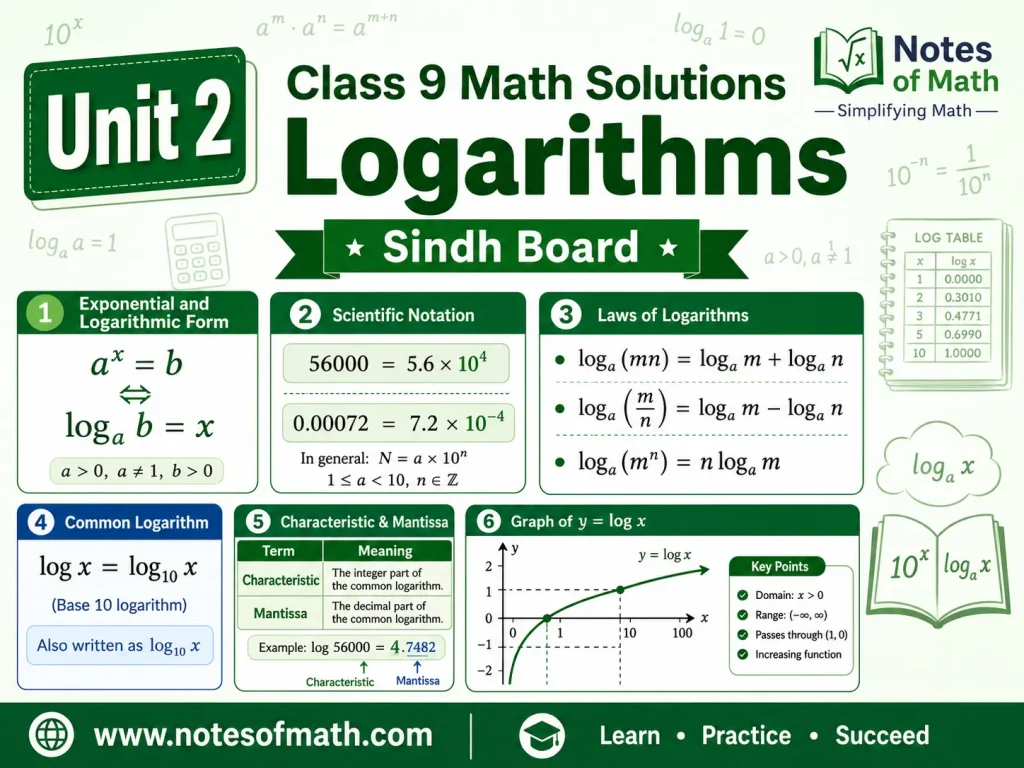
What Are Logarithms?
A logarithm tells us the power to which a base must be raised to obtain a given number.
If:
\[
a^x=b
\]
then the equivalent logarithmic form is:
\[
\log_a b=x
\]
Here:
- \(a\) is the base.
- \(b\) is the number.
- \(x\) is the logarithm or exponent.
For example:
\[
2^3=8
\]
Therefore:
\[
\log_2 8=3
\]
Logarithms are the inverse of exponents. They help simplify calculations involving multiplication, division, powers and roots.
Exercise 2.1 – Scientific Notation
Exercise 2.1 introduces scientific notation, which is used to write very large or very small numbers in a compact form.
A number written in scientific notation has the form:
\[
a\times 10^n
\]
where:
\[
1\leq a<10
\]
and \(n\) is an integer.
For example:
\[
56000=5.6\times 10^4
\]
Similarly:
\[
0.00072=7.2\times 10^{-4}
\]
A positive exponent is generally used for numbers greater than or equal to 10, while a negative exponent is used for numbers between 0 and 1.
Students also learn how to convert numbers from scientific notation back into ordinary notation.
For example:
\[
3.25\times 10^3=3250
\]
and:
\[
4.8\times 10^{-3}=0.0048
\]
The decimal point must be moved carefully according to the sign and value of the exponent.
Exercise 2.2 – Exponential and Logarithmic Forms
Exercise 2.2 introduces the relationship between exponential notation and logarithmic notation.
The general rule is:
\[
a^x=b\iff \log_a b=x
\]
For example:
\[
5^2=25
\]
can be written as:
\[
\log_5 25=2
\]
Similarly:
\[
10^{-3}=0.001
\]
can be written as:
\[
\log_{10}0.001=-3
\]
Students may also be asked to convert logarithmic statements into exponential form.
For example:
\[
\log_3 81=4
\]
means:
\[
3^4=81
\]
A logarithmic expression is defined only when:
\[
a>0,\qquad a\neq 1,\qquad b>0
\]
Students should identify the base, number and exponent before converting an expression.
Exercise 2.3 – Characteristic and Mantissa
Exercise 2.3 deals with common logarithms, characteristic and mantissa.
A common logarithm has base 10. It may be written as:
\[
\log_{10}x
\]
or simply:
\[
\log x
\]
The logarithm of a positive number usually consists of two parts:
\[
\log x=\text{characteristic}+\text{mantissa}
\]
The characteristic is the integer part of the logarithm, while the mantissa is its decimal part.
For a number greater than 1, the characteristic is one less than the number of digits before the decimal point.
For example, the number \(245\) has three digits before the decimal point. Therefore, its characteristic is:
\[
3-1=2
\]
For numbers between 0 and 1, the characteristic is negative. It is commonly written using bar notation.
For example:
\[
\log 0.0045
\]
has characteristic:
\[
\overline{3}
\]
because there are two zeros after the decimal point before the first non-zero digit.
Students also learn how to use a logarithm table to find the mantissa of a number. The row, column and mean difference must be read carefully.
Exercise 2.4 – Logarithms and Antilogarithms
Exercise 2.4 develops the use of logarithms and antilogarithms.
If:
\[
\log x=y
\]
then:
\[
x=\operatorname{antilog}(y)
\]
For example:
\[
\log 1000=3
\]
Therefore:
\[
\operatorname{antilog}(3)=1000
\]
An antilogarithm reverses the process of finding a logarithm.
When a logarithm contains a characteristic and mantissa, the mantissa is used to locate the significant digits, while the characteristic determines the placement of the decimal point.
For example, suppose:
\[
\log x=2.3010
\]
Since:
\[
\operatorname{antilog}(0.3010)=2
\]
and the characteristic is 2, the required number is:
\[
x=200
\]
Students should separate the characteristic and mantissa correctly before finding the antilogarithm.
Exercise 2.5 – Laws of Logarithms
Exercise 2.5 covers the main laws of logarithms. These laws allow students to expand logarithmic expressions or reduce several logarithms into a single term.
Product Law
\[
\log_a(mn)=\log_a m+\log_a n
\]
This means multiplication inside a logarithm becomes addition outside it.
Quotient Law
\[
\log_a\left(\frac{m}{n}\right)=\log_a m-\log_a n
\]
This means division inside a logarithm becomes subtraction outside it.
Power Law
\[
\log_a(m^n)=n\log_a m
\]
The power of a number can be written as a coefficient of its logarithm.
Logarithm of the Base
\[
\log_a a=1
\]
because:
\[
a^1=a
\]
Logarithm of Unity
\[
\log_a 1=0
\]
because:
\[
a^0=1
\]
For example:
\[
\log x+\log y
\]
can be written as:
\[
\log(xy)
\]
Similarly:
\[
2\log x-\log y
\]
can be reduced to:
\[
\log\left(\frac{x^2}{y}\right)
\]
Students should apply the power law before combining terms with the product or quotient law.
Exercise 2.6 – Calculations Using Logarithms
Exercise 2.6 applies logarithms and antilogarithms to numerical calculations.
Logarithms can change:
- Multiplication into addition
- Division into subtraction
- Powers into multiplication
- Roots into division
Multiplication Using Logarithms
If:
\[
x=ab
\]
then:
\[
\log x=\log a+\log b
\]
After adding the logarithms, the antilogarithm gives the required product.
Division Using Logarithms
If:
\[
x=\frac{a}{b}
\]
then:
\[
\log x=\log a-\log b
\]
Powers Using Logarithms
If:
\[
x=a^n
\]
then:
\[
\log x=n\log a
\]
Roots Using Logarithms
If:
\[
x=\sqrt[n]{a}
\]
then:
\[
\log x=\frac{1}{n}\log a
\]
Students must arrange the working in clear steps:
- Take the logarithm of the expression.
- Apply the relevant logarithm law.
- Find the required logarithmic values.
- Add, subtract, multiply or divide as required.
- Find the antilogarithm of the result.
Careful use of characteristic, mantissa and decimal placement is especially important in this exercise.
Unit 2 Review Exercise
The Unit 2 Review Exercise combines the main concepts from Exercises 2.1 to 2.6.
It may include questions related to:
- Scientific and ordinary notation
- Exponential and logarithmic forms
- Common logarithms
- Characteristic and mantissa
- Logarithm and antilogarithm tables
- Product, quotient and power laws
- Expansion of logarithmic expressions
- Reduction to a single logarithm
- Numerical calculations using logarithms
- Multiple-choice and short questions
Students should complete the review exercise after practising all six exercises.
Important Formulas from Unit 2
The following formulas are useful for revision:
\[
a^x=b\iff \log_a b=x
\]
\[
\log_a 1=0
\]
\[
\log_a a=1
\]
\[
\log_a(mn)=\log_a m+\log_a n
\]
\[
\log_a\left(\frac{m}{n}\right)=\log_a m-\log_a n
\]
\[
\log_a(m^n)=n\log_a m
\]
\[
\log_a\sqrt[n]{m}=\frac{1}{n}\log_a m
\]
The change-of-base formula is:
\[
\log_a b=\frac{\log_c b}{\log_c a}
\]
where \(c\) is another suitable base.
Common Mistakes to Avoid
Students commonly make the following mistakes in Unit 2:
- Moving the decimal point in the wrong direction
- Writing an incorrect exponent in scientific notation
- Confusing exponential form with logarithmic form
- Forgetting that the base of a logarithm cannot be 1
- Finding an incorrect characteristic
- Counting zeros incorrectly for numbers between 0 and 1
- Treating the mantissa as a negative number
- Reading the wrong row or column from a logarithm table
- Adding logarithms when the quotient law requires subtraction
- Applying logarithm laws to terms with different bases
- Forgetting to find the antilogarithm at the final step
- Placing the decimal point incorrectly in an antilogarithm answer
Students should write the characteristic and mantissa separately whenever the decimal placement is not clear.
How to Prepare Unit 2 for Exams
Begin with scientific notation and practise moving the decimal point correctly. After that, learn how to convert between exponential and logarithmic forms.
Memorize the product, quotient and power laws of logarithms. However, students should also understand how each law changes an expression.
Practise finding characteristic and mantissa for numbers greater than 1 and numbers between 0 and 1. Extra attention should be given to negative characteristics written in bar notation.
For numerical questions, show every step clearly. Write the logarithm first, complete the required operation and then find the antilogarithm.
After attempting the textbook questions independently, compare the working with the provided Unit 2 Class 9 Math Solutions Sindh Board PDFs.
Why These Unit 2 Solutions Are Helpful
These exercise-wise solutions help students:
- Understand logarithmic rules through complete working
- Learn how to use log and antilog values
- Check scientific notation questions
- Avoid errors in characteristic and mantissa
- Complete textbook homework
- Prepare for class tests and board examinations
- Revise each exercise separately
The solutions should be used for understanding the method rather than copying final answers only.
Frequently Asked Questions
What is the name of Unit 2 in Class 9 Sindh Board Mathematics?
The name of Unit 2 is Logarithms.
How many exercises are included in Unit 2?
Unit 2 contains six exercises, from Exercise 2.1 to Exercise 2.6, followed by a Review Exercise.
What topics are covered in Unit 2?
The unit covers scientific notation, exponential and logarithmic forms, characteristic and mantissa, logarithm laws, antilogarithms and calculations using logarithms.
Are all Unit 2 exercises solved on this page?
Yes. Separate PDF solutions are provided for Exercises 2.1 to 2.6 and the Unit 2 Review Exercise.
Are these solutions prepared for Sindh Board students?
Yes. The solutions follow the exercise structure of the Class 9 Mathematics textbook used by Sindh Board students.
Why are logarithms useful?
Logarithms simplify calculations involving multiplication, division, powers and roots. They are also used in science, engineering and higher mathematics.
Can students view the PDFs on mobile phones?
Yes. The exercise-wise PDF solutions can be viewed on mobile phones, tablets and computers.
Related Class 9 Math Resources
- Class 9 Math Notes Sindh Board
- Unit 1 Class 9 Math Solutions Sindh Board
- Unit 3 Class 9 Math Solutions Sindh Board
Disclaimer
These solutions are prepared for educational support. Students should also consult their official Sindh Textbook Board Mathematics book and follow the instructions provided by their teachers.
Final Words
The Unit 2 Class 9 Math Solutions Sindh Board provide exercise-wise help with scientific notation, logarithms, antilogarithms and logarithmic calculations.
Students should first attempt each textbook question independently. They can then use the PDF solutions to check their method, understand missing steps and correct calculation errors.
For solutions to all other units, visit the Class 9 Math Notes Sindh Board page.