
Unit 4 Class 9 Math Solutions Sindh Board – Factorization
Unit 4 Class 9 Math Solutions Sindh Board are available below for Exercises 4.1 to 4.8 and the Unit 4 Review Exercise. Students can view and download each PDF to study complete step-by-step solutions.
This unit covers factorization methods, algebraic identities, quadratic and cubic expressions, the remainder theorem, synthetic division and the factor theorem. For other units, visit our Class 9 Math Notes Sindh Board page.
Unit 4 Class 9 Math Exercise Solutions
Select an exercise below to view or download its complete PDF solutions.
Table of Contents
[Insert automatic table of contents here]
Unit 4 Quick Overview
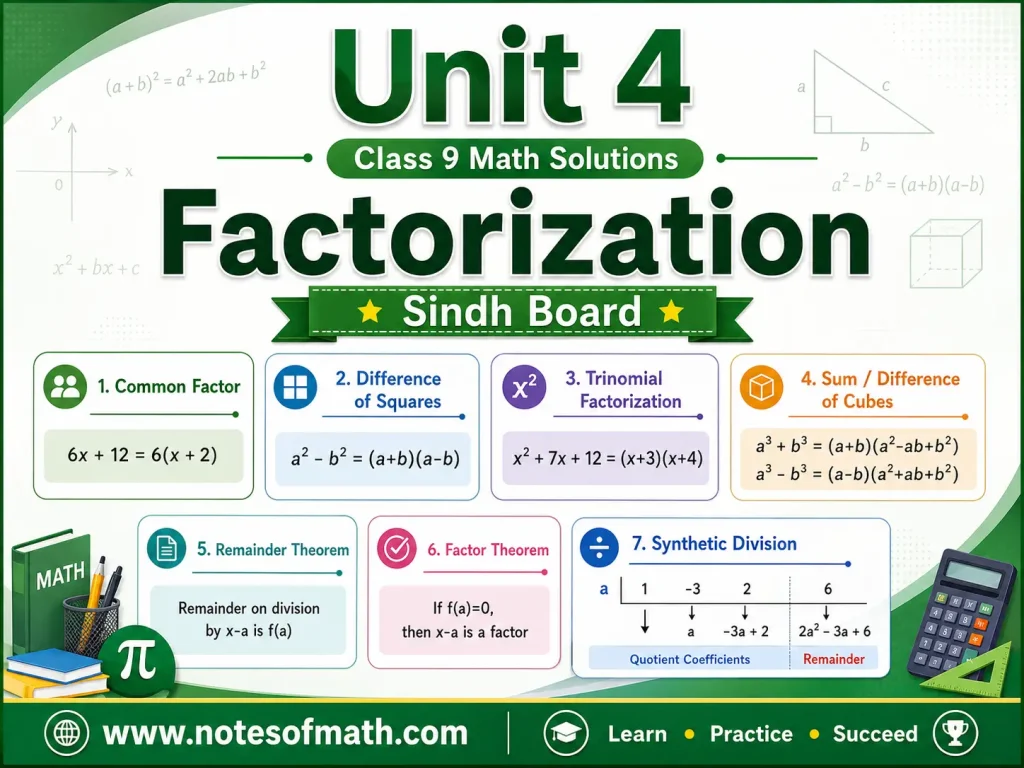
What Is Factorization?
Factorization is the process of writing an algebraic expression as a product of two or more simpler expressions called factors.
For example:
\[
6x+12
\]
can be factorized by taking \(6\) as the common factor:
\[
6x+12=6(x+2)
\]
Here, \(6\) and \(x+2\) are factors of the original expression.
Factorization is the reverse of expansion. During expansion, factors are multiplied:
\[
(x+2)(x+3)=x^2+5x+6
\]
During factorization, the expanded expression is changed back into factors:
\[
x^2+5x+6=(x+2)(x+3)
\]
Students must examine the expression carefully before selecting a factorization method.
Exercise 4.1 – Basic Methods of Factorization
Exercise 4.1 introduces the main methods used to factorize algebraic expressions.
Taking Out a Common Factor
The first step is to check whether all terms contain a common numerical or algebraic factor.
For example:
\[
8x^2y+12xy^2
\]
The common factor is \(4xy\). Therefore:
\[
8x^2y+12xy^2=4xy(2x+3y)
\]
Students should take out the highest common factor whenever possible.
Factorization by Grouping
Expressions containing four or more terms may be factorized by arranging them into suitable groups.
For example:
\[
ax+ay+bx+by
\]
Group the terms:
\[
(ax+ay)+(bx+by)
\]
Take the common factor from each group:
\[
a(x+y)+b(x+y)
\]
Now \(x+y\) is common:
\[
(a+b)(x+y)
\]
Difference of Two Squares
The identity is:
\[
a^2-b^2=(a+b)(a-b)
\]
For example:
\[
x^2-25=x^2-5^2
\]
Therefore:
\[
x^2-25=(x+5)(x-5)
\]
Students should always check whether the terms are perfect squares.
Exercise 4.2 – Factorization of Special Algebraic Expressions
Exercise 4.2 develops factorization using algebraic identities and recognizable patterns.
Perfect-Square Trinomials
The identity:
\[
a^2+2ab+b^2=(a+b)^2
\]
is used when the middle term is positive.
For example:
\[
x^2+6x+9
\]
Since:
\[
6x=2(x)(3)
\]
and:
\[
9=3^2
\]
we get:
\[
x^2+6x+9=(x+3)^2
\]
Similarly:
\[
a^2-2ab+b^2=(a-b)^2
\]
For example:
\[
x^2-10x+25=(x-5)^2
\]
Rearranging an Expression
Sometimes the terms must be rearranged before a familiar identity becomes visible.
For example:
\[
x^2+2xy+y^2-z^2
\]
The first three terms form a perfect square:
\[
(x+y)^2-z^2
\]
Now apply the difference-of-squares identity:
\[
(x+y+z)(x+y-z)
\]
Students should complete one factorization step before moving to the next.
Exercise 4.3 – Factorization of Trinomials
Exercise 4.3 focuses on factorizing quadratic trinomials.
A quadratic trinomial may have the form:
\[
x^2+bx+c
\]
Students find two numbers whose:
- Product is \(c\)
- Sum is \(b\)
For example:
\[
x^2+7x+12
\]
The required numbers are \(3\) and \(4\) because:
\[
3\times4=12
\]
and:
\[
3+4=7
\]
Therefore:
\[
x^2+7x+12=(x+3)(x+4)
\]
Splitting the Middle Term
For an expression of the form:
\[
ax^2+bx+c
\]
multiply \(a\) and \(c\), and find two numbers whose product is \(ac\) and whose sum is \(b\).
For example:
\[
2x^2+7x+3
\]
Here:
\[
a\times c=2\times3=6
\]
The required numbers are \(6\) and \(1\):
\[
2x^2+6x+x+3
\]
Group the terms:
\[
2x(x+3)+1(x+3)
\]
Therefore:
\[
2x^2+7x+3=(2x+1)(x+3)
\]
The sign of each factor must be checked by multiplying the factors again.
Exercise 4.4 – Advanced Factorization Patterns
Exercise 4.4 includes expressions that require more than one factorization technique.
Students may need to:
- Rearrange the terms
- Group suitable terms
- Complete a square
- Apply an algebraic identity
- Take out a common factor
- Factorize the resulting expression again
For example:
\[
x^4-5x^2+4
\]
Treat \(x^2\) as a single variable.
Let:
\[
y=x^2
\]
Then:
\[
y^2-5y+4
\]
Factorize:
\[
y^2-5y+4=(y-1)(y-4)
\]
Substitute \(y=x^2\):
\[
(x^2-1)(x^2-4)
\]
Apply the difference-of-squares identity:
\[
(x-1)(x+1)(x-2)(x+2)
\]
Students should continue factorization until no factor can be simplified further.
Exercise 4.5 – Factorization of Cubic Expressions
Exercise 4.5 covers algebraic expressions involving cubes.
Sum of Two Cubes
The identity is:
\[
a^3+b^3=(a+b)(a^2-ab+b^2)
\]
For example:
\[
x^3+8=x^3+2^3
\]
Therefore:
\[
x^3+8=(x+2)(x^2-2x+4)
\]
Difference of Two Cubes
The identity is:
\[
a^3-b^3=(a-b)(a^2+ab+b^2)
\]
For example:
\[
x^3-27=x^3-3^3
\]
Therefore:
\[
x^3-27=(x-3)(x^2+3x+9)
\]
Students should remember the sign pattern:
- The first factor uses the same sign as the original expression.
- The middle term of the second factor uses the opposite sign.
- The last term is always positive.
Cube of a Binomial
The identities:
\[
a^3+3a^2b+3ab^2+b^3=(a+b)^3
\]
and:
\[
a^3-3a^2b+3ab^2-b^3=(a-b)^3
\]
may also be used when the expression follows a complete cube pattern.
Exercise 4.6 – Remainder Theorem
Exercise 4.6 introduces the remainder theorem.
The remainder theorem states that when a polynomial \(f(x)\) is divided by \(x-a\), the remainder is:
\[
f(a)
\]
For example, suppose:
\[
f(x)=x^2+3x+2
\]
and the polynomial is divided by:
\[
x-1
\]
Here:
\[
a=1
\]
Therefore, the remainder is:
\[
f(1)
\]
Substitute \(x=1\):
\[
f(1)=1^2+3(1)+2
\]
\[
f(1)=1+3+2
\]
\[
f(1)=6
\]
Thus, the remainder is \(6\).
When the divisor is \(x+a\), write it as:
\[
x-(-a)
\]
Therefore, substitute \(-a\) into the polynomial.
Students should identify the correct value of \(a\) before performing substitution.
Exercise 4.7 – Synthetic Division
Exercise 4.7 uses synthetic division to divide a polynomial by a linear factor.
Synthetic division is a shorter method than ordinary polynomial division. It is normally used when the divisor has the form:
\[
x-a
\]
For example, divide:
\[
x^3-6x^2+11x-6
\]
by:
\[
x-1
\]
The coefficients are:
\[
1,\quad -6,\quad 11,\quad -6
\]
The value used in synthetic division is:
\[
a=1
\]
After completing the synthetic division, the quotient is:
\[
x^2-5x+6
\]
and the remainder is:
\[
0
\]
Therefore:
\[
x^3-6x^2+11x-6=(x-1)(x^2-5x+6)
\]
The quadratic factor can be factorized further:
\[
x^2-5x+6=(x-2)(x-3)
\]
Hence:
\[
x^3-6x^2+11x-6=(x-1)(x-2)(x-3)
\]
Students must include zero as a coefficient when a power of the variable is missing.
For example:
\[
x^3+2x-5
\]
must be written using coefficients:
\[
1,\quad 0,\quad 2,\quad -5
\]
Exercise 4.8 – Factor Theorem
Exercise 4.8 focuses on the factor theorem and factorization of polynomials.
The factor theorem states:
\[
x-a\text{ is a factor of }f(x)\iff f(a)=0
\]
This means that if substituting \(a\) into a polynomial gives zero, then \(x-a\) is a factor.
For example:
\[
f(x)=x^3-6x^2+11x-6
\]
Check whether \(x-1\) is a factor.
Substitute:
\[
x=1
\]
Then:
\[
f(1)=1-6+11-6
\]
\[
f(1)=0
\]
Therefore:
\[
x-1
\]
is a factor of the polynomial.
After identifying one factor, students may use synthetic division to find the remaining quadratic factor.
The polynomial can then be factorized completely:
\[
x^3-6x^2+11x-6=(x-1)(x-2)(x-3)
\]
The factor theorem is useful for finding unknown constants and checking possible factors of a polynomial.
Unit 4 Review Exercise
The Unit 4 Review Exercise combines concepts from all eight exercises.
It may contain questions related to:
- Common-factor method
- Factorization by grouping
- Difference of two squares
- Perfect-square trinomials
- Splitting the middle term
- Quadratic and higher-degree expressions
- Sum and difference of cubes
- Remainder theorem
- Synthetic division
- Factor theorem
- Complete factorization of cubic polynomials
- Multiple-choice and short questions
Students should attempt the review exercise after completing Exercises 4.1 to 4.8.
Important Formulas from Unit 4
The following formulas are useful for revision:
\[
a^2-b^2=(a+b)(a-b)
\]
\[
a^2+2ab+b^2=(a+b)^2
\]
\[
a^2-2ab+b^2=(a-b)^2
\]
\[
a^3+b^3=(a+b)(a^2-ab+b^2)
\]
\[
a^3-b^3=(a-b)(a^2+ab+b^2)
\]
\[
a^3+3a^2b+3ab^2+b^3=(a+b)^3
\]
\[
a^3-3a^2b+3ab^2-b^3=(a-b)^3
\]
The remainder theorem is:
\[
\text{Remainder}=f(a)
\]
when \(f(x)\) is divided by \(x-a\).
The factor theorem is:
\[
f(a)=0\iff x-a\text{ is a factor of }f(x)
\]
Common Mistakes to Avoid
Students should avoid the following mistakes:
- Ignoring a common factor
- Using the wrong algebraic identity
- Forgetting the middle term in a perfect square
- Choosing incorrect numbers while splitting the middle term
- Stopping before the expression is completely factorized
- Using the wrong signs in cube formulas
- Substituting the wrong value in the remainder theorem
- Forgetting that \(x+a=x-(-a)\)
- Omitting zero coefficients in synthetic division
- Confusing the quotient with the remainder
- Assuming that \(x-a\) is a factor without checking \(f(a)=0\)
- Failing to factorize the quotient after synthetic division
Students should multiply the final factors to verify the original expression whenever possible.
How to Prepare Unit 4 for Exams
Start by memorizing the main algebraic identities. Practise recognizing common factors, perfect squares, differences of squares and cubic patterns.
For quadratic trinomials, write the product and sum conditions before splitting the middle term.
For the remainder theorem, carefully identify the value to substitute. When the divisor is \(x-a\), use \(a\). When it is \(x+a\), use \(-a\).
During synthetic division, write all coefficients in descending order of powers. Insert a zero coefficient for every missing term.
For the factor theorem, test possible factors and then use synthetic division to complete the factorization.
After attempting each textbook question independently, use the Unit 4 Class 9 Math Solutions Sindh Board PDFs to check the method and final answer.
Why These Unit 4 Solutions Are Helpful
These exercise-wise solutions help students:
- Learn each factorization method step by step
- Select the correct identity
- Understand splitting of the middle term
- Apply the remainder theorem correctly
- Learn synthetic division
- Use the factor theorem to factorize polynomials
- Check homework answers
- Prepare for tests and board examinations
- View or download each exercise separately
The solutions should be used to understand the working rather than copy only the final answer.
Frequently Asked Questions
What is the name of Unit 4 in Class 9 Sindh Board Mathematics?
The name of Unit 4 is Factorization.
How many exercises are included in Unit 4?
Unit 4 contains eight exercises, from Exercise 4.1 to Exercise 4.8, followed by a Review Exercise.
What topics are covered in Unit 4?
The unit covers factorization methods, algebraic identities, quadratic and cubic expressions, the remainder theorem, synthetic division and the factor theorem.
Are all Unit 4 exercises solved on this page?
Yes. Separate PDFs are provided for Exercises 4.1 to 4.8 and the Unit 4 Review Exercise.
Can students download the solution PDFs?
Yes. Students can view or download each exercise-wise PDF on mobile phones, tablets and computers.
What is the difference between the remainder theorem and factor theorem?
The remainder theorem finds the remainder when a polynomial is divided by \(x-a\). The factor theorem checks whether \(x-a\) is a factor by determining whether \(f(a)=0\).
Why is synthetic division used?
Synthetic division provides a shorter method for dividing a polynomial by a linear expression of the form \(x-a\).
Related Class 9 Math Resources
- Class 9 Math Notes Sindh Board
- Unit 3 Class 9 Math Solutions Sindh Board
- Unit 5 Class 9 Math Solutions Sindh Board
Disclaimer
These solutions are prepared for educational support. Students should also consult their official Sindh Textbook Board Mathematics book and follow the instructions provided by their teachers.
Final Words
The Unit 4 Class 9 Math Solutions Sindh Board provide complete exercise-wise help with factorization, polynomial division, the remainder theorem and the factor theorem.
Students should first attempt each question themselves and then use the PDFs to check their working, identify mistakes and understand missing steps.
For solutions to all other units, visit the Class 9 Math Notes Sindh Board page.
