
Unit 10 Class 9 Math Solutions Sindh Board – Parallelograms and Triangles
Unit 10 Class 9 Math Solutions Sindh Board are available below for Exercises 10.1 to 10.5 and the Unit 10 Review Exercise. Students can view and download each PDF to study complete step-by-step solutions and geometrical proofs.
This unit covers the properties of parallelograms, tests used to prove that a quadrilateral is a parallelogram, the midpoint theorem, medians and the centroid of a triangle, and equal intercepts made by parallel lines. For solutions to all other units, visit our Class 9 Math Notes Sindh Board page.
Unit 10 Class 9 Math Exercise Solutions
Select an exercise below to view or download its complete PDF solutions.
Unit 10 Quick Overview
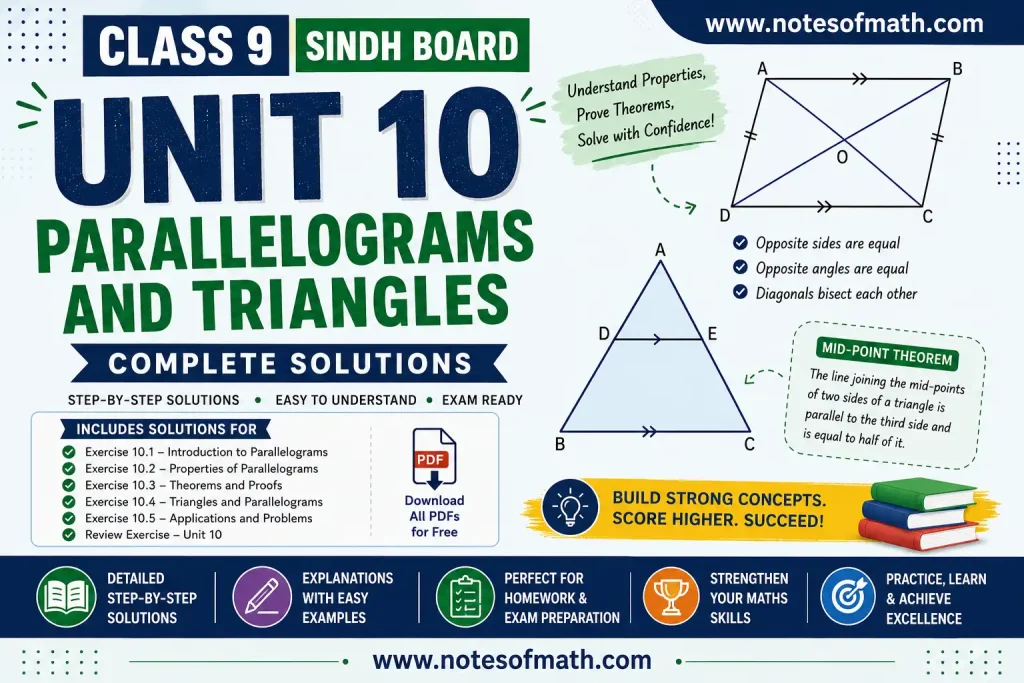
What Is a Parallelogram?
A parallelogram is a quadrilateral in which both pairs of opposite sides are parallel.
For a parallelogram \(ABCD\):\[ AB\parallel DC \]
and:\[ AD\parallel BC \]
The opposite sides are \(AB\) and \(DC\), while the other pair of opposite sides is \(AD\) and \(BC\).
Main Parts of a Parallelogram
- Four sides
- Four angles
- Two pairs of opposite parallel sides
- Two diagonals
The diagonals of parallelogram \(ABCD\) are:\[ AC \]
and:\[ BD \]
If the diagonals meet at \(O\), the properties of a parallelogram help us compare the lengths and angles formed inside the figure.
Examples of Parallelograms
A rectangle, square and rhombus are special types of parallelograms because both pairs of their opposite sides are parallel.
| Shape | Special Property |
|---|---|
| Parallelogram | Both pairs of opposite sides are parallel |
| Rectangle | A parallelogram with four right angles |
| Rhombus | A parallelogram with four equal sides |
| Square | A parallelogram with four equal sides and four right angles |
Exercise 10.1 – Properties of a Parallelogram
Exercise 10.1 is based on the main properties of a parallelogram. These properties are frequently used to find unknown sides and angles and to complete geometrical proofs.
Opposite Sides Are Congruent
In parallelogram \(ABCD\):\[ AB\cong DC \]
and:\[ AD\cong BC \]
This means that each side has the same length as its opposite side.
For example, if:\[ AB=8\text{ cm} \]
then:\[ DC=8\text{ cm} \]
If:\[ AD=5\text{ cm} \]
then:\[ BC=5\text{ cm} \]
Opposite Angles Are Congruent
In parallelogram \(ABCD\):\[ \angle A\cong\angle C \]
and:\[ \angle B\cong\angle D \]
Therefore, if:\[ m\angle A=70^\circ \]
then:\[ m\angle C=70^\circ \]
Adjacent Angles Are Supplementary
Two adjacent angles of a parallelogram have a sum of \(180^\circ\).\[ m\angle A+m\angle B=180^\circ \]
Similarly:\[ m\angle B+m\angle C=180^\circ \]
For example, if:\[ m\angle A=130^\circ \]
then:\[ m\angle B=180^\circ-130^\circ \] \[ m\angle B=50^\circ \]
Since opposite angles are equal:\[ m\angle C=130^\circ \]
and:\[ m\angle D=50^\circ \]
Diagonals Bisect Each Other
If diagonals \(AC\) and \(BD\) of parallelogram \(ABCD\) meet at \(O\), then:\[ AO\cong OC \]
and:\[ BO\cong OD \]
The word “bisect” means to divide into two equal parts.
For example, if:\[ AC=12\text{ cm} \]
then:\[ AO=OC=6\text{ cm} \]
A Diagonal Forms Two Congruent Triangles
A diagonal divides a parallelogram into two congruent triangles.
If diagonal \(BD\) is drawn in parallelogram \(ABCD\), then:\[ \triangle ABD\cong\triangle CDB \]
The congruence can be proved using the parallel sides and alternate interior angles, together with the common diagonal.
Finding Unknown Values
Suppose the opposite sides of a parallelogram are represented by:\[ AB=3x+2 \]
and:\[ DC=5x-6 \]
Since opposite sides are equal:\[ 3x+2=5x-6 \]
Add 6 to both sides:\[ 3x+8=5x \]
Subtract \(3x\) from both sides:\[ 8=2x \]
Therefore:\[ x=4 \]
Exercise 10.2 – Conditions for a Quadrilateral to Be a Parallelogram
Exercise 10.2 works in the reverse direction. Instead of starting with a known parallelogram, students use given information to prove that a quadrilateral is a parallelogram.
One Pair of Opposite Sides Equal and Parallel
If one pair of opposite sides of a quadrilateral is both congruent and parallel, then the quadrilateral is a parallelogram.
For quadrilateral \(ABCD\), if:\[ AB\cong DC \]
and:\[ AB\parallel DC \]
then \(ABCD\) is a parallelogram.
Both Pairs of Opposite Sides Are Congruent
If both pairs of opposite sides of a quadrilateral are congruent, then it is a parallelogram.\[ AB\cong DC \]
and:\[ AD\cong BC \]
Therefore, \(ABCD\) is a parallelogram.
Both Pairs of Opposite Angles Are Congruent
If both pairs of opposite angles of a quadrilateral are congruent, then the quadrilateral is a parallelogram.\[ \angle A\cong\angle C \]
and:\[ \angle B\cong\angle D \]
Therefore, \(ABCD\) is a parallelogram.
Diagonals Bisect Each Other
If the diagonals of a quadrilateral bisect each other, then the quadrilateral is a parallelogram.
If diagonals \(AC\) and \(BD\) meet at \(O\), and:\[ AO\cong OC \]
and:\[ BO\cong OD \]
then \(ABCD\) is a parallelogram.
Proof Pattern
To prove that a quadrilateral is a parallelogram:
- Write the given information.
- Select a suitable parallelogram test.
- Prove the required sides, angles or diagonal parts are equal or parallel.
- State the test clearly.
- Conclude that the quadrilateral is a parallelogram.
Example Using a Diagonal
Suppose in quadrilateral \(ABCD\):\[ AB\cong DC \]
and:\[ AB\parallel DC \]
Join \(B\) to \(D\). Since \(AB\parallel DC\), alternate interior angles are equal:\[ \angle ABD\cong\angle CDB \]
Also:\[ BD\cong BD \]
because \(BD\) is common.
Using the side-angle-side condition:\[ \triangle ABD\cong\triangle CDB \]
Corresponding angles are equal, so:\[ \angle ADB\cong\angle CBD \]
Therefore:\[ AD\parallel BC \]
Since both pairs of opposite sides are parallel, \(ABCD\) is a parallelogram.
Exercise 10.3 – Midpoint Theorem
Exercise 10.3 explains the relationship between the midpoints of two sides of a triangle and the third side.
Statement of the Midpoint Theorem
The line segment joining the midpoints of two sides of a triangle is parallel to the third side and is equal to one-half of its length.
In triangle \(ABC\), suppose \(L\) is the midpoint of \(AB\) and \(M\) is the midpoint of \(AC\).
Then:\[ AL\cong LB \]
and:\[ AM\cong MC \]
The midpoint theorem gives:\[ LM\parallel BC \]
and:\[ LM=\frac{1}{2}BC \]
Finding the Mid-Segment Length
If:\[ BC=14\text{ cm} \]
then:\[ LM=\frac{1}{2}(14) \] \[ LM=7\text{ cm} \]
If the mid-segment is known:\[ LM=6\text{ cm} \]
then:\[ BC=2(6) \] \[ BC=12\text{ cm} \]
Converse of the Midpoint Theorem
A line passing through the midpoint of one side of a triangle and parallel to another side bisects the third side.
In triangle \(ABC\), suppose \(D\) is the midpoint of \(AB\), and:\[ DE\parallel BC \]
where \(E\) lies on \(AC\). Then:\[ AE\cong EC \]
Therefore, \(E\) is the midpoint of \(AC\).
Joining Midpoints of a Quadrilateral
The midpoint theorem can also be applied to a quadrilateral by drawing one of its diagonals.
If \(P\), \(Q\), \(R\) and \(S\) are the midpoints of the four sides of quadrilateral \(ABCD\), then the segments joining these midpoints form a parallelogram.
After drawing diagonal \(AC\), the midpoint theorem gives:\[ PQ\parallel AC \]
and:\[ SR\parallel AC \]
Therefore:\[ PQ\parallel SR \]
The theorem also gives:\[ PQ=\frac{1}{2}AC \]
and:\[ SR=\frac{1}{2}AC \]
Hence:\[ PQ\cong SR \]
One pair of opposite sides is equal and parallel, so \(PQRS\) is a parallelogram.
Using the Midpoint Theorem in Proofs
When a question mentions midpoints, mark the equal parts immediately. Then identify the triangle in which the midpoint theorem can be applied.
The theorem may be used to prove:
- Two lines are parallel
- A segment is half another segment
- A point is a midpoint
- A quadrilateral is a parallelogram
- Two segments bisect each other
Exercise 10.4 – Medians and the Centroid of a Triangle
Exercise 10.4 covers the medians of a triangle and their common point of intersection.
What Is a Median?
A median is a line segment joining a vertex of a triangle to the midpoint of the opposite side.
In triangle \(ABC\), if \(D\) is the midpoint of \(BC\), then:\[ BD\cong DC \]
and \(AD\) is a median.
A triangle has three medians, one from each vertex.
Medians Are Concurrent
The three medians of a triangle meet at one point. Lines that meet at one common point are called concurrent lines.
The common point of the three medians is called the centroid.
The centroid is usually represented by:\[ G \]
Centroid Divides Each Median in the Ratio \(2:1\)
The centroid divides every median into two parts. The part from the vertex to the centroid is twice the part from the centroid to the midpoint of the opposite side.
If \(AD\) is a median and \(G\) is the centroid, then:\[ AG:GD=2:1 \]
Therefore:\[ AG=\frac{2}{3}AD \]
and:\[ GD=\frac{1}{3}AD \]
Example: Finding Parts of a Median
If:\[ AD=15\text{ cm} \]
then:\[ AG=\frac{2}{3}(15) \] \[ AG=10\text{ cm} \]
and:\[ GD=\frac{1}{3}(15) \] \[ GD=5\text{ cm} \]
Finding the Complete Median
If the distance from the vertex to the centroid is:\[ AG=8\text{ cm} \]
then \(AG\) represents two parts of the \(2:1\) ratio.
One part is:\[ \frac{8}{2}=4\text{ cm} \]
Therefore:\[ GD=4\text{ cm} \]
and:\[ AD=8+4=12\text{ cm} \]
Centroid of the Medial Triangle
The triangle formed by joining the midpoints of the sides of a triangle is called the medial triangle. The original triangle and its medial triangle have the same centroid.
This result connects the midpoint theorem with the concurrency of medians.
Common Errors in Centroid Questions
Students often reverse the \(2:1\) ratio. The longer part always lies between the vertex and the centroid.\[ \text{Vertex to centroid}:\text{centroid to midpoint}=2:1 \]
The centroid does not divide the median into three separate equal pieces. It divides the median into two lengths whose ratio is \(2:1\).
Exercise 10.5 – Equal Intercepts Made by Parallel Lines
Exercise 10.5 explains how a group of parallel lines divides different transversals into equal corresponding segments.
Main Theorem
If three or more parallel lines make congruent segments on one transversal, they also intercept congruent segments on any other transversal that cuts them.
Suppose:\[ AB\parallel CD\parallel EF \]
The parallel lines meet one transversal at \(M\), \(N\) and \(P\), and another transversal at \(R\), \(S\) and \(T\).
If:\[ MN\cong NP \]
then:\[ RS\cong ST \]
Dividing a Line Segment into Equal Parts
This theorem is useful for dividing a line segment into any required number of equal parts.
To divide a line segment \(AB\) into five equal parts:
- Draw an acute ray \(AX\) from \(A\).
- Mark five equal segments on the ray.
- Join the fifth point to \(B\).
- Through the first four marked points, draw lines parallel to the line joining the fifth point to \(B\).
- The parallel lines divide \(AB\) into five equal parts.
Application to a Triangle
If one side of a triangle is divided into equal segments and lines are drawn through the division points parallel to another side, the third side is divided into the same number of equal segments.
This is a direct application of the equal-intercepts theorem.
Application to a Trapezium
A line drawn through the midpoint of one non-parallel side of a trapezium and parallel to the parallel sides bisects the other non-parallel side.
This result is useful when proving midpoint relationships inside trapeziums and other figures containing parallel sides.
Difference Between the Midpoint Theorem and Equal-Intercept Theorem
| Midpoint Theorem | Equal-Intercept Theorem |
|---|---|
| Used mainly in one triangle | Used with three or more parallel lines |
| Joins midpoints of two triangle sides | Compares segments on different transversals |
| Gives parallelism and half-length | Transfers equal divisions from one transversal to another |
How to Write Theorem Proofs in Unit 10
A complete geometrical proof should be arranged clearly.
Given
Write the information provided in the question or theorem.
To Prove
State the exact result that must be established.
Construction
Write any additional diagonal, parallel line or segment added to help with the proof.
Proof
Write each mathematical statement with a valid reason.
Conclusion
End by stating that the required result has been proved.
Useful Reasons in Unit 10
- Opposite sides of a parallelogram are congruent
- Opposite angles of a parallelogram are congruent
- Diagonals of a parallelogram bisect each other
- Alternate interior angles between parallel lines are congruent
- Vertically opposite angles are congruent
- A common side is congruent to itself
- Corresponding parts of congruent triangles are congruent
- A midpoint divides a segment into two congruent parts
- The midpoint theorem
- The centroid divides a median in the ratio \(2:1\)
Important Results from Unit 10
Properties of a Parallelogram
\[ AB\cong DC \] \[ AD\cong BC \] \[ \angle A\cong\angle C \] \[ \angle B\cong\angle D \] \[ AO\cong OC \] \[ BO\cong OD \]
Midpoint Theorem
\[ LM\parallel BC \] \[ LM=\frac{1}{2}BC \]
Centroid Ratio
\[ AG:GD=2:1 \] \[ AG=\frac{2}{3}AD \] \[ GD=\frac{1}{3}AD \]
Equal Intercepts
If:\[ AB\parallel CD\parallel EF \]
and:\[ MN\cong NP \]
then:\[ RS\cong ST \]
Unit 10 Review Exercise
The Unit 10 Review Exercise combines definitions, theorems, calculations and geometrical proofs from Exercises 10.1 to 10.5.
- Definition of a parallelogram
- Opposite sides of a parallelogram
- Opposite and adjacent angles
- Diagonals bisecting each other
- Conditions for proving a quadrilateral is a parallelogram
- Midpoints of triangle sides
- Midpoint theorem and its converse
- Segments joining midpoints of a quadrilateral
- Medians of a triangle
- Concurrency of medians
- Centroid and the \(2:1\) ratio
- Parallel lines and equal intercepts
- Division of a line segment into equal parts
- Multiple-choice and short questions
Students should attempt the review exercise after completing all five exercises and revising the statements of the main theorems.
Common Mistakes to Avoid
- Confusing opposite sides with adjacent sides
- Assuming all four sides of every parallelogram are equal
- Assuming the diagonals of every parallelogram are equal
- Forgetting that adjacent angles are supplementary
- Using a parallelogram property before proving the figure is a parallelogram
- Writing that diagonals are perpendicular when only bisection is known
- Using the midpoint theorem without confirming two midpoints
- Writing the mid-segment as twice the third side
- Reversing the centroid ratio \(2:1\)
- Calling the midpoint of a side the centroid
- Applying the equal-intercepts theorem when the lines are not parallel
- Leaving reasons out of a geometrical proof
- Failing to mark equal segments and parallel lines on the diagram
How to Prepare Unit 10 for Exams
Begin by learning the definition and properties of a parallelogram. Practise finding missing angles and side lengths before moving to theorem proofs.
Memorize the tests used to prove that a quadrilateral is a parallelogram. In a proof, state the exact test you are applying.
For midpoint questions, mark the two equal parts of each bisected side. Remember that the segment joining two midpoints is parallel to the third side and half its length.
For median questions, learn the centroid ratio:\[ 2:1 \]
The longer part is always from the vertex to the centroid.
For parallel-line questions, identify the transversals and confirm that the parallel lines create equal segments on the first transversal before transferring that equality to another transversal.
Draw clean diagrams with matching arrow marks for parallel sides and matching strokes for equal segments.
After attempting each textbook question, use the Unit 10 Class 9 Math Solutions Sindh Board PDFs to compare your calculations, theorem statements and proof steps.
Why These Unit 10 Solutions Are Helpful
- Explain the properties of parallelograms clearly
- Show how to calculate unknown sides and angles
- Explain tests for proving a parallelogram
- Cover the midpoint theorem and its converse
- Explain medians and the centroid
- Show how to use the \(2:1\) centroid ratio
- Explain equal intercepts made by parallel lines
- Present geometrical proofs step by step
- Support homework, tests and board-exam preparation
- Allow each exercise PDF to be viewed or downloaded separately
Students should use the solutions to understand each theorem and reason rather than memorizing only the final answers.
Frequently Asked Questions
What is the name of Unit 10 in Class 9 Sindh Board Mathematics?
The name of Unit 10 is Parallelograms and Triangles.
How many exercises are included in Unit 10?
Unit 10 contains five exercises, from Exercise 10.1 to Exercise 10.5, followed by a Review Exercise.
What is covered in Exercise 10.1?
Exercise 10.1 covers opposite sides, opposite angles and diagonals of a parallelogram.
What is covered in Exercise 10.2?
Exercise 10.2 covers conditions used to prove that a quadrilateral is a parallelogram.
What is covered in Exercise 10.3?
Exercise 10.3 covers the midpoint theorem, its converse and applications involving midpoints.
What is covered in Exercise 10.4?
Exercise 10.4 covers medians of a triangle, their concurrency and the centroid ratio.
What is covered in Exercise 10.5?
Exercise 10.5 covers congruent intercepts made by parallel lines and the division of line segments into equal parts.
Do the diagonals of a parallelogram have equal lengths?
Not in every parallelogram. The general property is that the diagonals bisect each other. They are equal in special parallelograms such as rectangles and squares.
What is the ratio in which the centroid divides a median?
The centroid divides a median in the ratio:\[ 2:1 \]
The longer part lies between the vertex and the centroid.
Can students download all Unit 10 solution PDFs?
Yes. Separate viewable and downloadable PDFs are provided for Exercises 10.1, 10.2, 10.3, 10.4, 10.5 and the Unit 10 Review Exercise.
Related Class 9 Math Resources
- Class 9 Math Notes Sindh Board
- Unit 9 Class 9 Math Solutions Sindh Board
- Unit 11 Class 9 Math Solutions Sindh Board
Disclaimer
These solutions are prepared for educational support. Students should also consult their official Sindh Textbook Board Mathematics book and follow the instructions provided by their teachers.
Final Words
The Unit 10 Class 9 Math Solutions Sindh Board provide complete exercise-wise help with parallelogram properties, tests for parallelograms, the midpoint theorem, medians, centroid and equal intercepts formed by parallel lines.
Students should first attempt each question and theorem independently and then use the PDFs to check their working, reasons and final conclusions.
For solutions to all other units, visit the Class 9 Math Notes Sindh Board page.