
Unit 8 Class 9 Math Solutions Sindh Board – Quadratic Equations
Unit 8 Class 9 Math Solutions Sindh Board are available below for Exercises 8.1 to 8.4 and the Unit 8 Review Exercise. Students can view and download each PDF to study complete step-by-step solutions.
This unit explains quadratic equations, their standard form, factorization, completing the square, the quadratic formula, the discriminant and practical problems involving quadratic equations. For solutions to all other units, visit our Class 9 Math Notes Sindh Board page.
Unit 8 Class 9 Math Exercise Solutions
Select an exercise below to view or download its complete PDF solutions.
Unit 8 Quick Overview
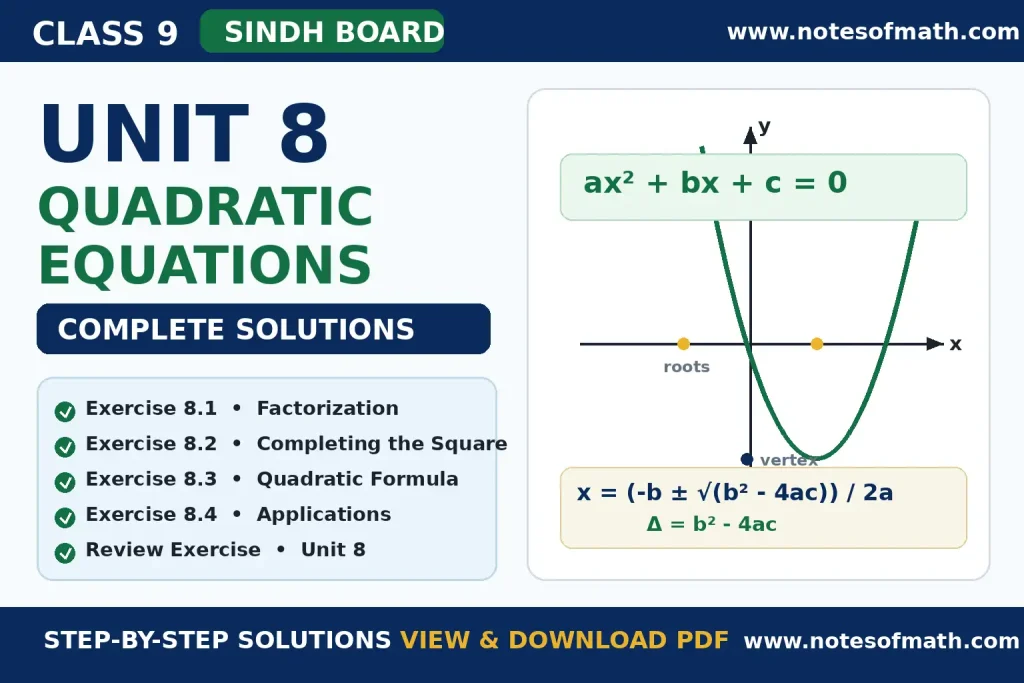
What Is a Quadratic Equation?
A quadratic equation is an equation in which the highest power of the variable is 2.
Its standard form is:\[ ax^{2}+bx+c=0 \]
where \(a\), \(b\) and \(c\) are constants and:\[ a\neq0 \]
The condition \(a\neq0\) is necessary because if \(a=0\), the equation becomes a linear equation.
For example:\[ 2x^{2}+5x-3=0 \]
is a quadratic equation because the highest power of \(x\) is 2.
Parts of a Quadratic Equation
In:\[ ax^{2}+bx+c=0 \]
- \(ax^{2}\) is the quadratic term.
- \(bx\) is the linear term.
- \(c\) is the constant term.
- \(a\), \(b\) and \(c\) are called coefficients.
For the equation:\[ 3x^{2}-7x+2=0 \]
the coefficients are:\[ a=3,\qquad b=-7,\qquad c=2 \]
Roots of a Quadratic Equation
The values of the variable that satisfy a quadratic equation are called its roots or solutions.
For example:\[ x^{2}-5x+6=0 \]
can be written as:\[ (x-2)(x-3)=0 \]
Therefore:\[ x=2\qquad\text{or}\qquad x=3 \]
So, 2 and 3 are the roots of the equation.
Exercise 8.1 – Solving Quadratic Equations by Factorization
Exercise 8.1 introduces quadratic equations and explains how to solve them by factorization.
Zero Product Property
If the product of two factors is zero, then at least one factor must be zero.\[ AB=0 \]
Therefore:\[ A=0\qquad\text{or}\qquad B=0 \]
This rule is used after expressing a quadratic equation as the product of two linear factors.
Solving a Simple Quadratic Equation
Consider:\[ x^{2}-5x+6=0 \]
Find two numbers whose product is 6 and whose sum is -5.\[ (-2)(-3)=6 \] \[ -2+(-3)=-5 \]
Therefore:\[ x^{2}-5x+6=(x-2)(x-3) \]
So:\[ (x-2)(x-3)=0 \]
Using the zero product property:\[ x-2=0 \]
or:\[ x-3=0 \]
Hence:\[ x=2\qquad\text{or}\qquad x=3 \]
Splitting the Middle Term
When the coefficient of \(x^{2}\) is not 1, the middle term may be split.
Consider:\[ 2x^{2}+7x+3=0 \]
Multiply the coefficient of \(x^{2}\) by the constant term:\[ 2\times3=6 \]
Find two numbers whose product is 6 and whose sum is 7:\[ 6+1=7 \]
Split the middle term:\[ 2x^{2}+6x+x+3=0 \]
Group the terms:\[ 2x(x+3)+1(x+3)=0 \]
Take the common factor:\[ (x+3)(2x+1)=0 \]
Therefore:\[ x+3=0 \]
or:\[ 2x+1=0 \]
Hence:\[ x=-3\qquad\text{or}\qquad x=-\frac{1}{2} \]
Equations Not Initially in Standard Form
Before factorization, move all terms to one side so that the other side becomes zero.
For example:\[ x^{2}+3x=10 \]
Move 10 to the left side:\[ x^{2}+3x-10=0 \]
Factorize:\[ (x+5)(x-2)=0 \]
Therefore:\[ x=-5\qquad\text{or}\qquad x=2 \]
Equations with a Common Factor
Consider:\[ 3x^{2}-12x=0 \]
Take \(3x\) as a common factor:\[ 3x(x-4)=0 \]
Therefore:\[ 3x=0 \]
or:\[ x-4=0 \]
Hence:\[ x=0\qquad\text{or}\qquad x=4 \]
Exercise 8.2 – Completing the Square
Exercise 8.2 explains how to solve quadratic equations by converting an expression into a perfect square.
Perfect Square Identity
The main identity used is:\[ x^{2}+2hx+h^{2}=(x+h)^{2} \]
Similarly:\[ x^{2}-2hx+h^{2}=(x-h)^{2} \]
How to Complete the Square
For an expression of the form:\[ x^{2}+bx \]
take half of the coefficient of \(x\), square it and add it to both sides of the equation.
The required number is:\[ \left(\frac{b}{2}\right)^{2} \]
Example of Completing the Square
Solve:\[ x^{2}+6x+5=0 \]
Move the constant term to the right side:\[ x^{2}+6x=-5 \]
Half of 6 is 3, and:\[ 3^{2}=9 \]
Add 9 to both sides:\[ x^{2}+6x+9=-5+9 \] \[ (x+3)^{2}=4 \]
Take square roots:\[ x+3=\pm2 \]
Therefore:\[ x=-3\pm2 \]
Hence:\[ x=-1\qquad\text{or}\qquad x=-5 \]
When the Coefficient of \(x^{2}\) Is Not 1
Consider:\[ 2x^{2}+8x-10=0 \]
Divide the complete equation by 2:\[ x^{2}+4x-5=0 \]
Move the constant term:\[ x^{2}+4x=5 \]
Half of 4 is 2, so add \(2^{2}=4\) to both sides:\[ x^{2}+4x+4=5+4 \] \[ (x+2)^{2}=9 \]
Take square roots:\[ x+2=\pm3 \]
Therefore:\[ x=1\qquad\text{or}\qquad x=-5 \]
Equations Giving Irrational Roots
Consider:\[ x^{2}+2x-1=0 \]
Move the constant:\[ x^{2}+2x=1 \]
Add 1 to both sides:\[ x^{2}+2x+1=2 \] \[ (x+1)^{2}=2 \]
Take square roots:\[ x+1=\pm\sqrt{2} \]
Hence:\[ x=-1\pm\sqrt{2} \]
Exercise 8.3 – Quadratic Formula and Discriminant
Exercise 8.3 uses the quadratic formula to solve equations that may be difficult to factorize.
Quadratic Formula
For:\[ ax^{2}+bx+c=0 \]
the roots are:\[ x=\frac{-b\pm\sqrt{b^{2}-4ac}}{2a} \]
Before using the formula, identify \(a\), \(b\) and \(c\) carefully, including their signs.
Example Using the Quadratic Formula
Solve:\[ 2x^{2}+3x-2=0 \]
Here:\[ a=2,\qquad b=3,\qquad c=-2 \]
Substitute into the formula:\[ x=\frac{-3\pm\sqrt{3^{2}-4(2)(-2)}}{2(2)} \] \[ x=\frac{-3\pm\sqrt{9+16}}{4} \] \[ x=\frac{-3\pm5}{4} \]
Therefore:\[ x=\frac{-3+5}{4}=\frac{1}{2} \]
or:\[ x=\frac{-3-5}{4}=-2 \]
The Discriminant
The expression inside the square root is called the discriminant.\[ \Delta=b^{2}-4ac \]
The discriminant tells us about the nature of the roots.
| Value of Discriminant | Nature of Roots |
|---|---|
| \(\Delta\gt0\) | Two distinct real roots |
| \(\Delta=0\) | Two equal real roots |
| \(\Delta\lt0\) | No real roots |
Two Distinct Real Roots
Consider:\[ x^{2}-5x+6=0 \]
Here:\[ a=1,\qquad b=-5,\qquad c=6 \]
The discriminant is:\[ \Delta=(-5)^{2}-4(1)(6) \] \[ \Delta=25-24=1 \]
Since:\[ \Delta\gt0 \]
the equation has two distinct real roots.
Equal Real Roots
Consider:\[ x^{2}-6x+9=0 \]
The discriminant is:\[ \Delta=(-6)^{2}-4(1)(9) \] \[ \Delta=36-36=0 \]
Therefore, the roots are equal.
No Real Roots
Consider:\[ x^{2}+2x+5=0 \]
The discriminant is:\[ \Delta=2^{2}-4(1)(5) \] \[ \Delta=4-20=-16 \]
Since:\[ \Delta\lt0 \]
the equation has no real roots.
Exercise 8.4 – Applications of Quadratic Equations
Exercise 8.4 applies quadratic equations to practical and geometrical problems.
Steps for Solving Word Problems
- Read the problem carefully.
- Represent the unknown quantity by a variable.
- Translate the given information into an equation.
- Arrange the equation in standard quadratic form.
- Solve the equation using a suitable method.
- Reject any answer that is not meaningful in the situation.
- Write the final answer with the correct unit.
Area Problems
Suppose the length of a rectangle is 3 metres more than its width and its area is 40 square metres.
Let the width be:\[ x\text{ m} \]
Then the length is:\[ (x+3)\text{ m} \]
Using:\[ \text{Area}=\text{length}\times\text{width} \]
we get:\[ x(x+3)=40 \] \[ x^{2}+3x-40=0 \]
Factorize:\[ (x+8)(x-5)=0 \]
Therefore:\[ x=-8\qquad\text{or}\qquad x=5 \]
A width cannot be negative, so:\[ x=5 \]
The width is 5 metres and the length is 8 metres.
Problems Involving Consecutive Integers
Suppose the product of two consecutive positive integers is 72.
Let the smaller integer be:\[ x \]
The next integer is:\[ x+1 \]
Therefore:\[ x(x+1)=72 \] \[ x^{2}+x-72=0 \]
Factorize:\[ (x+9)(x-8)=0 \]
Thus:\[ x=-9\qquad\text{or}\qquad x=8 \]
Since positive integers are required, the numbers are:\[ 8\qquad\text{and}\qquad9 \]
Problems Involving Speed and Time
In speed problems, use:\[ \text{Distance}=\text{Speed}\times\text{Time} \]
If a change in speed affects the travelling time, the resulting equation may be quadratic.
Students should write all quantities in compatible units before forming the equation.
Rejecting an Invalid Root
A quadratic equation often gives two algebraic roots, but both may not be acceptable in a practical problem.
Negative values are usually rejected when the variable represents:
- Length
- Width
- Area
- Time
- Speed
- Number of objects
The reason for rejecting a root should be stated clearly.
Unit 8 Review Exercise
The Unit 8 Review Exercise combines all the major concepts of the unit.
- Identifying quadratic equations
- Writing equations in standard form
- Finding coefficients \(a\), \(b\) and \(c\)
- Solving by factorization
- Splitting the middle term
- Using the zero product property
- Completing the square
- Using the quadratic formula
- Calculating the discriminant
- Determining the nature of roots
- Solving equations with irrational roots
- Solving practical word problems
- Rejecting invalid roots
- Multiple-choice and short questions
Students should attempt the review exercise after completing Exercises 8.1 to 8.4.
Important Formulas from Unit 8
Standard form:\[ ax^{2}+bx+c=0,\qquad a\neq0 \]
Quadratic formula:\[ x=\frac{-b\pm\sqrt{b^{2}-4ac}}{2a} \]
Discriminant:\[ \Delta=b^{2}-4ac \]
Perfect square identities:\[ x^{2}+2hx+h^{2}=(x+h)^{2} \] \[ x^{2}-2hx+h^{2}=(x-h)^{2} \]
Zero product property:\[ AB=0\quad\Rightarrow\quad A=0\text{ or }B=0 \]
Choosing the Correct Method
| Situation | Suitable Method |
|---|---|
| The quadratic expression factorizes easily | Factorization |
| The equation can be converted into a perfect square | Completing the square |
| Factorization is difficult or impossible | Quadratic formula |
| Only the nature of roots is required | Discriminant |
| The question describes a practical situation | Form an equation, then use a suitable method |
Common Mistakes to Avoid
- Failing to write the equation in standard form
- Using the quadratic formula when \(a=0\)
- Writing incorrect signs for \(a\), \(b\) or \(c\)
- Forgetting the negative sign before \(b\) in the formula
- Forgetting the \(\pm\) sign
- Dividing only part of the numerator by \(2a\)
- Calculating \(b^{2}-4ac\) incorrectly
- Taking the square root before simplifying the discriminant
- Writing only one root when two roots are required
- Failing to set each factor equal to zero
- Adding the completing-square term to only one side
- Accepting a negative length or time in a word problem
- Failing to check the final answer
How to Check the Roots
Substitute each root into the original equation.
For example, consider:\[ x^{2}-5x+6=0 \]
For \(x=2\):\[ 2^{2}-5(2)+6 \] \[ 4-10+6=0 \]
For \(x=3\):\[ 3^{2}-5(3)+6 \] \[ 9-15+6=0 \]
Both values satisfy the original equation.
How to Prepare Unit 8 for Exams
Begin by learning the standard form of a quadratic equation and identifying \(a\), \(b\) and \(c\) correctly.
Practise factorization first because it is usually the quickest method when the expression has simple factors.
For completing the square, remember to add the same number to both sides of the equation.
Memorize the quadratic formula exactly and practise substituting negative coefficients carefully.
Learn how the sign of the discriminant determines whether roots are distinct, equal or non-real.
In word problems, define the variable clearly, form the equation and reject any root that does not fit the practical situation.
After attempting each textbook question, use the Unit 8 Class 9 Math Solutions Sindh Board PDFs to compare your working and correct mistakes.
Why These Unit 8 Solutions Are Helpful
- Explain quadratic equations from the basic level
- Show factorization step by step
- Explain splitting the middle term
- Demonstrate completing the square
- Show correct use of the quadratic formula
- Explain the discriminant and nature of roots
- Cover practical word problems
- Help students check homework answers
- Support test and board-exam preparation
- Allow each exercise PDF to be viewed or downloaded separately
Students should use the solutions to understand each method instead of copying only the final roots.
Frequently Asked Questions
What is the name of Unit 8 in Class 9 Sindh Board Mathematics?
The name of Unit 8 is Quadratic Equations.
How many exercises are included in Unit 8?
Unit 8 contains four exercises, from Exercise 8.1 to Exercise 8.4, followed by a Review Exercise.
What is covered in Exercise 8.1?
Exercise 8.1 introduces quadratic equations and solving them by factorization.
What is covered in Exercise 8.2?
Exercise 8.2 focuses on solving quadratic equations by completing the square.
What is covered in Exercise 8.3?
Exercise 8.3 covers the quadratic formula, discriminant and nature of roots.
What is covered in Exercise 8.4?
Exercise 8.4 covers practical and geometrical problems that lead to quadratic equations.
What is the standard form of a quadratic equation?
The standard form is:\[ ax^{2}+bx+c=0,\qquad a\neq0 \]
What does the discriminant tell us?
The discriminant tells us whether the equation has two distinct real roots, equal real roots or no real roots.
Can students download all Unit 8 solution PDFs?
Yes. Separate viewable and downloadable PDFs are provided for Exercises 8.1, 8.2, 8.3, 8.4 and the Unit 8 Review Exercise.
Related Class 9 Math Resources
- Class 9 Math Notes Sindh Board
- Unit 7 Class 9 Math Solutions Sindh Board
- Unit 9 Class 9 Math Solutions Sindh Board
Disclaimer
These solutions are prepared for educational support. Students should also consult their official Sindh Textbook Board Mathematics book and follow the instructions provided by their teachers.
Final Words
The Unit 8 Class 9 Math Solutions Sindh Board provide complete exercise-wise help with factorization, completing the square, the quadratic formula, the discriminant and applications of quadratic equations.
Students should first attempt each question independently and then use the PDFs to check their method, calculations and final answers.
For solutions to all other units, visit the Class 9 Math Notes Sindh Board page.