
Unit 6 Class 9 Math Solutions Sindh Board – Linear Equation and Inequalities
Unit 6 Class 9 Math Solutions Sindh Board are available below for Exercises 6.1 to 6.3 and the Unit 6 Review Exercise. Students can view and download each PDF to study complete step-by-step solutions.
This unit covers linear equations in one variable, equations involving absolute values, linear inequalities and the representation of solution sets on number lines. For solutions to other units, visit our Class 9 Math Notes Sindh Board page.
Unit 6 Class 9 Math Exercise Solutions
Select an exercise below to view or download its complete PDF solutions.
[Insert Exercise 6.1 PDF accordion here]
Exercise 6.2 Solutions
[Insert Exercise 6.2 PDF accordion here]
Exercise 6.3 Solutions
[Insert Exercise 6.3 PDF accordion here]
Unit 6 Review Exercise Solutions
[Insert Unit 6 Review Exercise PDF accordion here]
Unit 6 Quick Overview
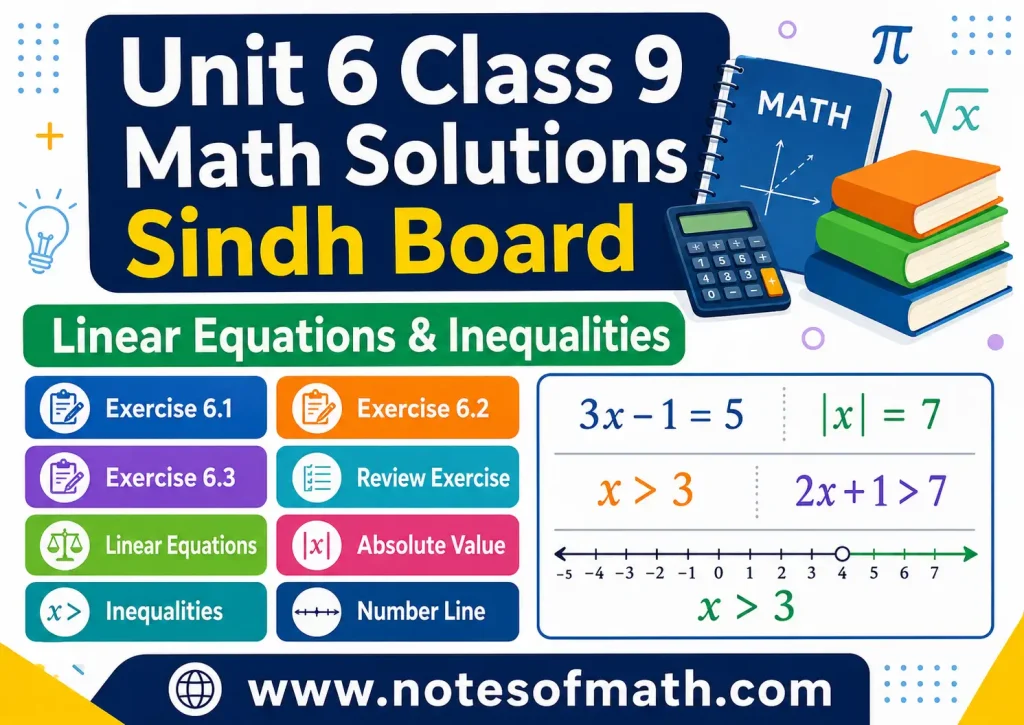
What Are Linear Equations and Inequalities?
A linear equation is an equation in which the highest power of the variable is one. Its solution is the value of the variable that makes both sides of the equation equal.
For example:\[ 3x-1=5 \]
Add 1 to both sides:\[ 3x=6 \]
Divide both sides by 3:\[ x=2 \]
An inequality compares two quantities using symbols such as:\[ <,\quad >,\quad \leq,\quad \geq \]
For example:\[ 2x+1>7 \]
Subtract 1 from both sides:\[ 2x>6 \]
Divide both sides by 2:\[ x>3 \]
The solution of an equation is usually a particular value or set of values. The solution of an inequality often contains many values and can be represented on a number line.
Exercise 6.1 – Linear Equations in One Variable
Exercise 6.1 focuses on solving linear equations containing one variable. Students simplify both sides of an equation and use inverse operations to isolate the variable.
Basic Linear Equations
A basic linear equation may have the form:\[ ax+b=c \]
where the coefficient of the variable is not zero.
For example:\[ 5x+7=22 \]
Subtract 7 from both sides:\[ 5x=15 \]
Divide both sides by 5:\[ x=3 \]
The same operation must always be performed on both sides of the equation so that equality is maintained.
Equations with Variables on Both Sides
Some equations contain the variable on both sides.
For example:\[ 6x+4=3x+19 \]
Subtract 3x from both sides:\[ 3x+4=19 \]
Subtract 4 from both sides:\[ 3x=15 \]
Divide both sides by 3:\[ x=5 \]
Students should collect all variable terms on one side and all constant terms on the other side.
Equations Containing Brackets
When an equation contains brackets, use the distributive law before collecting like terms.
For example:\[ 3(x+2)=18 \]
Open the brackets:\[ 3x+6=18 \]
Subtract 6 from both sides:\[ 3x=12 \]
Therefore:\[ x=4 \]
For equations with brackets on both sides, simplify each side separately before moving terms.
Equations Containing Fractions
Fractions can be removed by multiplying every term by the least common multiple of the denominators.
For example:\[ \frac{x}{3}+\frac{x}{2}=10 \]
The LCM of 3 and 2 is 6. Multiply every term by 6:\[ 6\left(\frac{x}{3}\right)+6\left(\frac{x}{2}\right)=6(10) \]
Simplify:\[ 2x+3x=60 \] \[ 5x=60 \]
Therefore:\[ x=12 \]
Students should multiply every term on both sides by the LCM. Missing even one term changes the equation.
Equations Involving Decimals
Decimal equations can be solved directly or converted into whole-number equations by multiplying by a suitable power of 10.
For example:\[ 0.4x+1.2=3.6 \]
Multiply the complete equation by 10:\[ 4x+12=36 \]
Subtract 12 from both sides:\[ 4x=24 \]
Therefore:\[ x=6 \]
Checking the Solution of an Equation
A solution can be checked by substituting it into the original equation.
Consider:\[ 4x-3=13 \]
The calculated solution is:\[ x=4 \]
Substitute 4 into the left-hand side:\[ 4(4)-3=16-3=13 \]
The left-hand side is equal to the right-hand side, so the solution is correct.
Word Problems Based on Linear Equations
Many practical questions can be translated into linear equations.
The general method is:
- Choose a variable for the unknown quantity.
- Translate the given information into an equation.
- Solve the equation.
- Check whether the answer satisfies the conditions of the problem.
For example, suppose a number increased by 9 is equal to 25. Let the number be x.\[ x+9=25 \]
Subtract 9 from both sides:\[ x=16 \]
Exercise 6.2 – Equations Involving Absolute Values
Exercise 6.2 covers equations involving the absolute value or modulus of an expression in one variable.
The absolute value of a number represents its distance from zero on the number line. Distance is always non-negative.
For example:\[ |5|=5 \]
and:\[ |-5|=5 \]
Definition of Absolute Value
The absolute value of x is defined as:\[ |x|= \begin{cases} x, & x\geq0\\ -x, & x<0 \end{cases} \]
For a positive number k:\[ |x|=k \]
gives two possible equations:\[ x=k \]
or:\[ x=-k \]
Solving a Simple Absolute Value Equation
Consider:\[ |x|=7 \]
The expression inside the absolute value can be positive or negative:\[ x=7 \]
or:\[ x=-7 \]
Therefore, the solution set is:\[ \{-7,7\} \]
Absolute Value Equation with an Expression
Consider:\[ |5x-3|=5 \]
Form the first equation:\[ 5x-3=5 \]
Add 3 to both sides:\[ 5x=8 \]
Therefore:\[ x=\frac{8}{5} \]
Now form the second equation:\[ 5x-3=-5 \]
Add 3 to both sides:\[ 5x=-2 \]
Therefore:\[ x=-\frac{2}{5} \]
The solution set is:\[ \left\{\frac{8}{5},-\frac{2}{5}\right\} \]
Isolating the Absolute Value First
The absolute value expression should be isolated before forming the two equations.
For example:\[ |2x+1|-4=3 \]
Add 4 to both sides:\[ |2x+1|=7 \]
Now form two equations:\[ 2x+1=7 \]
or:\[ 2x+1=-7 \]
Solving the first equation gives:\[ x=3 \]
Solving the second equation gives:\[ x=-4 \]
Therefore, the solution set is:\[ \{-4,3\} \]
Absolute Value Equal to Zero
If the absolute value of an expression is zero, the expression itself must be zero.\[ |3x-12|=0 \]
Therefore:\[ 3x-12=0 \] \[ 3x=12 \] \[ x=4 \]
There is only one solution in this case.
Absolute Value Equal to a Negative Number
An absolute value cannot be negative.
For example:\[ |x+2|=-5 \]
This equation has no solution because the left-hand side cannot be less than zero.
The solution set is:\[ \varnothing \]
Checking Absolute Value Solutions
Both calculated values should be substituted into the original equation because one of the values may fail when additional conditions are present.
Students should never remove the modulus sign and write only one equation when the right-hand side is positive.
Exercise 6.3 – Linear Inequalities
Exercise 6.3 focuses on solving linear inequalities and representing their solution sets on number lines.
The main inequality symbols are:\[ <,\quad >,\quad \leq,\quad \geq \]
The symbol less than means the first quantity is smaller. The symbol greater than means the first quantity is larger. The symbols less than or equal to and greater than or equal to include equality.
Solving a Basic Linear Inequality
Consider:\[ 2x+5>11 \]
Subtract 5 from both sides:\[ 2x>6 \]
Divide both sides by 2:\[ x>3 \]
The solution contains all values greater than 3.
Inequalities with Variables on Both Sides
Consider:\[ 7x-6>3x+10 \]
Subtract 3x from both sides:\[ 4x-6>10 \]
Add 6 to both sides:\[ 4x>16 \]
Divide both sides by 4:\[ x>4 \]
Reversing the Inequality Symbol
When both sides of an inequality are multiplied or divided by a negative number, the direction of the inequality sign must be reversed.
For example:\[ -3x>12 \]
Divide both sides by -3 and reverse the sign:\[ x<-4 \]
This is one of the most important rules in the unit.
Inequalities Containing Fractions
Fractions can be removed by multiplying every term by the LCM of the denominators.
For example:\[ \frac{x}{2}-\frac{1}{3}\leq\frac{5}{6} \]
The LCM of 2, 3 and 6 is 6. Multiply every term by 6:\[ 3x-2\leq5 \]
Add 2 to both sides:\[ 3x\leq7 \]
Divide by 3:\[ x\leq\frac{7}{3} \]
Representing Inequalities on a Number Line
A number line provides a visual representation of the solution set.
- Use an open circle for a strict inequality such as less than or greater than.
- Use a filled circle for an inclusive inequality such as less than or equal to or greater than or equal to.
- Shade or draw the arrow toward the values included in the solution.
For:\[ x>2 \]
place an open circle at 2 and draw the arrow toward the right.
For:\[ x\leq2 \]
place a filled circle at 2 and draw the arrow toward the left.
Solution Sets in Natural Numbers, Integers and Real Numbers
The form of the solution set depends on the given universal set.
If:\[ x>3,\qquad x\in\mathbb{N} \]
then the solution set is:\[ \{4,5,6,7,\ldots\} \]
If:\[ x\leq3,\qquad x\in\mathbb{Z} \]
then the solution set is:\[ \{\ldots,-2,-1,0,1,2,3\} \]
If x belongs to the real numbers, the solution contains every real value satisfying the inequality and is usually shown on a continuous number line.
Double Inequalities
A double inequality places the variable between two limits.
\[2\lt x\leq 6\]
For example: This means x is greater than 2 and less than or equal to 6 .
If x is an integer, the solution set is:\[ \{3,4,5,6\} \]
On the number line, use an open circle at 2 and a filled circle at 6.
Word Problems Involving Inequalities
Inequalities are used when a condition provides a minimum, maximum or range rather than one exact value.
Common phrases include:
- At least means greater than or equal to.
- At most means less than or equal to.
- More than means greater than.
- Less than means smaller than.
- Not more than means less than or equal to.
- Not less than means greater than or equal to.
For example, if a student needs at least 40 marks to pass, the condition can be written as:\[ x\geq40 \]
Unit 6 Review Exercise
The Unit 6 Review Exercise combines the important concepts from Exercises 6.1 to 6.3.
- Solving basic linear equations
- Equations with variables on both sides
- Equations containing brackets
- Equations containing fractions and decimals
- Word problems based on linear equations
- Absolute value equations
- Equations with two absolute value solutions
- Equations with no solution
- Solving linear inequalities
- Reversing the inequality sign
- Representing solution sets on number lines
- Writing solution sets in natural numbers, integers and real numbers
- Multiple-choice and short questions
Students should attempt the review exercise after completing all three exercises.
Important Rules and Forms from Unit 6
The general form of a linear equation in one variable is:\[ ax+b=0,\qquad a\neq0 \]
Its solution is:\[ x=-\frac{b}{a} \]
For an absolute value equation:\[ |x|=k,\qquad k>0 \]
the solutions are:\[ x=k \]
or:\[ x=-k \]
If:\[ |x|=0 \]
then:\[ x=0 \]
If:\[ |x|=k,\qquad k<0 \]
there is no solution.
For inequalities:\[ a\lt b \]
multiplying or dividing both sides by a negative number reverses the sign:\[ -ac\gt -bc,\qquad c\gt 0 \]
Common Mistakes to Avoid
- Performing an operation on only one side of an equation
- Moving a term without changing its sign correctly
- Opening brackets incorrectly
- Failing to multiply every term when removing fractions
- Combining unlike terms
- Writing only one solution for a positive absolute value equation
- Giving solutions for an absolute value equal to a negative number
- Forgetting to reverse the inequality sign after division by a negative number
- Using an open circle when equality is included
- Using a filled circle when equality is not included
- Ignoring the universal set while writing a solution set
- Failing to check solutions in the original equation
How to Prepare Unit 6 for Exams
Begin with simple linear equations and practise keeping both sides balanced. Then move to equations containing brackets, fractions and variables on both sides.
For absolute value equations, remember to isolate the modulus first. When the right-hand side is positive, form two equations. When it is zero, form one equation. When it is negative, there is no solution.
For inequalities, use the same basic operations as equations but remember the special rule for multiplication or division by a negative number.
Practise number-line representations because the type of circle and the direction of the arrow are frequently tested.
After attempting each textbook question, use the Unit 6 Class 9 Math Solutions Sindh Board PDFs to compare your steps and correct mistakes.
Why These Unit 6 Solutions Are Helpful
- Explain linear equations step by step
- Show how to remove brackets and fractions
- Explain absolute value equations clearly
- Cover all important inequality rules
- Show solution sets on number lines
- Help students check homework answers
- Support test and board-exam preparation
- Allow each exercise PDF to be viewed or downloaded separately
Students should use the solutions to understand each method instead of copying only the final answer.
Frequently Asked Questions
What is the name of Unit 6 in Class 9 Sindh Board Mathematics?
The name of Unit 6 is Linear Equation and Inequalities.
How many exercises are included in Unit 6?
Unit 6 contains three exercises, from Exercise 6.1 to Exercise 6.3, followed by a Review Exercise.
What is covered in Exercise 6.1?
Exercise 6.1 covers linear equations in one variable, including equations with brackets, fractions and variables on both sides.
What is covered in Exercise 6.2?
Exercise 6.2 covers equations involving absolute values or modulus in one variable.
What is covered in Exercise 6.3?
Exercise 6.3 covers linear inequalities, solution sets and their representation on number lines.
When is the inequality sign reversed?
The inequality sign is reversed when both sides are multiplied or divided by a negative number.
Can students download all Unit 6 solution PDFs?
Yes. Separate viewable and downloadable PDFs are provided for Exercises 6.1, 6.2, 6.3 and the Unit 6 Review Exercise.
Related Class 9 Math Resources
- Class 9 Math Notes Sindh Board
- Unit 5 Class 9 Math Solutions Sindh Board
- Unit 7 Class 9 Math Solutions Sindh Board
Disclaimer
These solutions are prepared for educational support. Students should also consult their official Sindh Textbook Board Mathematics book and follow the instructions provided by their teachers.
Final Words
The Unit 6 Class 9 Math Solutions Sindh Board provide complete exercise-wise help with linear equations, absolute value equations, inequalities and number-line representations.
Students should first attempt each question independently and then use the PDFs to check their working, understand missing steps and correct errors.
For solutions to all other units, visit the Class 9 Math Notes Sindh Board page.