
Unit 9 Class 9 Math Solutions Sindh Board – Congruent Triangles
Unit 9 Class 9 Math Solutions Sindh Board are available below for Exercises 9.1 to 9.4 and the Unit 9 Review Exercise. Students can view and download each exercise PDF to study complete step-by-step solutions.
This unit explains congruent triangles, corresponding parts, geometrical proofs, isosceles triangles and the main conditions used to prove that two triangles are congruent. For solutions to all other units, visit our Class 9 Math Notes Sindh Board page.
Unit 9 Class 9 Math Exercise Solutions
Select an exercise below to view or download its complete PDF solutions.
Unit 9 Quick Overview
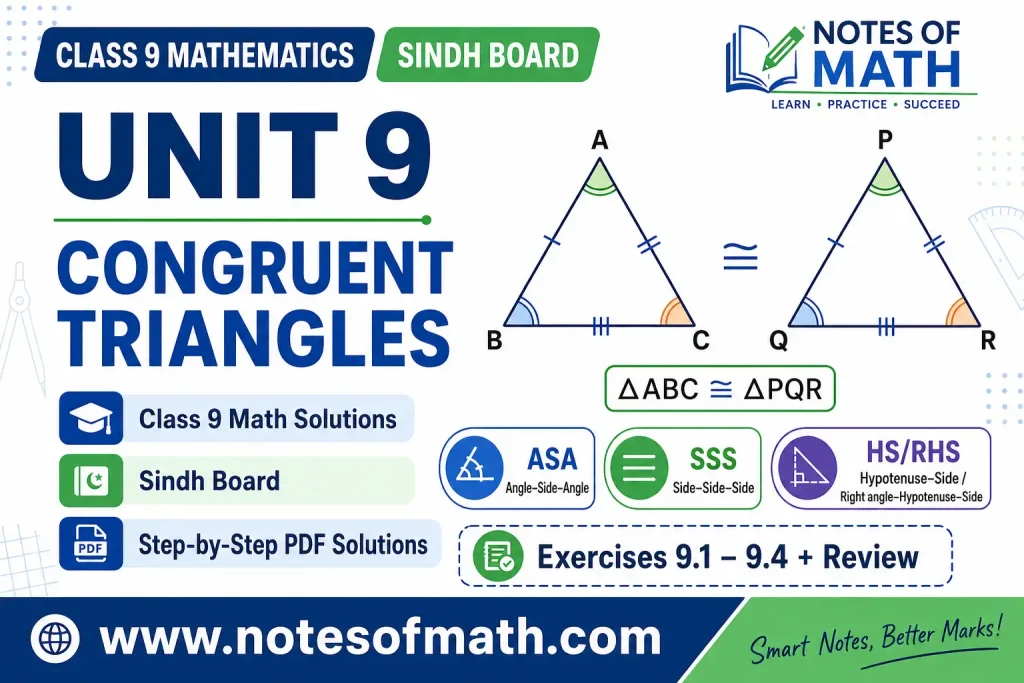
What Are Congruent Triangles?
Two triangles are congruent when they have exactly the same size and shape. One triangle may be turned, reflected or moved, but it will completely cover the other triangle when their corresponding vertices are placed together.
If triangle \(ABC\) is congruent to triangle \(PQR\), we write:\[ \triangle ABC\cong\triangle PQR \]
The order of the letters shows the correspondence between the vertices:\[ A\leftrightarrow P,\qquad B\leftrightarrow Q,\qquad C\leftrightarrow R \]
Therefore, the corresponding angles are:\[ \angle A\cong\angle P \] \[ \angle B\cong\angle Q \] \[ \angle C\cong\angle R \]
The corresponding sides are:\[ AB\cong PQ \] \[ BC\cong QR \] \[ CA\cong RP \]
The order of correspondence must be maintained throughout a proof. Writing the names of the triangles in the wrong order can produce incorrect statements about corresponding sides and angles.
Congruent Figures and Similar Figures
Congruent figures have the same shape and the same size. Similar figures have the same shape, but their sizes may be different.
| Congruent Figures | Similar Figures |
|---|---|
| Same shape | Same shape |
| Same size | Size may be different |
| Corresponding sides are equal | Corresponding sides are proportional |
| Corresponding angles are equal | Corresponding angles are equal |
Six Elements of a Triangle
A triangle has six basic elements:
- Three sides
- Three angles
To prove that two triangles are congruent, it is not always necessary to prove that all six corresponding elements are equal separately. Certain combinations of sides and angles are sufficient to establish congruence.
Corresponding Parts of Congruent Triangles
After two triangles have been proved congruent, their remaining corresponding parts are also congruent. This fact is commonly described as:
Corresponding parts of congruent triangles are congruent.
Suppose:\[ \triangle ABC\cong\triangle DEF \]
Then the order gives:\[ A\leftrightarrow D,\qquad B\leftrightarrow E,\qquad C\leftrightarrow F \]
Therefore:\[ AB\cong DE,\qquad BC\cong EF,\qquad AC\cong DF \]
and:\[ \angle A\cong\angle D,\qquad \angle B\cong\angle E,\qquad \angle C\cong\angle F \]
This principle is normally used after a congruence condition has been established. Students should first state why the triangles are congruent and then use corresponding parts to prove the required side or angle equality.
Exercise 9.1 – ASA Congruence
Exercise 9.1 introduces the correspondence of triangles and the angle-side-angle condition for congruence.
ASA Congruence Condition
If two angles and the included side of one triangle are respectively congruent to two angles and the included side of another triangle, then the two triangles are congruent.
Suppose, in the correspondence:\[ \triangle ABC\leftrightarrow\triangle PQR \]
we have:\[ \angle A\cong\angle P \] \[ AB\cong PQ \] \[ \angle B\cong\angle Q \]
Then:\[ \triangle ABC\cong\triangle PQR \]
The side \(AB\) is the included side because it lies between \(\angle A\) and \(\angle B\). Similarly, \(PQ\) lies between \(\angle P\) and \(\angle Q\).
Why the Order Matters in ASA
When applying ASA, corresponding parts must be written in the same order. If:\[ \angle A\cong\angle D \] \[ AB\cong DE \] \[ \angle B\cong\angle E \]
then the correct conclusion is:\[ \triangle ABC\cong\triangle DEF \]
Writing:\[ \triangle ABC\cong\triangle DFE \]
would be incorrect because it would match \(B\) with \(F\), although the given information matches \(B\) with \(E\).
Basic Proof Pattern Using ASA
A geometry proof can be written in the following order:
- Name the two triangles.
- State the first pair of equal angles.
- State the included pair of equal sides.
- State the second pair of equal angles.
- Conclude that the triangles are congruent by ASA.
- Use corresponding parts if another side or angle must be proved equal.
For example, suppose:\[ \angle BAC\cong\angle EDF \] \[ AC\cong DF \] \[ \angle ACB\cong\angle DFE \]
Then:\[ \triangle ACB\cong\triangle DFE \]
by ASA.
Common Side in Congruence Proofs
Sometimes two triangles share one side. A line segment is always congruent to itself.
For example:\[ AD\cong AD \]
This is called the common-side or reflexive property. It often provides the side needed to apply a congruence condition.
Vertical and Supplementary Angles
Some questions require students to establish an angle equality before applying ASA.
Vertically opposite angles are congruent. Therefore, if two lines intersect at \(O\):\[ \angle AOB\cong\angle COD \]
Angles forming a linear pair have a sum of \(180^\circ\). If two angles are supplementary to equal angles, the remaining angles may also be shown equal.
Exercise 9.2 – Equal Angles and Opposite Sides
Exercise 9.2 focuses on an important property of triangles: equal angles have equal opposite sides.
Theorem: Equal Angles Have Equal Opposite Sides
If two angles of a triangle are congruent, then the sides opposite those angles are also congruent.
In triangle \(ABC\), if:\[ \angle B\cong\angle C \]
then:\[ AC\cong AB \]
The side opposite \(\angle B\) is \(AC\), and the side opposite \(\angle C\) is \(AB\).
Connection with an Isosceles Triangle
A triangle having two congruent sides is called an isosceles triangle. The theorem above also helps identify an isosceles triangle from its angles.
If:\[ \angle B\cong\angle C \]
then:\[ AB\cong AC \]
Therefore, triangle \(ABC\) is isosceles.
Understanding Opposite Sides
Students sometimes select an adjacent side instead of the opposite side. The opposite side does not touch the vertex of the angle.
| Angle | Opposite Side |
|---|---|
| \(\angle A\) | \(BC\) |
| \(\angle B\) | \(AC\) |
| \(\angle C\) | \(AB\) |
Using an Angle Bisector
An angle bisector divides an angle into two congruent angles.
If \(AD\) bisects \(\angle A\), then:\[ \angle BAD\cong\angle DAC \]
If \(AD\) also has another suitable property, the two smaller triangles may be proved congruent. This can then be used to prove that two sides of the original triangle are equal.
Using a Perpendicular Bisector or Altitude
If a line is perpendicular to another line, it creates right angles. All right angles are congruent.
If:\[ AD\perp BC \]
then:\[ \angle ADB=\angle ADC=90^\circ \]
These equal right angles may be used together with another angle and a side to prove two triangles congruent.
Converse-Type Reasoning
Students should distinguish between the following two results:
- If two sides of a triangle are equal, the angles opposite them are equal.
- If two angles of a triangle are equal, the sides opposite them are equal.
The first starts with equal sides and concludes equal angles. The second starts with equal angles and concludes equal sides.
Exercise 9.3 – SSS Congruence
Exercise 9.3 covers the side-side-side condition and its use in geometrical proofs.
SSS Congruence Condition
If the three sides of one triangle are respectively congruent to the three corresponding sides of another triangle, then the triangles are congruent.
Suppose:\[ AB\cong DE \] \[ BC\cong EF \] \[ CA\cong FD \]
Then:\[ \triangle ABC\cong\triangle DEF \]
by SSS.
Finding the Correct Correspondence
When three side equalities are given, identify which vertices join corresponding sides.
Suppose:\[ AB\cong PQ \] \[ BC\cong QR \] \[ CA\cong RP \]
The vertex \(B\) is common to sides \(AB\) and \(BC\). The corresponding vertex common to \(PQ\) and \(QR\) is \(Q\). Therefore:\[ B\leftrightarrow Q \]
Similarly:\[ A\leftrightarrow P,\qquad C\leftrightarrow R \]
Hence:\[ \triangle ABC\cong\triangle PQR \]
Diagonal Dividing a Figure into Congruent Triangles
A diagonal often divides a quadrilateral into two triangles. If the opposite sides are equal and the diagonal is common, SSS may be applied.
For example, in quadrilateral \(ABCD\), suppose:\[ AB\cong CD \] \[ BC\cong AD \]
and \(AC\) is common to triangles \(ABC\) and \(CDA\):\[ AC\cong CA \]
Then:\[ \triangle ABC\cong\triangle CDA \]
by SSS.
Isosceles Triangle and Median to the Base
Suppose triangle \(ABC\) is isosceles with:\[ AB\cong AC \]
and \(D\) is the midpoint of \(BC\). Then:\[ BD\cong DC \]
Also:\[ AD\cong AD \]
Therefore:\[ \triangle ABD\cong\triangle ACD \]
by SSS.
After proving congruence, corresponding parts can be used to show that \(AD\) bisects the vertex angle or is perpendicular to the base, depending on the required result.
Midpoint Information
If \(M\) is the midpoint of \(AB\), then:\[ AM\cong MB \]
Students should always convert the word “midpoint” into a side equality before beginning the proof.
Exercise 9.4 – Congruent Right Triangles
Exercise 9.4 focuses on the special congruence condition for right-angled triangles.
Hypotenuse-Side Congruence
If the hypotenuse and one corresponding side of one right triangle are congruent to the hypotenuse and the corresponding side of another right triangle, then the two right triangles are congruent.
This condition is commonly written as HS or RHS.
Suppose triangles \(ABC\) and \(DEF\) are right-angled at \(B\) and \(E\):\[ \angle B=\angle E=90^\circ \]
If:\[ AC\cong DF \]
and:\[ AB\cong DE \]
then:\[ \triangle ABC\cong\triangle DEF \]
by hypotenuse-side congruence.
Identifying the Hypotenuse
The hypotenuse is the side opposite the right angle. It is also the longest side of a right triangle.
If:\[ \angle B=90^\circ \]
then \(AC\) is the hypotenuse.
If:\[ \angle P=90^\circ \]
then \(QR\) is the hypotenuse.
Why Right Angles Must Be Stated
The hypotenuse-side condition applies only to right triangles. A proof should clearly state that both triangles contain right angles.
For example:\[ \angle ADB=\angle ADC=90^\circ \]
because:\[ AD\perp BC \]
This establishes that both triangles are right-angled before the hypotenuse and side information is used.
Altitude in an Isosceles Triangle
Suppose triangle \(ABC\) is isosceles:\[ AB\cong AC \]
and:\[ AD\perp BC \]
Triangles \(ABD\) and \(ACD\) are right triangles. Their hypotenuses satisfy:\[ AB\cong AC \]
and they have the common side:\[ AD\cong AD \]
Therefore:\[ \triangle ABD\cong\triangle ACD \]
by hypotenuse-side congruence.
Corresponding parts then give:\[ BD\cong DC \]
and:\[ \angle BAD\cong\angle DAC \]
Thus, the altitude from the vertex of an isosceles triangle also bisects the base and the vertex angle.
Writing a Geometrical Proof
A complete geometrical proof normally contains the following parts:
Given
Write the information provided in the question.
To Prove
State the exact result that must be proved.
Construction
Include this part only when an extra line, angle bisector, perpendicular or point is added to the original figure.
Proof
Present each statement with a valid reason. Avoid jumping directly from the given information to the conclusion.
Example Proof Structure
Given: In triangle \(ABC\), \(AB\cong AC\), and \(D\) is the midpoint of \(BC\).
To prove: \(AD\) bisects \(\angle A\).
Proof:\[ AB\cong AC \]
Given.\[ BD\cong DC \]
Because \(D\) is the midpoint of \(BC\).\[ AD\cong AD \]
Common side.
Therefore:\[ \triangle ABD\cong\triangle ACD \]
by SSS.
Hence:\[ \angle BAD\cong\angle DAC \]
because corresponding parts of congruent triangles are congruent.
Therefore, \(AD\) bisects \(\angle A\).
Useful Facts for Unit 9 Proofs
| Information Given | Conclusion |
|---|---|
| A line bisects an angle | It forms two congruent angles |
| A point is a midpoint | It divides a segment into two congruent parts |
| Two lines are perpendicular | They form right angles |
| Two triangles share a side | The common side is congruent to itself |
| Two lines intersect | Vertically opposite angles are congruent |
| Two triangles are congruent | Their corresponding sides and angles are congruent |
| Two angles of a triangle are congruent | The opposite sides are congruent |
Congruence Conditions Covered in Unit 9
| Condition | Required Information |
|---|---|
| ASA | Two corresponding angles and their included side |
| SSS | Three corresponding sides |
| HS or RHS | Right triangles with equal hypotenuses and one corresponding side |
Equal angles and opposite sides are also studied as an important property used in isosceles-triangle proofs.
What Is Not a Sufficient Congruence Condition?
AAA Does Not Prove Congruence
Three equal corresponding angles prove that triangles have the same shape, but not necessarily the same size. Therefore, AAA proves similarity rather than congruence.
SSA Is Generally Not Sufficient
Two sides and a non-included angle do not generally determine one unique triangle. Therefore, SSA is not normally accepted as a triangle-congruence condition.
The special hypotenuse-side result works because the triangles are already known to be right-angled.
Unit 9 Review Exercise
The Unit 9 Review Exercise combines the definitions, theorems, proofs and applications covered in Exercises 9.1 to 9.4.
- Meaning of congruent figures
- Correspondence between triangles
- Correct order of corresponding vertices
- Corresponding sides and angles
- ASA congruence
- Equal angles and opposite sides
- Properties of isosceles triangles
- SSS congruence
- Hypotenuse-side congruence
- Use of common sides
- Use of angle bisectors
- Use of midpoints
- Use of perpendicular lines
- Proofs involving right triangles
- Corresponding parts of congruent triangles
- Multiple-choice and short questions
Students should attempt the review exercise after completing all four exercises and revising the statements of the main theorems.
Common Mistakes to Avoid
- Writing triangle names in the wrong corresponding order
- Assuming two triangles are congruent only because they look equal
- Using AAA as a congruence condition
- Using SSA as a general congruence condition
- Forgetting to state the common side
- Failing to convert midpoint information into equal segments
- Failing to convert an angle bisector into equal angles
- Using hypotenuse-side congruence without proving both triangles are right-angled
- Identifying the wrong side as the hypotenuse
- Using corresponding parts before proving the triangles congruent
- Leaving reasons out of a geometrical proof
- Confusing the theorem about equal sides with the theorem about equal angles
- Copying a figure without marking the given equal sides and angles
How to Prepare Unit 9 for Exams
Begin by learning how to identify corresponding vertices. Rewrite the triangle names so matching vertices appear in the same positions.
Memorize the statements of ASA, SSS and hypotenuse-side congruence. Do not memorize only the abbreviations; understand which sides and angles must be known.
Practise translating geometrical words into mathematical facts. A midpoint gives equal segments, an angle bisector gives equal angles, and perpendicular lines give right angles.
For every proof, write the given information, the result to be proved and a step-by-step argument with reasons.
Draw clean diagrams and mark equal sides with matching strokes. Mark equal angles with matching arcs and show right angles with a small square.
After proving triangles congruent, check the order before writing any result about corresponding parts.
After attempting each textbook question, use the Unit 9 Class 9 Math Solutions Sindh Board PDFs to compare your proof structure, statements and reasons.
Why These Unit 9 Solutions Are Helpful
- Explain congruent triangles from the basic level
- Show how to identify corresponding vertices
- Explain ASA, SSS and hypotenuse-side congruence
- Cover properties of isosceles triangles
- Show how to use midpoints and angle bisectors
- Explain common sides and right angles
- Present geometrical proofs step by step
- Help students understand theorem-based questions
- Support homework, tests and board-exam preparation
- Allow each exercise PDF to be viewed or downloaded separately
Students should use these solutions to understand the reason for every proof step instead of memorizing only the final conclusion.
Frequently Asked Questions
What is the name of Unit 9 in Class 9 Sindh Board Mathematics?
The name of Unit 9 is Congruent Triangles.
How many exercises are included in Unit 9?
Unit 9 contains four exercises, from Exercise 9.1 to Exercise 9.4, followed by a Review Exercise.
What is covered in Exercise 9.1?
Exercise 9.1 covers triangle correspondence and the angle-side-angle condition for congruence.
What is covered in Exercise 9.2?
Exercise 9.2 covers the theorem that equal angles of a triangle have equal opposite sides and its applications to isosceles triangles.
What is covered in Exercise 9.3?
Exercise 9.3 covers the side-side-side congruence condition and related geometrical proofs.
What is covered in Exercise 9.4?
Exercise 9.4 covers congruence of right triangles using the hypotenuse and one corresponding side.
What does the symbol \(\cong\) mean?
The symbol \(\cong\) means “is congruent to.” It shows that corresponding figures, sides or angles have equal measures in the required correspondence.
Does AAA prove that two triangles are congruent?
No. AAA establishes that the triangles have the same shape, but their sizes may be different. It proves similarity, not congruence.
When can corresponding parts be used?
Corresponding parts should be used only after the two triangles have been proved congruent by a valid congruence condition.
Can students download all Unit 9 solution PDFs?
Yes. Separate viewable and downloadable PDFs are provided for Exercises 9.1, 9.2, 9.3, 9.4 and the Unit 9 Review Exercise.
Related Class 9 Math Resources
- Class 9 Math Notes Sindh Board
- Unit 8 Class 9 Math Solutions Sindh Board
- Unit 10 Class 9 Math Solutions Sindh Board
Disclaimer
These solutions are prepared for educational support. Students should also consult their official Sindh Textbook Board Mathematics book and follow the instructions provided by their teachers.
Final Words
The Unit 9 Class 9 Math Solutions Sindh Board provide complete exercise-wise help with congruent triangles, corresponding parts, ASA congruence, equal angles and opposite sides, SSS congruence and hypotenuse-side congruence.
Students should first attempt every theorem and exercise question independently and then use the PDFs to check their proof statements, reasons and final conclusions.
For solutions to all other units, visit the Class 9 Math Notes Sindh Board page.
