
Unit 9 Class 9 Math Solutions – Similar Figures
Unit 9 Class 9 Math Solutions contain complete exercise-wise PDF solutions of the chapter Similar Figures. Students can find the solutions of Exercise 9.1, Exercise 9.2, Exercise 9.3, and Review Exercise 9 on this page.
This unit explains similarity of figures, proportional corresponding sides, similarity criteria for triangles, scale factors, areas of similar figures, surface areas and volumes of similar solids, and related applications.
The solution PDFs contain complete working, geometric diagrams, proportional calculations, area and volume ratios, polygon formulas, application questions, and clearly stated final answers for the Punjab Board Class 9 Mathematics book.
Students can view the PDFs online and use the save or download option in the PDF viewer to keep the solutions for offline study.
These Unit 9 solutions are useful for homework, revision, class tests, annual examinations, and board exam preparation.
Solutions of Exercise 9.1 Unit 9 Class 9 Math Notes
Exercise 9.1 of Unit 9 Class 9 Math Notes focuses on similarity of figures and triangles. Students compare corresponding dimensions, prove triangles similar, find missing lengths, and solve practical problems using proportional sides.
What Are Similar Figures?
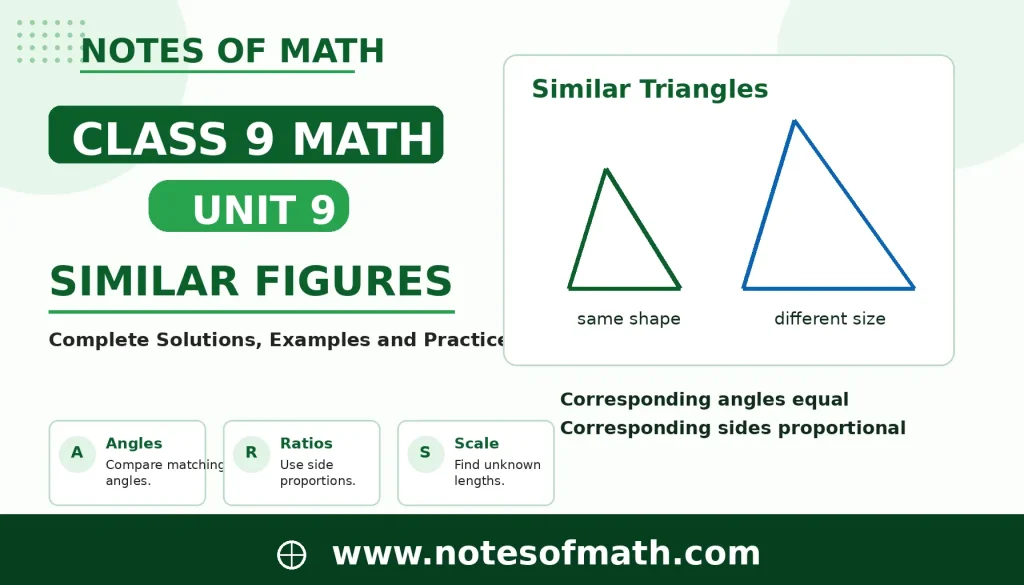
Similar figures have the same shape, but they may have different sizes.
Their corresponding angles are equal, and their corresponding lengths are proportional.
If the common scale factor is \(k\), then:
\(\frac{a_2}{a_1}=\frac{b_2}{b_1}=\frac{c_2}{c_1}=k\)
The same direction must be used in every ratio. If the first numerator belongs to the larger figure, all other numerators should also belong to the larger figure.
Similar and Congruent Figures
Similar figures have equal corresponding angles and proportional corresponding sides.
Congruent figures have the same shape and the same size.
Every pair of congruent figures is similar with scale factor 1, but similar figures are not always congruent.
Finding the Scale Factor
The scale factor is found by dividing one corresponding length by the matching length in the other figure.
\(k=\frac{\text{new corresponding length}}{\text{original corresponding length}}\)
Every pair of corresponding lengths must give the same value when the figures are similar.
Checking Whether Solids Are Similar
To decide whether two solids are similar, compare all corresponding dimensions.
For example, if the three ratios are:
\(\frac{4.5}{3}=\frac{7.5}{5}=\frac{6}{4}=1.5\)
then all dimensions have the same scale factor, so the solids are similar.
Reading the Correspondence Correctly
The order of a similarity statement identifies the matching vertices.
For example:
\(\triangle ABC\sim\triangle DEF\)
means:
\(A\leftrightarrow D,\qquad B\leftrightarrow E,\qquad C\leftrightarrow F\)
Therefore:
\(AB\leftrightarrow DE,\qquad BC\leftrightarrow EF,\qquad AC\leftrightarrow DF\)
Incorrect correspondence produces incorrect ratios even when the arithmetic is correct.
SSS Similarity Criterion
Two triangles are similar by SSS when their three pairs of corresponding sides are proportional.
\(\frac{AB}{DE}=\frac{BC}{EF}=\frac{AC}{DF}\)
Students should compare all three ratios and clearly state the matching vertices.
AA Similarity Criterion
Two triangles are similar by AA when two angles of one triangle are equal to two corresponding angles of the other triangle.
Parallel lines frequently create equal alternate interior angles.
Vertically opposite angles and common angles may provide the second required angle.
SAS Similarity Criterion
Two triangles are similar by SAS when two pairs of corresponding sides are proportional and the included angles are equal.
The equal angle must lie between the two proportional sides.
Parallel Lines and Similar Triangles
When a line is drawn parallel to one side of a triangle, the smaller triangle and the complete triangle are similar.
This follows from equal corresponding or alternate interior angles.
The missing length is then found from a proportion such as:
\(\frac{\text{side of smaller triangle}}{\text{matching side of larger triangle}}=\frac{\text{another smaller side}}{\text{matching larger side}}\)
Intersecting Triangles
Triangles formed by intersecting lines often have equal vertically opposite angles.
If another pair of angles is marked equal, the triangles are similar by AA.
After establishing similarity, write the corresponding-side ratio before substituting values.
Finding Missing Sides
After proving two triangles similar, select a ratio containing the unknown length and three known lengths.
For example:
\(\frac{x}{1.2}=\frac{7.5}{3}\)
Cross-multiplication then gives the required side.
Similarity in a Trapezoid
Parallel sides and intersecting diagonals can form similar triangles inside a trapezoid.
Equal alternate interior angles and vertically opposite angles establish AA similarity.
Corresponding side ratios can then be used to find a missing diagonal segment.
Plank and Rectangular Box Problem
Exercise 9.1 applies similarity to a plank placed across a rectangular stair space.
The complete triangular space and the smaller triangle above the box are similar because both are right triangles and share the angle made by the plank.
The box width is found from the ratio of corresponding heights and bases.
Height from Shadows
An object and its shadow form a right triangle.
Two objects measured at the same time form similar triangles because the sun rays make the same angle.
The proportion is:
\(\frac{\text{height of first object}}{\text{shadow of first object}}=\frac{\text{height of second object}}{\text{shadow of second object}}\)
Exercise 9.1 uses this method to find the height of a telephone pole.
Altitude to the Hypotenuse
When an altitude is drawn from the right angle to the hypotenuse, three similar triangles are formed.
The leg theorem is:
\((\text{leg})^2=(\text{whole hypotenuse})(\text{adjacent hypotenuse segment})\)
The altitude theorem is:
\((\text{altitude})^2=(\text{first segment})(\text{second segment})\)
These formulas are used to find the missing hypotenuse segment, altitude, and other leg.
Scaling the Side of a Regular Polygon
A regular polygon has equal side lengths.
First divide the perimeter by the number of sides to find one original side.
Then multiply that side by the stated scale factor.
For a regular polygon with \(n\) sides:
\(\text{one side}=\frac{\text{perimeter}}{n}\)
Printing Note in Exercise 9.1
The Exercise 9.1 solution identifies a mismatch between the printed scale factor and the official answer in the final dodecagon question.
The provided solution follows the numerical data stated in the question and explains why the printed official answer does not follow from that data.
Solutions of Exercise 9.2 Unit 9 Class 9 Math Notes
Exercise 9.2 focuses on the areas of similar figures. Students square the linear scale factor to find area ratios and take square roots of area ratios to recover corresponding length ratios.
Area Ratio of Similar Figures
If corresponding lengths are in the ratio \(a:b\), then the areas are in the ratio:
\(a^2:b^2\)
Equivalently, if the linear scale factor is \(k\), then:
\(\frac{A_2}{A_1}=k^2\)
Finding an Area Ratio from a Length Ratio
Square both terms of the length ratio.
For example:
\(3:4\Rightarrow3^2:4^2=9:16\)
The ratio must be simplified where possible.
Finding an Unknown Area
First find the linear scale factor between the two figures.
Square the scale factor to obtain the area scale factor.
Then multiply the known area by the area scale factor.
\(A_2=A_1k^2\)
Direction of the Scale Factor
The order of the scale factor must match the order of the areas.
If:
\(k=\frac{\text{side of figure 2}}{\text{side of figure 1}}\)
then:
\(\frac{A_2}{A_1}=k^2\)
Reversing only one of these ratios gives an incorrect answer.
Areas of Similar Rectangles and Triangles
The same area-scale rule applies to every pair of similar two-dimensional figures.
It is used in the exercise for rectangles, triangles, trapezoids, cones when comparing corresponding surface areas, quadrilaterals, and regular heptagons.
Finding a Length Ratio from an Area Ratio
Take the positive square root of both terms of the area ratio.
\(\text{length ratio}=\sqrt{\text{area ratio}}\)
For example:
\(16:25\Rightarrow\sqrt{16}:\sqrt{25}=4:5\)
Finding an Unknown Corresponding Side
First take the square root of the area ratio to find the linear ratio.
Then use a proportion with the known corresponding side.
For example, an area ratio of:
\(\frac{441}{25}\)
gives the length ratio:
\(\frac{21}{5}\)
Area of a Larger Similar Triangle
When a parallel segment creates two similar triangles, find the complete corresponding side first.
The linear scale factor between the small and large triangle is then squared.
The area of the region between them is found by subtraction.
Area of a Trapezium Between Similar Triangles
If a smaller triangle lies inside a larger similar triangle, the surrounding trapezium area is:
\(\text{trapezium area}=\text{larger triangle area}-\text{smaller triangle area}\)
Decimal Scale Factors
A decimal scale factor is squared in the same way as a fractional scale factor.
For example:
\((1.7)^2=2.89\)
Therefore, a figure enlarged by a linear factor of 1.7 has an area 2.89 times as large.
Book Interpretation of Scale Factors
Some Exercise 9.2 questions define the scale factor in a specific direction.
The solution follows the direction used by the official answer and states the corresponding-side order explicitly.
Students should always check which figure is placed in the numerator.
Solutions of Exercise 9.3 Unit 9 Class 9 Math Notes
Exercise 9.3 covers surface areas and volumes of similar solids. Students square linear ratios for surface areas, cube linear ratios for volumes, and use square or cube roots to work backward.
Surface-Area Ratio of Similar Solids
If the corresponding length ratio of two similar solids is \(a:b\), then the surface-area ratio is:
\(a^2:b^2\)
Every two-dimensional measurement scales with the square of the linear scale factor.
Volume Ratio of Similar Solids
If the corresponding length ratio is \(a:b\), then the volume ratio is:
\(a^3:b^3\)
Every three-dimensional measurement scales with the cube of the linear scale factor.
Finding a Length Ratio from a Volume Ratio
Take the positive cube root of both terms.
\(\text{length ratio}=\sqrt[3]{\text{volume ratio}}\)
For example:
\(8:27\Rightarrow\sqrt[3]{8}:\sqrt[3]{27}=2:3\)
Similar Spheres
The radii are corresponding lengths.
Therefore, the ratio of sphere volumes is the cube of the radius ratio.
\(\frac{V_1}{V_2}=\left(\frac{r_1}{r_2}\right)^3\)
The ratio of their surface areas is the square of the radius ratio.
Similar Cones
The heights, radii, and slant heights of similar cones share the same linear ratio.
Base areas and total surface areas use the square of that ratio.
Volumes use the cube of that ratio.
Similar Pyramids and Tetrahedrons
Corresponding edges and heights share the linear ratio.
Surface areas scale with the square, while volumes scale with the cube.
A volume ratio can be converted into a side ratio by taking cube roots.
Similar Cylinders and Water Tanks
The height ratio of similar cylinders is also their radius ratio and general linear ratio.
The surface-area ratio is the square of the height ratio.
The volume or capacity ratio is the cube of the height ratio.
Using Surface Areas to Find a Volume
When the surface areas of two similar solids are known, take the square root of their ratio to obtain the linear ratio.
Then cube that linear ratio to obtain the volume ratio.
This method is used for similar cuboids.
Finding an Unknown Radius from Volumes
Take the cube root of the volume ratio to obtain the radius ratio.
Use the known radius in a proportion to find the unknown radius.
Conical Can Applications
Exercise 9.3 includes similar conical cans.
The surface area is found from the squared linear ratio, while capacity is found from the cubed linear ratio.
The same pair of solids can therefore have different surface-area and volume ratios.
Cylindrical Tank Applications
The exercise also compares similar cylindrical water tanks.
A known surface area is converted using the squared height ratio.
A known volume is converted using the cubed height ratio.
Units for Area and Volume
Surface area is written in square units such as \(\text{cm}^2\) or \(\text{m}^2\).
Volume and capacity are written in cubic units such as \(\text{cm}^3\) or \(\text{m}^3\).
The exponent on the unit must match the type of measurement.
Solutions of Review Exercise 9 Unit 9 Class 9 Math Notes
Review Exercise 9 revises similarity, area and volume scaling, regular polygons, and practical applications involving models, bottles, jugs, glasses, jars, and tessellations.
[Embed the Review Exercise 9 PDF here]
Similarity and Scale-Factor Revision
The review asks students to connect corresponding side ratios with area and volume ratios.
A length ratio is squared for an area and cubed for a volume.
Square roots and cube roots are used to recover length ratios.
Sum of Interior Angles of a Polygon
For a polygon with \(n\) sides:
\(\text{sum of interior angles}=(n-2)\times180^\circ\)
This formula is also used in reverse to find the number of sides from the total interior-angle sum.
Number of Diagonals
The number of diagonals in an \(n\)-sided polygon is:
\(\frac{n(n-3)}{2}\)
The formula divides by two because each diagonal would otherwise be counted from both endpoints.
Exterior Angle of a Regular Polygon
For a regular polygon:
\(\text{exterior angle}=\frac{360^\circ}{n}\)
The exterior angles of every convex polygon add to 360 degrees.
Interior Angle of a Regular Polygon
An interior angle and its adjacent exterior angle form a straight line.
\(\text{interior angle}=180^\circ-\text{exterior angle}\)
The number of sides can be found by first calculating the exterior angle.
Similar Bottles
When one similar bottle is twice as high as another, the surface-area ratio is \(2^2:1^2\), while the capacity ratio is \(2^3:1^3\).
This shows why capacity changes more quickly than height.
Model Car Applications
A model and an actual car share one linear scale ratio.
Lengths use the original ratio, areas use its square, and capacities use its cube.
Counts such as the number of wheels do not change with geometric scale, so their ratio remains \(1:1\).
Capacities of Similar Jugs and Glasses
Capacity is a volume, so it changes with the cube of the height ratio.
The review uses this rule for similar jugs and drinking glasses of different heights.
Keep the height ratio in the same direction as the required capacity ratio.
Areas of Labels and Capacities of Jars
A label area ratio is first converted into a height ratio by taking square roots.
The height ratio is then cubed to obtain the capacity ratio.
Tessellation Application
The review includes a repeating pattern made from a regular hexagon, squares, and equilateral triangles.
The total area of one pattern is found by adding the areas of all tiles in the repeating block.
The solution also notes that the official book appears to place this answer under the wrong question number.
Printing Notes in Review Exercise 9
The review solution identifies a numbering mismatch in the tessellation question.
The PDF explains the issue and gives the area that agrees with the official numerical answer.
Important Rules and Formulas of Unit 9 Class 9 Math
Corresponding Lengths of Similar Figures
\(\frac{a_2}{a_1}=\frac{b_2}{b_1}=\frac{c_2}{c_1}=k\)
Area Scale Factor
\(\frac{A_2}{A_1}=k^2\)
Volume Scale Factor
\(\frac{V_2}{V_1}=k^3\)
Length Ratio from Area Ratio
\(\text{length ratio}=\sqrt{\text{area ratio}}\)
Length Ratio from Volume Ratio
\(\text{length ratio}=\sqrt[3]{\text{volume ratio}}\)
Leg Theorem
\((\text{leg})^2=(\text{whole hypotenuse})(\text{adjacent segment})\)
Altitude Theorem
\((\text{altitude})^2=(\text{first hypotenuse segment})(\text{second hypotenuse segment})\)
Polygon Interior-Angle Sum
\((n-2)\times180^\circ\)
Number of Polygon Diagonals
\(\frac{n(n-3)}{2}\)
Regular-Polygon Exterior Angle
\(\frac{360^\circ}{n}\)
Regular-Polygon Interior Angle
\(180^\circ-\frac{360^\circ}{n}\)
Common Mistakes in Unit 9 Class 9 Math Notes
Students sometimes compare non-corresponding sides of similar figures.
The direction of one ratio may be reversed while the other ratios remain unchanged.
Students may state that triangles are similar without naming the AA, SSS, or SAS reason.
Equal angles alone do not provide side lengths until the correct correspondence is established.
The linear scale factor should not be used directly for area or volume.
Area ratios require the square of the linear ratio.
Volume ratios require the cube of the linear ratio.
When working backward from an area ratio, take a square root, not a cube root.
When working backward from a volume ratio, take a cube root, not a square root.
Students sometimes subtract areas before finding the complete larger area.
Area units and volume units are sometimes confused.
Rounding too early can change the final result.
In polygon questions, \(n\) represents the number of sides.
Book answers containing an inconsistency should be checked against the printed data and formulas.
Exam Preparation Tips for Unit 9 Class 9 Math Notes
Memorize the AA, SSS, and SAS similarity criteria.
Read similarity statements in order and mark corresponding vertices.
Write all ratios in the same direction.
Practise scale-factor questions involving missing sides.
Learn the leg and altitude theorems for a right triangle split by an altitude.
Memorize that area uses the square and volume uses the cube of the linear ratio.
Practise taking square roots and cube roots of ratios.
Learn the polygon interior-angle, exterior-angle, and diagonal formulas.
Write square units for area and cubic units for volume.
Keep exact fractions during working and round only the final answer where required.
Attempt Review Exercise 9 independently before checking the solution PDF.
Use the save or download option in the PDF viewer to keep the solutions for offline revision.
Why Unit 9 Class 9 Math Solutions Are Important
Unit 9 Class 9 Math Solutions are important because similarity connects shape, proportion, area, and volume.
These ideas are used in maps, scale drawings, models, architecture, photography, engineering, surveying, shadows, and geometric design.
The unit also prepares students for trigonometry, mensuration, coordinate geometry, and advanced geometry.
Understanding how lengths, areas, and volumes scale prevents common errors in practical measurement problems.
FAQs About Unit 9 Class 9 Math Solutions
What is the topic of Unit 9 Class 9 Math?
The topic of Unit 9 Class 9 Math is Similar Figures.
How many exercises are included in Unit 9?
Unit 9 includes Exercise 9.1, Exercise 9.2, Exercise 9.3, and Review Exercise 9.
What is covered in Exercise 9.1?
Exercise 9.1 covers similarity of figures, triangle similarity criteria, corresponding sides, scale factors, parallel-line triangles, shadows, and the altitude-to-hypotenuse theorems.
What is covered in Exercise 9.2?
Exercise 9.2 covers areas of similar figures, squared scale factors, finding unknown areas, and finding length ratios from area ratios.
What is covered in Exercise 9.3?
Exercise 9.3 covers surface areas and volumes of similar solids, squared and cubed scale factors, and applications involving spheres, cones, pyramids, cylinders, cuboids, cans, and tanks.
What is covered in Review Exercise 9?
Review Exercise 9 revises similarity, areas, volumes, regular polygons, diagonals, model scales, capacities, and tessellations.
What is the difference between similar and congruent figures?
Similar figures have the same shape and proportional sides. Congruent figures have the same shape and the same size.
How is an area ratio found from a length ratio?
Square the corresponding length ratio. If the length ratio is \(a:b\), the area ratio is \(a^2:b^2\).
How is a volume ratio found from a length ratio?
Cube the corresponding length ratio. If the length ratio is \(a:b\), the volume ratio is \(a^3:b^3\).
How is a length ratio found from an area ratio?
Take the positive square root of both terms of the area ratio.
How is a length ratio found from a volume ratio?
Take the positive cube root of both terms of the volume ratio.
Can students download the Unit 9 solutions PDFs?
Yes. Students can view the exercise-wise PDFs on this page and use the save or download option provided by the PDF viewer.
Are these Unit 9 Class 9 Math Solutions useful for exam preparation?
Yes. The solutions are useful for homework, revision, class tests, annual examinations, and board exam preparation.
Disclaimer
These Unit 9 Class 9 Math Solutions are provided for educational help. Students should use them to understand the methods, check their work, and study alongside the official textbook and their teacher’s instructions.
Where a printed question or official answer appears inconsistent, the solution follows the stated mathematical data and explains the issue.
Final Words
Unit 9 Class 9 Math Solutions help students understand Similar Figures in a clear and organized way.
Exercise 9.1 develops similarity and proportion skills, Exercise 9.2 explains area scaling, and Exercise 9.3 explains surface-area and volume scaling.
Study the exercises in order, keep corresponding ratios consistent, and use Review Exercise 9 to revise both similarity and regular-polygon applications.
