Unit 7 Class 9 Math Solutions – Coordinate Geometry
Unit 7 Class 9 Math Solutions contain complete exercise-wise PDF solutions of the chapter Coordinate Geometry. Students can find the solutions of Exercise 7.1, Exercise 7.2, Exercise 7.3, and Review Exercise 7 on this page.
This unit explains points in the coordinate plane, distance and midpoint formulas, gradients, inclination, collinearity, parallel and perpendicular lines, equations of straight lines, and practical applications of coordinates.
The uploaded PDFs include complete calculations, coordinate diagrams, triangle and quadrilateral checks, equation conversions, practical word problems, and boxed final answers for the Punjab Board Class 9 Mathematics book.
Students can use these solutions for homework, revision, class tests, annual examinations, and board exam preparation.
Solutions of Exercise 7.1 Unit 7 Class 9 Math Notes
Exercise 7.1 introduces the coordinate plane and the main formulas used to study points, line segments, triangles, quadrilaterals, and circles.
Location of Points in the Coordinate Plane
The signs of the coordinates determine the quadrant or region in which a point lies.
Two positive coordinates place a point in Quadrant I.
A negative horizontal coordinate and positive vertical coordinate place a point in Quadrant II.
Two negative coordinates place a point in Quadrant III.
A positive horizontal coordinate and negative vertical coordinate place a point in Quadrant IV.
Points on the Axes
A point lies on the vertical axis when its horizontal coordinate is zero.
\(x=0\)
A point lies on the horizontal axis when its vertical coordinate is zero.
\(y=0\)
The origin is:
\(O(0,0)\)
Conditions involving inequalities may describe a half-plane or a region instead of one point.
Distance Between Two Points
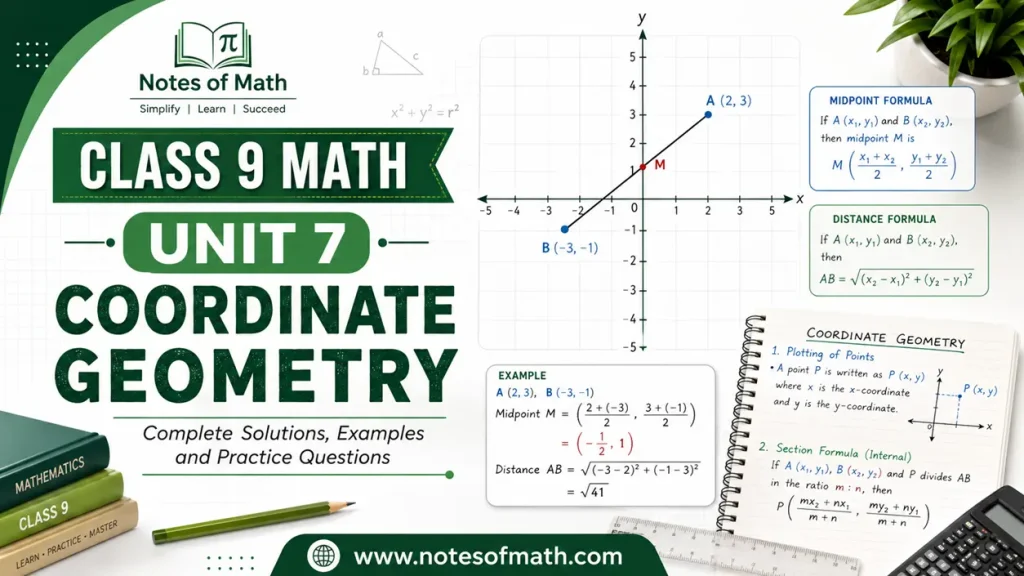
The distance between two points is found from the horizontal and vertical changes.
\(d=\sqrt{(x_2-x_1)^2+(y_2-y_1)^2}\)
Subtract the coordinates in the same order, square both differences, add them, and simplify the square root.
The order of the two points does not change the distance because the differences are squared.
Distance from the Origin
The distance from the origin is a special case of the distance formula.
\(OP=\sqrt{x^2+y^2}\)
Exercise 7.1 uses this rule to test whether given points lie at a specified distance from the origin.
Midpoint of a Line Segment
The midpoint is obtained by averaging the corresponding coordinates.
\(M=\left(\frac{x_1+x_2}{2},\frac{y_1+y_2}{2}\right)\)
The midpoint divides a line segment into two equal parts.
Negative coordinates should be placed inside brackets before addition.
Distance and Midpoint in the Same Question
Some questions ask for both the length of a line segment and its midpoint.
Use the two formulas separately and simplify radical and fractional answers completely.
Slope of a Line Segment
The slope or gradient of a line through two points is:
\(m=\frac{y_2-y_1}{x_2-x_1}\)
The same coordinate order must be used in the numerator and denominator.
Checking Collinearity
Three points are collinear when they lie on one straight line.
One method is to compare two consecutive slopes.
\(m_{AB}=m_{BC}\)
If the slopes are equal, the three points are collinear.
Exercise 7.1 also finds an unknown coordinate by setting two slopes equal.
Verifying a Right Triangle
Find the three side lengths using the distance formula.
Then compare their squares.
\(a^2+b^2=c^2\)
If the relation holds for the largest side, the triangle is right-angled by the converse of Pythagoras’ theorem.
Verifying an Isosceles Triangle
Calculate the three side lengths.
If two distances are equal, the triangle is isosceles.
Verifying a Parallelogram
A quadrilateral is a parallelogram when both pairs of opposite sides are parallel.
Compare the slopes of opposite sides.
\(m_{AB}=m_{CD}\)
\(m_{BC}=m_{AD}\)
If both equalities hold, the quadrilateral is a parallelogram.
Right Angle Using the Dot Product
When the right angle is specified at one vertex, form two vectors starting from that vertex.
Perpendicular vectors have zero dot product.
\(\vec{u}\cdot\vec{v}=0\)
This condition is used to find unknown coordinate values.
Centre and Radius from a Diameter
The centre of a circle is the midpoint of the endpoints of its diameter.
\(C=\left(\frac{x_1+x_2}{2},\frac{y_1+y_2}{2}\right)\)
Find the diameter with the distance formula and divide it by two.
\(r=\frac{d}{2}\)
Midpoints Forming a Parallelogram
Exercise 7.1 also finds the midpoints of the four sides of a quadrilateral.
The slopes of opposite sides of the new midpoint figure are then compared.
Equal opposite slopes prove that the midpoint figure is a parallelogram.
Solutions of Exercise 7.2 Unit 7 Class 9 Math Notes
Exercise 7.2 focuses on slopes and equations of straight lines. Students calculate gradients and inclinations, test collinearity, identify parallel and perpendicular lines, and write line equations in several forms.
Slope and Inclination
The slope of a line is connected to its angle of inclination by:
\(m=\tan\alpha\)
A positive slope gives an acute inclination.
A negative slope gives an inclination between 90 degrees and 180 degrees.
The inverse tangent function is used to find the reference angle.
Horizontal and Vertical Lines
A horizontal line has slope zero.
\(y=k\)
A vertical line has an undefined slope.
\(x=k\)
The inclination of a vertical line is 90 degrees.
Collinearity by Equal Slopes
Calculate the slope between the first and second points and the slope between the second and third points.
\(m_{AB}=m_{BC}\)
Equal slopes prove that the three points lie on one straight line.
The exercise includes both numerical and algebraic coordinates.
Parallel Lines
Two non-vertical lines are parallel when their slopes are equal.
\(m_1=m_2\)
A line through a given point and parallel to another line must use the same slope.
Perpendicular Lines
Two non-vertical lines are perpendicular when the product of their slopes is negative one.
\(m_1m_2=-1\)
The perpendicular slope is the negative reciprocal of the original slope.
Finding an Unknown Coordinate
When an unknown coordinate occurs in a slope, form an equation from the required condition.
For parallel lines, set the two slopes equal.
For perpendicular lines, set their product equal to negative one.
Then solve for the unknown coordinate.
Showing That a Triangle Is Right-Angled
Find the slopes of two sides meeting at the suspected right-angle vertex.
If their product is negative one, the sides are perpendicular and the included angle is 90 degrees.
Classifying Pairs of Lines
Calculate both slopes.
Equal slopes mean parallel lines.
A product of negative one means perpendicular lines.
If neither condition holds, the lines are neither parallel nor perpendicular.
General Form of a Straight Line
The general form is:
\(Ax+By+C=0\)
Many final answers in Exercise 7.2 are simplified into this form.
Slope-Intercept Form
The slope-intercept form is:
\(y=mx+c\)
The coefficient of the horizontal variable is the slope, and the constant is the vertical intercept.
Point-Slope Form
When one point and the slope are known, use:
\(y-y_1=m(x-x_1)\)
Two-Point Form
When two points are known, use:
\(\frac{y-y_1}{y_2-y_1}=\frac{x-x_1}{x_2-x_1}\)
Two-Intercept Form
When the horizontal and vertical intercepts are known, use:
\(\frac{x}{a}+\frac{y}{b}=1\)
A negative intercept must keep its negative sign.
Symmetric Form
A line through a point with direction angle may be written as:
\(\frac{x-x_1}{\cos\alpha}=\frac{y-y_1}{\sin\alpha}=r\)
Normal Form
The normal form is:
\(x\cos\alpha+y\sin\alpha=p\)
To convert a general equation into normal form, divide by:
\(\sqrt{A^2+B^2}\)
Choose the sign so that the perpendicular distance on the right is positive.
Perpendicular Bisector
First find the midpoint of the segment.
Then calculate the slope of the segment and take its negative reciprocal.
Use point-slope form through the midpoint.
Parallel or Perpendicular Line Through a Point
For a parallel line, keep the original slope.
For a perpendicular line, use the negative reciprocal slope.
Substitute the given point into point-slope form and simplify.
Checking Printed Answers
The Exercise 7.2 solution identifies a printing error in one perpendicular-line answer.
The corrected equation is checked by substituting the required point and confirming the perpendicular-slope condition.
Solutions of Exercise 7.3 Unit 7 Class 9 Math Notes
Exercise 7.3 applies coordinate geometry to daily-life situations. Students translate houses, trails, buildings, roads, ports, cities, fields, plots, and gardens into coordinate models.
Distance Between Real-Life Locations
The distance formula is used for houses, buildings, delivery locations, ports, and cities.
\(d=\sqrt{(x_2-x_1)^2+(y_2-y_1)^2}\)
The coordinate unit is converted into kilometres, metres, or another unit according to the question.
Midpoint of a Trail, Track, or Road
The midpoint formula identifies the point halfway between two locations.
\(M=\left(\frac{x_1+x_2}{2},\frac{y_1+y_2}{2}\right)\)
The exercise applies this method to a trail, race track, and road.
Latitude and Longitude as Coordinates
In the coordinate model used in the exercise, north is positive on the vertical axis and west is negative on the horizontal axis.
For example:
\((-65,12)\)
This represents 65 degrees west and 12 degrees north.
The result is a coordinate-plane distance. Actual distance on Earth requires a geographical formula because Earth is curved.
Perimeter of a Rectangular Field
Find the side lengths from coordinate differences.
Then use:
\(P=2(l+w)\)
This gives the total fencing required.
Fencing Around a Garden
The perimeter can also be found by adding all four sides.
\(P=AB+BC+CD+DA\)
For a rectangle, this agrees with the standard perimeter formula.
Interpreting Units
The final answer should include the unit stated in the question.
A coordinate unit may represent one kilometre, one metre, or another measurement.
Solutions of Review Exercise 7 Unit 7 Class 9 Math Notes
Review Exercise 7 revises Coordinate Geometry and Straight Lines. It includes multiple-choice questions, distance, midpoint, gradient, equations of lines, parallel lines, practical coordinate problems, and different forms of a straight-line equation.
Multiple-Choice Questions
The multiple-choice section checks line forms, parallel and perpendicular gradients, distance, midpoint, and conversion of a general equation into slope-intercept form.
Distance and Midpoint Questions
The review includes direct applications of the distance and midpoint formulas.
Substitute the coordinates carefully and simplify radical answers.
Gradient of a Line
The gradient is found from:
\(m=\frac{y_2-y_1}{x_2-x_1}\)
The review also includes a drone question that asks for both gradient and total distance.
Equation Through Two Points
First calculate the slope.
Then use point-slope form or slope-intercept form.
\(y=mx+c\)
Substitute one point to find the constant.
Gradient of a Parallel Line
Parallel lines have equal gradients.
\(m_2=m_1\)
Writing One Line in Different Forms
The final review question asks for slope-intercept, point-slope, two-point, intercept, symmetric, and normal forms.
The solution notes a printing inconsistency between the stated line and the printed points.
The corrected working keeps the intended equation consistent in every form.
Important Rules and Formulas of Unit 7 Class 9 Math
Distance Formula
\(d=\sqrt{(x_2-x_1)^2+(y_2-y_1)^2}\)
Distance from the Origin
\(d=\sqrt{x^2+y^2}\)
Midpoint Formula
\(M=\left(\frac{x_1+x_2}{2},\frac{y_1+y_2}{2}\right)\)
Slope Formula
\(m=\frac{y_2-y_1}{x_2-x_1}\)
Slope and Inclination
\(m=\tan\alpha\)
Parallel Lines
\(m_1=m_2\)
Perpendicular Lines
\(m_1m_2=-1\)
Slope-Intercept Form
\(y=mx+c\)
Point-Slope Form
\(y-y_1=m(x-x_1)\)
Two-Point Form
\(\frac{y-y_1}{y_2-y_1}=\frac{x-x_1}{x_2-x_1}\)
Two-Intercept Form
\(\frac{x}{a}+\frac{y}{b}=1\)
Symmetric Form
\(\frac{x-x_1}{\cos\alpha}=\frac{y-y_1}{\sin\alpha}=r\)
Normal Form
\(x\cos\alpha+y\sin\alpha=p\)
Perpendicular Vectors
\(\vec{u}\cdot\vec{v}=0\)
Rectangle Perimeter
\(P=2(l+w)\)
Common Mistakes in Unit 7 Class 9 Math Notes
Students sometimes use a different subtraction order in the numerator and denominator of the slope formula.
The distance formula requires both coordinate differences to be squared.
Negative coordinates should be placed inside brackets before subtraction.
The midpoint formula uses averages, not differences.
A vertical line has an undefined slope, while a horizontal line has slope zero.
Equal slopes indicate parallel lines or collinear points, depending on the question.
Perpendicular slopes are negative reciprocals, and their product must be negative one.
Both pairs of opposite sides must be checked when proving a parallelogram.
A right angle at a named vertex requires sides or vectors starting from that vertex.
Negative intercepts must remain negative in intercept form.
Normal form requires division by the square root of the sum of the squared coefficients.
A coordinate-plane distance based on latitude and longitude is not the actual curved distance on Earth.
Printed answers should be checked by substitution and slope conditions when an inconsistency is suspected.
Exam Preparation Tips for Unit 7 Class 9 Math Notes
Memorize the distance, midpoint, and slope formulas.
Practise identifying quadrants, axes, and half-planes.
Keep the same coordinate order in every slope calculation.
Simplify square roots completely.
Learn the tests for parallel, perpendicular, and collinear lines.
Practise finding the centre and radius of a circle from a diameter.
Use the midpoint and perpendicular slope for a perpendicular bisector.
Learn all common forms of a straight-line equation.
Check a line equation by substituting a known point.
Write the correct unit in practical questions.
Attempt Review Exercise 7 without viewing the solution PDF first.
Why Unit 7 Class 9 Math Solutions Are Important
Unit 7 Class 9 Math Solutions are important because coordinate geometry connects algebra with geometry.
The distance, midpoint, and slope formulas allow students to study shapes and lines using numerical coordinates.
Straight-line equations are used in graphs, functions, physics, engineering, computer graphics, mapping, navigation, and data analysis.
A strong understanding of this unit prepares students for advanced coordinate geometry, analytic geometry, vectors, graphs, and calculus.
FAQs About Unit 7 Class 9 Math Solutions
What is the topic of Unit 7 Class 9 Math?
The topic of Unit 7 Class 9 Math is Coordinate Geometry.
How many exercises are included in Unit 7?
Unit 7 includes Exercise 7.1, Exercise 7.2, Exercise 7.3, and Review Exercise 7.
What is covered in Exercise 7.1?
Exercise 7.1 covers point locations, distance, midpoint, slope, collinearity, triangles, parallelograms, perpendicular vectors, circles, and midpoint figures.
What is covered in Exercise 7.2?
Exercise 7.2 covers slope, inclination, collinearity, parallel and perpendicular lines, equations of straight lines, line forms, and perpendicular bisectors.
What is covered in Exercise 7.3?
Exercise 7.3 applies distance, midpoint, and perimeter formulas to houses, buildings, roads, trails, ports, cities, fields, plots, and gardens.
What is the distance formula?
The distance formula is \(d=\sqrt{(x_2-x_1)^2+(y_2-y_1)^2}\).
What is the midpoint formula?
The midpoint formula is \(M=\left(\frac{x_1+x_2}{2},\frac{y_1+y_2}{2}\right)\).
What is the slope formula?
The slope formula is \(m=\frac{y_2-y_1}{x_2-x_1}\).
How can three points be shown to be collinear?
Calculate two consecutive slopes. If the slopes are equal, the points are collinear.
How can parallel lines be identified?
Parallel non-vertical lines have equal slopes.
How can perpendicular lines be identified?
The product of the slopes of two perpendicular non-vertical lines is negative one.
What is the equation of a horizontal line?
A horizontal line has the form \(y=k\).
What is the equation of a vertical line?
A vertical line has the form \(x=k\).
Are these Unit 7 Class 9 Math Solutions available in PDF format?
Yes. The solutions of Exercises 7.1, 7.2, 7.3, and Review Exercise 7 are available in PDF format on this page.
Are these solutions useful for exam preparation?
Yes. Students can use these solutions for homework, revision, class tests, annual examinations, and board exam preparation.
Disclaimer
These Unit 7 Class 9 Math Solutions are provided for educational help. Students should use them to understand the method, check their work, and study alongside the official textbook and their teacher’s instructions.
Final Words
Unit 7 Class 9 Math Solutions help students understand Coordinate Geometry and Straight Lines in a clear and organized way.
Exercise 7.1 develops distance, midpoint, and geometric-verification skills. Exercise 7.2 explains gradients and line equations, while Exercise 7.3 applies coordinate methods to practical situations.
Study the exercises in order, practise every formula, verify line equations by substitution, and use Review Exercise 7 to test your understanding of the complete unit.
