
Unit 4 Class 9 Math Solutions – Factorization and Algebraic Manipulation
Unit 4 Class 9 Math Solutions contain complete exercise-wise PDF solutions of the chapter Factorization and Algebraic Manipulation. Students can find the solutions of Exercise 4.1, Exercise 4.2, Exercise 4.3, Exercise 4.4, and Review Exercise 4 on this page.
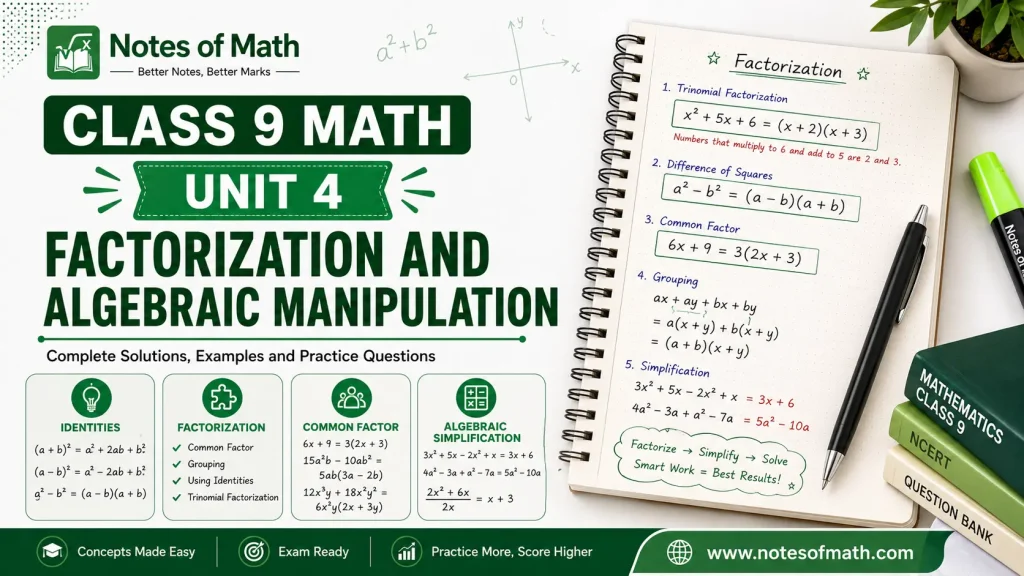
This unit explains how algebraic expressions and polynomials can be written as products of simpler factors. It also covers important algebraic identities, HCF and LCM of polynomials, square roots of polynomials, and practical questions solved through factorization.
The exercise PDFs provide complete step-by-step working for the Punjab Board Class 9 Mathematics book. Students can use these solutions for homework, revision, class tests, annual examinations, and board exam preparation.
Solutions of Exercise 4.1 Unit 4 Class 9 Math Notes
Exercise 4.1 of Unit 4 Class 9 Math Notes introduces the basic methods of factorization. Students take common factors, factorize simple trinomials, and split the middle term of quadratic expressions.
Factorization by Taking a Common Factor
The first method is to identify the greatest factor common to every term and take it outside the brackets.
The distributive rule used in reverse is:
\(ab+ac=a(b+c)\)
For example:
\(6x+12=6(x+2)\)
When variables occur in every term, take the lowest common power of each variable.
For example:
\(4a^2b+8ab^2=4ab(a+2b)\)
A negative common factor may be taken when it makes the terms inside the brackets easier to read.
For example:
\(-12x^2-3x=-3x(4x+1)\)
Factorizing Simple Trinomials
A monic quadratic trinomial has the form:
\(x^2+bx+c\)
To factorize it, find two numbers whose product is \(c\) and whose sum is \(b\).
For example, in:
\(x^2+4x+3\)
the required numbers are 1 and 3 because:
\(1\times3=3\)
and:
\(1+3=4\)
Therefore:
\(x^2+4x+3=(x+1)(x+3)\)
Factorizing Trinomials with Negative Terms
When the constant term is negative, the two required numbers have opposite signs.
For example:
\(x^2+x-12\)
requires the numbers 4 and \(-3\), because their product is \(-12\) and their sum is 1.
Therefore:
\(x^2+x-12=(x+4)(x-3)\)
When both the middle term and constant term are positive, both factors normally contain positive signs. When the middle term is negative and the constant term is positive, both signs are normally negative.
Splitting the Middle Term
For a quadratic expression of the form:
\(ax^2+bx+c\)
first multiply \(a\) and \(c\). Then find two numbers whose product is \(ac\) and whose sum is \(b\). Use those numbers to split the middle term and factorize by grouping.
For example:
\(2x^2+7x+3\)
Here:
\(ac=2\times3=6\)
The numbers 6 and 1 have product 6 and sum 7. Therefore:
\(2x^2+7x+3=2x^2+6x+x+3\)
\(=2x(x+3)+1(x+3)\)
\(=(2x+1)(x+3)\)
Rearranging an Expression Before Factorization
An expression should normally be arranged in descending powers before factorization.
When the leading coefficient is negative, taking \(-1\) common may make the remaining quadratic easier to factorize.
For example:
\(6+7x-3x^2=-(3x^2-7x-6)\)
After factorization, the negative sign may be included in either factor to obtain a clear final answer.
Solutions of Exercise 4.2 Unit 4 Class 9 Math Notes
Exercise 4.2 focuses on algebraic factorization using identities, substitution, perfect cubes, and the sum or difference of cubes. Many questions contain fourth-degree expressions that must first be rewritten as a difference of two squares.
Difference of Two Squares
The difference of two squares identity is:
\(A^2-B^2=(A-B)(A+B)\)
Before applying this identity, both terms must be perfect squares and there must be a minus sign between them.
For example:
\(x^4-14x^2+1\)
can be rewritten as:
\((x^2+1)^2-(4x)^2\)
Therefore:
\(x^4-14x^2+1=(x^2-4x+1)(x^2+4x+1)\)
Factorizing Fourth-Degree Expressions
Some fourth-degree expressions do not look like a difference of squares at first. A suitable term is added and subtracted so that part of the expression becomes a perfect square.
For example:
\(x^4+4x^2+16\)
may be written as:
\(x^4+8x^2+16-4x^2\)
\(=(x^2+4)^2-(2x)^2\)
Therefore:
\(x^4+4x^2+16=(x^2-2x+4)(x^2+2x+4)\)
Factorization by Substitution
Long expressions containing several brackets can often be simplified by pairing factors and replacing a repeated expression with a temporary variable such as \(A\) or \(u\).
For example, products may be arranged in the form:
\((A-1)(A+1)+1\)
Using the difference of squares:
\((A-1)(A+1)+1=A^2-1+1=A^2\)
After simplification, substitute the original expression back in place of \(A\).
Perfect Cube Identities
The cube of a sum is:
\((A+B)^3=A^3+3A^2B+3AB^2+B^3\)
The cube of a difference is:
\((A-B)^3=A^3-3A^2B+3AB^2-B^3\)
For example:
\(8x^3+12x^2+6x+1=(2x+1)^3\)
Similarly:
\(8x^3-60x^2y+150xy^2-125y^3=(2x-5y)^3\)
Students should arrange the terms in the standard order before comparing them with a cube identity.
Sum of Two Cubes
The sum of two cubes identity is:
\(A^3+B^3=(A+B)(A^2-AB+B^2)\)
For example:
\(64x^3+125=(4x)^3+5^3\)
Therefore:
\(64x^3+125=(4x+5)(16x^2-20x+25)\)
Difference of Two Cubes
The difference of two cubes identity is:
\(A^3-B^3=(A-B)(A^2+AB+B^2)\)
For example:
\(125a^3-1=(5a)^3-1^3\)
Therefore:
\(125a^3-1=(5a-1)(25a^2+5a+1)\)
The sign in the second bracket is always positive for the middle term in the difference-of-cubes identity.
Solutions of Exercise 4.3 Unit 4 Class 9 Math Notes
Exercise 4.3 of Unit 4 Class 9 Math Notes covers the HCF and LCM of algebraic expressions and polynomials. Students use factorization and division methods and apply the relationship between the product, HCF, and LCM of two polynomials.
HCF of Algebraic Expressions
The highest common factor is the greatest factor common to all the given expressions.
For numerical coefficients, take their numerical HCF. For variables and polynomial factors, take only the factors common to every expression with their lowest powers.
For example, the HCF of:
\(21x^2y\)
and:
\(35xy^2\)
is:
\(7xy\)
The coefficient 7 is common, while the lowest common powers are \(x^1\) and \(y^1\).
HCF by Factorization
Factorize each polynomial completely and identify the factors appearing in every expression.
For example:
\(4x^2-9y^2=(2x-3y)(2x+3y)\)
and:
\(2x^2-3xy=x(2x-3y)\)
The common polynomial factor is:
\(2x-3y\)
HCF by the Division Method
In the division method, divide the polynomial of higher degree by the polynomial of lower degree.
If the remainder is zero, the divisor is the HCF. If the remainder is not zero, divide the previous divisor by the remainder and continue.
The last non-zero divisor is the HCF.
When several polynomials are given, first find the HCF of two expressions and then find the HCF of that result with the next expression.
LCM of Algebraic Expressions
The least common multiple contains every factor required by any of the given expressions.
For numerical coefficients, take their numerical LCM. For variables and polynomial factors, take each distinct factor with its highest power.
For example, if the factorizations contain \(x\), \(x^2\), and \((x+1)\), the LCM uses:
\(x^2(x+1)\)
A difference in the sign of a factor does not change the LCM because:
\(2-x=-(x-2)\)
Relationship Between HCF and LCM
For two polynomials:
\(\text{HCF}\times\text{LCM}=\text{product of the two polynomials}\)
If one polynomial, the HCF, and the LCM are known, the other polynomial can be found from:
\(P_2=\frac{\text{HCF}\times\text{LCM}}{P_1}\)
All expressions should be factorized before cancellation. Cancelling terms without factorization can produce an incorrect result.
Finding an Unknown Polynomial
Exercise 4.3 includes questions in which one polynomial is unknown.
The method is to multiply the HCF and LCM, divide by the known polynomial, factorize where required, and cancel only common factors.
The same product relationship is also used when the question asks only for the product of the two polynomials.
Solutions of Exercise 4.4 Unit 4 Class 9 Math Notes
Exercise 4.4 covers square roots of polynomials by factorization and division. It also applies factorization to zero-return, break-even, potential-energy, and zero-deflection problems.
Perfect-Square Identities
The square of a sum is:
\((A+B)^2=A^2+2AB+B^2\)
The square of a difference is:
\((A-B)^2=A^2-2AB+B^2\)
A trinomial is a perfect square when its first and last terms are perfect squares and its middle term is twice their product.
Square Root by Factorization
Rewrite the polynomial as the square of a simpler expression and then take both square roots.
For example:
\(x^2-8x+16=(x-4)^2\)
Therefore:
\(\sqrt{x^2-8x+16}=\pm(x-4)\)
Both signs are written because a non-zero perfect square has a positive and a negative square root.
Taking a Common Factor Before Finding a Square Root
Sometimes a numerical factor must be taken common before the expression inside the brackets can be recognized as a perfect square.
For example:
\(200t^2-120t+18=2(100t^2-60t+9)\)
\(=2(10t-3)^2\)
Therefore, its square roots are:
\(\pm\sqrt{2}(10t-3)\)
Square Root by the Division Method
Arrange the polynomial in descending powers and include missing powers with zero coefficients when necessary.
Select the square root of the first term as the first term of the root.
Subtract its square, double the partial root, and use the result to determine the next term.
Continue until the remainder becomes zero.
The completed partial root is one square root, and its negative is the other square root.
Checking a Polynomial Square Root
The answer may be checked by squaring the obtained root.
For example, if the root is:
\(2x^2-7x-3\)
then the original polynomial should equal:
\((2x^2-7x-3)^2\)
A non-zero remainder in the division method means the given polynomial is not an exact perfect square under that method.
Solving Zero-Value Problems by Factorization
Some application questions give a polynomial model and ask where its value becomes zero.
Set the polynomial equal to zero, factorize it completely, and apply the zero-product property.
If:
\((x-a)(x-b)=0\)
then:
\(x=a\text{ or }x=b\)
The solutions must then be interpreted according to the units in the question, such as years, investment in thousands of rupees, or physical positions.
Break-Even and Zero-Return Questions
A break-even point occurs when the profit is zero. A zero-return point occurs when the return model is equal to zero.
For example, if:
\(R(x)=-x^2+6x-8\)
then:
\(R(x)=-(x-2)(x-4)\)
The zero-return values are:
\(x=2\text{ or }x=4\)
The meaning of these values depends on the definition of \(x\) given in the question.
Solutions of Review Exercise 4 Unit 4 Class 9 Math Notes
Review Exercise 4 revises the complete chapter. It includes multiple-choice questions, common-factor and trinomial factorization, algebraic identities, HCF and LCM, square roots of polynomials, and practical equations solved by factorization.
Factorization Questions in Review Exercise 4
The review exercise combines common factors, splitting the middle term, the sum and difference of cubes, fourth-degree identities, and substitution.
Students must first identify the structure of the expression before selecting a method.
An expression may require more than one step, such as taking a common factor and then factorizing the remaining polynomial.
HCF and LCM Questions in Review Exercise 4
The HCF is found from common factors with the lowest powers. The LCM is formed from all required factors with the highest powers.
Every polynomial should be factorized completely before the HCF or LCM is selected.
The relationship between HCF, LCM, and the product of two expressions is also revised.
Square Roots in Review Exercise 4
The review exercise asks students to find a polynomial square root by both factorization and division.
When the expression is recognized as:
\(A^2+2AB+B^2\)
its square roots are:
\(\pm(A+B)\)
Both methods should give the same result.
Practical Factorization Problems
The review includes a loan-repayment model in which the polynomial cost is set equal to zero.
After factorization, each factor is set equal to zero to find the possible repayment periods.
The same method can be used for profit, return, energy, deflection, and other polynomial models.
Important Rules of Unit 4 Class 9 Math
Common-Factor Rule
\(ab+ac=a(b+c)\)
Difference of Two Squares
\(A^2-B^2=(A-B)(A+B)\)
Square of a Sum
\((A+B)^2=A^2+2AB+B^2\)
Square of a Difference
\((A-B)^2=A^2-2AB+B^2\)
Cube of a Sum
\((A+B)^3=A^3+3A^2B+3AB^2+B^3\)
Cube of a Difference
\((A-B)^3=A^3-3A^2B+3AB^2-B^3\)
Sum of Two Cubes
\(A^3+B^3=(A+B)(A^2-AB+B^2)\)
Difference of Two Cubes
\(A^3-B^3=(A-B)(A^2+AB+B^2)\)
Sophie Germain Identity
\(A^4+4B^4=(A^2-2AB+2B^2)(A^2+2AB+2B^2)\)
HCF and LCM Relationship
\(\text{HCF}\times\text{LCM}=\text{product of two polynomials}\)
Zero-Product Property
\(AB=0\Rightarrow A=0\text{ or }B=0\)
Common Mistakes in Unit 4 Class 9 Math Notes
Many students begin with an identity before checking whether a common factor can be taken first.
When factorizing a trinomial, students sometimes choose two numbers with the correct product but the wrong sum.
In \(ax^2+bx+c\), the product used for splitting the middle term is \(ac\), not only \(c\).
A difference-of-squares identity cannot be applied to a sum of squares.
Students often confuse the signs in the sum and difference of cubes. The sign in the first factor follows the original sign, while the middle sign in the quadratic factor is opposite for a sum and positive for a difference.
An expression should be arranged in descending powers before it is compared with an identity.
For the HCF, use the lowest powers of common factors. For the LCM, use the highest powers of every required factor.
Students sometimes cancel terms instead of factors. Cancellation is valid only after the numerator and denominator have been factorized.
When finding the square root of a perfect-square polynomial, both the positive and negative roots should be included.
In the polynomial division method, missing powers should be represented by zero coefficients.
In application questions, students may find algebraic roots but forget to interpret them using the units given in the question.
Exam Preparation Tips for Unit 4 Class 9 Math Notes
Learn the common algebraic identities before attempting the exercises.
Always check for a common factor before using another factorization method.
Practise finding number pairs with a given product and sum.
For non-monic quadratics, calculate \(ac\) and split the middle term.
Rewrite fourth-degree expressions as a difference of squares where possible.
Memorize the sum and difference of cubes identities and pay close attention to signs.
Factorize every polynomial completely before finding its HCF or LCM.
In the division method, arrange terms in descending order and work one term at a time.
Check a square-root answer by squaring it.
For practical questions, set the model equal to zero and use the zero-product property.
Attempt Review Exercise 4 independently before checking the PDF solution.
Why Unit 4 Class 9 Math Solutions Are Important
Unit 4 Class 9 Math Solutions are important because factorization is used throughout algebra.
Students need factorization to simplify rational expressions, solve equations, find zeros of polynomials, work with algebraic fractions, and study graphs and functions.
HCF and LCM help students combine and simplify polynomial expressions, while polynomial square roots strengthen their understanding of identities.
A strong command of this unit will make later topics in Class 9 and higher mathematics easier.
FAQs About Unit 4 Class 9 Math Solutions
What is the topic of Unit 4 Class 9 Math?
The topic of Unit 4 Class 9 Math is Factorization and Algebraic Manipulation.
How many exercises are included in Unit 4?
Unit 4 includes Exercise 4.1, Exercise 4.2, Exercise 4.3, Exercise 4.4, and Review Exercise 4.
What is covered in Exercise 4.1?
Exercise 4.1 covers common factors, monic quadratic trinomials, and splitting the middle term of non-monic quadratics.
What is covered in Exercise 4.2?
Exercise 4.2 covers algebraic identities, fourth-degree expressions, substitution, perfect cubes, and the sum and difference of cubes.
What is covered in Exercise 4.3?
Exercise 4.3 covers the HCF and LCM of polynomials by factorization and division, along with the relationship between HCF, LCM, and the product of two polynomials.
What is covered in Exercise 4.4?
Exercise 4.4 covers square roots of polynomials by factorization and division and practical equations solved through factorization.
What is factorization?
Factorization is the process of writing an algebraic expression as a product of simpler expressions called factors.
What is the first step in factorization?
The first step is to check whether all terms have a common numerical or algebraic factor.
How is a quadratic trinomial factorized?
For \(x^2+bx+c\), find two numbers whose product is \(c\) and whose sum is \(b\). For \(ax^2+bx+c\), use the product \(ac\) when splitting the middle term.
How is the HCF of polynomials found?
Factorize the polynomials completely and select only the common factors with their lowest powers.
How is the LCM of polynomials found?
Factorize the polynomials completely and select every required factor with its highest power.
Why are both signs used for a polynomial square root?
If a non-zero expression squares to the given polynomial, its negative also gives the same square. Therefore, both positive and negative roots are included.
Are these Unit 4 Class 9 Math Solutions available in PDF format?
Yes. The solutions of Exercises 4.1, 4.2, 4.3, 4.4, and Review Exercise 4 are available in PDF format on this page.
Are these solutions useful for exam preparation?
Yes. Students can use these solutions for homework, revision, class tests, annual examinations, and board exam preparation.
Disclaimer
These Unit 4 Class 9 Math Solutions are prepared for educational help. Students should use them to understand the method and check their work.
Students should also study the official Class 9 Mathematics textbook and follow the method recommended by their teacher.
Final Words
Unit 4 Class 9 Math Solutions help students understand Factorization and Algebraic Manipulation in a clear and organized way.
Exercise 4.1 develops basic factorization skills, Exercise 4.2 applies algebraic identities, Exercise 4.3 covers HCF and LCM, and Exercise 4.4 explains square roots of polynomials and practical applications.
Study the exercises in order, practise each method independently, and use Review Exercise 4 to test your understanding of the complete unit.
