
Unit 16 Class 9 Math Solutions Sindh Board – Introduction to Coordinate Geometry
Unit 16 Class 9 Math Solutions Sindh Board are available below for Exercise 16.1, Exercise 16.2, Exercise 16.3, and the Unit 16 Review Exercise. Open the required PDF to view complete step-by-step solutions and analytical proofs.
This final unit introduces coordinate geometry (also known as analytical geometry), bridging algebra and geometry by locating points on a Cartesian plane and calculating distances, midpoints, and line segment ratios. For other units, visit our Class 9 Math Notes Sindh Board main page.
Unit 16 Class 9 Math Exercise Solutions
Select an exercise below to view its complete PDF solutions.
Unit 16 Quick Overview
| Detail | Information |
| Class | Class 9 |
| Subject | Mathematics |
| Board | Sindh Board |
| Unit | Unit 16 |
| Unit Name | Introduction to Coordinate Geometry |
| Exercises | Exercise 16.1 to Exercise 16.3 |
| Additional Material | Unit 16 Review Exercise |
| Solution Format | Step-by-step PDF solutions with graph plots |
What Is Introduction to Coordinate Geometry About?
Coordinate Geometry (Analytical Geometry) uses an ordered pair of numbers \( (x, y) \) to specify the exact position of a point on a two-dimensional plane:
- X-axis & Y-axis: Perpendicular number lines intersecting at the origin \( O(0, 0) \).
- Quadrants: The Cartesian plane is divided into four quadrants determined by the signs of \( x \) and \( y \) coordinates.
- Algebraic Geometry: Geometric figures such as line segments, triangles, and quadrilaterals are analyzed algebraically using coordinate formulas.
Exercise 16.1 – Cartesian Plane and Distance Formula
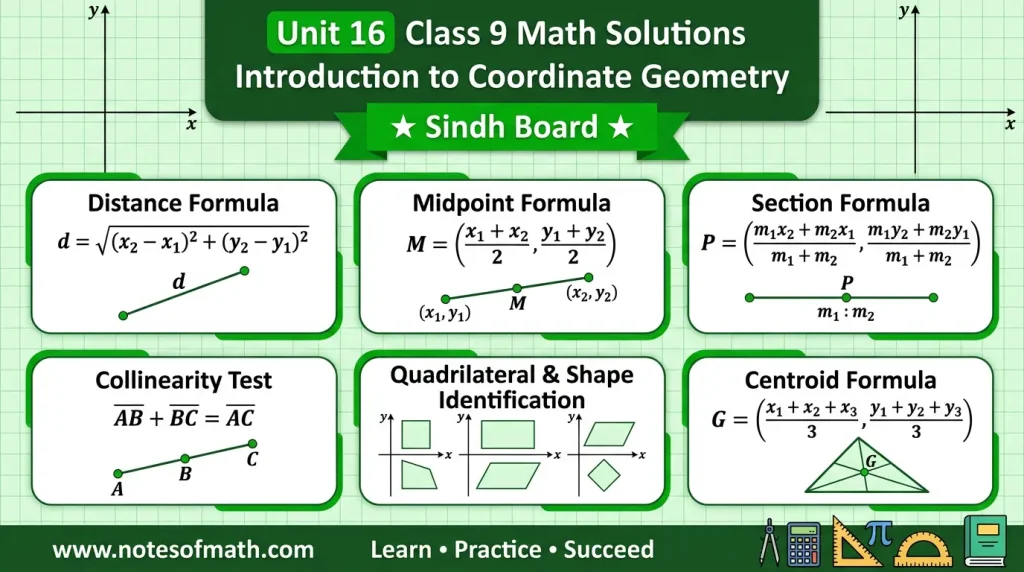
Exercise 16.1 introduces plotting points in quadrants and calculating the distance between any two given points \( P(x_1, y_1) \) and \( Q(x_2, y_2) \).
Key Applications in Exercise 16.1
- Plotting Points: Locating ordered pairs across Quadrants I \( (+,+) \), II \( (-,+) \), III \( (-,-) \), and IV \( (+,-) \).
- Applying the Distance Formula: Calculating line segment lengths using:
\[ d = \sqrt{(x_2 – x_1)^2 + (y_2 – y_1)^2} \]
- Proving Right Triangles: Using distances between three points to satisfy the Pythagorean condition:
\[ c^2 = a^2 + b^2 \]
Exercise 16.2 – Midpoint Formula and Section Formula
Exercise 16.2 focuses on finding the exact coordinates of points that divide line segments internally in specific ratios.
Core Concepts in Exercise 16.2
- Midpoint Formula: The midpoint \( M(x, y) \) of segment \( AB \) connecting \( A(x_1, y_1) \) and \( B(x_2, y_2) \) is given by:
\[ M(x, y) = \left( \frac{x_1 + x_2}{2}, \frac{y_1 + y_2}{2} \right) \]
- Section Formula (Internal Division): Coordinates of a point \( P(x, y) \) dividing segment \( AB \) in the ratio \( m_1 : m_2 \) are:
\[ P(x, y) = \left( \frac{m_1 x_2 + m_2 x_1}{m_1 + m_2}, \frac{m_1 y_2 + m_2 y_1}{m_1 + m_2} \right) \]
- Centroid of a Triangle: Given vertices \( A(x_1, y_1) \), \( B(x_2, y_2) \), and \( C(x_3, y_3) \), the centroid \( G(x, y) \) is:
\[ G(x, y) = \left( \frac{x_1 + x_2 + x_3}{3}, \frac{y_1 + y_2 + y_3}{3} \right) \]
Exercise 16.3 – Testing Collinearity and Geometric Shapes
Exercise 16.3 applies coordinate formulas to prove whether three or more points form specific geometric shapes or lie along a single straight line.
Core Applications in Exercise 16.3
- Collinearity Test: Points \( A \), \( B \), and \( C \) are collinear if the sum of two smaller distances equals the total distance:
\[ AB + BC = AC \]
- Classifying Triangles:
- Equilateral: \( AB = BC = CA \)
- Isosceles: Any two sides equal
- Scalene: All three sides unequal
- Classifying Quadrilaterals:
- Square: All 4 sides equal AND diagonals equal.
- Rectangle: Opposite sides equal AND diagonals equal.
- Parallelogram: Opposite sides equal but diagonals unequal.
- Rhombus: All 4 sides equal but diagonals unequal.
Unit 16 Review Exercise
The Unit 16 Review Exercise consolidates coordinate geometry concepts across board exam question formats:
- MCQs: Quadrant locations, origin coordinates, and standard distance/midpoint formulas.
- Short Questions: Quick distance and midpoint calculations between two coordinate points.
- Analytical Proofs: Proving whether given sets of four coordinate points form a rectangle, square, or parallelogram.
Important Formulas and Rules from Unit 16
- Distance Formula:
\[ d = \sqrt{(x_2 – x_1)^2 + (y_2 – y_1)^2} \]
- Midpoint Formula:
\[ M(x, y) = \left( \frac{x_1 + x_2}{2}, \frac{y_1 + y_2}{2} \right) \]
- Section Formula:
\[ P(x, y) = \left( \frac{m_1 x_2 + m_2 x_1}{m_1 + m_2}, \frac{m_1 y_2 + m_2 y_1}{m_1 + m_2} \right) \]
- Distance from Origin: Distance from \( O(0, 0) \) to \( P(x, y) \) is:
\[ d = \sqrt{x^2 + y^2} \]
Common Mistakes to Avoid
- Sign Errors Under the Square Root: Forgetting that \( (-x)^2 \) becomes positive inside the distance formula.
- Swapping Coordinate Order: Confusing \( (x_1 – x_2) \) with \( (y_1 – y_2) \) or reversing \( x \) and \( y \) values in ordered pairs.
- Incomplete Shape Proofs: Proving only that 4 sides are equal to claim a figure is a square without checking if the diagonals are also equal.
- Section Formula Ratio Placement: Multiplying \( m_1 \) with \( x_1 \) instead of \( x_2 \) in the section formula numerator.
How to Prepare Unit 16 for Exams
- Memorize the Core Formulas: Write down distance, midpoint, and section formulas daily until fluent.
- Double-Check Arithmetic Signs: Be meticulous with negative coordinates when subtracting under square root signs.
- Draw Rough Graphs: Plot points roughly on a grid before applying distance formulas to visualize the shape.
- Practice Quadrilateral Proofs: Revisit Exercise 16.3 long questions, as Sindh Board exams frequently ask students to identify geometric figures using coordinate points.
Why These Unit 16 Solutions Are Helpful
- Fully Solved Examples: Every exercise problem is solved with complete algebraic steps.
- Board Exam Format: Designed to match Class 9 Sindh Board and Karachi Board marking schemes.
- PDF Format Access: Clean, easily readable PDFs for quick mobile or desktop revision.
Frequently Asked Questions
What is the distance formula in coordinate geometry?
The distance between \( P(x_1, y_1) \) and \( Q(x_2, y_2) \) is:
\[ d = \sqrt{(x_2 – x_1)^2 + (y_2 – y_1)^2} \]
How do you prove three points are collinear using distance?
Calculate distances \( AB \), \( BC \), and \( AC \). If the sum of the two shorter distances equals the longest distance (\( AB + BC = AC \)), the points are collinear.
What is the formula for the midpoint of a line segment?
The midpoint \( M \) is:
\[ M = \left( \frac{x_1 + x_2}{2}, \frac{y_1 + y_2}{2} \right) \]
How many exercises are included in Unit 16?
Unit 16 contains three main exercises (Exercise 16.1, 16.2, and 16.3) plus a Review Exercise.
Related Class 9 Math Resources
- Class 9 Math Notes Sindh Board – All Units
- Unit 15 Class 9 Math Solutions – Projection of a Side of a Triangle
- Unit 7 Class 9 Math Solutions – Linear Graphs and Their Applications
Disclaimer
These solved notes are provided for educational revision and self-study purposes. Students should practice analytical geometry problems independently and follow the official Sindh Textbook Board curriculum.
Final Words
Unit 16 Class 9 Math Solutions Sindh Board completes curriculum. By mastering distance, midpoint, and section formulas, students gain a powerful tool that connects algebra to geometric problem-solving for higher secondary mathematics.
