
Unit 15 Class 9 Math Solutions Sindh Board – Projection of a Side of a Triangle
Unit 15 Class 9 Math Solutions Sindh Board are available below for Exercise 15.1, Exercise 15.2, and the Unit 15 Review Exercise. Open the required PDF to view complete step-by-step proofs and exercise solutions.
This unit focuses on orthogonal projections, generalizations of the Pythagorean theorem for obtuse and acute triangles, and Apollonius’ theorem. For other units, visit our Class 9 Math Notes Sindh Board main page.
Unit 15 Class 9 Math Exercise Solutions
Select an exercise below to view its complete PDF solutions.
Unit 15 Quick Overview
| Detail | Information |
| Class | Class 9 |
| Subject | Mathematics |
| Board | Sindh Board |
| Unit | Unit 15 |
| Unit Name | Projection of a Side of a Triangle |
| Exercises | Exercise 15.1 to Exercise 15.2 |
| Additional Material | Unit 15 Review Exercise |
| Solution Format | Step-by-step PDF solutions with geometric proofs |
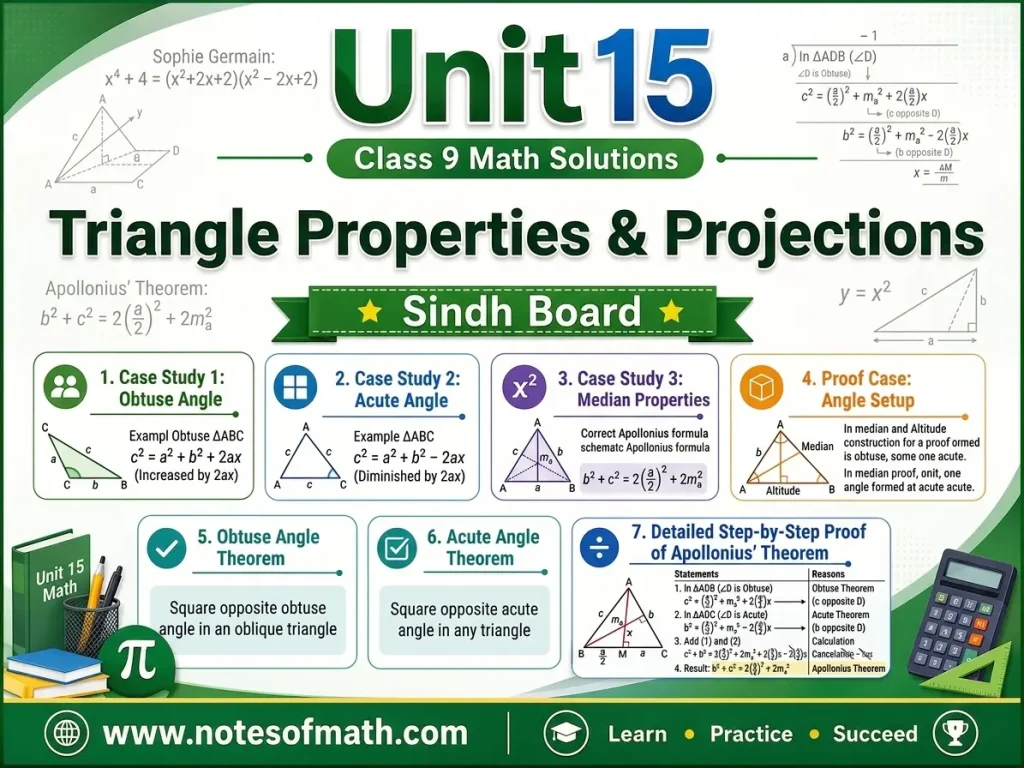
What Is Projection of a Side of a Triangle About?
In geometry, the orthogonal projection of a point on a straight line is the foot of the perpendicular drawn from that point to the line. Similarly, the projection of a line segment onto a line is the portion of the line bounded by the perpendicular projections of its endpoints.
Unit 15 extends the famous Pythagoras Theorem (a² + b² = c² for right-angled triangles) to oblique triangles (triangles without a right angle):
- Obtuse-Angled Triangles: Evaluates how much greater the square on the side opposite to an obtuse angle is compared to the sum of the squares on the other two sides.
- Acute-Angled Triangles: Evaluates how much smaller the square on the side opposite to an acute angle is compared to the sum of the squares on the other two sides.
- Apollonius’ Theorem: Connects the lengths of the sides of a triangle to the length of one of its medians.
Exercise 15.1 – Obtuse and Acute Triangle Projections
Exercise 15.1 focuses on applying projection formulas to calculate missing side lengths and projections in acute and obtuse triangles.
Core Numerical & Proof Applications
- Obtuse Triangle Calculation: Given two sides containing an obtuse angle and the projection of one side onto the other, calculating the length of the third side opposite the obtuse angle.
- Acute Triangle Calculation: Finding the length of a projection when all three side lengths of an acute triangle are given.
- Geometric Verifications: Verifying whether a triangle is acute, right, or obtuse based on the relationship between c² and (a² + b²).
Exercise 15.2 – Apollonius’ Theorem and Applications
Exercise 15.2 covers advanced applications involving median lengths and side projections in general triangles.
Key Topics in Exercise 15.2
- Calculating Median Lengths: Using Apollonius’ theorem to find the length of a median given the lengths of the three sides of a triangle.
- Property of Isosceles Triangles: Proving that the projection of congruent sides onto the base in an isosceles triangle results in equal segments.
- Rider Deductions: Solving multi-step geometric rider questions derived from Theorem 15.1.1, 15.1.2, and Apollonius’ theorem.
Key Theorems Covered in Unit 15
- Theorem 15.1.1 (Obtuse-Angled Triangle):In an obtuse-angled triangle, the square on the side opposite to the obtuse angle is equal to the sum of the squares on the sides containing the obtuse angle together with twice the rectangle contained by one of those sides and the projection on it of the other.c² = a² + b² + 2 × a × x(where x is the projection of side b on side a produced)
- Theorem 15.1.2 (Acute-Angled Triangle):In any triangle, the square on the side opposite to an acute angle is equal to the sum of the squares on the sides containing that acute angle diminished by twice the rectangle contained by one of those sides and the projection on it of the other.c² = a² + b² – 2 × a × x(where x is the projection of side b on side a)
- Theorem 15.1.3 (Apollonius’ Theorem):In any triangle, the sum of the squares on any two sides is equal to twice the square on half the third side together with twice the square on the median that bisects the third side.b² + c² = 2 × (a / 2)² + 2 × (m_a)²
Unit 15 Review Exercise
The Unit 15 Review Exercise tests students on foundational definitions, formula applications, and two-column theorem proofs:
- Multiple Choice Questions (MCQs): Identifying correct projection formulas for acute and obtuse triangles.
- Fill in the Blanks: Recalling theorem statements and point-projection definitions.
- Short Problems: Direct numerical evaluation of projections and median lengths.
Important Concepts and Rules from Unit 15
- Projection of a Point: The foot of the perpendicular drawn from a point to a line segment.
- Pythagoras Theorem as a Special Case: When the angle between two sides is 90°, projection x = 0, reducing the formula to c² = a² + b².
- Triangle Classification Rule:
- If c² = a² + b² → Right-angled triangle
- If c² > a² + b² → Obtuse-angled triangle
- If c² < a² + b² → Acute-angled triangle
Common Mistakes to Avoid
- Sign Errors in Formulas: Using addition (+) instead of subtraction (-) for acute triangles, or vice versa.
- Confusing Altitude with Projection: Mistaking the height (altitude perpendicular segment) for the projection (horizontal line segment between the foot of altitude and vertex).
- Forgetting ‘Twice the Rectangle’: Leaving out the factor of 2 in 2ax when stating or applying projection theorems.
- Incorrect Base Identification: Projecting onto the wrong side when setting up statement-reason tables in two-column proofs.
How to Prepare Unit 15 for Exams
- Memorize Theorem Statements: Learn the exact formal text for Theorem 15.1.1 and Theorem 15.1.2.
- Practice Drawing Figures: Draw perpendicular altitudes to clearly illustrate projection lengths (x) on extended or internal base lines.
- Master Statement-Reason Logic: Practice two-column proofs using right triangle applications of Pythagoras’ theorem.
- Solve Numerical Exercises: Ensure fluency in calculating unknown values in Exercise 15.1 and Exercise 15.2.
Why These Unit 15 Solutions Are Helpful
- Clear Geometric Diagrams: Includes precise diagrams showing perpendicular projections and altitudes.
- Clean Two-Column Layout: Step-by-step proofs follow standard Sindh Board examination criteria.
- Downloadable PDFs: Ideal for quick exam preparation, self-study, and offline practice.
Frequently Asked Questions
What is the main topic of Unit 15 in Class 9 Sindh Board Math?
Unit 15 covers the Projection of a Side of a Triangle, extending Pythagoras’ theorem to acute and obtuse triangles.
What is the formula for the side opposite an obtuse angle?
The formula is c² = a² + b² + 2ax, where x is the projection of side b on side a.
What is Apollonius’ Theorem?
Apollonius’ theorem relates the lengths of a triangle’s sides to the length of its median: b² + c² = 2(a/2)² + 2(m_a)².
How many exercises are in Unit 15?
Unit 15 contains two main exercises (Exercise 15.1 and Exercise 15.2) and a Review Exercise.
Related Class 9 Math Resources
- Class 9 Math Notes Sindh Board – All Units
- Unit 14 Class 9 Math Solutions – Theorems Related with Area
- Unit 16 Class 9 Math Solutions – Introduction to Coordinate Geometry
Disclaimer
These solved notes and theorems are provided for educational and guidance purposes. Students are encouraged to practice writing geometric proofs independently and refer to the official Sindh Textbook Board curriculum.
Final Words
Unit 15 Class 9 Math Solutions Sindh Board bridges elementary geometry with trigonometry. Understanding how projections modify side length relationships makes mastering obtuse, acute, and median-based geometric proofs straightforward for board examinations.