
Unit 1 Class 9 Math Solutions Sindh Board– Real and Complex Numbers
Unit 1 Class 9 Math Solutions Sindh Board are available below for Exercises 1.1 to 1.6 and the Unit 1 Review Exercise. Open the required PDF to view complete step-by-step solutions.
This unit covers real and complex numbers, rational and irrational numbers, radicals, exponents and operations on complex numbers. For other units, visit our Class 9 Math Notes Sindh Board page.
Unit 1 Class 9 Math Solutions Sindh Board
The PDF solutions for every exercise of Unit 1 are given below. Open the required exercise to read the complete working and final answers.
Table of Contents
Unit 1 Quick Overview
| Detail | Information |
|---|---|
| Class | Class 9 |
| Subject | Mathematics |
| Board | Sindh Board |
| Unit | Unit 1 |
| Unit Name | Real and Complex Numbers |
| Exercises | Exercise 1.1 to Exercise 1.6 |
| Additional Material | Unit 1 Review Exercise |
| Solution Format | Step-by-step PDF solutions |
What Is Unit 1 About?
Unit 1 develops the number concepts that students will use throughout secondary-level mathematics.
Students first revise different sets of numbers and learn how rational and irrational numbers combine to form the set of real numbers. They then study the properties of real numbers, radicals, indices and the laws of exponents.
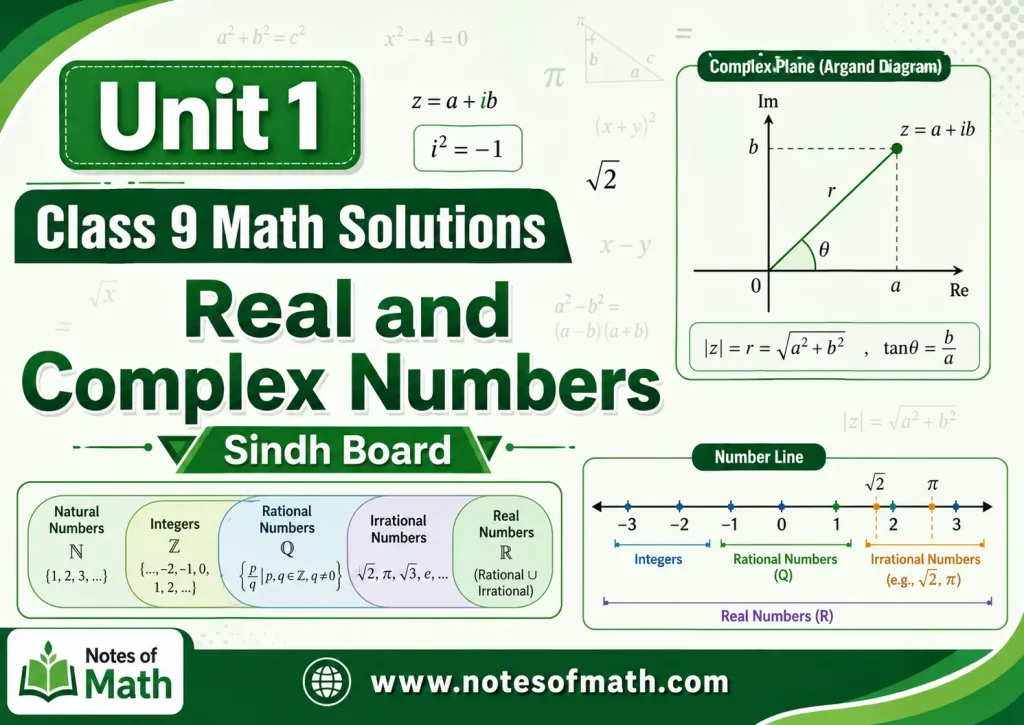
The later exercises introduce complex numbers. Students learn why the imaginary unit is needed, how a complex number is written and how basic operations are performed on complex numbers.
A complex number is generally written as:
\[
z=a+ib
\]
Here, (a) and (b) are real numbers and:
\[
i=\sqrt{-1}
\]
Therefore:
\[
i^2=-1
\]
These concepts create a foundation for algebra, quadratic equations and several higher-level mathematical topics.
Exercise 1.1 – Real, Rational and Irrational Numbers
Exercise 1.1 focuses on the classification and representation of real numbers.
Students learn about important sets of numbers, including:
- Natural numbers
- Whole numbers
- Integers
- Rational numbers
- Irrational numbers
- Real numbers
A rational number can be expressed in the form:
\[
\frac{p}{q}
\]
where (p) and (q) are integers and:
\[
q\neq 0
\]
For example:
\[
\frac{3}{4},\quad -5,\quad 0.25
\]
are rational numbers.
Numbers that cannot be expressed as a ratio of two integers are called irrational numbers. Common examples include:
\[
\sqrt{2},\quad \sqrt{3},\quad \pi
\]
This exercise also helps students distinguish between terminating, recurring and non-recurring decimal representations. Questions may also require students to represent real numbers on a number line.
Students should carefully examine the decimal form of a number before deciding whether it is rational or irrational.
Exercise 1.2 – Properties of Real Numbers
Exercise 1.2 covers the fundamental properties of real numbers under addition and multiplication.
The main properties include:
- Closure property
- Commutative property
- Associative property
- Additive identity
- Multiplicative identity
- Additive inverse
- Multiplicative inverse
- Distributive property
For addition, the commutative property states:
\[
a+b=b+a
\]
The associative property states:
\[
(a+b)+c=a+(b+c)
\]
The distributive property of multiplication over addition is:
\[
a(b+c)=ab+ac
\]
Students also study the properties of equality and inequality. When multiplying or dividing an inequality by a negative number, the direction of the inequality sign must be reversed.
For example, if:
\[
a>b
\]
then multiplying both sides by (-1) gives:
\[
-a<-b
\]
The Unit 1 Class 9 Math solutions explain which property is being used at each step.
Exercise 1.3 – Radicals and Radicands
Exercise 1.3 introduces radicals, radicands and indices.
In the expression:
\[
\sqrt[n]{a}
\]
the symbol \(\sqrt{\phantom{x}}\) is the radical sign, \(a\) is the radicand and \(n\) is the index.
Students learn how to convert expressions from radical form to exponential form and from exponential form to radical form.
The general relationship is:
\[
\sqrt[n]{a^m}=a^{\frac{m}{n}}
\]
For example:
\[
\sqrt[3]{x^2}=x^{\frac{2}{3}}
\]
Similarly:
\[
x^{\frac{3}{4}}=\sqrt[4]{x^3}
\]
Students should pay close attention to the numerator and denominator of a fractional exponent. The numerator becomes the power, while the denominator becomes the index of the radical.
Exercise 1.4 – Laws of Exponents
Exercise 1.4 teaches students how to simplify expressions by applying the laws of exponents or indices.
Some important laws are given below.
Product of Powers
\[
a^m\times a^n=a^{m+n}
\]
Quotient of Powers
\[
\frac{a^m}{a^n}=a^{m-n}
\]
where (a\neq 0).
Power of a Power
\[
(a^m)^n=a^{mn}
\]
Power of a Product
\[
(ab)^n=a^nb^n
\]
Zero Exponent
\[
a^0=1
\]
where \(a\neq 0\).
Negative Exponent
\[
a^{-n}=\frac{1}{a^n}
\]
Students should first identify the base of each term and then select the correct law. Exponents can only be added directly when powers with the same base are multiplied.
Exercise 1.5 – Introduction to Complex Numbers
Exercise 1.5 introduces imaginary and complex numbers.
The imaginary unit is represented by (i), where:
\[
i=\sqrt{-1}
\]
and:
\[
i^2=-1
\]
A complex number has the standard form:
\[
z=a+ib
\]
Here:
- (a) is the real part.
- (b) is the imaginary part.
The real and imaginary parts may be written as:
\[
\operatorname{Re}(z)=a
\]
and:
\[
\operatorname{Im}(z)=b
\]
Students also learn how to write complex numbers as ordered pairs:
\[
a+ib=(a,b)
\]
For example:
\[
3+4i=(3,4)
\]
The conjugate of:
\[
z=a+ib
\]
is:
\[
\overline{z}=a-ib
\]
Only the sign of the imaginary part changes when finding the conjugate.
Two complex numbers are equal when their corresponding real and imaginary parts are equal. Therefore:
\[
a+ib=c+id
\]
if and only if:
\[
a=c
\]
and:
\[
b=d
\]
Exercise 1.6 – Operations on Complex Numbers
Exercise 1.6 covers addition, subtraction, multiplication and division of complex numbers.
Suppose:
\[
z_1=a+ib
\]
and:
\[
z_2=c+id
\]
Addition of Complex Numbers
\[
z_1+z_2=(a+c)+i(b+d)
\]
The real parts are added together, and the imaginary parts are added together.
Subtraction of Complex Numbers
\[
z_1-z_2=(a-c)+i(b-d)
\]
Students must apply the negative sign to both terms of the second complex number.
Multiplication of Complex Numbers
\[
(a+ib)(c+id)
\]
After expanding and using (i^2=-1), the result becomes:
\[
(ac-bd)+i(ad+bc)
\]
Division of Complex Numbers
To divide complex numbers, multiply the numerator and denominator by the conjugate of the denominator.
For example:
\[
\frac{a+ib}{c+id}
\]
is multiplied by:
\[
\frac{c-id}{c-id}
\]
The conjugate removes the imaginary term from the denominator because:
\[
(c+id)(c-id)=c^2+d^2
\]
The step-by-step Exercise 1.6 solutions show how each operation is completed and how the final answer is written in standard form.
Unit 1 Review Exercise
The Unit 1 Review Exercise combines concepts from all six exercises.
It may contain questions related to:
- Classification of numbers
- Properties of real numbers
- Radicals and fractional exponents
- Laws of indices
- Real and imaginary parts
- Conjugates of complex numbers
- Addition and subtraction of complex numbers
- Multiplication and division of complex numbers
- Multiple-choice questions
- Fill-in-the-blank questions
Students should attempt the review exercise after completing Exercises 1.1 to 1.6. It provides a useful check of whether the main concepts of the unit have been understood.
Important Formulas from Unit 1
The following formulas are useful for revision:
\[
\mathbb{R}=\mathbb{Q}\cup\mathbb{Q}’
\]
\[
\sqrt[n]{a^m}=a^{\frac{m}{n}}
\]
\[
a^m\times a^n=a^{m+n}
\]
\[
\frac{a^m}{a^n}=a^{m-n}
\]
\[
(a^m)^n=a^{mn}
\]
\[
a^{-n}=\frac{1}{a^n}
\]
\[
i^2=-1
\]
\[
(a+ib)+(c+id)=(a+c)+i(b+d)
\]
\[
(a+ib)-(c+id)=(a-c)+i(b-d)
\]
\[
(a+ib)(c+id)=(ac-bd)+i(ad+bc)
\]
Common Mistakes to Avoid
Students should avoid the following common mistakes while solving Unit 1 questions:
- Treating every non-terminating decimal as an irrational number
- Forgetting that recurring decimals are rational numbers
- Writing a rational number with a zero denominator
- Confusing additive identity with multiplicative identity
- Adding exponents when the bases are different
- Interchanging the numerator and denominator of a fractional exponent
- Forgetting that \(i^2=-1\)
- Combining real and imaginary terms incorrectly
- Changing the sign of the real part when finding a conjugate
- Dividing complex numbers without using the conjugate
Writing every step clearly can prevent most of these errors.
How to Prepare Unit 1 for Exams
Begin by learning the definitions of rational, irrational, real and complex numbers. After that, revise the properties of real numbers and practise identifying the property used in each statement.
Memorize the main laws of exponents, but also understand when each law can be applied. Practise converting between radical and exponential forms until the placement of the index and power becomes clear.
For complex numbers, remember to separate the real and imaginary parts. During multiplication, replace every occurrence of \(i^2\) with \(-1\). During division, use the conjugate of the denominator.
After studying the concepts, solve the textbook questions independently. Use the PDF solutions to check the method and correct any mistakes.
Why These Unit 1 Solutions Are Helpful
These exercise-wise solutions can help students:
- Understand difficult questions through complete working
- Learn the correct use of formulas and mathematical rules
- Check homework answers
- Revise each exercise separately
- Prepare for class tests and board examinations
- Identify and correct mistakes in calculations
Students should use the solutions as a learning resource rather than copying final answers without understanding the method.
Frequently Asked Questions
What is the name of Unit 1 in Class 9 Sindh Board Mathematics?
The name of Unit 1 is Real and Complex Numbers.
How many exercises are included in Unit 1?
The unit contains six exercises, from Exercise 1.1 to Exercise 1.6, followed by a Review Exercise.
Are all Unit 1 exercises solved on this page?
Yes. Separate PDF solutions are provided for all six exercises and the Unit 1 Review Exercise.
Are these solutions suitable for Sindh Board students?
Yes. The solutions follow the topics and exercise structure of the Class 9 Mathematics textbook prescribed for Sindh Board students.
Can these solutions help with examination preparation?
Yes. They explain the required methods, formulas and calculations step by step. Students should first attempt each question themselves and then compare their work with the solution.
Can the PDF solutions be viewed on a mobile phone?
Yes. Students can open and read the exercise-wise PDF solutions on mobile phones, tablets and computers.
Disclaimer
These solutions have been prepared for educational support. Students should also consult their official Sindh Textbook Board Mathematics book and follow the instructions provided by their teachers.
Final Words
The Unit 1 Class 9 Math solutions for Sindh Board provide complete help with real numbers, radicals, exponents and complex numbers. The exercise-wise PDFs make it easier to locate a question and understand its complete working.
Students should not use the solutions only for copying answers. They should first attempt each question independently, identify the relevant rule or formula and then use the provided solution to check their method.