Unit 13 Class 9 Math Solutions Sindh Board Practical Geometry Triangles
Unit 13 Class 9 Math Solutions Sindh Board are available below for Exercises 13.1 to 13.3 and the Unit 13 Review Exercise. Open the required PDF to view complete step-by-step solutions.
This unit covers the construction of triangles, angle bisectors, perpendicular bisectors, altitudes, and medians using a straightedge and compass. For other units, visit our Class 9 Math Notes Sindh Board page.
Unit 13 Class 9 Math Solutions Sindh Board
Select an exercise below to view its complete PDF solutions.
Unit 13 Quick Overview
| Detail | Information |
| Class | Class 9 |
| Subject | Mathematics |
| Board | Sindh Board |
| Unit | Unit 13 |
| Unit Name | Practical Geometry – Triangles |
| Exercises | Exercise 13.1 to Exercise 13.3 |
| Additional Material | Unit 13 Review Exercise |
| Solution Format | Step-by-step PDF solutions |
What Is Practical Geometry – Triangles About?
Practical Geometry involves constructing geometric figures accurately using drawing instruments such as a ruler (straightedge), a pair of compasses, and a protractor.
In Unit 13, students learn how to construct different types of triangles given specific combinations of measurements, such as:
- Three sides (SSS)
- Two sides and the included angle (SAS)
- Two angles and the included side (ASA)
- Right-angle, hypotenuse, and one side (RHS)
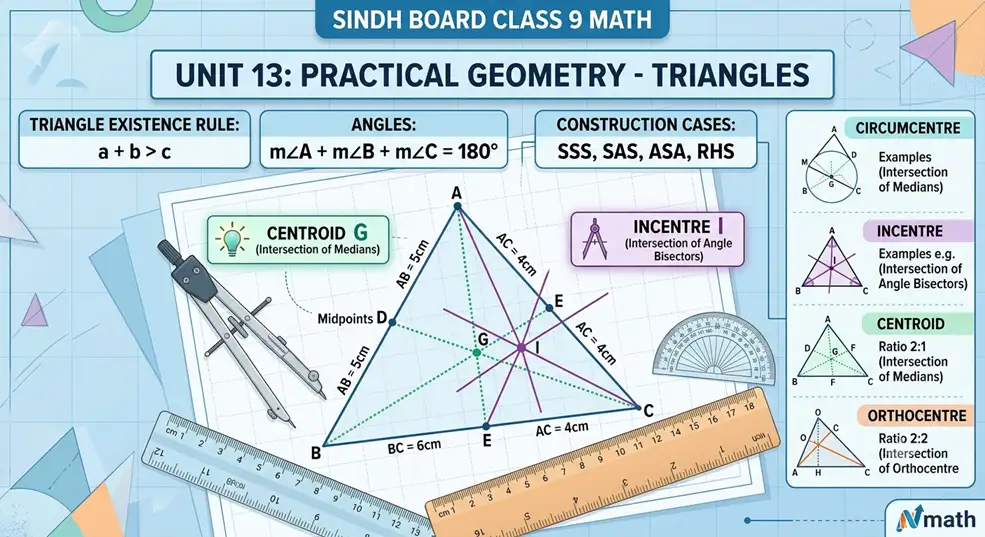
A triangle can only be constructed if the sum of any two side lengths is strictly greater than the third side:
a + b > c, b + c > a, c + a > b
Exercise 13.1 – Construction of Triangles
Exercise 13.1 guides students through constructing basic triangles when given specific side lengths and interior angle measures.
Essential Construction Cases
- Given Three Sides (SSS):
- Draw base line segment AB of given length.
- With center A and radius equal to the second side, draw an arc.
- With center B and radius equal to the third side, draw another arc intersecting the first arc at point C.
- Join AC and BC to complete △ABC.
- Given Two Sides and Included Angle (SAS):
- Draw base line segment AB.
- At point A, construct the given angle m∠A using a compass or protractor.
- Cut off side AC along the ray forming the angle.
- Join BC to form △ABC.
- Given Two Angles and Included Side (ASA):
- Draw base line segment AB.
- Construct given angles m∠A and m∠B at endpoints A and B.
- The point where the two angle rays intersect is vertex C.
Exercise 13.2 – Angle and Side Bisectors
Exercise 13.2 focuses on drawing perpendicular bisectors of sides and bisectors of interior angles within a triangle to demonstrate points of concurrency.
Key Concepts
- Perpendicular Bisector of a Side: A line perpendicular to a side that divides it into two equal halves.
- Circumcentre: The point of concurrency where all three perpendicular bisectors of a triangle meet. The circumcentre is equidistant from all three vertices of the triangle.
- Angle Bisector: A ray that divides an angle into two equal parts.
- Incentre: The point of concurrency where all three angle bisectors of a triangle meet. The incentre is the center of the inscribed circle (incircle).
Exercise 13.3 – Altitudes and Medians of Triangles
Exercise 13.3 covers the construction of altitudes and medians in a triangle and explores their intersection points.
Key Definitions
- Altitude: A perpendicular line segment drawn from a vertex to the opposite side (or its extension).
- Orthocentre: The point where the three altitudes of a triangle intersect.
- Median: A line segment connecting a vertex to the midpoint of the opposite side.
- Centroid: The point where the three medians of a triangle intersect. The centroid divides each median in a 2:1 ratio.
Unit 13 Review Exercise
The Unit 13 Review Exercise consolidates practical construction steps and geometric definitions:
- MCQs: Questions testing properties of circumcentre, incentre, centroid, and orthocentre.
- Construction Problems: Drawing triangles and locating points of concurrency step by step.
- True/False Statements: Identifying valid triangle existence criteria (e.g., triangle inequality rules).
Important Concepts and Rules from Unit 13
- Triangle Inequality Rule: a + b > c
- Sum of Interior Angles: m∠A + m∠B + m∠C = 180°
- Points of Concurrency:
- Perpendicular Bisectors → Circumcentre
- Angle Bisectors → Incentre
- Altitudes → Orthocentre
- Medians → Centroid
Common Mistakes to Avoid
- Triangle Inequality Failure: Trying to construct a triangle where the sum of two smaller sides is less than or equal to the third side.
- Inaccurate Compass Radius: Accidentally shifting the compass width mid-construction, resulting in misaligned intersection arcs.
- Omitting Steps of Construction: Forgetting to write out the numbered steps of construction alongside the geometric diagram.
- Confusing Altitude and Median: Treating a perpendicular line (altitude) as a line connecting to the midpoint of a side (median).
How to Prepare Unit 13 for Exams
- Practice with Geometry Tools: Use a sharp pencil, an accurate ruler, and a firm compass for all construction practice.
- Memorize Construction Steps: Learn the standard phrasing for steps of construction (e.g., “Draw a line segment AB…”, “With center A, draw an arc…”).
- Know Points of Concurrency: Differentiate clearly between circumcentre, incentre, orthocentre, and centroid for objective questions.
- Keep Diagrams Clean: Leave arc lines visible on the paper—examiners inspect construction marks to verify correct technique.
Why These Unit 13 Solutions Are Helpful
- Precise Geometric Figures: Features clear step-by-step diagrams corresponding to textbook problems.
- Written Construction Steps: Every solution includes fully written construction steps in plain language.
- Sindh Board Alignment: Follows the exact exercise structure and syllabus for Class 9 Sindh Board.
Frequently Asked Questions
What is the name of Unit 13 in Class 9 Sindh Board Mathematics?
The name of Unit 13 is Practical Geometry – Triangles.
How many exercises are included in Unit 13?
Unit 13 contains three main exercises (Exercise 13.1, Exercise 13.2, and Exercise 13.3) followed by a Review Exercise.
Are steps of construction required in exam answers?
Yes. Drawing the diagram alone is usually insufficient; written steps of construction are required for full marks.
Are all solutions available in PDF format?
Yes. Complete step-by-step PDF solutions for Exercises 13.1 to 13.3 and the Review Exercise are available.
Related Class 9 Math Resources
- Class 9 Math Notes Sindh Board – All Units
- Unit 12 Class 9 Math Solutions – Sides and Angles of a Triangle
- Unit 14 Class 9 Math Solutions – Theorems Related with Area
Disclaimer
These solved notes are provided for educational support and self-study purposes. Students should practice geometric constructions independently using physical instruments and follow official Sindh Textbook Board guidelines.
Final Words
Unit 13 Class 9 Math Solutions offer a clear roadmap to mastering geometric constructions. By practicing arc placements, line bisections, and written steps of construction, students can confidently score full marks in the practical geometry section of their examinations.
