
Unit 11 Class 9 Math Solutions Sindh Board – Line Bisectors and Angles Bisectors
Unit 11 Class 9 Math Solutions Sindh Board are available below for Exercises 11.1 and 11.2 and the Unit 11 Review Exercise. Students can view or download each PDF to study complete step-by-step solutions, theorem proofs and geometrical reasoning.
This unit explains the perpendicular bisector of a line segment, the bisector of an angle, points equidistant from endpoints or angle arms, and the concurrency of perpendicular bisectors and angle bisectors in a triangle. For solutions to all units, visit the Class 9 Math Notes Sindh Board hub page.
Unit 11 Class 9 Math Exercise Solutions
Select an exercise below to view or download its complete PDF solutions.
Unit 11 Quick Overview
What Is a Bisector?
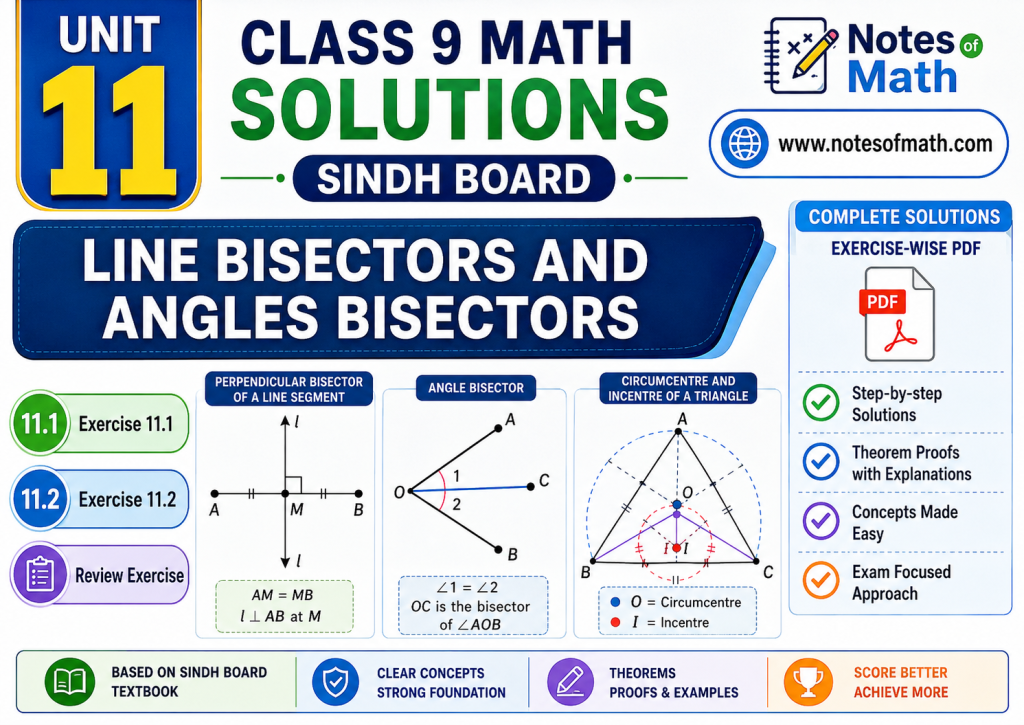
A bisector divides a geometrical object into two equal parts. Unit 11 covers two important types:
- The right or perpendicular bisector of a line segment
- The bisector of an angle
Both ideas are connected with equal distances. A point on the perpendicular bisector of a segment is equally distant from its endpoints. A point on the angle bisector is equally distant from the two arms of the angle.
Right Bisector of a Line Segment
The textbook uses the term right bisector for a perpendicular bisector. It divides a line segment into two equal parts at a right angle.
Suppose line \(l\) is the right bisector of segment \(AB\) and meets \(AB\) at \(M\). Then:\[ AM\cong MB \]
and:\[ l\perp AB \]
A line passing only through the midpoint is not necessarily a perpendicular bisector. It must also be perpendicular to the segment.
Exercise 11.1 – Perpendicular Bisectors
Exercise 11.1 focuses on the right bisector of a line segment, points equidistant from the endpoints of a segment and the common point of the perpendicular bisectors of a triangle.
Theorem 1: A Point on the Right Bisector Is Equidistant from the Endpoints
Statement: Any point on the right bisector of a line segment is equidistant from the endpoints of that segment.
Let \(M\) be the midpoint of \(XY\), and let \(PM\) be perpendicular to \(XY\). Then:\[ XM\cong MY \] \[ PM\perp XY \]
We need to prove:\[ PX\cong PY \]
Consider triangles \(PMX\) and \(PMY\). Since \(M\) is the midpoint:\[ XM\cong MY \]
Also:\[ PM\cong PM \]
because it is common, and:\[ \angle PMX=\angle PMY=90^\circ \]
Therefore:\[ \triangle PMX\cong\triangle PMY \]
by side-angle-side congruence. Hence:\[ PX\cong PY \]
because corresponding parts of congruent triangles are congruent.
Using the Theorem in Algebraic Questions
If \(P\) lies on the perpendicular bisector of \(AB\), and:\[ PA=3x+2 \] \[ PB=5x-6 \]
then:\[ 3x+2=5x-6 \] \[ 3x+8=5x \] \[ 8=2x \] \[ x=4 \]
Theorem 2: Converse of the Perpendicular-Bisector Theorem
Statement: Any point equidistant from the endpoints of a line segment lies on the right bisector of that segment.
Suppose:\[ PX\cong PY \]
Let \(M\) be the midpoint of \(XY\), so:\[ XM\cong MY \]
Join \(P\) to \(M\). Also:\[ PM\cong PM \]
Therefore:\[ \triangle PMX\cong\triangle PMY \]
by side-side-side congruence. Hence:\[ \angle PMX\cong\angle PMY \]
These equal adjacent angles form a straight angle, so each is \(90^\circ\). Therefore:\[ PM\perp XY \]
Since \(M\) is the midpoint of \(XY\), \(PM\) is its perpendicular bisector. Thus, \(P\) lies on the right bisector of \(XY\).
Original Theorem and Converse
| Original Theorem | Converse |
|---|---|
| The point lies on the perpendicular bisector. | The point is equidistant from the endpoints. |
| Conclusion: the two distances are equal. | Conclusion: the point lies on the perpendicular bisector. |
Theorem 3: Perpendicular Bisectors of a Triangle Are Concurrent
Statement: The right bisectors of the sides of a triangle are concurrent.
Concurrent lines pass through one common point. In triangle \(ABC\), let the perpendicular bisectors of \(AB\) and \(BC\) meet at \(O\).
Since \(O\) lies on the perpendicular bisector of \(AB\):\[ OA\cong OB \]
Since \(O\) lies on the perpendicular bisector of \(BC\):\[ OB\cong OC \]
Therefore:\[ OA\cong OC \]
Thus, \(O\) is equidistant from \(A\) and \(C\). By the converse theorem, \(O\) also lies on the perpendicular bisector of \(AC\). Hence all three perpendicular bisectors are concurrent.
Circumcentre and Circumcircle
The common point of the perpendicular bisectors of a triangle is called the circumcentre.
If \(O\) is the circumcentre of triangle \(ABC\), then:\[ OA\cong OB\cong OC \]
A circle with centre \(O\) passing through the three vertices is called the circumcircle.
| Type of Triangle | Position of Circumcentre |
|---|---|
| Acute triangle | Inside the triangle |
| Right triangle | At the midpoint of the hypotenuse |
| Obtuse triangle | Outside the triangle |
Bisector of an Angle
An angle bisector divides an angle into two congruent angles.
If ray \(AP\) bisects \(\angle BAC\), then:\[ \angle BAP\cong\angle PAC \]
The distance from a point to a line is measured along a perpendicular. If \(P\) lies inside \(\angle BAC\), draw:\[ PM\perp AB \] \[ PN\perp AC \]
Then \(PM\) and \(PN\) represent the distances from \(P\) to the two arms of the angle.
Exercise 11.2 – Angle Bisectors
Exercise 11.2 focuses on points lying on angle bisectors, the converse theorem and the common point of the internal angle bisectors of a triangle.
Theorem 4: A Point on an Angle Bisector Is Equidistant from the Arms
Statement: Any point on the bisector of an angle is equidistant from the arms of the angle.
Let \(AP\) bisect \(\angle BAC\). Draw perpendiculars:\[ PM\perp AB \] \[ PN\perp AC \]
We need to prove:\[ PM\cong PN \]
In right triangles \(APM\) and \(APN\):\[ \angle MAP\cong\angle PAN \]
because \(AP\) bisects the angle,\[ \angle AMP=\angle ANP=90^\circ \]
and:\[ AP\cong AP \]
Therefore:\[ \triangle APM\cong\triangle APN \]
Hence:\[ PM\cong PN \]
Using the Theorem Algebraically
If the perpendicular distances from \(P\) to the arms are:\[ PM=4x-1 \] \[ PN=2x+7 \]
then:\[ 4x-1=2x+7 \] \[ 2x=8 \] \[ x=4 \]
Theorem 5: Converse of the Angle-Bisector Theorem
Statement: Any point inside an angle that is equidistant from its arms lies on the bisector of the angle.
Suppose:\[ PM\perp AB \] \[ PN\perp AC \]
and:\[ PM\cong PN \]
In right triangles \(APM\) and \(APN\), the hypotenuse \(AP\) is common and one corresponding side is equal. Therefore:\[ \triangle APM\cong\triangle APN \]
by hypotenuse-side congruence. Hence:\[ \angle MAP\cong\angle PAN \]
Therefore, \(AP\) bisects \(\angle BAC\).
Original and Converse Angle-Bisector Results
| Original Theorem | Converse |
|---|---|
| The point lies on the angle bisector. | The point is equidistant from the arms. |
| Conclusion: perpendicular distances are equal. | Conclusion: the point lies on the angle bisector. |
Theorem 6: Angle Bisectors of a Triangle Are Concurrent
Statement: The bisectors of the angles of a triangle are concurrent.
Let the bisectors of \(\angle A\) and \(\angle B\) of triangle \(ABC\) meet at \(I\). Draw perpendiculars from \(I\) to the three sides:\[ ID\perp AB \] \[ IE\perp AC \] \[ IF\perp BC \]
Since \(I\) lies on the bisector of \(\angle A\):\[ ID\cong IE \]
Since \(I\) lies on the bisector of \(\angle B\):\[ ID\cong IF \]
Therefore:\[ IE\cong IF \]
Thus, \(I\) is equidistant from the arms of \(\angle C\). By the converse theorem, \(I\) lies on the bisector of \(\angle C\). Hence all three internal angle bisectors are concurrent.
Incentre and Incircle
The common point of the internal angle bisectors of a triangle is called the incentre.
If \(I\) is the incentre and \(ID\), \(IE\) and \(IF\) are perpendicular to the sides, then:\[ ID\cong IE\cong IF \]
A circle with centre \(I\) and radius equal to these perpendicular distances touches all three sides. It is called the incircle.
The incentre always lies inside the triangle.
Circumcentre and Incentre Compared
| Circumcentre | Incentre |
|---|---|
| Intersection of perpendicular bisectors | Intersection of internal angle bisectors |
| Equidistant from the three vertices | Equidistant from the three sides |
| Centre of the circumcircle | Centre of the incircle |
| May lie inside, on or outside the triangle | Always lies inside the triangle |
How to Identify the Correct Theorem
| Given Information | Result |
|---|---|
| Point lies on a perpendicular bisector | It is equidistant from the endpoints. |
| Point is equidistant from two endpoints | It lies on the perpendicular bisector. |
| Perpendicular bisectors of triangle sides | They meet at the circumcentre. |
| Point lies on an angle bisector | It is equidistant from the arms. |
| Point is equidistant from the angle arms | It lies on the angle bisector. |
| Internal angle bisectors of a triangle | They meet at the incentre. |
Writing Theorem Proofs in Unit 11
A complete proof should contain the following parts:
Given
Write the information provided in the question.
To Prove
State the exact equality, bisection or concurrency result required.
Construction
Write any extra perpendicular, joining segment or intersection point added to the figure.
Proof
Present every statement with a valid reason.
Useful Reasons
- Definition of midpoint
- Definition of perpendicular bisector
- Definition of angle bisector
- All right angles are congruent
- A common side is congruent to itself
- Triangle congruence conditions
- Corresponding parts of congruent triangles are congruent
- Transitive property of equality
- Converse of a proved theorem
Unit 11 Review Exercise
The Unit 11 Review Exercise combines definitions, theorem statements, applications and geometrical proofs from Exercises 11.1 and 11.2.
- Right or perpendicular bisector of a segment
- Points equidistant from two endpoints
- Original and converse perpendicular-bisector theorems
- Concurrency of perpendicular bisectors
- Circumcentre and circumcircle
- Angle bisector and perpendicular distance
- Points equidistant from angle arms
- Original and converse angle-bisector theorems
- Concurrency of angle bisectors
- Incentre and incircle
- Algebraic equal-distance questions
- Theorem proofs and multiple-choice questions
Common Mistakes to Avoid
- Confusing a midpoint line with a perpendicular bisector
- Forgetting that a perpendicular bisector forms a right angle
- Measuring distance to a line along a non-perpendicular segment
- Using the original theorem when the converse is required
- Confusing endpoints of a segment with arms of an angle
- Calling the circumcentre the incentre
- Assuming the circumcentre is always inside the triangle
- Using corresponding parts before proving triangles congruent
- Leaving reasons out of a theorem proof
- Failing to mark equal segments, equal angles and right angles
How to Prepare Unit 11 for Exams
Begin by learning the definitions of perpendicular bisector, angle bisector, circumcentre and incentre.
Memorize all six theorem statements, but also understand the difference between each theorem and its converse.
Practise drawing clean diagrams. Mark equal segments with matching strokes, equal angles with matching arcs and perpendicular angles with small squares.
For concurrency proofs, follow the chain of equal distances carefully. Two bisectors establish two equalities, and the transitive property places the common point on the third bisector.
After attempting each textbook question, use the Unit 11 Class 9 Math Solutions Sindh Board PDFs to compare your diagram, construction, statements, reasons and final conclusion.
Why These Unit 11 Solutions Are Helpful
- Explain perpendicular and angle bisectors clearly
- Distinguish theorems from their converses
- Show congruence proofs step by step
- Explain the circumcentre and circumcircle
- Explain the incentre and incircle
- Cover all six main theorems
- Help students solve equal-distance questions
- Provide proper proof-writing formats
- Support homework, tests and board-exam preparation
- Allow each PDF to be viewed or downloaded separately
Frequently Asked Questions
What is the name of Unit 11?
The name of Unit 11 is Line Bisectors and Angles Bisectors.
How many exercises are included in Unit 11?
Unit 11 contains Exercise 11.1 and Exercise 11.2, followed by a Review Exercise.
What is covered in Exercise 11.1?
Exercise 11.1 covers perpendicular bisectors, points equidistant from endpoints, converse results and the circumcentre.
What is covered in Exercise 11.2?
Exercise 11.2 covers angle bisectors, points equidistant from angle arms, converse results and the incentre.
What is a perpendicular bisector?
It is a line that divides a segment into two equal parts at a right angle.
What is the circumcentre?
The circumcentre is the common point of the perpendicular bisectors of a triangle. It is equidistant from the three vertices.
What is the incentre?
The incentre is the common point of the internal angle bisectors of a triangle. It is equidistant from the three sides.
Can students download all Unit 11 solution PDFs?
Yes. Separate viewable and downloadable PDFs are provided for Exercises 11.1, 11.2 and the Unit 11 Review Exercise.
Related Class 9 Math Resources
- Class 9 Math Notes Sindh Board
- Unit 10 Class 9 Math Solutions Sindh Board
- Unit 12 Class 9 Math Solutions Sindh Board
Disclaimer
These solutions are prepared independently for educational support. Students should also consult their official Sindh Textbook Board Mathematics book and follow their teachers’ instructions.
Final Words
The Unit 11 Class 9 Math Solutions Sindh Board provide complete exercise-wise help with perpendicular bisectors, angle bisectors, equal-distance theorems, circumcentre, incentre and geometrical proofs.
Students should first attempt every theorem and exercise question independently and then use the PDFs to check their diagram, construction, statements, reasons and final conclusion.
For all other units, visit the Class 9 Math Notes Sindh Board hub page.