
Unit 28 Class 10 Math Sindh Board Solutions – Angle in a Segment of a Circle
The Unit 28 Class 10 Math Sindh Board Solutions available on this page provide complete, step-by-step answers for the chapter Angle in a Segment of a Circle. These solutions are prepared according to the Class 10 Mathematics textbook prescribed by the Sindh Textbook Board.
This unit explains the relationship between central angles, inscribed angles, arcs, chords and cyclic quadrilaterals. The PDF includes essential geometrical facts, complete solutions of Exercise 28.1 and Exercise 28.2, proof-based questions, diagrams and solved multiple-choice questions from Review Exercise 28.
Students can use these solutions to understand each theorem, practise numerical questions and prepare for examinations.
About Unit 28: Angle in a Segment of a Circle
An angle in a segment of a circle is an angle formed at the circumference by two chords. Its measurement depends on the arc intercepted by the angle.
Unit 28 introduces several important circle theorems. These theorems help students calculate unknown angles and prove geometrical relationships involving circles.
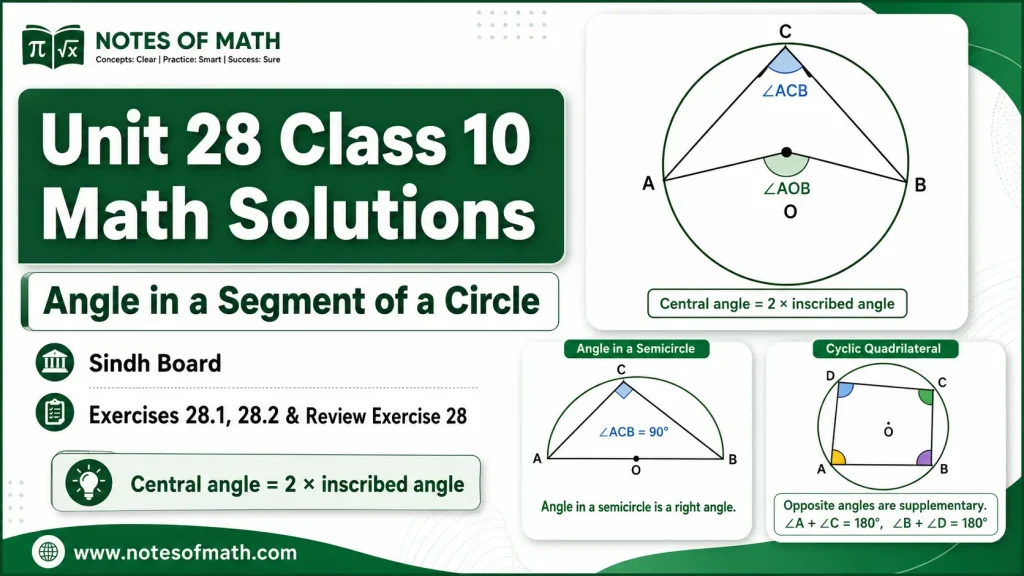
The main topics covered in this unit include:
- Central and inscribed angles
- Angles in a semicircle
- Angles in the same segment
- Major and minor arcs
- Cyclic quadrilaterals
- Exterior angles of cyclic quadrilaterals
- Proofs involving inscribed figures
- Classification of acute, obtuse and right inscribed angles
What Is Included in the Unit 28 Solutions PDF?
The complete PDF contains:
- Essential facts and theorems used in Unit 28
- Step-by-step solutions of Exercise 28.1
- Numerical questions involving central and inscribed angles
- Detailed geometrical proofs
- Complete solutions of Exercise 28.2
- Questions involving diameters and semicircles
- Questions involving major and minor arcs
- Proof that a cyclic rhombus is a square
- Proof of the exterior-angle property of a cyclic quadrilateral
- Solved Review Exercise 28
- Correct answers to all multiple-choice questions
- Clearly labelled circle diagrams
Each question is written with its complete statement, relevant theorem, calculations and final answer.
Important Concepts Used in Unit 28
Central and Inscribed Angles
When a central angle and an inscribed angle stand on the same arc, the central angle is twice the inscribed angle.
\(\angle AOB=2\angle ACB\)
Therefore:
\(\angle ACB=\frac{1}{2}\angle AOB\)
For example, when an inscribed angle is \(30^\circ\), the corresponding central angle is:
\(\angle AOB=2(30^\circ)=60^\circ\)
This property is repeatedly used in Exercise 28.1.
Angle in a Semicircle
An angle formed by a diameter at any point on the remaining semicircle is always a right angle.
\(\angle ABC=90^\circ\)
This theorem allows students to treat the inscribed triangle as a right-angled triangle and then use the angle-sum property:
\(\angle A+\angle B+\angle C=180^\circ\)
Angles in the Same Segment
Angles standing on the same chord and lying in the same segment of a circle are equal.
\(\angle ACB=\angle ADB\)
This property is useful when two inscribed angles intercept the same arc.
Major and Minor Arcs
An inscribed angle whose vertex lies on a major arc intercepts the corresponding minor arc. Such an angle is normally acute:
\(\angle C<90^\circ\)
An inscribed angle whose vertex lies on a minor arc intercepts the corresponding major arc. Such an angle is obtuse:
\(\angle C>90^\circ\)
Students use these conditions to solve inequalities involving unknown values of \(x\).
Cyclic Quadrilateral
A quadrilateral whose four vertices lie on a circle is called a cyclic quadrilateral.
The opposite angles of a cyclic quadrilateral are supplementary:
\(\angle A+\angle C=180^\circ\)
\(\angle B+\angle D=180^\circ\)
Another important result is that an exterior angle of a cyclic quadrilateral is equal to its interior opposite angle.
Exercise 28.1 Solutions
Exercise 28.1 focuses mainly on the relationship between central angles, inscribed angles and intercepted arcs.
Finding a Central Angle
Students are required to find a central angle when the corresponding inscribed angle is given.
The rule used is:
\(\text{Central angle}=2\times\text{inscribed angle}\)
For an inscribed angle of \(30^\circ\):
\(x=2(30^\circ)=60^\circ\)
Finding an Inscribed Angle
Some questions provide the reflex central angle. Students must first calculate the minor central angle by subtracting it from \(360^\circ\).
For example:
\(\angle QOR=360^\circ-240^\circ=120^\circ\)
The corresponding inscribed angle is:
\(\angle QPR=\frac{1}{2}(120^\circ)=60^\circ\)
The remaining angle can then be calculated using the angle sum of a triangle.
Isosceles Triangles Formed by Radii
When two sides of a triangle are radii of the same circle, they are equal.
\(\displaystyle OA=OB\)
Therefore, triangle \(AOB\) is isosceles and its base angles are equal. This fact is used together with the central-angle theorem to calculate expressions such as \(x+y\).
Proof Questions in Exercise 28.1
The exercise also includes geometrical proofs.
Students prove that the inscribed angles of congruent major arcs in congruent circles are congruent. Since an inscribed angle is half the measure of its intercepted arc, equal arcs produce equal inscribed angles.
Another proof shows that inscribed angles intercepting a major arc and its corresponding minor arc are supplementary. Since the major and minor arcs together form a complete circle:
\(\text{Major arc}+\text{Minor arc}=360^\circ\)
Taking half of both arc measures gives:
\(\angle ACB+\angle ADB=180^\circ\)
Exercise 28.2 Solutions
Exercise 28.2 covers angles in a semicircle, inequalities involving inscribed angles and properties of cyclic quadrilaterals.
Diameter and Triangle Angles
When one side of an inscribed triangle is a diameter, the opposite angle is \(90^\circ\).
For expressions \(x+11^\circ\) and \(2x+25^\circ\), the angle sum becomes:
\((x+11^\circ)+(2x+25^\circ)+90^\circ=180^\circ\)
Simplifying:
\(3x+126^\circ=180^\circ\)
\(3x=54^\circ\)
\(x=18^\circ\)
Inscribed Angle on a Major Arc
When the vertex of an inscribed angle lies on a major arc, the angle is acute.
For an angle measuring \(2x-2^\circ\):
\(2x-2^\circ<90^\circ\)
\(2x<92^\circ\)
\(x<46^\circ\)
Inscribed Angle on a Minor Arc
When the vertex lies on a minor arc, the inscribed angle is obtuse.
For an angle measuring \(7x-1^\circ\):
\(7x-1^\circ>90^\circ\)
\(7x>91^\circ\)
\(x>13^\circ\)
These questions help students connect geometrical properties with algebraic inequalities.
Proof That a Cyclic Rhombus Is a Square
One of the important proof questions asks students to prove that a rhombus inscribed in a circle is a square.
In a rhombus, opposite angles are equal:
\(\angle A=\angle C\)
A cyclic quadrilateral has supplementary opposite angles:
\(\angle A+\angle C=180^\circ\)
Since the angles are equal:
\(2\angle A=180^\circ\)
\(\angle A=\angle C=90^\circ\)
Similarly:
\(\angle B=\angle D=90^\circ\)
The rhombus therefore has four equal sides and four right angles. Hence, it is a square.
Exterior Angle of a Cyclic Quadrilateral
The exterior angle of a cyclic quadrilateral is equal to its interior opposite angle.
For cyclic quadrilateral \(ABCD\):
\(\angle DAB+\angle BCD=180^\circ\)
The interior angle and adjacent exterior angle form a linear pair:
\(\angle DAB+\angle EAD=180^\circ\)
Comparing both equations gives:
\(\angle EAD=\angle BCD\)
This proof combines the cyclic-quadrilateral property with the linear-pair property.
Review Exercise 28
Review Exercise 28 contains multiple-choice questions based on the complete unit. The questions test whether students understand:
- The nature of an inscribed angle on a minor arc
- The definition of a segment of a circle
- The relationship between central and inscribed angles
- Angles in the same segment
- Supplementary angles in a cyclic quadrilateral
- Properties of a cyclic parallelogram
- The sum of central angles around a circle
For example, if \(2x\) is an inscribed angle, the corresponding central angle is:
\(2(2x)=4x\)
Similarly, if \(2x\) and \(60^\circ\) are angles in the same segment:
\(2x=60^\circ\)
\(x=30^\circ\)
All correct options are clearly marked in the PDF, along with brief explanations.
Important Formulas of Unit 28
Students should revise the following results before attempting the exercises.
Central and inscribed angles:
\(\angle AOB=2\angle ACB\)
\(\angle ACB=\frac{1}{2}\angle AOB\)
Angle in a semicircle:
\(\angle ABC=90^\circ\)
Angles in the same segment:
\(\angle ACB=\angle ADB\)
Opposite angles of a cyclic quadrilateral:
\(\angle A+\angle C=180^\circ\)
\(\angle B+\angle D=180^\circ\)
Exterior angle of a cyclic quadrilateral:
\(\text{Exterior angle}=\text{interior opposite angle}\)
Complete angle around the centre:
\(\text{Sum of central angles}=360^\circ\)
How to Use These Solutions
Students should first review the important theorems and try to solve each question independently. After completing a question, they can compare their method and final answer with the detailed solution.
For proof questions, students should pay attention to the Given, To Prove and Proof sections. This structure makes geometrical arguments easier to understand and reproduce in examinations.
The diagrams should also be studied carefully because they show which angles intercept the same arc, which line is a diameter and which quadrilateral is cyclic.
Why These Solutions Are Helpful
The Unit 28 Class 10 Math Sindh Board Solutions help students:
- Understand circle theorems through diagrams
- Identify central and inscribed angles correctly
- Solve angle-based numerical questions
- Work with algebraic inequalities
- Write complete geometrical proofs
- Prepare for board-examination questions
- Revise important multiple-choice concepts
The steps are arranged in a student-friendly manner so that learners can understand both the method and the reason behind each calculation.
Frequently Asked Questions
What is the title of Unit 28 Class 10 Math?
The title of Unit 28 is Angle in a Segment of a Circle.
Which exercises are included in the PDF?
The PDF includes complete solutions of Exercise 28.1, Exercise 28.2 and Review Exercise 28.
What is the relationship between a central angle and an inscribed angle?
A central angle is twice the corresponding inscribed angle:
\(\angle AOB=2\angle ACB\)
What is the angle in a semicircle?
An angle formed in a semicircle is always a right angle:
\(\angle ABC=90^\circ\)
What is the sum of opposite angles of a cyclic quadrilateral?
The opposite angles are supplementary, so their sum is:
\(180^\circ\)
Final Words
These Unit 28 solutions provide complete preparation for the chapter Angle in a Segment of a Circle. By studying the theorems, worked examples, diagrams and proofs, students can develop a clear understanding of the geometrical relationships used throughout the unit.
Students should practise drawing the figures themselves and mention the relevant theorem at every important step. This will help them present clear and complete solutions in their Class 10 Mathematics examinations.