
Unit 27 Class 10 Math Sindh Board Solutions – Chords and Arcs
Unit 27 of Class 10 Mathematics explains important geometrical relationships involving chords, arcs, central angles, diameters and cyclic quadrilaterals.
The Unit 27 Class 10 Math Sindh Board Solutions available on this page contain complete, student-friendly answers according to the Class 10 Mathematics textbook prescribed by the Sindh Textbook Board. The PDF includes step-by-step solutions of Exercise 27.1 and the complete Review Exercise 27.
Students can use these solutions to understand geometrical proofs, practise circle theorems and prepare for school and board examinations.
Download Solutions of Unit 27 Class 10 Math Sindh Board
The PDF provided on this page contains complete solutions of Unit 27, including:
- Important results related to chords and arcs
- Complete solutions of Exercise 27.1
- Geometrical proofs with diagrams
- Step-by-step angle calculations
- Complete Review Exercise 27
- Correct answers to multiple-choice questions
- Explanations of possible printing mistakes in the textbook
Students should try to solve each question independently before checking the detailed solution.
Unit 27: Chords and Arcs
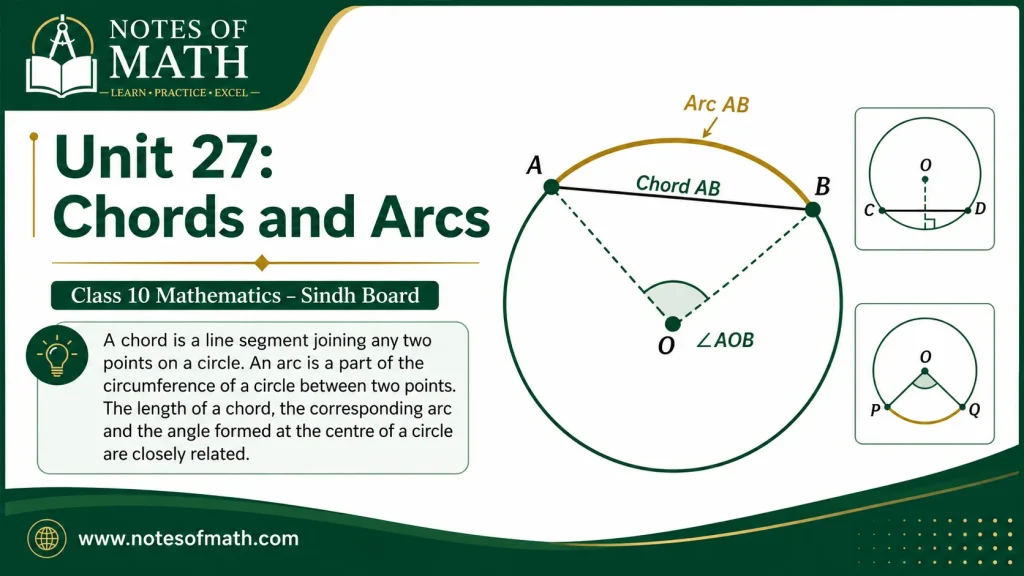
A chord is a line segment joining any two points on a circle.
An arc is a part of the circumference of a circle between two points.
The length of a chord, the corresponding arc and the angle formed at the centre of a circle are closely related. Unit 27 explains these relationships and shows how they can be used in geometrical proofs and numerical questions.
Important Results Used in Unit 27
Students should revise the following results before attempting Exercise 27.1.
Congruent Arcs and Chords
Congruent arcs of the same circle have congruent corresponding chords.
Similarly, equal chords of the same circle intercept equal arcs.
Equal Chords and Central Angles
Equal chords subtend equal angles at the centre of a circle.
Therefore, if:
\[AB=CD\]
then:
\[\angle AOB=\angle COD\]
Equal Central Angles
Equal central angles intercept equal arcs and equal chords.
This result can also be applied to equal or congruent circles.
Parallel and Equal Chords
Two parallel and equal chords of a circle cut off equal arcs between them.
This theorem is proved in the first question of Exercise 27.1.
Angle at the Centre
The angle subtended by an arc at the centre of a circle is twice the angle subtended by the same arc at the circumference.
\[\text{Angle at the centre}=2\times\text{angle at the circumference}\]
Cyclic Quadrilateral
A quadrilateral whose four vertices lie on a circle is called a cyclic quadrilateral.
The opposite angles of a cyclic quadrilateral are supplementary.
\[\angle A+\angle C=180^\circ\]
\[\angle B+\angle D=180^\circ\]
An exterior angle of a cyclic quadrilateral is equal to its opposite interior angle.
Angle in a Semicircle
An angle formed at the circumference by the endpoints of a diameter is always a right angle.
If \(AB\) is a diameter, then:
\[\angle ACB=90^\circ\]
This theorem is commonly used in questions involving a diameter.
Exercise 27.1 Solutions
Exercise 27.1 includes geometrical proofs and questions in which students must calculate unknown angles.
The complete Unit 27 Class 10 Math Sindh Board Solutions explain every step and identify the theorem used in each question.
Question 1: Equal Parallel Chords Cut Off Equal Arcs
The first question asks students to prove that the arcs between two parallel and equal chords are equal.
Suppose \(AB\) and \(CD\) are two equal and parallel chords of a circle with centre \(O\).
Draw:
\[OM\perp AB\]
and:
\[ON\perp CD\]
A perpendicular drawn from the centre of a circle bisects both the chord and the angle subtended by that chord.
Therefore:
\[\angle AOM=\angle MOB\]
and:
\[\angle CON=\angle NOD\]
Since the chords are equal:
\[AB=CD\]
they subtend equal central angles:
\[\angle AOB=\angle COD\]
Therefore, their corresponding half-angles are also equal:
\[\angle AOM=\angle CON\]
and:
\[\angle MOB=\angle NOD\]
Now:
\[\angle AOC=\angle AOM+\angle MON+\angle NOC\]
and:
\[\angle BOD=\angle BOM+\angle MON+\angle NOD\]
The corresponding parts are equal, so:
\[\angle AOC=\angle BOD\]
Equal central angles intercept equal arcs. Therefore:
\[\widehat{AC}=\widehat{BD}\]
Hence, the arcs between the two parallel and equal chords are equal.
Question 2: Equal Central Angles in Equal Circles
This question asks students to prove that equal central angles in equal circles intercept equal arcs.
Suppose the two circles have centres \(O_1\) and \(O_2\).
Given:
\[\angle AO_1B=\angle CO_2D\]
Since the circles are equal, their radii are equal:
\[O_1A=O_2C\]
and:
\[O_1B=O_2D\]
Therefore:
\[\triangle AO_1B\cong\triangle CO_2D\]
by the SAS congruence rule.
Thus:
\[AB=CD\]
Equal chords in congruent circles intercept equal corresponding arcs. Therefore:
\[\widehat{AB}=\widehat{CD}\]
Hence, equal central angles in equal circles intercept equal arcs.
Question 3: Find xxx and yyy
This question involves an exterior angle of a cyclic quadrilateral.
The exterior angle of a cyclic quadrilateral is equal to its opposite interior angle.
Therefore:
\[x+6y=3x+2y\]
Rearranging:
\[6y-2y=3x-x\]
\[4y=2x\]
\[x=2y\]
The second angle relationship shown in the diagram gives:
\[x+6y=80\]
Substitute \(x=2y\):
\[2y+6y=80\]
\[8y=80\]
\[y=10\]
Now:
\[x=2y\]
\[x=2(10)\]
\[x=20\]
Therefore:
\[\boxed{x=20,\quad y=10}\]
Question 4: Find ∠QPR\angle QPR∠QPR and ∠OQR\angle OQR∠OQR
The given angles are:
\[\angle PQR=35^\circ\]
and:
\[\angle PRQ=31^\circ\]
In triangle \(PQR\):
\[\angle QPR+\angle PQR+\angle PRQ=180^\circ\]
Therefore:
\[\angle QPR=180^\circ-35^\circ-31^\circ\]
\[\angle QPR=114^\circ\]
The angle \(\angle QPR\) stands on the major arc \(QR\).
The corresponding reflex central angle is:
\[2(114^\circ)=228^\circ\]
Therefore, the minor central angle is:
\[\angle QOR=360^\circ-228^\circ\]
\[\angle QOR=132^\circ\]
Since \(OQ=OR\), triangle \(QOR\) is isosceles.
Therefore:
\[\angle OQR=\angle ORQ\]
Using the angle sum of a triangle:
\[\angle OQR=\frac{180^\circ-132^\circ}{2}\]
\[\angle OQR=\frac{48^\circ}{2}\]
\[\angle OQR=24^\circ\]
Therefore:
\[\boxed{\angle QPR=114^\circ,\quad \angle OQR=24^\circ}\]
The official answer in the book gives \(92^\circ\) for the second value. However, according to the angles stated in the question, the correct value is \(24^\circ\). There appears to be a printing mistake in the book.
Question 5: Find ∠OAD\angle OAD∠OAD
Given:
\[\angle AOB=120^\circ\]
and:
\[\angle BCD=85^\circ\]
Since \(OA=OB\), triangle \(AOB\) is isosceles.
Therefore:
\[\angle OAB=\angle OBA\]
Using the angle sum of a triangle:
\[\angle OAB=\frac{180^\circ-120^\circ}{2}\]
\[\angle OAB=\frac{60^\circ}{2}\]
\[\angle OAB=30^\circ\]
Since \(ABCD\) is a cyclic quadrilateral, its opposite angles are supplementary:
\[\angle DAB+\angle BCD=180^\circ\]
Therefore:
\[\angle DAB=180^\circ-85^\circ\]
\[\angle DAB=95^\circ\]
At point \(A\):
\[\angle DAB=\angle DAO+\angle OAB\]
Therefore:
\[\angle OAD=95^\circ-30^\circ\]
\[\boxed{\angle OAD=65^\circ}\]
Question 6: Find ∠ACD\angle ACD∠ACD
Given that \(AB\) is a diameter and:
\[\angle DAB=30^\circ\]
Since \(AB\) is a diameter, the angle in the semicircle is a right angle:
\[\angle ADB=90^\circ\]
In triangle \(ADB\):
\[\angle ABD=180^\circ-\angle ADB-\angle DAB\]
\[\angle ABD=180^\circ-90^\circ-30^\circ\]
\[\angle ABD=60^\circ\]
The quadrilateral \(ACDB\) is cyclic. Therefore, its opposite angles are supplementary:
\[\angle ACD+\angle ABD=180^\circ\]
Thus:
\[\angle ACD=180^\circ-60^\circ\]
\[\boxed{\angle ACD=120^\circ}\]
Review Exercise 27 Solutions
Review Exercise 27 contains ten multiple-choice questions based on the important concepts of chords and arcs.
These questions test students’ understanding of:
- Chords subtending central angles
- Congruent chords and congruent arcs
- The relationship between a chord and the radius
- A chord subtending an angle of \(180^\circ\)
- Central angles formed by congruent arcs
- The division of a circle by a diameter
The correct option for every MCQ is marked in the PDF.
Important MCQ Concepts
Chord Subtending an Angle of 60∘60^\circ60∘
When a chord subtends an angle of \(60^\circ\) at the centre, the triangle formed by the chord and the two radii is equilateral.
Therefore, the chord and radius are congruent.
Chord Subtending an Angle of 180∘180^\circ180∘
A chord subtending an angle of \(180^\circ\) at the centre is a diameter.
Since:
\[d=2r\]
the chord is double the radius.
Congruent Chord and Radius
When a chord is equal to the radius, the triangle formed by the chord and the two radii is equilateral.
Therefore, each angle is:
\[60^\circ\]
Diameter of a Circle
A diameter divides a circle into two equal semicircles.
The official answer key appears to contain printing mistakes in parts (i), (viii) and (ix). The answers provided in the PDF are based on the correct geometrical relationships.
How to Prepare Unit 27
Students should begin by learning the definitions of chord, arc, central angle, diameter and cyclic quadrilateral.
After learning the definitions, revise the main theorems and practise identifying which theorem applies to each diagram.
While solving questions:
- Write the given information clearly.
- Identify equal radii and isosceles triangles.
- Check whether the quadrilateral is cyclic.
- Look for a diameter or semicircle.
- Apply the angle-sum property of a triangle where required.
- Write the geometrical reason for every step.
- Include the degree symbol in the final answer.
Why Use These Unit 27 Solutions?
These Solutions of Unit 27 Class 10 Math Sindh Board help students:
- Understand geometrical proofs
- Learn how to select the correct circle theorem
- Check answers after independent practice
- Prepare for class tests and board examinations
- Revise Exercise 27.1 and Review Exercise 27
- Understand textbook answer-key mistakes
- Improve their geometrical reasoning
The diagrams and complete calculations make the PDF useful for classroom study, homework and examination revision.
Frequently Asked Questions
What is the name of Unit 27 in Class 10 Math Sindh Board?
The name of Unit 27 is Chords and Arcs.
Which exercises are included in the PDF?
The PDF contains complete solutions of Exercise 27.1 and Review Exercise 27.
What are the main topics covered in Unit 27?
The unit covers chords, arcs, central angles, equal circles, cyclic quadrilaterals, diameters and angles at the centre and circumference.
Are diagrams included in the solutions?
Yes. Relevant geometrical diagrams are included with the proofs and angle-calculation questions.
Is there a mistake in the official answer key?
The calculations indicate possible printing mistakes in Exercise 27.1 Question 4 and in parts (i), (viii) and (ix) of the Review Exercise answer key. The PDF provides the mathematically correct answers according to the information given in the questions.