
Unit 26 Class 10 Math Sindh Board Solutions
Unit 26 of Class 10 Mathematics Sindh Board is titled Tangents of a Circle. In this unit, students study tangents, points of tangency, secants, equal tangent segments, tangent–secant relationships, common tangents, and externally touching circles.
On this page, students can download complete Unit 26 Class 10 Math Sindh Board Solutions in PDF format. The PDF includes student-friendly and step-by-step solutions of Exercise 26.1, Exercise 26.2, Exercise 26.3, and Review Exercise 26.
The solution file also includes essential circle theorems, complete geometrical proofs, numerical calculations, tangent and secant diagrams, and solved multiple-choice questions.
Class 10 Math Unit 26 Tangents of a Circle Solutions
A tangent is a straight line that touches a circle at exactly one point. This point is called the point of tangency.
The radius drawn to the point of tangency is perpendicular to the tangent. Therefore, if \(OT\) is a radius and \(PT\) is a tangent at \(T\), then:
\[OT\perp PT\]
This result forms a right-angled triangle and allows students to use the Pythagorean theorem in many numerical questions.
Unit 26 also explains the relationship between tangents and secants drawn from an exterior point. Students learn how to calculate unknown lengths and prove important properties of touching circles.
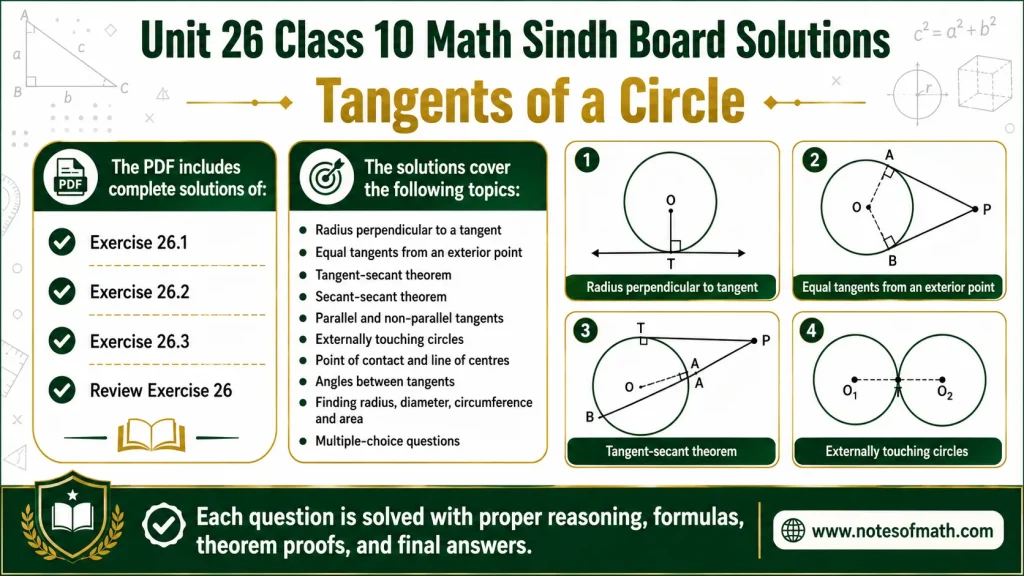
What Is Included in Unit 26 Class 10 Math Sindh Board Solutions?
The PDF includes complete solutions of:
- Exercise 26.1
- Exercise 26.2
- Exercise 26.3
- Review Exercise 26
The solutions cover the following topics:
- Radius perpendicular to a tangent
- Equal tangents from an exterior point
- Triangles and rectangles circumscribing circles
- Tangent segments in concentric circles
- Finding radius, diameter, circumference, and area
- Tangents drawn at the endpoints of a chord
- Parallel and non-parallel tangents
- Tangent–secant theorem
- Secant–secant theorem
- Externally touching circles
- Point of contact and line of centres
- Angles between tangents
- Common tangents of two circles
- Multiple-choice questions
Each question is explained with formulas, theorem statements, construction steps, proper reasoning, and final answers.
Essential Facts Used in Unit 26
Students should revise the following results before attempting the exercises.
Radius and Tangent Theorem
A radius drawn to the point of tangency is perpendicular to the tangent.
If \(OT\) is a radius and \(PT\) is tangent at \(T\), then:
\[OT\perp PT\]
Therefore, triangle \(OPT\) is right-angled at \(T\):
\[OP^2=OT^2+PT^2\]
Equal Tangents from an Exterior Point
Two tangent segments drawn from the same exterior point are equal.
If \(PA\) and \(PB\) are tangents from the same point \(P\), then:
\[PA=PB\]
Tangent–Secant Theorem
If \(PT\) is a tangent and \(PAB\) is a secant drawn from the same exterior point \(P\), then:
\[PT^2=PA\cdot PB\]
Here, \(PA\) is the external part and \(PB\) is the whole secant.
If the external part is \(x\) and the internal part is \(y\), then the whole secant is:
\[x+y\]
Therefore:
\[PT^2=x(x+y)\]
Secant–Secant Theorem
If two secants \(PAB\) and \(PCD\) are drawn from the same exterior point, then:
\[PA\cdot PB=PC\cdot PD\]
The external part of each secant is multiplied by its complete length.
Exercise 26.1 Solutions
Exercise 26.1 includes theorem-based and numerical questions involving circumscribed figures, tangent segments, concentric circles, radius, circumference, and area.
Triangle Circumscribing a Circle
The textbook statement asks students to show that a triangle circumscribing a circle is equilateral.
However, this statement requires an additional condition because every ordinary triangle has an incircle, but every triangle is not equilateral.
Suppose the incircle touches sides \(AB\), \(BC\), and \(CA\) at \(X\), \(Y\), and \(Z\).
Tangents drawn from the same exterior point are equal:
\[AX=AZ=p\]
\[BX=BY=q\]
\[CY=CZ=r\]
Therefore:
\[AB=p+q\]
\[BC=q+r\]
\[CA=r+p\]
The three sides are equal only when:
\[p=q=r\]
If the circle touches the three sides at their midpoints, then all six tangent segments are equal. Hence:
\[AB=BC=CA\]
Therefore, under this additional condition, the triangle is equilateral.
Rectangle Circumscribing a Circle
Exercise 26.1 also proves that a rectangle circumscribing a circle must be a square.
Let rectangle \(ABCD\) touch the circle at \(P\), \(Q\), \(R\), and \(S\).
Tangents drawn from the same vertex are equal:
\[AP=AS\]
\[BP=BQ\]
\[CQ=CR\]
\[DR=DS\]
The sides can be written as:
\[AB=AP+PB\]
\[BC=BQ+QC\]
\[CD=CR+RD\]
\[DA=DS+SA\]
Using the equality of tangent segments:
\[AB+CD=BC+DA\]
Since opposite sides of a rectangle are equal:
\[AB=CD\]
and:
\[BC=DA\]
Therefore:
\[2AB=2BC\]
Dividing by \(2\):
\[AB=BC\]
Thus, the rectangle has equal length and breadth and is therefore a square.
Two Concentric Circles
Suppose the diameters of two concentric circles are \(10\) cm and \(5\) cm.
The radius of the outer circle is:
\[R=\frac{10}{2}=5\text{ cm}\]
The radius of the inner circle is:
\[r=\frac{5}{2}=2.5\text{ cm}\]
Let \(P\) lie on the outer circle and \(PT\) be tangent to the inner circle.
Since:
\[OT\perp PT\]
using the Pythagorean theorem:
\[OP^2=OT^2+PT^2\]
\[5^2=(2.5)^2+PT^2\]
\[25=6.25+PT^2\]
\[PT^2=18.75\]
\[PT^2=\frac{75}{4}\]
\[PT=\sqrt{\frac{75}{4}}\]
\[PT=\frac{5\sqrt{3}}{2}\text{ cm}\]
The perpendicular from the centre bisects the chord, so the complete chord is:
\[\text{Chord}=2PT\]
\[\text{Chord}=2\left(\frac{5\sqrt{3}}{2}\right)\]
\[\text{Chord}=5\sqrt{3}\text{ cm}\]
Finding Diameter, Circumference, and Area
Suppose a tangent has length \(4\) cm and the exterior point is \(5\) cm from the centre.
Let:
\[PT=4\text{ cm}\]
\[OP=5\text{ cm}\]
\[OT=r\]
Using the Pythagorean theorem:
\[OP^2=OT^2+PT^2\]
\[5^2=r^2+4^2\]
\[25=r^2+16\]
\[r^2=9\]
\[r=3\text{ cm}\]
The diameter is:
\[d=2r\]
\[d=2(3)=6\text{ cm}\]
The circumference is:
\[C=2\pi r\]
\[C=2\pi(3)\]
\[C=6\pi\text{ cm}\]
The area is:
\[A=\pi r^2\]
\[A=\pi(3)^2\]
\[A=9\pi\text{ cm}^2\]
Finding Tangent Length
Suppose the radius is \(7\) cm and the distance of the exterior point from the centre is \(25\) cm.
Let the tangent length be \(x\).
\[25^2=7^2+x^2\]
\[625=49+x^2\]
\[x^2=625-49\]
\[x^2=576\]
\[x=\sqrt{576}\]
\[x=24\text{ cm}\]
Only the positive value is accepted because length cannot be negative.
Exercise 26.2 Solutions
Exercise 26.2 focuses on tangent theorems, parallel tangents, tangent–secant problems, secant–secant problems, and equal tangent segments.
Tangents at the Ends of a Chord
Suppose \(AB\) is a chord and tangents at \(A\) and \(B\) meet at \(P\).
Tangents drawn from the same exterior point are equal:
\[PA=PB\]
Therefore, triangle \(PAB\) is isosceles.
Angles opposite equal sides of an isosceles triangle are equal:
\[\angle PAB=\angle PBA\]
Hence, tangents drawn at the endpoints of a chord make equal angles with that chord.
Parallel Tangents
Suppose two parallel tangents touch a circle at \(A\) and \(B\).
Join \(OA\) and \(OB\).
A radius is perpendicular to the tangent at the point of tangency:
\[OA\perp \text{ tangent at }A\]
\[OB\perp \text{ tangent at }B\]
Since the tangents are parallel, the radii perpendicular to them lie on the same straight line.
Therefore, \(A\), \(O\), and \(B\) are collinear.
Since \(AB\) passes through the centre:
\[AB\text{ is a diameter}\]
Non-Parallel Tangents
If two non-parallel tangents touch the circle at distinct points \(A\) and \(B\), then both points lie on the circle.
A line segment joining two distinct points of a circle is a chord.
Therefore:
\[AB\text{ is a chord}\]
Tangent–Secant Questions
For a tangent \(PT\) and secant \(PAB\):
\[PT^2=PA\cdot PB\]
Example 1
Suppose the tangent is \(x\), the external part of the secant is \(4\), and the internal part is \(5\).
The whole secant is:
\[4+5=9\]
Therefore:
\[x^2=4(9)\]
\[x^2=36\]
\[x=\sqrt{36}\]
\[x=6\]
Example 2
Suppose the external part is \(11\) and the internal part is \(13\).
\[x^2=11(11+13)\]
\[x^2=11(24)\]
\[x^2=264\]
\[x=\sqrt{264}\]
\[x=\sqrt{4\times66}\]
\[x=2\sqrt{66}\]
Secant–Secant Questions
For two secants from the same exterior point:
\[\text{External part}\times\text{Whole secant}=\text{External part}\times\text{Whole secant}\]
Example
Suppose the first secant has external part \(6\) and internal part \(x\), while the second has external part \(3\) and internal part \(23\).
\[6(6+x)=3(3+23)\]
\[36+6x=3(26)\]
\[36+6x=78\]
\[6x=42\]
\[x=7\]
Students should remember that the whole secant is the sum of the external and internal parts.
Equal Tangent Segments
If two tangents are drawn from the same exterior point, their lengths are equal.
If one tangent has length \(6\) and the other has length \(x\), then:
\[x=6\]
Similarly, if one tangent has length \(13\), then:
\[x=13\]
Exercise 26.3 Solutions
Exercise 26.3 deals with externally touching circles, distances between centres, common contact points, angles between tangents, chord lengths, and radii of touching circles.
Condition for External Contact
Suppose two circles have centres \(O_1\) and \(O_2\) and radii \(r_1\) and \(r_2\).
If:
\[O_1O_2=r_1+r_2\]
then the circles touch externally.
Let the point of contact be \(T\).
\[O_1T=r_1\]
and:
\[O_2T=r_2\]
Therefore:
\[O_1O_2=O_1T+TO_2\]
\[O_1O_2=r_1+r_2\]
Hence, the two circles have one common point and touch externally at \(T\).
Three Circles Touching in Pairs
Suppose three non-overlapping circles have centres \(O_1\), \(O_2\), and \(O_3\) with radii \(r_1\), \(r_2\), and \(r_3\).
For non-overlapping circles:
\[O_1O_2\geq r_1+r_2\]
\[O_2O_3\geq r_2+r_3\]
\[O_3O_1\geq r_3+r_1\]
Adding:
\[O_1O_2+O_2O_3+O_3O_1\geq2(r_1+r_2+r_3)\]
If the perimeter of the triangle formed by the centres equals the sum of the diameters, then:
\[O_1O_2+O_2O_3+O_3O_1=2r_1+2r_2+2r_3\]
Therefore, equality holds in all three inequalities:
\[O_1O_2=r_1+r_2\]
\[O_2O_3=r_2+r_3\]
\[O_3O_1=r_3+r_1\]
Hence, all three circles touch one another externally in pairs.
Congruent Externally Touching Circles
Suppose two congruent circles touch externally and the distance between their centres is \(12\) cm.
Let the radius of each circle be \(r\).
\[r+r=12\]
\[2r=12\]
\[r=6\text{ cm}\]
The circumference of each circle is:
\[C=2\pi r\]
\[C=2\pi(6)\]
\[C=12\pi\text{ cm}\]
Using \(\pi\approx3.1416\):
\[C\approx12(3.1416)\]
\[C\approx37.7\text{ cm}\]
Angle Between Two Tangents
Suppose tangents \(PA\) and \(PB\) are drawn from an exterior point \(P\) and the central angle is \(\angle AOB\).
Since:
\[\angle OAP=90^\circ\]
and:
\[\angle OBP=90^\circ\]
the quadrilateral \(OAPB\) gives:
\[\angle APB+\angle AOB+90^\circ+90^\circ=360^\circ\]
Therefore:
\[\angle APB=180^\circ-\angle AOB\]
Equivalently:
\[\angle APB+\angle AOB=180^\circ\]
For example, if:
\[\angle AOB=110^\circ\]
then:
\[\angle APB=180^\circ-110^\circ\]
\[\angle APB=70^\circ\]
Point of Contact and Line of Centres
If two circles touch externally at \(T\), their point of contact lies on the line segment joining their centres.
The radii drawn to the point of tangency are perpendicular to the common tangent:
\[O_1T\perp \text{ tangent at }T\]
\[O_2T\perp \text{ tangent at }T\]
Only one perpendicular can be drawn through a given point to a given line. Therefore, \(O_1\), \(T\), and \(O_2\) lie on the same straight line.
Hence:
\[T\in \overline{O_1O_2}\]
Review Exercise 26 Solutions
Review Exercise 26 tests the main facts, definitions, and theorems of Tangents of a Circle.
It includes multiple-choice questions about:
- Number of tangents from an exterior point
- Angle between a radius and tangent
- Internally and externally touching circles
- Points of contact
- Tangents and secants
- Tangents at the endpoints of a diameter
- Maximum number of common tangents
- Point of tangency
The PDF provides the correct option for every question and includes explanations of the relevant theorem or definition.
Important Formulas of Unit 26
Students should revise the following formulas before attempting the exercises.
Radius and tangent relationship:
\[OT\perp PT\]
Pythagorean relationship:
\[OP^2=OT^2+PT^2\]
Tangent length:
\[PT=\sqrt{OP^2-OT^2}\]
Distance from centre:
\[OP=\sqrt{OT^2+PT^2}\]
Equal tangent segments:
\[PA=PB\]
Tangent–secant theorem:
\[PT^2=PA\cdot PB\]
If the external part is \(x\) and the internal part is \(y\):
\[PT^2=x(x+y)\]
Secant–secant theorem:
\[PA\cdot PB=PC\cdot PD\]
Condition for external contact:
\[O_1O_2=r_1+r_2\]
Angle between two tangents:
\[\angle APB=180^\circ-\angle AOB\]
Diameter:
\[d=2r\]
Circumference:
\[C=2\pi r\]
Area:
\[A=\pi r^2\]
Common Mistakes in Tangents of a Circle
Students sometimes use only the internal part of a secant in the tangent–secant theorem. The whole secant must be used.
For example, if the external part is \(4\) and the internal part is \(5\), then:
\[\text{Whole secant}=4+5=9\]
The correct equation is:
\[PT^2=4(9)\]
not:
\[PT^2=4(5)\]
Another common mistake is forgetting that a radius is perpendicular to the tangent only at the point of tangency.
Students should also reject negative answers when solving quadratic equations for lengths.
For example:
\[x=-16\quad\text{or}\quad x=4\]
Since length cannot be negative:
\[x=4\]
Why These Solutions Are Helpful
These Unit 26 Class 10 Math Sindh Board Solutions explain theorem proofs, numerical calculations, tangent–secant relationships, secant–secant problems, and touching-circle questions in a clear and organized way.
The diagrams help students identify:
- The centre of a circle
- The point of tangency
- Radius and tangent
- Exterior and internal secant segments
- Common tangents
- Points where circles touch
Students can use these solutions for:
- Completing homework
- Checking textbook answers
- Learning geometrical proofs
- Practising tangent and secant problems
- Revising important formulas
- Preparing for school tests
- Preparing for Sindh Board examinations
Download Unit 26 Class 10 Math Sindh Board Solutions PDF
Students can download the complete PDF of Unit 26 Class 10 Math Sindh Board Solutions from this page.
The PDF contains:
- Essential tangent theorems
- Complete Exercise 26.1 solutions
- Complete Exercise 26.2 solutions
- Complete Exercise 26.3 solutions
- Solved Review Exercise 26
- Step-by-step geometrical proofs
- Tangent and secant diagrams
- Numerical calculations
- Correct multiple-choice answers
These solutions cover the complete unit Tangents of a Circle according to the Class 10 Mathematics Sindh Board textbook.
Students should attempt each textbook question independently before consulting the solutions. This will improve their understanding of circle geometry and help them recognize the correct theorem or formula required in each problem.