Unit 23 Class 10 Math Sindh Board Solutions
Unit 23 of Class 10 Mathematics Sindh Board is about Pythagoras’ Theorem. This unit teaches students how to find the missing side of a right-angled triangle and how to verify whether a triangle is right-angled or not.
On this page, students can download complete Unit 23 Class 10 Math Sindh Board Solutions in PDF format. The PDF includes complete, student-friendly, step-by-step solutions of Exercise 23.1 and Review Exercise 23. The solution file also begins with an essential method section that explains the theorem, the hypotenuse, and the formulas used to find missing sides.
Class 10 Math Unit 23 Pythagoras’ Theorem Solutions
Pythagoras’ theorem is one of the most important results in geometry. It is used only in a right-angled triangle. A right-angled triangle has one angle equal to \(90^\circ\).
In a right-angled triangle, the side opposite the right angle is called the hypotenuse. It is always the longest side of the triangle.
If the perpendicular sides are \(a\) and \(b\), and the hypotenuse is \(c\), then Pythagoras’ theorem is written as:
\(\displaystyle c^2=a^2+b^2\)
This formula is used throughout Unit 23.
What is Included in Unit 23 Class 10 Math Sindh Board Solutions?
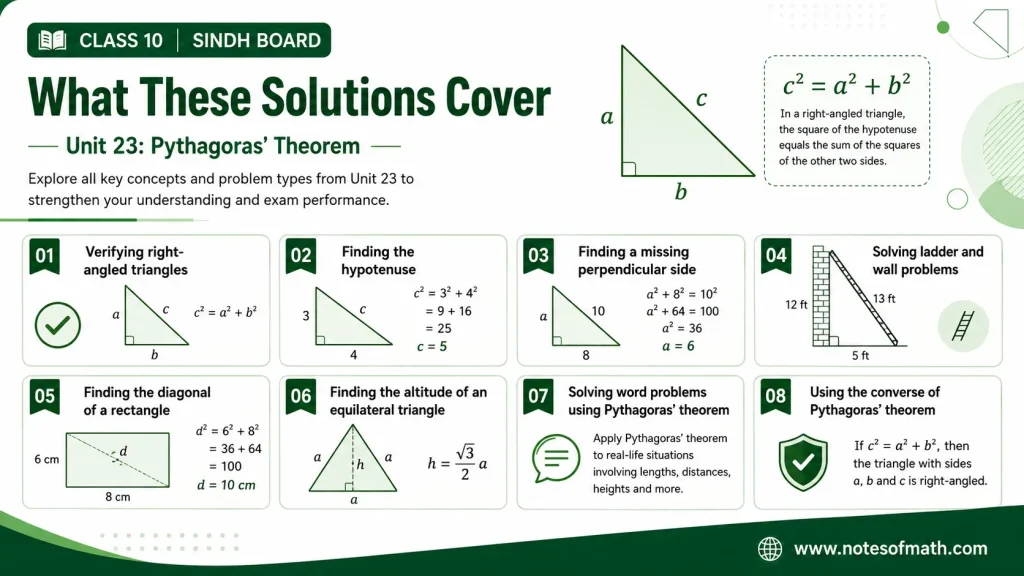
The PDF includes solutions of:
Exercise 23.1
Review Exercise 23
These solutions cover all important question types from this unit, including:
Verifying right-angled triangles
Finding the hypotenuse
Finding a missing perpendicular side
Solving ladder and wall problems
Finding the diagonal of a rectangle
Finding the altitude of an equilateral triangle
Solving word problems using Pythagoras’ theorem
Using the converse of Pythagoras’ theorem
Exercise 23.1 Solutions
Exercise 23.1 is the main exercise of Unit 23. It includes several questions based on Pythagoras’ theorem and its applications.
In the first question, students verify whether given side lengths form a right-angled triangle. To do this, students must first identify the largest side. The largest side is treated as the possible hypotenuse.
Then they check whether:
\(\displaystyle c^2=a^2+b^2\)
For example, if the sides are \(16\), \(30\), and \(34\), the largest side is \(34\). So we check:
\(\displaystyle 34^2=16^2+30^2\)
\(\displaystyle 1156=256+900\)
\(\displaystyle 1156=1156\)
Since both sides are equal, the triangle is right-angled.
Finding the Hypotenuse
When the two perpendicular sides are given, the hypotenuse is found by using:
\(\displaystyle c=\sqrt{a^2+b^2}\)
For example, if the perpendicular sides are \(7\) and \(24\), then:
\(\displaystyle c^2=7^2+24^2\)
\(\displaystyle c^2=49+576\)
\(\displaystyle c^2=625\)
\(\displaystyle c=\sqrt{625}=25\)
So the hypotenuse is \(25\).
Finding a Missing Perpendicular Side
When the hypotenuse and one perpendicular side are given, the missing side is found by subtracting the square of the known side from the square of the hypotenuse.
The formula is:
\(\displaystyle a=\sqrt{c^2-b^2}\)
For example, if the hypotenuse is \(13\) and one side is \(5\), then:
\(\displaystyle 13^2=x^2+5^2\)
\(\displaystyle 169=x^2+25\)
\(\displaystyle x^2=169-25\)
\(\displaystyle x^2=144\)
\(\displaystyle x=\sqrt{144}=12\)
So the missing side is \(12\).
Word Problems in Unit 23
Unit 23 also contains word problems where students must first understand the shape of the problem.
For example, in a ladder problem, the wall and the ground form a right angle. The ladder becomes the hypotenuse. If the foot of the ladder is \(6\) feet from the wall and the top reaches \(8\) feet up the wall, then:
\(\displaystyle L^2=6^2+8^2\)
\(\displaystyle L^2=36+64\)
\(\displaystyle L^2=100\)
\(\displaystyle L=\sqrt{100}=10\)
So the ladder is \(10\) feet long.
This type of question is very common in exams because it connects geometry with real-life situations.
Diagonal of a Rectangle
Pythagoras’ theorem is also used to find the diagonal of a rectangle. The length and breadth of a rectangle form the two perpendicular sides, while the diagonal is the hypotenuse.
If a rectangular swimming pool is \(50\) m long and \(30\) m wide, then the diagonal \(d\) is:
\(\displaystyle d^2=50^2+30^2\)
\(\displaystyle d^2=2500+900\)
\(\displaystyle d^2=3400\)
\(\displaystyle d=\sqrt{3400}=10\sqrt{34}\)
So the distance between opposite corners is:
\(\displaystyle 10\sqrt{34}\text{ m}\)
Altitude of an Equilateral Triangle
In an equilateral triangle, all sides are equal. When an altitude is drawn, it bisects the base and forms two right-angled triangles.
If each side of an equilateral triangle is \(8\) units, then half of the base is:
\(\displaystyle \frac{8}{2}=4\)
Let the altitude be \(h\). Then:
\(\displaystyle 8^2=h^2+4^2\)
\(\displaystyle 64=h^2+16\)
\(\displaystyle h^2=48\)
\(\displaystyle h=\sqrt{48}=4\sqrt{3}\)
So the altitude is:
\(\displaystyle 4\sqrt{3}\text{ units}\)
Review Exercise 23 Solutions
Review Exercise 23 helps students revise the whole unit. It includes MCQs, explanation of Pythagoras’ theorem, ladder problems, and missing side questions.
The review exercise covers:
Definition of Pythagoras’ theorem
Converse of Pythagoras’ theorem
Hypotenuse identification
Pythagorean triples
Finding missing sides
Solving practical right-triangle problems
Students should solve the review exercise after completing Exercise 23.1 because it checks the main concepts of the whole unit.
Important Formulas of Unit 23
Students should revise these formulas before solving Unit 23.
Pythagoras’ theorem:
\(\displaystyle c^2=a^2+b^2\)
To find the hypotenuse:
\(\displaystyle c=\sqrt{a^2+b^2}\)
To find a missing perpendicular side:
\(\displaystyle a=\sqrt{c^2-b^2}\)
or:
\(\displaystyle b=\sqrt{c^2-a^2}\)
Converse of Pythagoras’ theorem:
If:
\(\displaystyle c^2=a^2+b^2\)
then the triangle is right-angled.
Common Pythagorean Triples
Students should remember some common Pythagorean triples because they make calculations easier.
\(3,4,5\)
\(5,12,13\)
\(6,8,10\)
\(7,24,25\)
\(8,15,17\)
\(12,16,20\)
For example:
\(\displaystyle 7^2+24^2=25^2\)
\(\displaystyle 49+576=625\)
\(\displaystyle 625=625\)
So \(7,24,25\) is a Pythagorean triple.
Common Mistakes in Unit 23
Many students make mistakes because they do not identify the hypotenuse correctly. The hypotenuse is always the side opposite the right angle. It is also the longest side of a right-angled triangle.
Another common mistake is placing the wrong side alone in the formula. In the formula:
\(\displaystyle c^2=a^2+b^2\)
the side \(c\) must be the hypotenuse.
Some students also forget to take the square root at the end. For example, after getting:
\(\displaystyle x^2=144\)
the answer is not \(144\). The correct answer is:
\(\displaystyle x=\sqrt{144}=12\)
Students should also remember that side lengths cannot be negative. If a quadratic equation gives one positive and one negative value, the negative value must be rejected.
How to Prepare Unit 23 for Exams
To prepare this unit, students should first memorize the theorem and understand the meaning of hypotenuse. After that, they should practice diagrams carefully.
Before solving any question, students should ask:
Where is the right angle?
Which side is opposite the right angle?
Which side is the hypotenuse?
Are we finding the hypotenuse or a missing perpendicular side?
After identifying these parts, the calculation becomes simple.
Students should also practice word problems because many exam questions are based on ladders, rectangles, diagonals, distances, and heights.
Why These Solutions Are Helpful
These Unit 23 Class 10 Math Sindh Board Solutions are helpful because each question is solved step by step. The solutions do not only give final answers. They show how to identify the hypotenuse, how to apply the theorem, how to simplify square roots, and how to check the answer.
This makes the PDF useful for homework, revision, test preparation, and board exam practice.
Download Unit 23 Class 10 Math Sindh Board Solutions PDF
Students can download the complete PDF of Unit 23 Class 10 Math Sindh Board Solutions from this page.
The PDF includes complete step-by-step solutions of:
Exercise 23.1
Review Exercise 23
These solutions cover the full chapter Pythagoras’ Theorem from Class 10 Mathematics Sindh Textbook Board.