
Unit 2 Class 10 Math New Book Solutions
Unit 2 Class 10 Math New Book Solutions are available here in easy PDF format. This unit is titled Quadratic Equations and Inequalities and includes Exercise 2.1 to Exercise 2.7 and Review Exercise 2. These step-by-step solved notes help students understand quadratic equations, graphical solutions, roots and coefficients, discriminant, quadratic inequalities, formulas, and real-life applications. Students can use these Unit 2 solved PDFs for homework, school tests, monthly tests, final exams, and board exam revision.
This unit is part of our Class 10 maths notes for the new book (2026–27, Punjab Board), where you can open the solved exercises of all 12 units.
PDF Solutions of Unit 2 Class 10 Math New Book
These Unit 2 Class 10 Math New Book Solutions are arranged exercise-wise so that students can open the exact PDF they need.
Table Of Contents
Quick Overview of Unit 2 Exercises
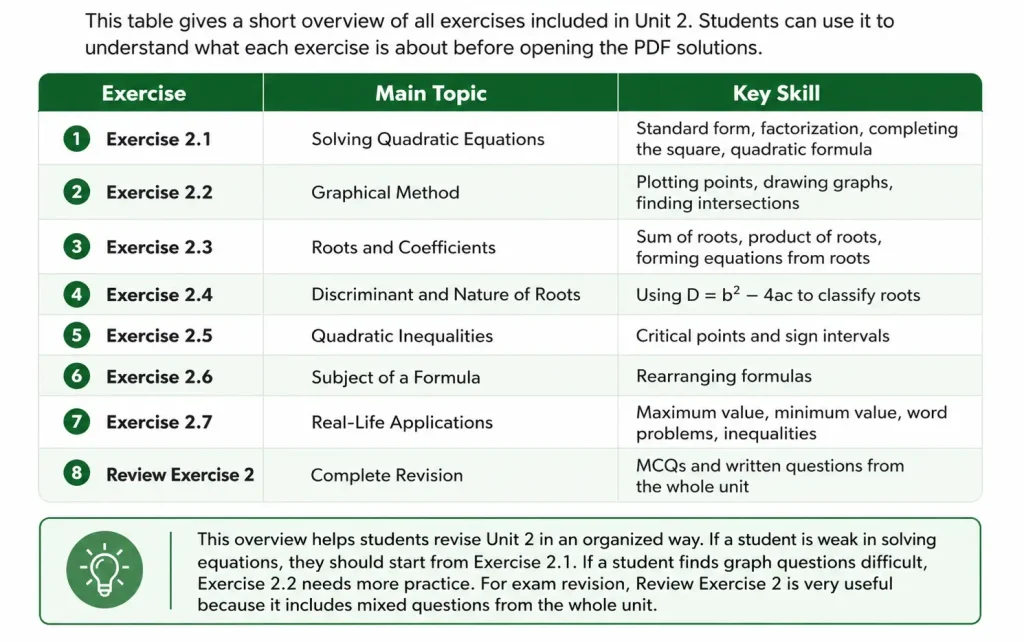
What is Unit 2 Class 10 Math New Book About?
Unit 2 of the Class 10 Math New Book is about quadratic equations and related algebraic ideas. In this unit, students learn how to write quadratic equations in standard form, solve them by different methods, understand roots, use the discriminant, solve quadratic inequalities, rearrange formulas, and apply quadratic equations in real-life situations.
A quadratic equation is an equation in which the highest power of the variable is 2.
The standard form is:
ax² + bx + c = 0
Here, a, b, and c are real numbers and a ≠ 0.
For example:
x² + 5x + 6 = 0
This is a quadratic equation because the highest power of x is 2.
Unit 2 is important because many exam questions can be taken from this unit. It includes short questions, MCQs, long questions, graphical questions, formula-based questions, inequalities, and word problems.
Solutions of Exercise 2.1 Class 10 Math New Book
What the PDF Includes
The solution PDF includes questions based on standard form, factorization, completing the square method, and quadratic formula. Each question is solved with proper steps.
Main Concept
Exercise 2.1 is the starting exercise of Unit 2, Quadratic Equations and Inequalities. It builds the base for solving quadratic equations.
Standard Form
In the first part, students learn how to write quadratic equations in standard form.
Quick Example
If the equation is:
Standard form: 2x² − 3x + 1 = 0
Important Methods
The PDF also explains factorization, completing the square method, and quadratic formula method. These methods are important for exams.
How to Use These Solutions
First try to solve the questions yourself. Then compare your steps with the PDF solution and correct your mistakes.
Solutions of Exercise 2.2 Class 10 Math New Book
What the PDF Covers
Tables of values, plotted points, graphs, and final answers.
Main Method
Graphical method with answers read from lines and points of intersection.
Axis Intersections
Some questions show where a line cuts the x-axis and y-axis.
System of Equations
Two lines are drawn. Their meeting point gives the solution.
Go to Exercise 2.2 Solution PDF
Solutions of Exercise 2.3 Class 10 Math New Book
Complete Solved PDF
The PDF contains step-by-step solutions of all questions from Exercise 2.3.
Main Formula
If α and β are roots, the required quadratic equation is:
Sum and Product
The solutions show how to find the sum and product of roots before forming the equation.
αβ = product
Roots-Based Questions
The PDF also covers new roots, double roots, reciprocal roots, and roots involving α and β.
Go to Exercise 2.3 Solution PDF
Solutions of Exercise 2.4 Class 10 Math New Book
Complete Solved PDF
The PDF contains step-by-step solutions of all questions from Exercise 2.4.
Main Formula
The solutions use the discriminant to check the nature of roots.
Nature of Roots
The solved notes explain real, equal, unequal, rational, irrational, and imaginary roots.
Unknown Values
The PDF also covers questions where students find the value of an unknown letter using the discriminant.
Go to Exercise 2.4 Solution PDF
Solutions of Exercise 2.5 Class 10 Math New Book
Complete Solved PDF
The PDF contains step-by-step solutions of all questions from Exercise 2.5.
Main Topic
This exercise is about solving quadratic inequalities with greater than or less than signs.
Critical Points
The solved notes show how to factorize the expression and find critical points.
x = −4, x = 1
Sign Intervals
The PDF explains how to check intervals and choose the correct solution set.
Go to Exercise 2.5 Solution PDF
Solutions of Exercise 2.6 Class 10 Math New Book
Complete Solved PDF
The PDF contains step-by-step solutions of all questions from Exercise 2.6.
Main Topic
This exercise is about rearranging formulas and keeping the required variable alone.
Same Operation Rule
The solved notes show how to add, subtract, multiply, or divide on both sides.
Formula-Based Questions
The PDF includes formulas from temperature, simple interest, cylinder, trapezoid, line, rectangle, parabola, profit, and cone.
Go to Exercise 2.6 Solution PDF
Solutions of Exercise 2.7 Class 10 Math New Book
Complete Solved PDF
The PDF contains step-by-step solutions of all questions from Exercise 2.7.
Real-Life Applications
The solved notes include questions from population, profit, motion, height of a ball, and earnings.
Maximum or Minimum
The PDF explains how to find maximum or minimum values of a quadratic function.
Quadratic Inequalities
The solutions also show how inequalities are used in real-life situations.
Go to Exercise 2.7 Solution PDF
Solutions of Review Exercise 2 Class 10 Math New Book
Complete Solved PDF
The PDF contains step-by-step solutions of all questions from Review Exercise 2.
MCQs Revision
The solved notes include MCQs from quadratic equations, roots, discriminant, and formulas.
Written Questions
The PDF revises solving equations, forming equations from roots, nature of roots, and formula rearrangement.
Full Unit Practice
Review Exercise 2 combines important concepts from Exercise 2.1 to Exercise 2.7.
Go to Review Exercise 2 Solution PDF
Important Definitions of Unit 2
Quadratic Equation
An equation in which the highest power of the variable is 2 is called a quadratic equation. For a detailed explanation of this topic, read our complete guide on Quadratic Equations.
For example:
x² + 5x + 6 = 0
Standard Form of Quadratic Equation
The standard form of a quadratic equation is:
ax² + bx + c = 0
where a, b, and c are real numbers and a ≠ 0.
Roots of a Quadratic Equation
The values of x that satisfy a quadratic equation are called its roots. For a complete explanation, read our guide on Roots of a Quadratic Equation.
For example, if:
(x − 2)(x − 3) = 0
then the roots are:
x = 2 and x = 3
Discriminant
The discriminant of a quadratic equation is:
D = b² − 4ac
It tells us about the nature of roots.
Quadratic Inequality
A quadratic inequality is an inequality that contains a quadratic expression.
For example:
x² + 3x − 4 > 0
Critical Points
Critical points are the values obtained by putting each factor equal to zero while solving an inequality.
For example:
(x + 4)(x − 1) > 0
Critical points are:
x = −4 and x = 1
Subject of a Formula
The variable which is written alone on one side of a formula is called the subject of the formula.
For example, in:
v = u + at
v is the subject of the formula.
Important Formulas of Unit 2
Students should revise these formulas again and again.
Standard Form
ax² + bx + c = 0
where a ≠ 0
Quadratic Formula
x = (-b ± √(b² − 4ac)) / 2a
Example of Quadratic Formula
Solve:
2x² − 5x + 3 = 0
Here:
a = 2, b = −5, c = 3
Using the quadratic formula:
x = (-b ± √(b² − 4ac)) / 2a
x = (-(-5) ± √((-5)² − 4(2)(3))) / 2(2)
x = (5 ± √(25 − 24)) / 4
x = (5 ± 1) / 4
So:
x = 3/2 or x = 1
Therefore:
Solution set = {1, 3/2}
Discriminant
D = b² − 4ac
Nature of Roots
D > 0 means roots are real and unequal.
D = 0 means roots are real and equal.
D < 0 means roots are imaginary.
D > 0 and perfect square means roots are rational and unequal.
D > 0 and not a perfect square means roots are irrational and unequal.
Sum and Product of Roots
For ax² + bx + c = 0:
Sum of roots = −b/a
Product of roots = c/a
Example of Sum and Product of Roots
For the equation:
3x² + 5x − 12 = 0
Here:
a = 3, b = 5, c = −12
Sum of roots = −b/a
Sum of roots = −5/3
Product of roots = c/a
Product of roots = −12/3
Product of roots = −4
So, the sum of roots is −5/3 and the product of roots is −4.
Equation from Roots
If α and β are roots, then:
x² − (α + β)x + αβ = 0
Maximum or Minimum Value
For:
f(x) = ax² + bx + c
the maximum or minimum occurs at:
x = −b/2a
If a < 0, maximum value occurs.
If a > 0, minimum value occurs.
Short Revision Table of Unit 2
| Concept | Key Rule | Example |
|---|---|---|
| Quadratic equation | Highest power is 2 | x² + 5x + 6 = 0 |
| Standard form | ax² + bx + c = 0 | 2x² − 3x + 1 = 0 |
| Factorization | Split the middle term | x² − 5x + 6 = 0 |
| Quadratic formula | Use a, b, c in formula | x = (-b ± √(b² − 4ac)) / 2a |
| Discriminant | D = b² − 4ac | Used to check nature of roots |
| Equal roots | D = 0 | Roots are same |
| Real unequal roots | D > 0 | Roots are different |
| Imaginary roots | D < 0 | No real roots |
| Equation from roots | x² − (sum)x + product = 0 | roots 2, 3 give x² − 5x + 6 = 0 |
| Quadratic inequality | Use critical points | (x − 1)(x − 3) > 0 |
| Subject of formula | Keep required variable alone | y = mx + c gives x = (y − c)/m |
| Maximum value | x = −b/2a when a < 0 | Profit or height questions |
Common Mistakes Students Make in Unit 2
Not Writing the Equation in Standard Form
Many students start solving without arranging the equation in standard form.
Always write the equation as:
ax² + bx + c = 0
before applying factorization, quadratic formula, or discriminant.
Wrong Signs in Factorization
Students often make mistakes while splitting the middle term.
For example:
x² − x − 6 = 0
The correct split is:
x² − 3x + 2x − 6 = 0
because −3 + 2 = −1 and (−3)(2) = −6.
Forgetting ± in Square Root
When taking square root, students should remember both positive and negative values.
For example:
x² = 9
x = ±3
Do not write only x = 3.
Using Wrong Values of a, b, and c
In the quadratic formula and discriminant, students must identify a, b, and c correctly.
For example, in:
2x² − 5x + 3 = 0
a = 2, b = −5, c = 3
The negative sign with b is important.
Confusing Sum and Product of Roots
For ax² + bx + c = 0:
Sum of roots = −b/a
Product of roots = c/a
Students often forget the negative sign in the sum of roots.
Choosing Wrong Intervals in Inequalities
In quadratic inequalities, finding the critical points is not enough. Students must also check the sign of each interval.
For example, if:
(x + 4)(x − 1) > 0
then the answer is outside the roots:
(−∞, −4) ∪ (1, ∞)
not between the roots.
Forgetting to Change the Inequality Sign
When multiplying or dividing an inequality by a negative number, the inequality sign changes.
For example:
−2x > 6
x < −3
Drawing Graphs Without Scale
In graphical questions, students should choose a proper scale. If the scale is not clear, the graph may give a wrong answer.
Always label the x-axis, y-axis, points, line, and curve clearly.
Making Formula Rearrangement Too Quickly
In Exercise 2.6, students often try to move terms without showing proper steps.
It is better to use the same operation on both sides and write each step clearly.
How to Use These Notes
These notes are not only for copying answers. They are prepared to help students understand the method.
First, read the basic explanation of the exercise.
Then try to solve the question yourself.
After that, open the PDF solution and compare your work.
If your answer is wrong, check the exact step where the mistake happened.
Then solve the same question again without looking at the solution.
For best results, students should first revise the formulas, then solve the exercise, then check the PDF solution. This method will help in tests and exams.
Exam Importance of Unit 2
Unit 2 is important for exams because it includes many types of questions. Students can get MCQs, short questions, and long questions from this unit.
Exercise 2.1 is important because it includes solving quadratic equations by different methods. Students should practise factorization, completing the square method, and quadratic formula.
Exercise 2.2 is important for graphical questions. Students should know how to make a table of values, plot points, draw graphs, and find the point of intersection.
Exercise 2.3 is important because questions about roots and coefficients are common. Students should remember the sum and product of roots formulas.
Exercise 2.4 is important for MCQs and short questions. The discriminant helps students find whether roots are real, equal, unequal, rational, irrational, or imaginary.
Exercise 2.5 is important because quadratic inequalities need careful steps. Students should know how to find critical points and choose the correct interval.
Exercise 2.6 is useful for short questions because it is based on making a variable the subject of a formula.
Exercise 2.7 is important for word problems and real-life applications. Students should practise maximum and minimum value questions carefully.
Review Exercise 2 is best for final revision because it includes MCQs and written questions from the whole unit.
Exam Preparation Tips for Unit 2
Unit 2 becomes easy when students practise the basic rules again and again.
For MCQs, revise standard form, discriminant, nature of roots, sum of roots, product of roots, and subject of formula.
For short questions, learn definitions and formulas clearly.
For long questions, practise solving quadratic equations by factorization, completing square method, and quadratic formula.
For graphical questions, practise making tables of values and drawing graphs neatly.
For inequalities, always find critical points and check intervals.
For real-life questions, read the statement carefully and identify what is given and what is required.
Before exams, solve Review Exercise 2 as a complete revision test. It includes many important concepts of the unit.
Related Class 10 Math Resources
Quadratic equations are one of the most important topics in Class 10 Mathematics. To practise this unit more, students can also use our Quadratic Equation Solver. It helps students check roots, discriminant, and solution steps.
Students who want to revise algebra basics can also use our Simultaneous Equations Solver. It is useful for graphical method and equation-based practice.
If students want to revise the previous unit, they can also study Unit 1 Complex Numbers Class 10 Math New Book Solutions.
FAQs About Unit 2 Class 10 Math New Book Solutions
What is Unit 2 of Class 10 Math New Book about?
Unit 2 is about quadratic equations and related topics. It includes standard form, algebraic solution methods, graphical method, roots and coefficients, discriminant, quadratic inequalities, subject of formula, and real-life applications.
Are these solutions according to the new Class 10 Math book?
Yes, these solutions are prepared according to the new Class 10 Mathematics book for the 2026–27 session.
How many exercises are included in Unit 2?
Unit 2 includes Exercise 2.1, Exercise 2.2, Exercise 2.3, Exercise 2.4, Exercise 2.5, Exercise 2.6, Exercise 2.7, and Review Exercise 2.
Can I download the PDF solutions?
Yes, students can view the PDF solutions online and download them for offline study.
What is the standard form of a quadratic equation?
The standard form of a quadratic equation is:
ax² + bx + c = 0
where a ≠ 0.
What is the quadratic formula?
The quadratic formula is:
x = (-b ± √(b² − 4ac)) / 2a
It is used to solve quadratic equations.
What is the completing the square method?
Completing the square is a method used to solve quadratic equations. In this method, we change the quadratic expression into a perfect square form.
For example:
x² + 6x + 5 = 0
First move the constant term:
x² + 6x = −5
Half of 6 is 3, and 3² = 9.
Add 9 on both sides:
x² + 6x + 9 = −5 + 9
(x + 3)² = 4
Now take square root:
x + 3 = ±2
So:
x = −3 ± 2
Therefore:
x = −1 or x = −5
What is the discriminant?
The discriminant is:
D = b² − 4ac
It tells us about the nature of roots of a quadratic equation.
What is the difference between real and imaginary roots?
Real roots are values of x that belong to the real number system. Imaginary roots are not real number values.
The discriminant helps us identify the type of roots.
For a quadratic equation:
ax² + bx + c = 0
D = b² − 4ac
If D > 0, the roots are real and unequal.
If D = 0, the roots are real and equal.
If D < 0, the roots are imaginary.
For example, if D = −24, then the roots are imaginary because the discriminant is less than zero.
Which exercise is about quadratic inequalities?
Exercise 2.5 is about solving quadratic inequalities using critical points and sign intervals.
Which exercise is about real-life applications?
Exercise 2.7 is about real-life applications of quadratic equations, maximum values, and quadratic inequalities.
Which exercise is most important for exams?
All exercises are important. Exercise 2.1, Exercise 2.3, Exercise 2.4, Exercise 2.5, Exercise 2.7, and Review Exercise 2 are especially important because they include solution methods, roots, discriminant, inequalities, applications, and mixed revision.
How should I prepare Unit 2 for exams?
First revise all formulas. Then solve Exercise 2.1 to Exercise 2.7. After that, solve Review Exercise 2 without looking at the solution. Also revise common mistakes so that you do not repeat them in exams.
Disclaimer
These solved notes are prepared by notesofmath.com for educational help only. We are not affiliated with any textbook board or official publisher. Every effort has been made to keep the solutions correct and easy to understand. Students should also consult their official textbook, classroom teacher, and school instructions for final exam preparation.
Final Words
Unit 2 is an important unit of the Class 10 Math New Book. It may look lengthy at first because it includes quadratic equations, graphs, roots, discriminant, inequalities, formulas, and applications. But when students practise one exercise at a time, the whole unit becomes easy.
Use the PDF solutions for step-by-step practice. Revise the formulas daily. Try to solve every question yourself before checking the answer. If you make a mistake, do not worry. Find the wrong step, correct it, and practise again.
With regular practice, students can prepare Unit 2 completely and confidently.