
Unit 3 Class 10 Math New Book Solutions
Unit 3 Class 10 Math New Book Solutions are available here in easy PDF format. This unit is titled Matrices and includes Exercise 3.1 to Exercise 3.6 and Review Exercise 3.
These notes are prepared for students who want simple and step-by-step solutions of Unit 3 from the new Class 10 Mathematics book. Each exercise is solved in an easy method so that students can understand the complete working, not only the final answer.
This unit is part of our Class 10 math notes for the new book (2026–27, Punjab Board), where you can open the solved exercises of all 12 units.
Unit 3 is an important algebra unit in the new Class 10 Math book. It includes rows and columns of matrices, order of a matrix, types of matrices, transpose, negative of a matrix, addition, subtraction, multiplication, determinant, adjoint, inverse matrix, and solving simultaneous linear equations by matrices.
If you are preparing for a school test, monthly test, final exam, or board exam, these Unit 3 solutions can help you revise the full unit in one place.
Exercise wise Solutions of Unit 3 Class 10 Math
Table of Contents
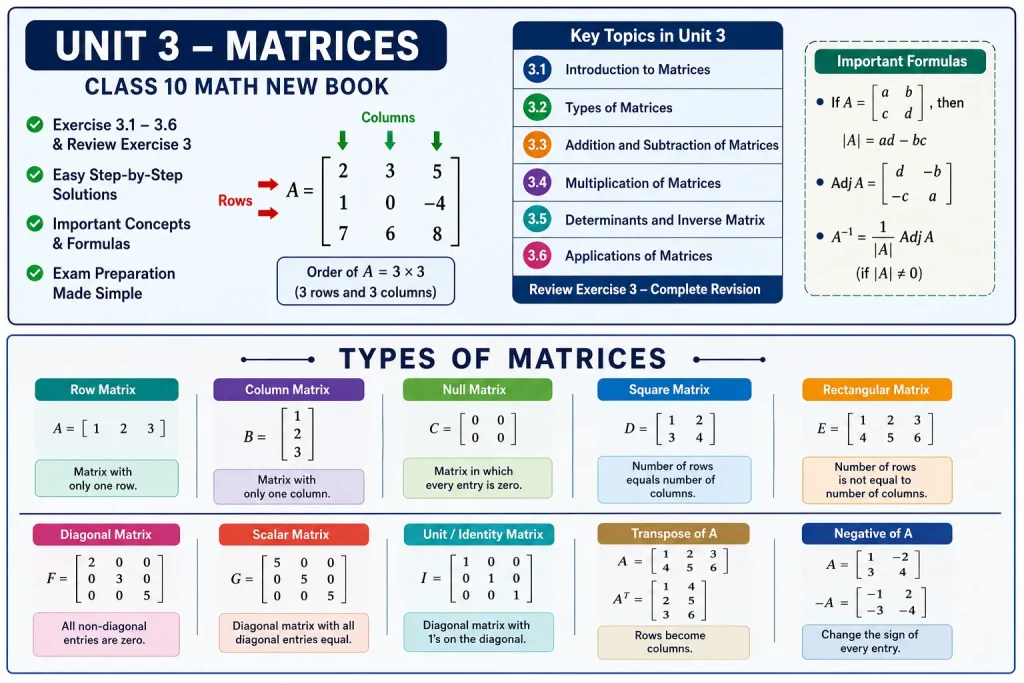
Quick Overview of Unit 3 Class 10 Math New Book
| Exercise | Main Topic | What Students Learn |
|---|---|---|
| Exercise 3.1 | Introduction to Matrices | Rows, columns, order of a matrix, and equal matrices |
| Exercise 3.2 | Types of Matrices | Row, column, null, square, rectangular, diagonal, scalar, unit, transpose, negative, and symmetric matrices |
| Exercise 3.3 | Addition and Subtraction of Matrices | Conformable matrices, additive inverse, and basic laws of addition |
| Exercise 3.4 | Multiplication of Matrices | Matrix multiplication, order of product, AB and BA, and verification of laws |
| Exercise 3.5 | Determinants and Inverse Matrix | Determinant, singular matrix, non-singular matrix, adjoint, and multiplicative inverse |
| Exercise 3.6 | Applications of Matrices | Solving simultaneous equations by matrix inversion method and Cramer’s rule |
| Review Exercise 3 | Complete Revision | MCQs and important written questions from the whole unit |
What is Unit 3 of Class 10 Math About?
Unit 3 of the new Class 10 Math book is about Matrices. A matrix is a rectangular arrangement of numbers in rows and columns. Matrices are used in mathematics to organize numbers and solve different types of problems.
At the start of this unit, students learn how to identify rows, columns, and the order of a matrix. After that, they study different types of matrices such as row matrix, column matrix, square matrix, null matrix, diagonal matrix, scalar matrix, and unit matrix.
In the next exercises, students learn operations on matrices. These include addition, subtraction, additive inverse, transpose, and multiplication of matrices. The unit then moves towards determinants, inverse matrices, and solving simultaneous linear equations by matrix methods.
This unit is important because it connects basic algebra with a new way of writing and solving mathematical problems. Students who understand this unit properly can solve matrix questions more confidently in exams.
Solutions of Exercise 3.1 Class 10 Math New Book
Solutions of Exercise 3.1 Class 10 Math New Book are given here in easy PDF format. This exercise is about the basic introduction of matrices.
In Exercise 3.1, students learn how to identify rows and columns of a matrix. A row is a horizontal line of entries, while a column is a vertical line of entries.
Students also learn how to write the order of a matrix. If a matrix has m rows and n columns, its order is written as m-by-n.
This exercise also includes equal matrices. Two matrices are equal only when their orders are the same and their corresponding entries are equal.
Main concepts in Exercise 3.1
| Concept | Meaning |
|---|---|
| Row | Horizontal line of entries |
| Column | Vertical line of entries |
| Order of matrix | Number of rows × number of columns |
| Equal matrices | Matrices with the same order and same corresponding entries |
Exercise 3.1 is very basic, but it is important. If students do not understand rows, columns, and order properly, they may face difficulty in later exercises.
Solutions of Exercise 3.2 Class 10 Math New Book
Solutions of Exercise 3.2 Class 10 Math New Book are available here with simple step-by-step working. This exercise is about different types of matrices.
In Exercise 3.2, students identify row matrices, column matrices, null matrices, square matrices, rectangular matrices, diagonal matrices, scalar matrices, and unit matrices.
This exercise also includes transpose of a matrix and negative of a matrix. In transpose, rows are changed into columns. In negative of a matrix, the sign of every entry is changed.
Students should focus on definitions in this exercise because most questions are based on recognizing the type of matrix correctly.
Main types of matrices in Exercise 3.2
| Type of Matrix | Identification |
|---|---|
| Row matrix | Has only one row |
| Column matrix | Has only one column |
| Null matrix | All entries are zero |
| Square matrix | Number of rows = number of columns |
| Rectangular matrix | Number of rows ≠ number of columns |
| Diagonal matrix | All non-diagonal entries are zero |
| Scalar matrix | A diagonal matrix with equal diagonal entries |
| Unit matrix | Has 1 on the main diagonal and 0 elsewhere |
This exercise is mostly based on identification. Students should carefully count rows and columns before naming the type of matrix.
Solutions of Exercise 3.3 Class 10 Math New Book
Solutions of Exercise 3.3 Class 10 Math New Book are provided here in PDF form. This exercise explains addition and subtraction of matrices.
Before adding or subtracting two matrices, students must check their order. Matrices can be added or subtracted only when they have the same order. Such matrices are called conformable matrices for addition and subtraction.
In matrix addition, corresponding entries are added. In matrix subtraction, corresponding entries are subtracted.
This exercise also includes additive inverse of a matrix. The additive inverse is found by changing the sign of every entry of the matrix. When a matrix is added to its additive inverse, the result is a null matrix.
Important ideas in Exercise 3.3
| Concept | Explanation |
|---|---|
| Conformable matrices | Matrices with the same order |
| Matrix addition | Add corresponding entries |
| Matrix subtraction | Subtract corresponding entries |
| Additive inverse | Change the sign of every entry |
| Null matrix | Result of A + (−A) |
Exercise 3.3 is important because it builds the basic operation skills needed for later questions in matrices.
Solutions of Exercise 3.4 Class 10 Math New Book
Solutions of Exercise 3.4 Class 10 Math New Book are given here with clear steps. This exercise is about multiplication of matrices.
Matrix multiplication is different from ordinary multiplication. For multiplying two matrices, the number of columns of the first matrix must be equal to the number of rows of the second matrix.
If matrix A has order m-by-n and matrix B has order n-by-p, then AB is possible and the order of AB is m-by-p.
Students also learn that matrix multiplication is not always commutative. This means AB is usually not equal to BA.
Main points of Exercise 3.4
| Point | Explanation |
|---|---|
| Condition for AB | Columns of A = Rows of B |
| Order of AB | Rows of A × Columns of B |
| Entry of product | Row × column multiplication |
| Important rule | Usually AB ≠ BA |
This exercise needs careful calculation. Students should multiply each row by each column slowly and check signs carefully.
Solutions of Exercise 3.5 Class 10 Math New Book
Solutions of Exercise 3.5 Class 10 Math New Book are available here in step-by-step PDF format. This exercise is about determinants and inverse matrices.
In this exercise, students learn how to find the determinant of a 2-by-2 matrix. For A = [a b; c d], the determinant is:
|A| = ad − bc
Students also learn about singular and non-singular matrices. If |A| = 0, the matrix is singular. If |A| ≠ 0, the matrix is non-singular.
Exercise 3.5 also includes adjoint and inverse of a matrix. For a 2-by-2 matrix, the adjoint is found by interchanging a and d, and changing the signs of b and c.
If |A| ≠ 0, then:
A⁻¹ = 1/|A| Adj A
Main formulas in Exercise 3.5
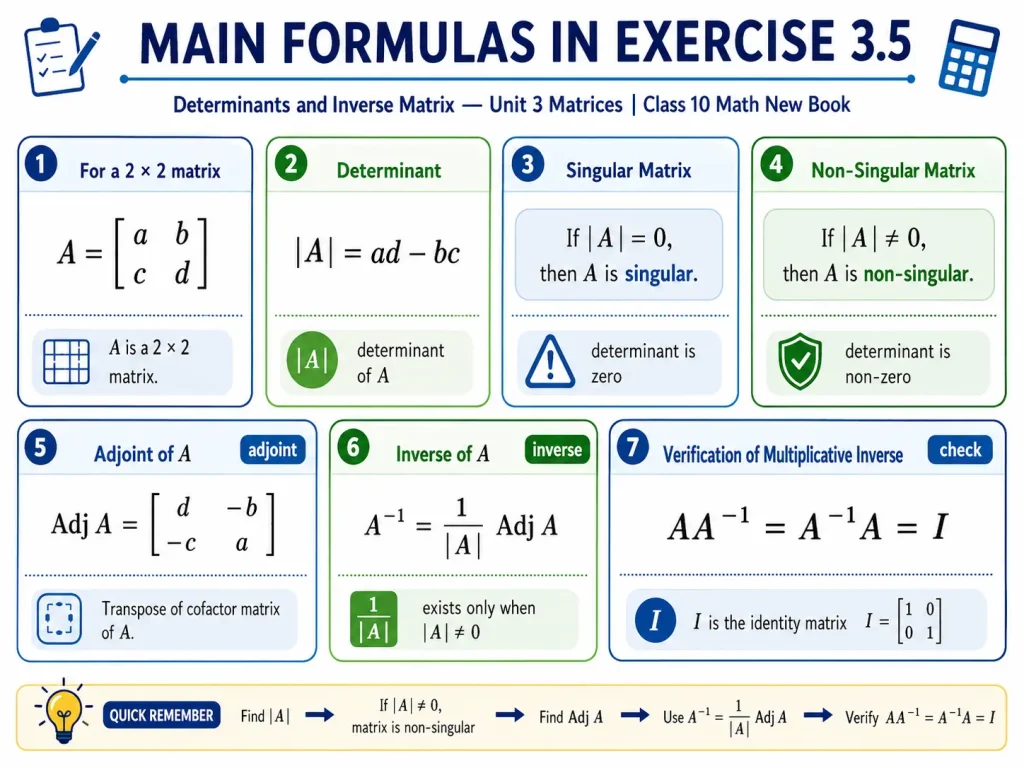
Exercise 3.5 is very important for long questions. Students should remember that inverse of a matrix exists only when the determinant is not zero.
Solutions of Exercise 3.6 Class 10 Math New Book
Solutions of Exercise 3.6 Class 10 Math New Book are provided here for students who want easy and complete solutions. This exercise is about solving simultaneous linear equations by matrices.
In Exercise 3.6, students learn the matrix inversion method and Cramer’s rule. A pair of linear equations can be written in matrix form and then solved by using inverse matrix or determinants.
A pair of linear equations can be written as:
AX = B
Then the solution can be found by:
X = A⁻¹B
Students also learn Cramer’s rule. In Cramer’s rule:
x = Δx/Δ, y = Δy/Δ
This exercise also includes application-based questions. Students may need to convert a word problem into two linear equations and then solve it by matrices.
Main methods in Exercise 3.6
| Method | Basic Idea |
|---|---|
| Matrix inversion method | Write AX = B, then X = A⁻¹B |
| Cramer’s rule | Use determinants to find x and y |
| Application questions | Convert word problem into two equations |
Exercise 3.6 is one of the most important exercises of Unit 3 because it connects matrices with simultaneous equations and real-life problems.
Solutions of Review Exercise 3 Class 10 Math New Book
Solutions of Review Exercise 3 Class 10 Math New Book are given here for complete revision of Unit 3 Matrices.
Review Exercise 3 includes MCQs and written questions from the whole unit. The MCQs help students revise important concepts such as row matrix, column matrix, identity matrix, skew-symmetric matrix, transpose, additive inverse, and determinant.
The written questions include matrix addition, subtraction, multiplication, inverse matrix, and application questions.
Students should solve Review Exercise 3 after completing Exercise 3.1 to Exercise 3.6. It helps them revise the full unit and prepare better for exams.
Important Formulas of Unit 3 Matrices
| Concept | Formula or Rule |
|---|---|
| Order of matrix | rows-by-columns |
| Equal matrices | Same order and same corresponding entries |
| Transpose | Rows become columns |
| Negative matrix | Change sign of every entry |
| Addition/Subtraction | Only possible for matrices of the same order |
| Determinant | |
| Singular matrix | |
| Non-singular matrix | |
| Adjoint | Adj A = [d −b; −c a] |
| Inverse matrix | A⁻¹ = 1/ |
| Matrix equation | AX = B |
| Matrix solution | X = A⁻¹B |
| Cramer’s rule | x = Δx/Δ, y = Δy/Δ |
Common Mistakes in Unit 3 Matrices
Students often confuse rows and columns. Rows go from left to right, while columns go from top to bottom.
Another common mistake is adding or subtracting matrices of different orders. This is not allowed. Matrices can be added or subtracted only when their orders are the same.
In transpose questions, some students only rewrite the same matrix. This is wrong. In transpose, rows must become columns.
In negative of a matrix, every entry must change its sign. Positive numbers become negative, and negative numbers become positive.
In matrix multiplication, many students forget the rule that columns of the first matrix must be equal to rows of the second matrix.
In determinant questions, students sometimes write ad + bc instead of ad − bc. The correct formula is |A| = ad − bc.
In inverse matrix questions, students should first check the determinant. If the determinant is zero, inverse does not exist.
In Cramer’s rule, students should place the constants in the correct determinant. A small mistake in Δx or Δy can change the final answer.
How to Prepare Unit 3 for Exams
Start from Exercise 3.1 and understand rows, columns, and order of matrices first.
Then learn the types of matrices from Exercise 3.2. These questions are usually easy marks if you know the definitions.
After that, practise addition and subtraction of matrices from Exercise 3.3. Always check the order before adding or subtracting.
For Exercise 3.4, practise matrix multiplication slowly. Write every row-by-column multiplication clearly.
Exercise 3.5 needs more practice because determinant, adjoint, and inverse matrix are important for long questions.
Exercise 3.6 should be prepared carefully because it includes simultaneous equations and word problems. Students should practise converting word problems into equations.
At the end, solve Review Exercise 3 for complete revision.
FAQs About Unit 3 Class 10 Math New Book Solutions
What is Unit 3 in Class 10 Math New Book?
Unit 3 is about Matrices. It includes types of matrices, matrix operations, determinants, inverse matrix, and solving simultaneous equations by matrices.
How many exercises are there in Unit 3 Class 10 Math New Book?
Unit 3 includes Exercise 3.1 to Exercise 3.6 and Review Exercise 3.
What is the most important exercise in Unit 3?
Exercise 3.5 and Exercise 3.6 are very important because they include determinants, inverse matrices, Cramer’s rule, and real-life applications.
What is a matrix?
A matrix is an arrangement of numbers in rows and columns.
What is the order of a matrix?
The order of a matrix tells the number of rows and columns. If a matrix has m rows and n columns, its order is m-by-n.
When are two matrices equal?
Two matrices are equal when they have the same order and their corresponding entries are equal.
When can two matrices be added?
Two matrices can be added only when they have the same order.
Can we multiply any two matrices?
No. Two matrices can be multiplied only when the number of columns of the first matrix is equal to the number of rows of the second matrix.
Is AB always equal to BA in matrices?
No. In matrix multiplication, AB is usually not equal to BA.
What is the formula of determinant of a 2-by-2 matrix?
For A = [a b; c d], the determinant is |A| = ad − bc.
What is a singular matrix?
A matrix is singular when its determinant is zero.
What is a non-singular matrix?
A matrix is non-singular when its determinant is not zero.
What is the inverse of a matrix used for?
The inverse of a matrix is used to solve matrix equations and simultaneous linear equations.
What is Cramer’s rule?
Cramer’s rule is a method used to solve simultaneous linear equations by using determinants.
Related Class 10 Math New Book Solutions
Students who are studying Unit 3 should also revise the previous units of the new Class 10 Math book. Unit 1 explains complex numbers, while Unit 2 explains quadratic equations and inequalities.
You can also study these solved units here:
Unit 1 Complex Numbers Class 10 Math New Book Solutions
Unit 2 Class 10 Math New Book Solutions
These units are also solved step by step in PDF format, so students can revise the earlier topics before preparing Unit 3 Matrices.
Final Words
Unit 3 Class 10 Math New Book Solutions help students understand matrices in a simple and step-by-step way. This unit may look new at first, but it becomes easy when students understand rows, columns, order, types of matrices, operations, determinant, adjoint, and inverse matrix properly.
Students should practise each exercise carefully and revise the important formulas before exams. The PDF solutions given above can help students prepare Unit 3 in less time and with better understanding.