
Unit 1 Complex Numbers Class 10 Math New Book Solutions
Unit 1 Complex Numbers Class 10 Math New Book Solutions are available here in easy PDF format. On this page, students can view and download the complete solved notes of Exercise 1.1, Exercise 1.2, Exercise 1.3, Exercise 1.4, and Review Exercise 1.
These notes are prepared for students who want simple, clear, and step-by-step solutions of Unit 1 from the new Class 10 Mathematics book. Each exercise is solved in an easy method so that students can understand the complete working, not only the final answer.
This unit is part of our Class 10 math notes for the new book (2026–27, Punjab Board), where you can open the solved exercises of all 12 units.
Unit 1 is about complex numbers. In this unit, students learn about the imaginary unit i, powers of i, square roots of negative numbers, real and imaginary parts, addition and subtraction of complex numbers, multiplication and division of complex numbers, conjugate, modulus, additive inverse, multiplicative inverse, and simultaneous equations with complex coefficients.
If you are preparing for a school test, monthly test, final exam, or board exam, these notes can help you revise the full unit in a better way.
PDF Solutions of Unit 1 Class 10 Math New Book
Click on any button below to open the PDF solution of that exercise. You can view the PDF online or download it for later study.
What is Unit 1 Complex Numbers About?
Unit 1 of the Class 10 Math New Book introduces students to complex numbers. This is an important topic because it extends the number system.
In earlier classes, students learn about natural numbers, whole numbers, integers, rational numbers, irrational numbers, and real numbers. But in real numbers, we cannot find the square root of a negative number.
For example: √−1
There is no real number whose square is −1. To solve this problem, mathematicians introduced a new number called the imaginary unit.
It is written as: i
and it is defined as: i² = −1
This is the basic rule of Unit 1. If students remember this rule, many questions of this unit become easy.
A complex number is written in the form: a + bi
Here, a and b are real numbers. The number a is called the real part, and b is called the imaginary part.
For example, in: 5 + 3i
the real part is 5, and the imaginary part is 3.
This unit teaches how to solve questions involving complex numbers using ordinary algebra rules and the special rule: i² = −1
Exercise 1.1 Explanation
Exercise 1.1 is the starting exercise of Unit 1. It explains the basic use of i. In this exercise, students learn how to simplify powers of i, how to write square roots of negative numbers in terms of i, and how to find unknown values by comparing real and imaginary parts.
The most important idea in this exercise is: i² = −1
Using this rule, we can find higher powers of i.
For example: i³ = i² · i
i³ = −1 · i so i³ = −i
Also: i⁴ = i² · i² = (−1)(−1)
i⁴ = 1
After this, the powers of i repeat again. The cycle is:
i, −1, −i, 1
So students should remember this cycle carefully.
Exercise 1.1 also includes questions like: √−4
To solve this, we write:
√−4 = √4 √−1
√−4 = 2i
In the same way: √−7 = √7i
So the general rule is: √−a = √a i
This exercise also includes questions where two complex numbers are equal. If:
a + bi = c + di
then: a = c and: b = d
This means we compare real parts separately and imaginary parts separately.
For example, if:
(2x + 5) + (y − 3)i = 1 + 2i
then: 2x + 5 = 1 and: y − 3 = 2
This method helps us find the values of x and y.
Exercise 1.1 is very important because it builds the base for the whole unit. Students should not move to the next exercise without understanding powers of i and comparison of real and imaginary parts.
Exercise 1.2 Explanation
Exercise 1.2 is about operations on complex numbers. In this exercise, students learn how to add, subtract, multiply, and divide complex numbers.
Addition and subtraction are simple. We combine real parts with real parts and imaginary parts with imaginary parts.
For example:
(16 − 3i) + (9 + 2i)
= (16 + 9) + (−3i + 2i)
= 25 − i
This is just like collecting like terms in algebra.
In subtraction, students must be careful with signs.
For example: (9 − 2i) − (7 − 3i)
= 9 − 2i − 7 + 3i = 2 + i
Many students make mistakes in subtraction because they forget to change the signs after the minus sign.
Multiplication of complex numbers is also similar to algebraic multiplication. We multiply the brackets and then use: i² = −1
For example: (3 + 4i)(2 − 3i)
= 6 − 9i + 8i − 12i²
Since: i² = −1
we get: = 6 − i + 12= 18 − i
Division of complex numbers is more important. In division, we multiply numerator and denominator by the conjugate of the denominator.
For example, if the denominator is: 2 − 4i
then its conjugate is: 2 + 4i
This method removes i from the denominator and helps us write the final answer in the form: a + bi
Exercise 1.2 also explains additive inverse and multiplicative inverse.
The additive inverse of a complex number is the number which gives zero when added to it.
For example, the additive inverse of: 3 + 2i is: −3 − 2i
because: (3 + 2i) + (−3 − 2i) = 0
The multiplicative inverse of a complex number z is: 1/z
For example, the multiplicative inverse of: 4 + 5i
is found by writing: 1/(4 + 5i)
Then we multiply numerator and denominator by the conjugate: 4 − 5i
Exercise 1.2 is one of the most important exercises of Unit 1 because it teaches the main operations of complex numbers. These operations are also used in Exercise 1.3, Exercise 1.4, and Review Exercise 1.
Exercise 1.3 Explanation
Exercise 1.3 is about modulus and conjugate of complex numbers. These two ideas are very important in Unit 1.
If: z = a + bi
then the conjugate of z is: z̄ = a − bi
In simple words, to find the conjugate, we change only the sign of the imaginary part. The real part remains the same.
For example, the conjugate of: 5 − 2i is: 5 + 2i
The conjugate of: 3 + 4i is: 3 − 4i
Students should remember that the real part does not change in conjugate.
The modulus of a complex number is written as: |z|
If: z = a + bi
then: |z| = √(a² + b²)
For example, if: z = 4 + 3i
then: |z| = √(4² + 3²)
|z| = √(16 + 9) = √25
|z| = 5
Exercise 1.3 also includes verification questions. In these questions, students prove different properties of conjugate and modulus.
One of the most important properties is:
z z̄ = |z|²
This means that when a complex number is multiplied by its conjugate, the answer is equal to the square of its modulus.
For example, if: z = 5 − 2i
then: z̄ = 5 + 2i
Now: z z̄ = (5 − 2i)(5 + 2i)
= 25 − 4i²
Since: i² = −1
we get: = 25 + 4= 29
Also:
|z| = √(5² + (−2)²)
|z| = √(25 + 4)= √29
So: |z|² = 29
Therefore: z z̄ = |z|²
Exercise 1.3 helps students understand the relation between complex numbers, their conjugates, and their moduli. It is also useful for MCQs and short questions.
Exercise 1.4 Explanation
Exercise 1.4 is a little more advanced than the previous exercises. It includes real and imaginary parts of complex expressions and simultaneous linear equations with complex coefficients.
In the first type of question, students simplify the given expression and write it in the form: a + bi
After that, they identify the real part and imaginary part.
For example: (8 − 3i)²
First expand it: (8 − 3i)² = 64 − 48i + 9i²
Since: i² = −1
we get: 64 − 48i − 9= 55 − 48i
So the real part is 55, and the imaginary part is −48.
This exercise also includes negative powers such as:
(5 + 3i)⁻¹
This means: 1/(5 + 3i)
To simplify this, we multiply numerator and denominator by the conjugate:
5 − 3i
This gives the answer in the form: a + bi
The second part of Exercise 1.4 includes simultaneous equations with complex coefficients. In these equations, letters like z and w are unknown complex numbers.
For example, in (2 + i)w, the expression 2 + i is the coefficient of w. It means that 2 + i is multiplied by w.
These questions look difficult, but the method is similar to ordinary simultaneous equations. Students can solve them by substitution or elimination. The only extra care needed is that i must be handled correctly.
Whenever i² appears during multiplication, replace it with −1.
After finding one unknown, students should put its value back into one of the original equations to find the second unknown.
Exercise 1.4 is important for long questions. Students should practise it slowly and check each step carefully.
Review Exercise 1 Explanation
Review Exercise 1 is the final practice of Unit 1. It includes questions from all concepts of the unit.
This exercise has MCQs, short questions, simplification questions, inverse questions, verification questions, modulus questions, and equations involving complex numbers.
The MCQs are useful for quick revision. They test important ideas such as:
i² + i⁴
real part of a complex expression, imaginary part of a complex expression, pure imaginary numbers, additive inverse, multiplicative inverse, conjugate, and modulus.
The written questions revise the complete unit. Students solve powers of i, products and divisions of complex numbers, additive and multiplicative inverse, properties of conjugate, properties of modulus, simultaneous equations, and comparison of real and imaginary parts.
Review Exercise 1 should not be skipped. It is very useful for final preparation because it combines all ideas of Unit 1 in one place.
Students should solve Review Exercise 1 after completing Exercise 1.1 to Exercise 1.4. It will help them check whether they understand the whole unit or not.
Important Definitions of Unit 1
Imaginary Unit
The imaginary unit is written as i. It is defined by:
i² = −1
It can also be written as:
i = √−1
Complex Number
A number of the form: a + bi
is called a complex number, where a and b are real numbers.
Real Part
In the complex number: a + bi
the number a is called the real part.
For example, in: 7 + 5i
the real part is 7.
Imaginary Part
In the complex number: a + bi
the number b is called the imaginary part.
For example, in: 7 + 5i
the imaginary part is 5, not 5i.
Pure Imaginary Number
A complex number is called a pure imaginary number if its real part is zero.
For example: 5i
is a pure imaginary number because it can be written as: 0 + 5i
Conjugate of a Complex Number
If: z = a + bi
then the conjugate of z is: z̄ = a − bi
Only the sign of the imaginary part changes.
Modulus of a Complex Number
If: z = a + bi
then the modulus of z is: |z| = √(a² + b²)
The modulus is always a non-negative real number.
Additive Inverse
The additive inverse of: a + bi is: −a − bi
When a complex number is added to its additive inverse, the answer is zero.
Multiplicative Inverse
The multiplicative inverse of a complex number z is: 1/z
If: z = a + bi
then: 1/z = (a − bi)/(a² + b²)
provided z ≠ 0.
Equality of Complex Numbers
Two complex numbers are equal if their real parts are equal and their imaginary parts are equal.
If: a + bi = c + di
then: a = c and b = d
Important Formulas of Unit 1 Complex Numbers
Students should revise these formulas again and again.
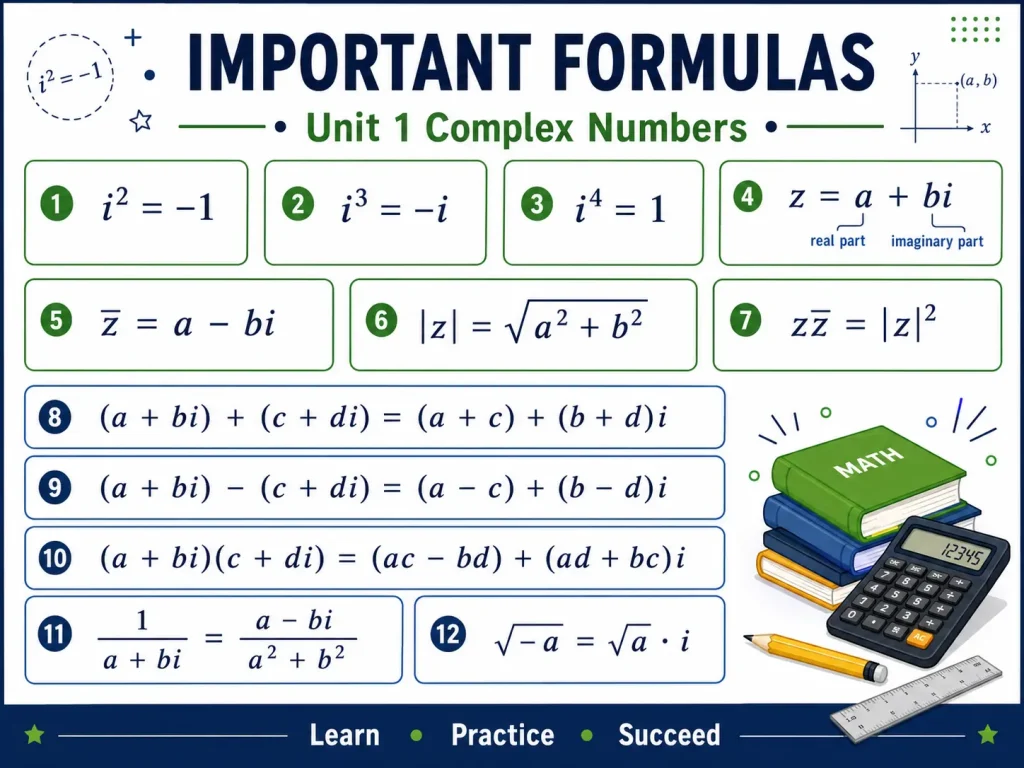
Important Formulas of Complex Numbers
Class 10 Quick SheetPowers of i
i² = −1, i³ = −i, i⁴ = 1
i²ⁿ = (−1)ⁿ
i²ⁿ⁺¹ = (−1)ⁿi
Powers repeat after every 4 steps.
Negative Square Root
√(−a) = √a i
Used when the number under root is negative.
Add / Subtract
(a + bi) + (c + di) = (a + c) + (b + d)i
(a + bi) − (c + di) = (a − c) + (b − d)i
−(a + bi) = −a − bi
Multiplication
(a + bi)(c + di) = (ac − bd) + (ad + bc)i
(a + bi)(a − bi) = a² + b²
Always replace i² with −1.
Conjugate
z̄ = a − bi
z̄̄ = z
z + z̄ = 2a, z − z̄ = 2bi
Modulus
|z| = √(a² + b²)
z z̄ = |z|²
|z| = |z̄| = |−z|
Reciprocal
1/(a + bi) = (a − bi)/(a² + b²)
Multiply by conjugate to remove i from denominator.
Real & Imaginary Parts
Re(z) = a
Im(z) = b
In z = a + bi, a is real part and b is imaginary coefficient.
Exam Use
Add/Subtract: combine like parts.
Multiply: expand and use i² = −1.
Divide: multiply by conjugate.
Short Revision Table of Unit 1
| Concept | Key Rule | Example |
|---|---|---|
| Imaginary unit | i² = −1 | i² = −1 |
| Powers of i | Cycle repeats after 4 powers | i⁴ = 1 |
| Negative square root | √−a = √a i | √−9 = 3i |
| Complex number | Written as a + bi | 5 + 2i |
| Real part | Number without i | Re(5 + 2i) = 5 |
| Imaginary part | Coefficient of i | Im(5 + 2i) = 2 |
| Conjugate | Change sign of imaginary part | z̄ of 5 + 2i is 5 − 2i |
| Modulus | z | |
| Additive inverse | Change signs of both parts | −(3 + 4i) = −3 − 4i |
| Multiplicative inverse | Use conjugate method | 1/(a + bi) = (a − bi)/(a² + b²) |
| Product with conjugate | z z̄ = | z |
| Equality | Compare real and imaginary parts | a + bi = c + di ⇒ a = c, b = d |
Common Mistakes Students Make in Unit 1
Forgetting that i² = −1
This is the biggest mistake in Unit 1. Many students forget to replace i² by −1. If this step is wrong, the whole answer becomes wrong.
Always remember: i² = −1
Writing the imaginary part incorrectly
In: 3 + 4i
the imaginary part is 4, not 4i.
This is a common mistake in MCQs and short questions.
Confusing conjugate with additive inverse
The conjugate of: 3 + 4i
is: 3 − 4i
But the additive inverse is: −3 − 4i
These two are different.
Changing the real part in conjugate
In conjugate, only the sign of the imaginary part changes. The real part remains the same.
For example: z̄ of 7 − 5i is 7 + 5i
not: −7 + 5i
Forgetting to change signs in subtraction
In subtraction, every term after the minus sign changes its sign.
For example:
(9 − 2i) − (7 − 3i)
= 9 − 2i − 7 + 3i
Students often forget to change −3i into +3i.
Using the wrong conjugate in division
In division, always multiply by the conjugate of the denominator.
For example, in: (3 + 4i)/(5 − 7i)
the conjugate of the denominator is: 5 + 7i
So we multiply numerator and denominator by: 5 + 7i
Leaving i in the denominator
The final answer should be in the form: a + bi
So the denominator should not contain i. Use the conjugate method to remove i from the denominator.
Not comparing both parts
When two complex numbers are equal, students must compare both real and imaginary parts.
If: a + bi = c + di
then: a = c and: b = d
Do not compare only the real parts.
Skipping steps in verification questions
When the question says “verify,” students should solve both sides separately and show that they are equal.
Do not only write “verified.” Proper working is necessary.
Not checking answers in simultaneous equations
In Exercise 1.4, students solve simultaneous equations with complex coefficients. After finding the values of z and w, it is better to put the answers back into the original equations to check them.
How to Use These Notes
These notes are not only for copying answers. They are prepared to help students understand the method.
First, read the basic explanation of the exercise.
Then try to solve the question yourself.
After that, open the PDF solution and compare your work.
If your answer is wrong, check the exact step where the mistake happened.
Then solve the same question again without looking at the solution.
For best results, students should first revise the formulas, then solve the exercise, then check the PDF solution. This method will help in tests and exams.
Exam Preparation Tips for Unit 1
Unit 1 becomes easy when students practise the basic rules again and again.
For MCQs, revise powers of i, real part, imaginary part, conjugate, modulus, additive inverse, and multiplicative inverse.
For short questions, learn the definitions clearly. Important definitions include complex number, imaginary unit, conjugate, modulus, pure imaginary number, additive inverse, and multiplicative inverse.
For long questions, practise multiplication, division, inverse, verification questions, and simultaneous equations with complex coefficients.
Students should especially focus on these formulas:
i² = −1
√−a = √a i
z̄ = a − bi
|z| = √(a² + b²)
z z̄ = |z|²
Before exams, solve Review Exercise 1 as a complete revision test. It includes almost all important concepts of the unit.
FAQs About Unit 1 Complex Numbers Class 10 Math New Book Solutions
What is Unit 1 of Class 10 Math New Book about?
Unit 1 is about complex numbers. It includes imaginary unit i, powers of i, square roots of negative numbers, operations on complex numbers, conjugate, modulus, additive inverse, multiplicative inverse, and equations with complex coefficients.
Are these solutions according to the new Class 10 Math book?
Yes, these solutions are prepared according to the new Class 10 Mathematics book for the 2026–27 session.
Can I download the PDF solutions?
Yes, students can view the PDF solutions online and download them for offline study.
How many exercises are included in Unit 1?
Unit 1 includes Exercise 1.1, Exercise 1.2, Exercise 1.3, Exercise 1.4, and Review Exercise 1.
What is the most important rule in Unit 1?
The most important rule is:
i² = −1
Most questions of this unit are based on this rule.
What is the conjugate of a complex number?
If: z = a + bi
then the conjugate of z is: z̄ = a − bi
Only the sign of the imaginary part changes.
What is the modulus of a complex number?
If: z = a + bi
then the modulus of z is: |z| = √(a² + b²)
What is the difference between conjugate and additive inverse?
The conjugate changes only the sign of the imaginary part.
For example: z̄ of 3 + 4i is 3 − 4i
The additive inverse changes the signs of both parts.
−(3 + 4i) = −3 − 4i
Which exercise is most important for exams?
All exercises are important. Exercise 1.2, Exercise 1.3, Exercise 1.4, and Review Exercise 1 are especially important because they contain operations, modulus, conjugate, inverse, and equation-based questions.
How should I prepare Unit 1 for exams?
First revise the formulas. Then solve Exercise 1.1 to Exercise 1.4. After that, solve Review Exercise 1. Also revise common mistakes so that you do not repeat them in exams.
Disclaimer
These solved notes are prepared by notesofmath.com for educational help only. We are not affiliated with any textbook board or official publisher. Every effort has been made to keep the solutions correct and easy to understand. Students should also consult their official textbook, classroom teacher, and school instructions for final exam preparation.
Final Words
Unit 1 Complex Numbers is an important chapter of the Class 10 Math New Book. At first, complex numbers may look difficult because i is a new idea for students. But once students understand that: i² = −1
the whole unit becomes easier.
Use the PDF solutions for step-by-step practice. Revise the formulas daily. Try to solve every question yourself before checking the answer. If you make a mistake, do not worry. Find the wrong step, correct it, and practise again.
With regular practice, students can prepare Unit 1 completely and confidently.