
Coordinate Geometry Formulas – Distance, Midpoint, Slope & Line Equations
Coordinate geometry is the bridge between algebra and geometry — and it quietly powers the technology you use every day. When your GPS pinpoints your location, when an architect drafts a building plan digitally, or when a game developer places characters on a screen, they are all using the principles of coordinate geometry. Understanding its core formulas does not just help you pass exams — it gives you a lens through which the physical world starts to make mathematical sense.
Coordinate geometry is a branch of mathematics that uses coordinates and algebraic equations to study geometric shapes, points, and lines on a plane.
This guide covers every major coordinate geometry formula in depth, with clear explanations, worked examples, real-life connections, and practice questions. Whether you are a Class 10 student preparing for board exams, a Class 11 student stepping into advanced math, or simply someone brushing up on the fundamentals, this article has everything you need.
Coordinate Geometry Formula Index
Jump directly to any section:
- What Is Coordinate Geometry?
- Coordinate Plane & Quadrants
- Quick Formula Reference Table
- Distance Formula
- Midpoint Formula
- Slope Formula
- Point-Slope Form
- Slope-Intercept Form
- Equation of a Straight Line
- Distance Between Two Points (Extended)
- Section Formula
- Area of Triangle Formula
- When to Use Which Formula
- Common Formula Confusion Guide
- Comprehensive Solved Examples
- Common Mistakes to Avoid
- Practice Questions
- Free PDF Formula Sheet Download
- FAQs
- Final Revision Tips
What Is Coordinate Geometry?
Coordinate geometry — also called analytic geometry or Cartesian geometry — is the study of geometry using a coordinate system. Instead of relying on diagrams and rulers, it uses numbers and equations to describe shapes, lines, and points precisely.
The foundation of coordinate geometry is the Cartesian plane, named after the French mathematician René Descartes. It consists of two perpendicular number lines:
- The x-axis — the horizontal line
- The y-axis — the vertical line
These two axes meet at a point called the origin, written as (0, 0). Every point on the plane is described by an ordered pair (x, y), where x tells you how far to move left or right from the origin, and y tells you how far to move up or down.
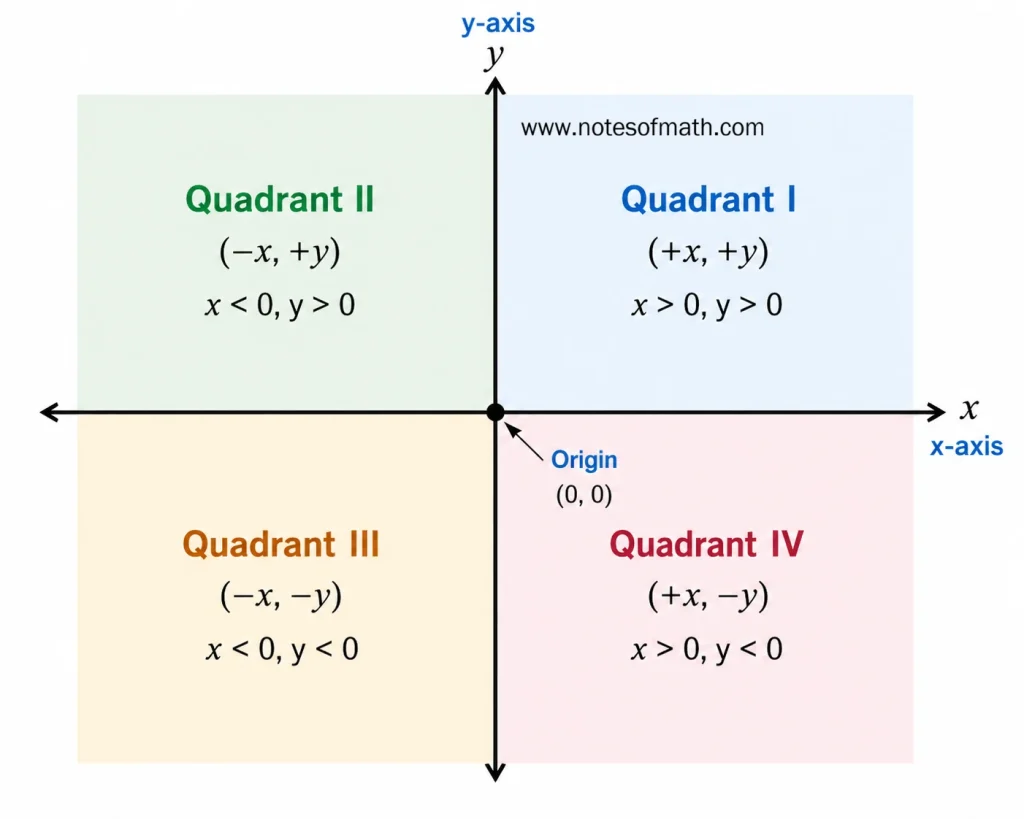
The Four Quadrants
The x-axis and y-axis divide the coordinate plane into four sections called quadrants:
| Quadrant | x value | y value | Example Point |
|---|---|---|---|
| Quadrant I (top-right) | Positive (+) | Positive (+) | (3, 5) |
| Quadrant II (top-left) | Negative (−) | Positive (+) | (−3, 5) |
| Quadrant III (bottom-left) | Negative (−) | Negative (−) | (−3, −5) |
| Quadrant IV (bottom-right) | Positive (+) | Negative (−) | (3, −5) |
Plotting Points on the Coordinate Graph
To plot a point (x, y):
- Start at the origin (0, 0)
- Move x units along the horizontal axis (right if positive, left if negative)
- Move y units along the vertical axis (up if positive, down if negative)
- Mark the point
Example: To plot (−4, 3), move 4 units left and 3 units up from the origin.
Quick-Reference Formula Table
Before diving into each formula in detail, here is a complete summary for fast lookup — bookmark this!
| Formula | Expression |
|---|---|
| Distance Formula | d = √[(x₂ − x₁)² + (y₂ − y₁)²] |
| Midpoint Formula | M = ((x₁ + x₂)/2 , (y₁ + y₂)/2) |
| Slope Formula | m = (y₂ − y₁) / (x₂ − x₁) |
| Point-Slope Form | y − y₁ = m(x − x₁) |
| Slope-Intercept Form | y = mx + b |
| Standard Form of Line | Ax + By + C = 0 |
| Section Formula (Internal) | P = ((mx₂ + nx₁)/(m+n) , (my₂ + ny₁)/(m+n)) |
| Triangle Area Formula | Area = ½ |x₁(y₂−y₃) + x₂(y₃−y₁) + x₃(y₁−y₂)| |
| Point-to-Line Distance | d = |Ax₁ + By₁ + C| / √(A² + B²) |
| Collinearity Condition | x₁(y₂ − y₃) + x₂(y₃ − y₁) + x₃(y₁ − y₂) = 0 |
Important Coordinate Geometry Formulas
1. Distance Formula
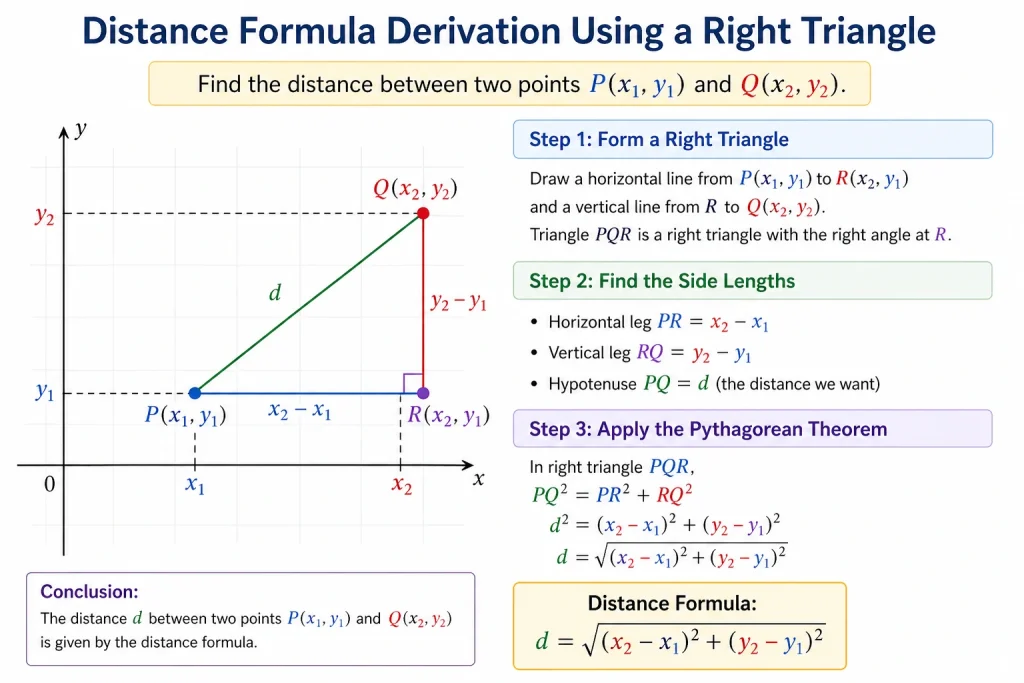
What it is: The distance formula calculates the straight-line distance between any two points on a coordinate plane.
The Formula:
d = √[(x₂ − x₁)² + (y₂ − y₁)²]
Where:
- (x₁, y₁) is the first point
- (x₂, y₂) is the second point
- d is the distance between them
Where it comes from: This formula is a direct application of the Pythagorean theorem. If you draw a right triangle between two points, the horizontal leg has length |x₂ − x₁| and the vertical leg has length |y₂ − y₁|. The hypotenuse — the distance between the two points — is found using a² + b² = c².
Horizontal distance = (x₂ − x₁)
Vertical distance   = (y₂ − y₁)
Therefore: d = √[(x₂ − x₁)² + (y₂ − y₁)²]
Real-world connection: Delivery apps use this formula to calculate how far a driver is from a customer. GPS systems use it to compute straight-line distances between coordinates.
✅ Worked Example
Find the distance between points A(−6, −6) and B(6, 6).
d = √[(6 − (−6))² + (6 − (−6))²]
d = √[(12)² + (12)²]
d = √[144 + 144]
d = √288
d ≈ 16.97 units
⚠️ Common Mistakes
- Forgetting the square root — it applies to the entire expression, not just one term.
- Mixing up coordinates — (x₁, y₁) and (x₂, y₂) can be assigned to either point; just be consistent.
- Dropping the negative sign — watch subtraction: 6 − (−6) = 12, not 0.
2. Midpoint Formula
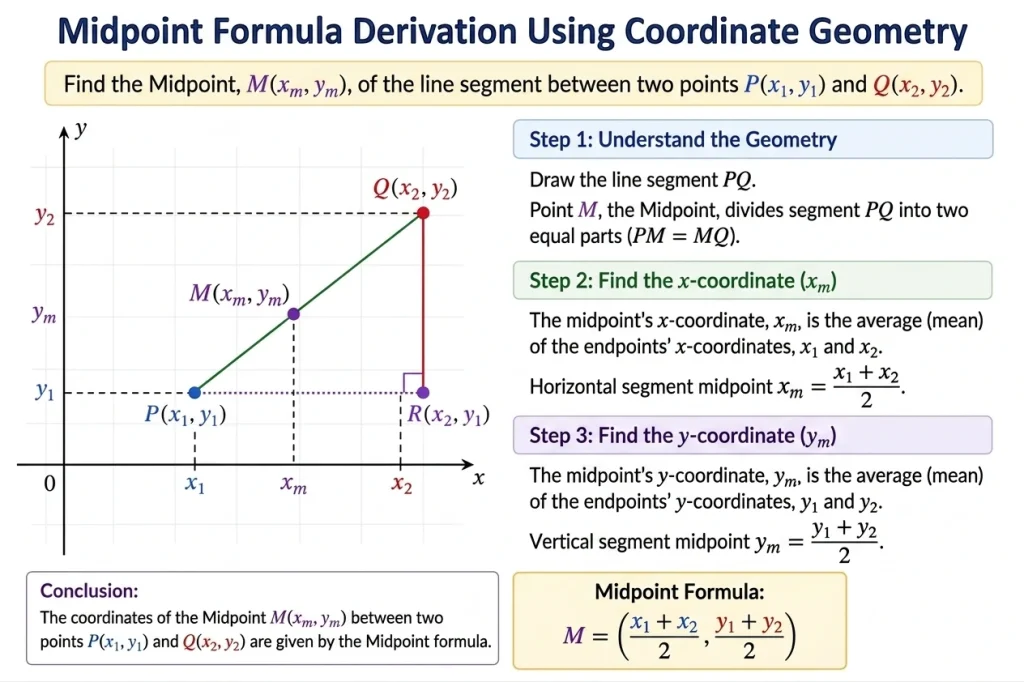
What it is: The midpoint formula finds the exact center point between two given points on a coordinate plane.
The Formula:
M = ((x₁ + x₂)/2 , (y₁ + y₂)/2)
Where M is the midpoint of the segment joining (x₁, y₁) and (x₂, y₂).
How to think about it: You are simply finding the average of the x-coordinates and the average of the y-coordinates. The midpoint is the “mean” of two points.
Real-world connection: Used in construction to find the center of a beam, or in graphic design to center an element on a canvas.
✅ Worked Example
Find the midpoint of segment AB where A(−7, −3) and B(5, 7).
M = ((−7 + 5)/2 , (−3 + 7)/2)
M = (−2/2 , 4/2)
M = (−1, 2)
The midpoint is (−1, 2).
⚠️ Common Mistakes
- Adding instead of averaging — always divide the sum by 2.
- Treating midpoint as a distance — the midpoint is a point (x, y), not a single number.
- Arithmetic errors with negatives — −7 + 5 = −2, not −12.
3. Slope Formula
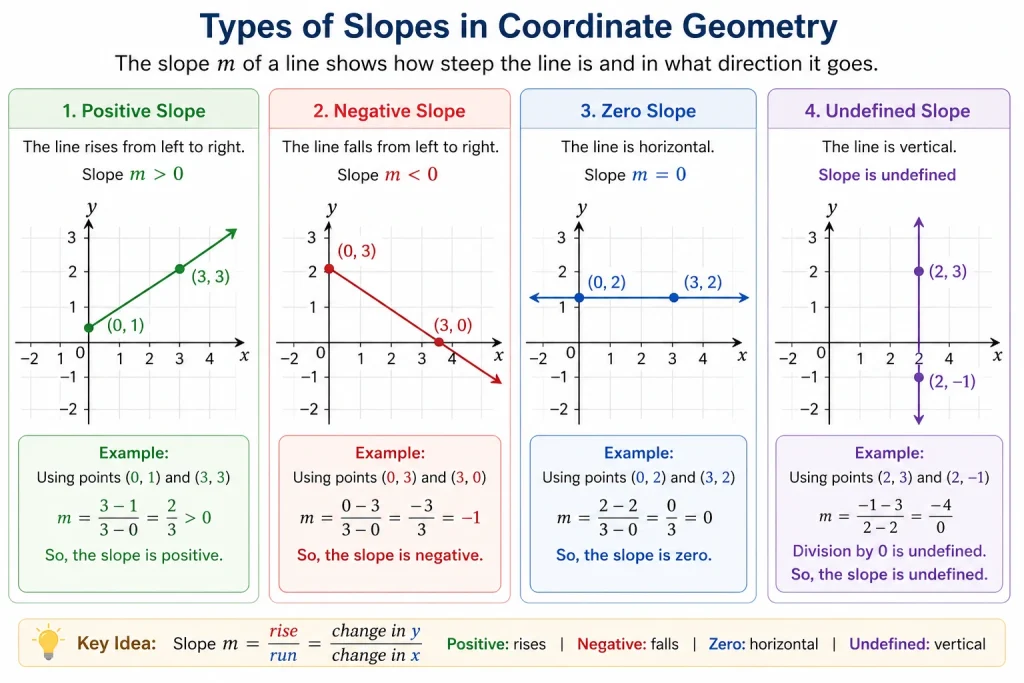
What it is: The slope of a line measures its steepness and direction. It tells you how much the line rises (or falls) for every unit it moves horizontally.
The Formula:
m = (y₂ − y₁) / (x₂ − x₁)
Interpreting slope:
| Slope Value | What it Means |
|---|---|
| m > 0 (positive) | Line goes upward from left to right |
| m < 0 (negative) | Line goes downward from left to right |
| m = 0 | Horizontal line (flat) |
| m = undefined | Vertical line (x₂ = x₁) |
| m | |
| m |
Real-world connection: Civil engineers use slope to design roads and ramps. A highway ramp with a slope of 0.06 rises 6 feet for every 100 feet traveled horizontally.
✅ Worked Example
Find the slope of the line passing through (−8, −8) and (8, 8).
m = (8 − (−8)) / (8 − (−8))
m = 16 / 16
m = 1
A slope of 1 means the line rises at exactly 45°.
Special Cases: Parallel and Perpendicular Lines
- Parallel lines have equal slopes: m₁ = m₂
- Perpendicular lines have negative reciprocal slopes: m₁ × m₂ = −1
Example: If one line has slope 2, a perpendicular line has slope −1/2.
⚠️ Common Mistakes
- Reversing the order — always keep (y₂ − y₁) on top and (x₂ − x₁) on the bottom.
- Dividing by zero — if x₂ = x₁, the slope is undefined (vertical line), not zero.
4. Point-Slope Form
What it is: Point-slope form is the most direct way to write the equation of a line when you know its slope and any one point it passes through.
The Formula:
y − y₁ = m(x − x₁)
Where:
- (x₁, y₁) is any known point on the line
- m is the slope
- x and y are variables representing all other points on the line
When to use it: Use point-slope form when you are given a point and a slope, or when you calculate the slope from two points and need to write the line’s equation immediately.
✅ Worked Example
Write the equation of the line passing through (2, 3) with slope m = 4.
y − 3 = 4(x − 2)
y − 3 = 4x − 8
y = 4x − 5
✅ Worked Example (from two points)
Find the equation of the line through (1, 2) and (3, 8).
Step 1: Find the slope.
m = (8 − 2) / (3 − 1) = 6/2 = 3
Step 2: Apply point-slope form using (1, 2).
y − 2 = 3(x − 1)
y − 2 = 3x − 3
y = 3x − 1
⚠️ Common Mistakes
- Forgetting the minus sign — the formula is y − y₁, not y + y₁.
- Using the wrong point — any point on the line works, but double-check your substitution.
5. Slope-Intercept Form
What it is: Slope-intercept form is the most widely used equation of a line. It directly shows the slope and the y-intercept.
The Formula:
y = mx + b
Where:
- m is the slope (steepness and direction)
- b is the y-intercept (where the line crosses the y-axis)
Why it is useful: If you have this form, you can immediately graph a line — start at (0, b) on the y-axis and use the slope to find the next point.
Graphing a line in slope-intercept form:
- Plot the y-intercept: point (0, b)
- From that point, apply the slope as rise/run
- Draw a straight line through the points
✅ Worked Example
Graph and analyze the line y = 2x + 5.
- Slope (m) = 2 → the line rises 2 units for every 1 unit right
- Y-intercept (b) = 5 → the line crosses the y-axis at (0, 5)
- X-intercept: Set y = 0 → 0 = 2x + 5 → x = −2.5 → crosses x-axis at (−2.5, 0)
Converting Between Forms
- From point-slope to slope-intercept: expand and solve for y
- From slope-intercept to standard form: rearrange to Ax + By + C = 0
⚠️ Common Mistakes
- Confusing m and b — m is always the coefficient of x; b is always the constant term.
- Misreading negative slopes — y = −3x + 2 has a negative slope; the line falls from left to right.
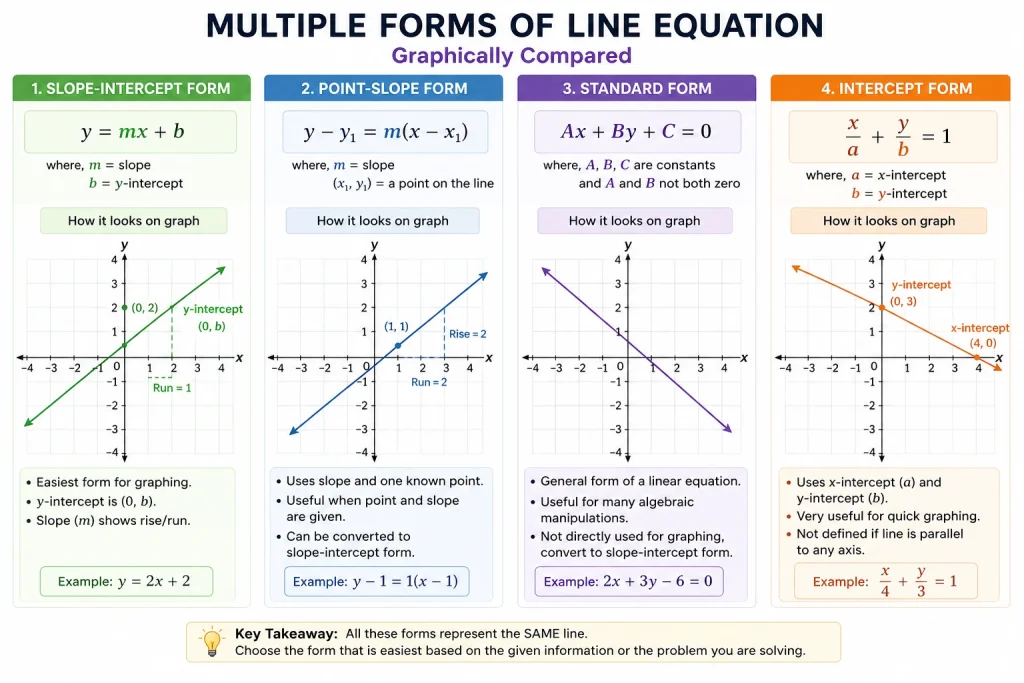
6. Equation of a Straight Line
A straight line can be expressed in multiple equivalent forms depending on what information is known.
Standard Form (General Form)
Ax + By + C = 0
Example: Convert y = 3x − 5 to standard form:
3x − y − 5 = 0
Intercept Form
x/a + y/b = 1
Where a is the x-intercept and b is the y-intercept.
Example: A line with x-intercept 4 and y-intercept 3:
x/4 + y/3 = 1 → 3x + 4y = 12
Two-Point Form
When two points (x₁, y₁) and (x₂, y₂) are known:
(y − y₁)/(y₂ − y₁) = (x − x₁)/(x₂ − x₁)
Condition for Collinearity (Three Points)
Three points A(x₁, y₁), B(x₂, y₂), and C(x₃, y₃) are collinear if:
x₁(y₂ − y₃) + x₂(y₃ − y₁) + x₃(y₁ − y₂) = 0
If the result is not zero, the three points form a triangle.
7. Distance Between Two Points (Extended)
Distance from origin (0, 0) to point (x, y):
d = √(x² + y²)
Perpendicular distance from a point to a line:
The distance from point (x₁, y₁) to the line Ax + By + C = 0:
d = |Ax₁ + By₁ + C| / √(A² + B²)
✅ Worked Example
Find the distance from point (3, 4) to the line 3x + 4y − 10 = 0.
d = |3(3) + 4(4) − 10| / √(3² + 4²)
d = |9 + 16 − 10| / √(9 + 16)
d = |15| / √25
d = 15 / 5
d = 3 units
8. Section Formula
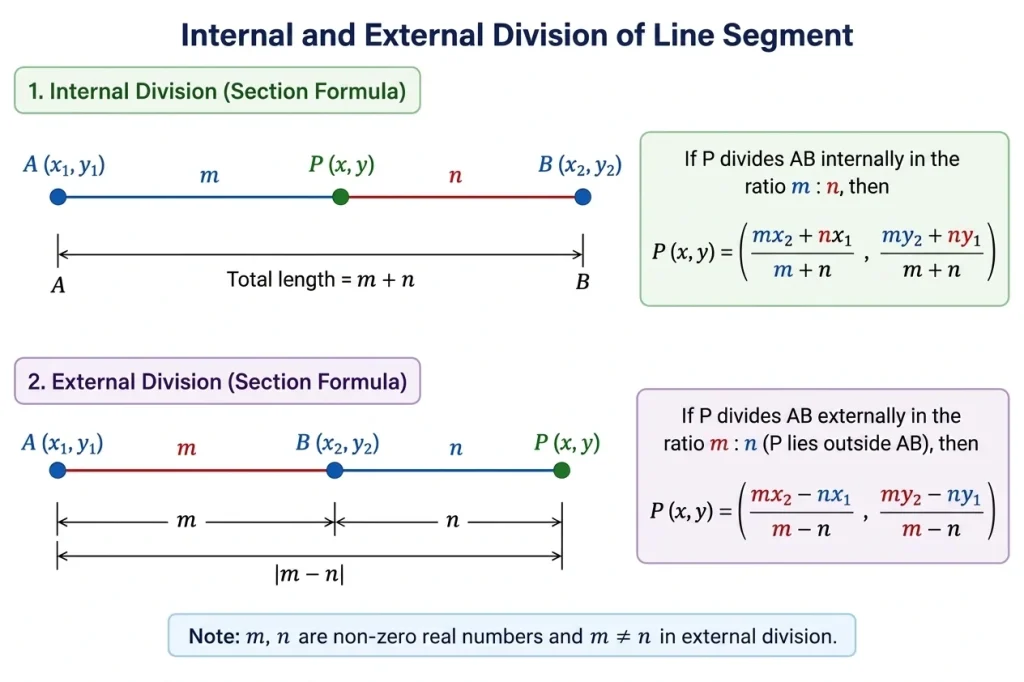
What it is: The section formula finds the coordinates of a point that divides a line segment joining two given points in a given ratio.
Internal Division Formula
When point P divides segment AB joining A(x₁, y₁) and B(x₂, y₂) internally in the ratio m:n:
P = ((mx₂ + nx₁)/(m + n) , (my₂ + ny₁)/(m + n))
External Division Formula
When point P divides segment AB externally in the ratio m:n:
P = ((mx₂ − nx₁)/(m − n) , (my₂ − ny₁)/(m − n))
Note: The midpoint formula is a special case of the section formula where m:n = 1:1.
✅ Worked Example
Find the point that divides the segment joining A(1, 3) and B(7, 9) in the ratio 2:1 internally.
P = ((2×7 + 1×1)/(2+1) , (2×9 + 1×3)/(2+1))
P = ((14 + 1)/3 , (18 + 3)/3)
P = (15/3 , 21/3)
P = (5, 7)
✅ Worked Example (Trisection Points)
Find the points that trisect the segment joining A(0, 0) and B(9, 6).
First trisection point (ratio 1:2):
P₁ = ((1×9 + 2×0)/3 , (1×6 + 2×0)/3) = (3, 2)
Second trisection point (ratio 2:1):
P₂ = ((2×9 + 1×0)/3 , (2×6 + 1×0)/3) = (6, 4)
⚠️ Common Mistakes
- Swapping m and n — the ratio m:n means m parts toward B and n parts toward A. Keep them in order.
- Using external division formula when internal is needed — read the problem carefully.
9. Area of Triangle Formula
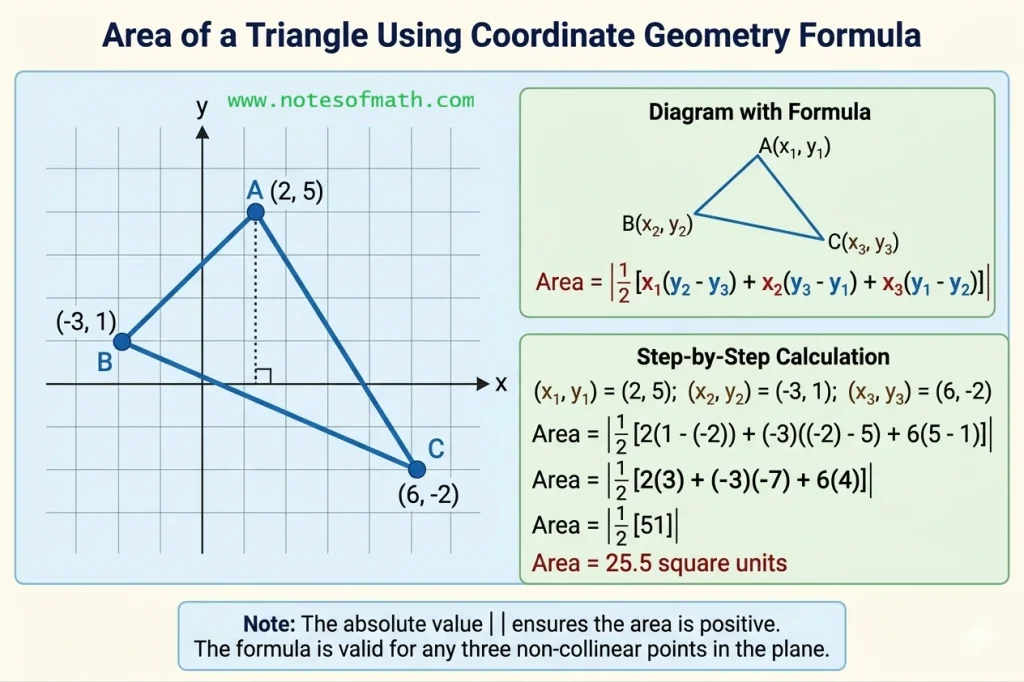
What it is: When three vertices of a triangle are given as coordinates, the area can be calculated directly without measuring any sides.
The Formula:
Area = ½ |x₁(y₂ − y₃) + x₂(y₃ − y₁) + x₃(y₁ − y₂)|
Where (x₁, y₁), (x₂, y₂), and (x₃, y₃) are the three vertices.
Important: The absolute value (| |) is essential — area is always positive.
When to use it: Any time you are given three coordinate points and need the area, this formula is faster and more accurate than computing base and height separately.
✅ Worked Example
Find the area of the triangle with vertices A(0, 0), B(4, 0), and C(2, 6).
Area = ½ |0(0 − 6) + 4(6 − 0) + 2(0 − 0)|
Area = ½ |0 + 24 + 0|
Area = ½ × 24
Area = 12 square units
✅ Worked Example (General Vertices)
Find the area of the triangle with vertices P(1, 2), Q(4, 6), R(7, 3).
Area = ½ |1(6 − 3) + 4(3 − 2) + 7(2 − 6)|
Area = ½ |1(3) + 4(1) + 7(−4)|
Area = ½ |3 + 4 − 28|
Area = ½ |−21|
Area = ½ × 21
Area = 10.5 square units
Special case — Collinearity check: If the area comes out to zero, the three points are collinear (they lie on a straight line and do not form a triangle).
⚠️ Common Mistakes
- Forgetting the absolute value — the expression inside can be negative; always take its absolute value.
- Forgetting to multiply by ½ — the formula requires halving the result.
- Wrong pairing of coordinates — be consistent: use (x₁ with y₂−y₃), (x₂ with y₃−y₁), (x₃ with y₁−y₂).
When to Use Which Formula
This table helps you instantly identify the right formula for any coordinate geometry problem.
| Problem Type | Formula to Use |
|---|---|
| Find distance between two points | Distance Formula |
| Find center of a line segment | Midpoint Formula |
| Measure steepness of a line | Slope Formula |
| Write line equation from a point + slope | Point-Slope Form |
| Graph a line or read slope and intercept | Slope-Intercept Form |
| Divide a line segment in a given ratio | Section Formula |
| Find area of a triangle from coordinates | Triangle Area Formula |
| Find distance from a point to a line | Point-to-Line Distance Formula |
| Check if three points lie on one line | Collinearity Condition |
| Find point equidistant from two endpoints | Midpoint Formula |
Common Formula Confusion Guide
Students frequently mix up formulas that sound or look similar. Here is a clear breakdown:
Distance Formula vs Midpoint Formula
- Distance gives you a single number — how far apart two points are.
- Midpoint gives you a coordinate pair — the center point between two points.
- Rule: If the answer should be a location, use midpoint. If it should be a measurement, use distance.
Slope Formula vs Equation of a Line
- Slope measures only the steepness — it is one number (m).
- Equation of a line describes every point on the line — it involves both x and y.
- Rule: Find slope first, then use it to build the equation.
Section Formula vs Midpoint Formula
- Midpoint is a special case of section formula where the ratio is exactly 1:1.
- Section formula works for any ratio m:n.
- Rule: If the ratio is given as anything other than equal halves, use section formula.
Point-Slope Form vs Slope-Intercept Form
- Point-slope form is for writing an equation when any point is known.
- Slope-intercept form is for reading and graphing — slope and y-intercept are immediately visible.
- Rule: Use point-slope to create the equation, convert to slope-intercept to graph it.
Internal Division vs External Division
- Internal division: the dividing point lies between the two endpoints.
- External division: the dividing point lies outside the segment, on the extension.
- Rule: If the problem says “divides internally” or gives no qualifier, use internal. If it says “externally,” use external.
Real-World Applications of Coordinate Geometry
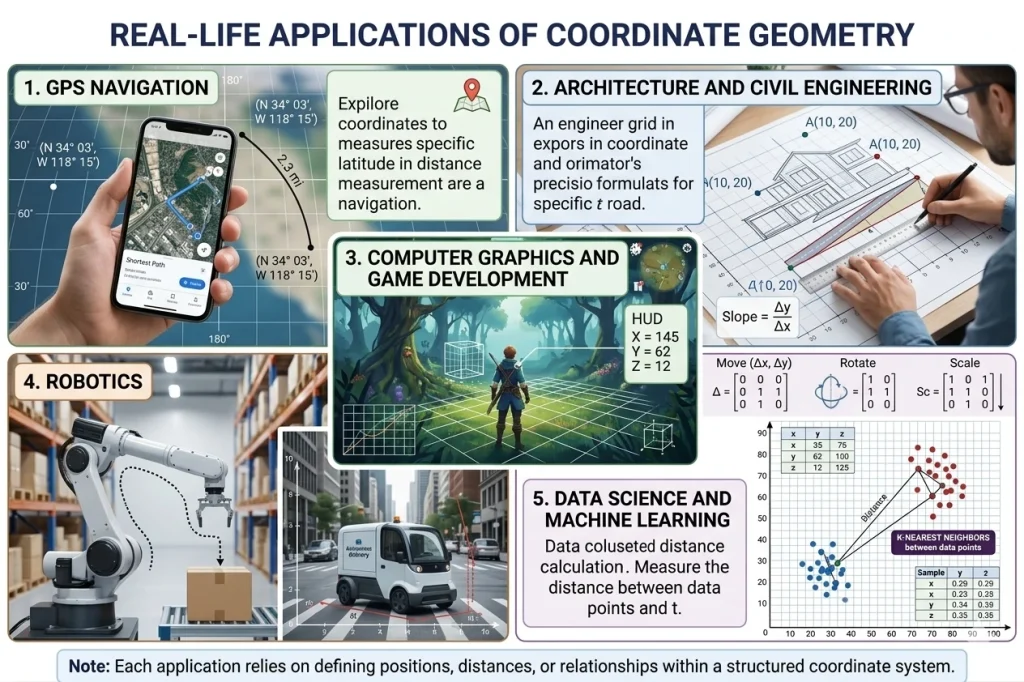
GPS Navigation: Every location on Earth is described by coordinates (latitude and longitude). Distance formulas calculate the shortest path between two positions.
Architecture and Civil Engineering: Blueprints are drawn on coordinate grids. Slope formulas help design roads, ramps, and drainage systems with precise inclines.
Computer Graphics and Game Development: Every pixel, character, and object in a game or animation is placed using coordinate geometry. Transformations — moving, rotating, scaling — all rely on coordinate calculations.
Robotics: Robot arms and autonomous vehicles calculate movements using coordinate positions and distance formulas to navigate space accurately.
Data Science and Machine Learning: Algorithms like k-nearest neighbors measure the distance between data points on a coordinate plane to make predictions.
Comprehensive Solved Examples
Example 1 — Full Problem Using Multiple Formulas
Problem: Three points are given: A(2, 4), B(8, 4), and C(5, 10). Verify they form a triangle, find the midpoint of AB, and determine the equation of line AC.
Step 1: Check if they form a triangle (collinearity test)
= 2(4 − 10) + 8(10 − 4) + 5(4 − 4)
= 2(−6) + 8(6) + 5(0)
= −12 + 48 + 0
= 36 ≠ 0
Result is not zero → A, B, C form a triangle. ✓
Step 2: Find midpoint of AB
M = ((2+8)/2 , (4+4)/2) = (5, 4)
Step 3: Equation of line AC
Slope of AC:
m = (10 − 4)/(5 − 2) = 6/3 = 2
Point-slope form using A(2, 4):
y − 4 = 2(x − 2)
y = 2x
Example 2 — Distance and Section Formula Combined
Problem: Point P divides the line segment from A(−2, 3) to B(4, −1) in the ratio 3:1. Find P, then find its distance from the origin.
Step 1: Find P
P = ((3×4 + 1×(−2))/4 , (3×(−1) + 1×3)/4)
P = (10/4 , 0/4)
P = (2.5, 0)
Step 2: Distance from P to origin
d = √(2.5² + 0²) = 2.5 units
Example 3 — Parallel and Perpendicular Lines
Problem: Line L₁ has equation y = 3x + 2. Write equations of (a) a parallel line through (0, −1) and (b) a perpendicular line through (1, 5).
(a) Parallel line — same slope m = 3:
y = 3x + b
Substitute (0, −1): −1 = 3(0) + b → b = −1
Answer: y = 3x − 1
(b) Perpendicular line — slope = −1/3:
y − 5 = −(1/3)(x − 1)
y = −x/3 + 16/3
Example 4 — Area of Triangle and Collinearity
Problem: Find the area of the triangle formed by A(1, 1), B(5, 3), and C(3, 7). Then verify whether A, B, and D(7, 5) are collinear.
Area of triangle ABC:
Area = ½ |1(3 − 7) + 5(7 − 1) + 3(1 − 3)|
Area = ½ |1(−4) + 5(6) + 3(−2)|
Area = ½ |−4 + 30 − 6|
Area = ½ × 20 = 10 square units
Collinearity check for A(1,1), B(5,3), D(7,5):
= 1(3 − 5) + 5(5 − 1) + 7(1 − 3)
= 1(−2) + 5(4) + 7(−2)
= −2 + 20 − 14 = 4 ≠ 0
A, B, D are not collinear — they form a triangle.
Common Mistakes to Avoid in Coordinate Geometry
1. Forgetting to apply the square root in the distance formula The square root covers the entire expression. Computing (x₂−x₁)² + (y₂−y₁)² without taking the root is one of the most frequent errors.
2. Mixing up the order of subtraction in slope Always write (y₂ − y₁) over (x₂ − x₁). Switching one but not the other flips the sign of the slope incorrectly.
3. Confusing midpoint with distance The midpoint is a coordinate pair (x, y). The distance is a single number. These answer completely different questions.
4. Assuming slope of 0 and undefined slope are the same Slope = 0 means a flat horizontal line. Undefined slope means a perfectly vertical line. They are opposite extremes.
5. Using the wrong section formula (internal vs external) If a point lies between the two endpoints, use internal division. If the problem says “externally,” use external division with subtraction in the denominator.
6. Forgetting absolute value in the area formula The expression inside the triangle area formula can be negative. Without the absolute value, you would get a negative area — which is meaningless.
7. Plotting ordered pairs as (y, x) instead of (x, y) Always read ordered pairs as (horizontal, vertical) — x first, then y.
8. Errors with negative coordinates in substitution When substituting negative values, always use parentheses: m = (y₂ − (−3)) is not the same as m = (y₂ − 3).
Practice Questions
Basic Level
- Find the distance between points (2, 3) and (6, 7).
- Find the midpoint between (−2, 4) and (8, 10).
- Find the slope of the line through (1, 2) and (5, 10).
Intermediate Level
- Write the equation of the line with slope 3 passing through (2, 5).
- A point divides the segment from (0, 0) to (10, 20) in the ratio 1:2. Find the point.
- Find the area of the triangle with vertices (0, 0), (4, 0), and (2, 6).
- Find the distance from point (3, 4) to the line 3x + 4y − 10 = 0.
- Are the points (1, 1), (2, 3), and (3, 5) collinear? Verify using the area formula.
Advanced Level
- The midpoint of a segment is (3, −4). One endpoint is (7, 2). Find the other endpoint.
- Find the equation of the perpendicular line to y = 2x + 1 passing through (1, 4).
- A line has x-intercept 6 and y-intercept −4. Write its equation in slope-intercept, point-slope, and standard form.
- Prove that the points A(0, 0), B(4, 0), C(4, 3), and D(0, 3) form a rectangle using coordinate geometry.
Answers:
- d = √[(6−2)² + (7−3)²] = √[16+16] = √32 ≈ 5.66 units
- M = ((−2+8)/2 , (4+10)/2) = (3, 7)
- m = (10−2)/(5−1) = 8/4 = 2
- y − 5 = 3(x − 2) → y = 3x − 1
- P = ((1×10+2×0)/3 , (1×20+2×0)/3) = (10/3 , 20/3)
- Area = ½|0(0−6)+4(6−0)+2(0−0)| = ½×24 = 12 square units
- d = |3(3)+4(4)−10|/√25 = 15/5 = 3 units
- Area = ½|1(3−5)+2(5−1)+3(1−3)| = ½|−2+8−6| = ½×0 = 0 → Collinear ✓
- Other endpoint = (2×3−7 , 2×(−4)−2) = (−1, −10)
- Perpendicular slope = −1/2; y − 4 = −½(x−1) → y = −x/2 + 9/2
- Slope = (−4−0)/(0−6) = 2/3; y = (2/3)x − 4 | y+4 = (2/3)(x−0) | 2x − 3y − 12 = 0
- Slopes of AB and DC = 0 (parallel); slopes of AD and BC = undefined (parallel); AB ⊥ AD (0 × undefined = vertical); AB = DC = 4, AD = BC = 3 → Rectangle proved ✓
Formula Cheat Sheet
| Formula | Remember It As |
|---|---|
| Distance Formula | “Length between two points” |
| Midpoint Formula | “Center between two points” |
| Slope Formula | “Steepness of a line” |
| Point-Slope Form | “Line from one point” |
| Slope-Intercept Form | “Line for graphing” |
| Section Formula | “Dividing point in ratio” |
| Triangle Area Formula | “Area from three vertices” |
| Point-to-Line Distance | “Gap from point to line” |
Coordinate Geometry Formulas PDF Download
Suggested PDF contents:
- Complete formula list with all forms
- Visual diagrams for each formula
- Worked examples summary
- Common mistakes checklist
- Practice questions with answers
- Quick revision sheet for Class 10 and Class 11
Frequently Asked Questions (FAQs)
Q1. What is coordinate geometry? Coordinate geometry is a branch of mathematics that uses a coordinate system — specifically the Cartesian plane with x and y axes — to study geometric shapes, points, and lines using algebraic equations and numerical coordinates.
Q2. What is coordinate geometry used for in real life? Coordinate geometry is used in GPS navigation, computer graphics, architecture, robotics, machine learning, and engineering. Any field that works with positions, distances, or shapes in a plane depends on it.
Q3. What is the distance formula in coordinate geometry? The distance formula calculates the straight-line distance between two points (x₁, y₁) and (x₂, y₂): d = √[(x₂ − x₁)² + (y₂ − y₁)²]. It is derived directly from the Pythagorean theorem.
Q4. What is the midpoint formula? The midpoint formula finds the center point of a segment: M = ((x₁+x₂)/2 , (y₁+y₂)/2). It works by averaging the x-coordinates and averaging the y-coordinates separately.
Q5. What is the slope formula? The slope formula m = (y₂ − y₁)/(x₂ − x₁) measures the steepness and direction of a line. A positive result means an upward slope; negative means downward; zero means horizontal; undefined means vertical.
Q6. What is the section formula and when is it used? The section formula finds a point that divides a line segment in a given ratio m:n. Use it when you need to locate a point that lies between (or outside) two given endpoints at a specific proportion.
Q7. Can the distance between two points ever be negative? No. Distance is always a non-negative value. The square root in the distance formula ensures this. If you get a negative result, there is an arithmetic error in your calculation.
Q8. What is the difference between point-slope form and slope-intercept form? Both describe the same line in different ways. Point-slope form (y − y₁ = m(x − x₁)) is easiest to write when you know any point on the line. Slope-intercept form (y = mx + b) is easiest to read and graph because slope and y-intercept are directly visible.
Q9. Is coordinate geometry important for Class 10 and Class 11? Yes, very much so. Class 10 boards focus on distance formula, section formula, and area of triangle. Class 11 expands to all line equation forms, distance from a point to a line, and angle between two lines. Both levels feature 3–6 mark questions from this chapter regularly.
Q10. How is the triangle area formula related to the collinearity condition? They are the same expression. When you apply the triangle area formula to three points and the result is zero, it means the three points do not form a triangle — they are collinear (lying on one straight line).
Final Revision Tips
Before any exam, revise in this order for maximum efficiency:
- Quick Formula Table — refresh all formulas in one view
- “When to Use Which Formula” table — train your formula-selection instinct
- “Common Formula Confusion” section — resolve any mix-ups before they cost marks
- Worked examples — re-solve at least one example per formula without looking at the steps
- Common mistakes list — read through once to activate your error-detection mode
- Practice questions — attempt at least the intermediate level under timed conditions
This order takes you from memory → judgment → application → accuracy — exactly the progression exam questions are designed to test.
Summary
Coordinate geometry makes it possible to solve geometric problems using equations and coordinates — precisely, efficiently, and without guesswork.
In this guide you learned:
- How the coordinate plane, quadrants, and ordered pairs work
- The distance formula and its derivation from the Pythagorean theorem
- The midpoint formula as an average of two coordinates
- The slope formula and how to interpret positive, negative, zero, and undefined slopes
- How to write line equations using point-slope and slope-intercept forms
- All major forms of the equation of a straight line
- How to find the distance from a point to a line
- The section formula for internal and external division
- The area of triangle formula and its connection to collinearity
- How to choose the right formula for any problem
- How to avoid the most common mistakes students make
Related Resources