
Unit Circle: Complete Guide (Chart, Values, Memorization)
The unit circle is the single most important diagram in all of trigonometry. Once you truly understand it, sine, cosine, tangent — and all the other trig functions — stop being arbitrary formulas and start making perfect geometric sense. This guide covers everything: what the unit circle is, how to read it, every value in degrees and radians, how tangent works, how to memorize it fast, and answers to every question students ask about it.
Unit Circle Resources
Use these unit circle resources to practise angles, radians, coordinates, exact trig values, and related circle calculations through interactive tools and activities.

Unit Circle Practice
Practise unit circle angles, radians, coordinates, reference angles, quadrant signs, and exact trig values with interactive practice missions.
Start Practice
Unit Circle Game
Play an interactive unit circle game with missions, XP, streaks, clickable points, instant feedback, and speed challenges.
Play Game
Circle Calculator
Use the circle calculator to find radius, diameter, circumference, area, and other circle values quickly with step-by-step results.
Use CalculatorWhat Is the Unit Circle?
A unit circle is a circle with a radius of exactly 1 unit, centered at the origin (0, 0) on a coordinate plane. The word “unit” simply means its radius equals 1 — no more, no less.
What makes it special is that having a radius of exactly 1 turns every point on the circle’s edge into a direct readout of trigonometric values. For any angle θ drawn from the positive x-axis:
- The x-coordinate of the point where the angle meets the circle = cos(θ)
- The y-coordinate of the point = sin(θ)
This is the core insight of the unit circle. You don’t need to calculate anything — the values are built into the coordinates of each point on the circle.
Unit Circle Construction tool by notesofmath.com
The Equation of the Unit Circle
Because the unit circle is centered at the origin with radius 1, it obeys the standard equation of a circle: x² + y² = r². With r = 1:
x² + y² = 1
This single equation is the foundation of the most important trig identity — the Pythagorean Identity. Since x = cos(θ) and y = sin(θ), substituting gives you:
cos²(θ) + sin²(θ) = 1
This identity is always true, for every angle, forever. It comes directly from the Pythagorean Theorem applied to the right triangle formed inside the unit circle.
How the right triangle works: Draw any angle θ from the positive x-axis. Drop a vertical line from the point on the circle down to the x-axis. You now have a right triangle where:
- The hypotenuse = 1 (the radius)
- The horizontal leg = cos(θ)
- The vertical leg = sin(θ)
Since a² + b² = c², we get cos²(θ) + sin²(θ) = 1². Simple.
The Complete Unit Circle Chart
The unit circle is typically drawn with 16 standard angles — the ones that come up in virtually every trig problem. These angles correspond to the special right triangles (30-60-90 and 45-45-90) and their reflections through all four quadrants.
Here are the 16 key angles with both their degree and radian measurements, and the exact (x, y) coordinates — meaning (cos θ, sin θ) — at each point:
Note on notation: √2/2 is the same as 1/√2, and √3/2 is the same as (√3)/2. Most textbooks and exams prefer the form with a rationalized denominator (e.g., √2/2 rather than 1/√2).
Sin and Cos on the Unit Circle — Which Is X and Which Is Y?
This is one of the most searched questions about the unit circle, and it confuses a lot of students. Here’s the definitive answer:
- Cosine = x-coordinate (horizontal axis)
- Sine = y-coordinate (vertical axis)
Memory trick:
Think of the alphabet. C comes before S, just like x comes before y. Cos = x, Sin = y.
Another way to remember: “Sine” sounds like it starts with a side, and the sine corresponds to the side that goes up (the vertical axis, or y).
Why does this work?
In a right triangle with hypotenuse 1:
- sin(θ) = opposite/hypotenuse = opposite/1 = opposite side
- cos(θ) = adjacent/hypotenuse = adjacent/1 = adjacent side
In the unit circle, the “opposite” side is the vertical distance (y), and the “adjacent” side is the horizontal distance (x). So:
- sin(θ) = y
- cos(θ) = x
Every point on the unit circle can be written as (cos θ, sin θ).
Want to check any angle instantly? Try our Unit Circle Calculator to find sine, cosine, tangent, radians, and coordinates for any degree.
The Four Quadrants and Sign Rules
One of the most powerful things the unit circle shows is where trig functions are positive and negative. Since the coordinates (x, y) change sign depending on which quadrant you’re in, so do cos and sin.
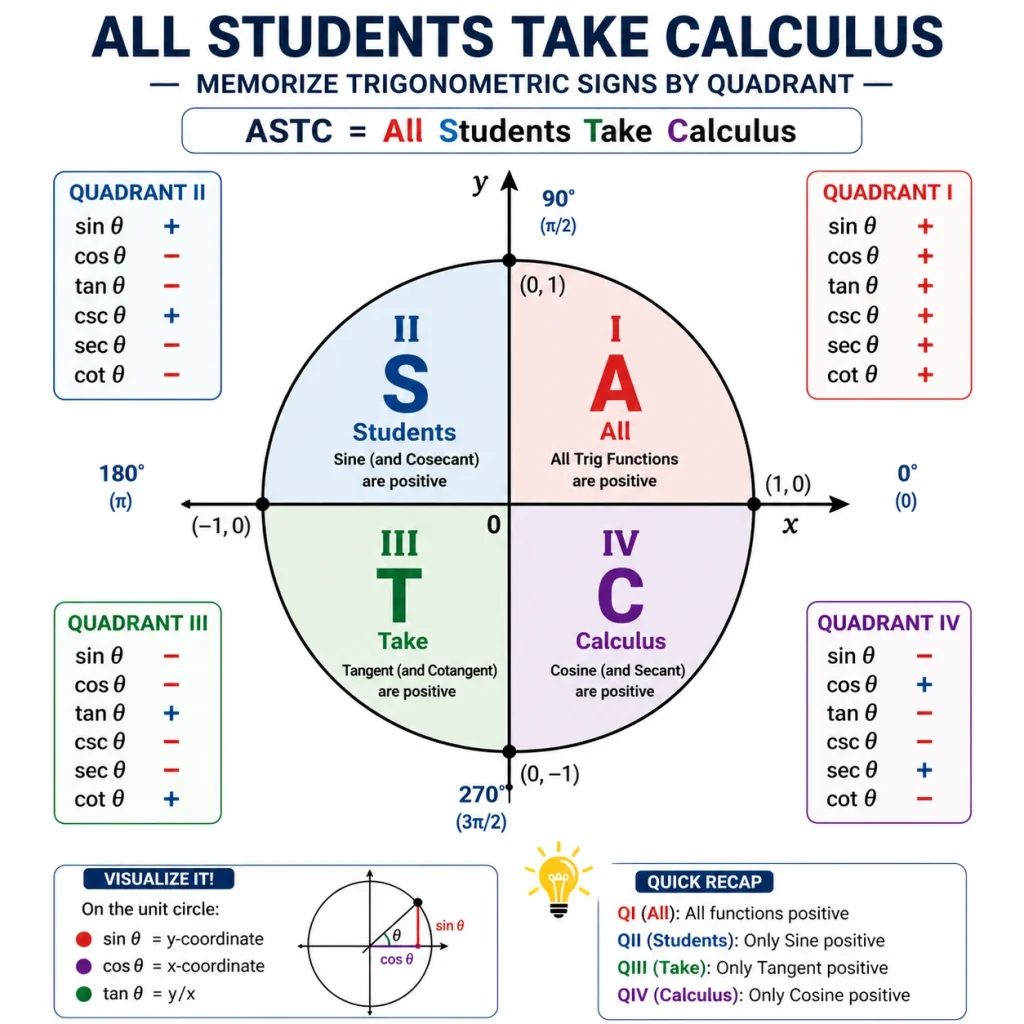
The ASTC Memory Device
The classic mnemonic for remembering which trig functions are positive in each quadrant is ASTC, read going counterclockwise from Quadrant I:
All Students Take Calculus
- All — All functions (sin, cos, tan) are positive in Quadrant I
- Students — Sine (and cosecant) is positive in Quadrant II
- Take — Tangent (and cotangent) is positive in Quadrant III
- Calculus — Cosine (and secant) is positive in Quadrant IV
Negative Angles on the Unit Circle
Angles can also be measured going clockwise (negative direction). For example, −90° is the same point as 270°. To find a negative angle, simply subtract from 360°: −θ = 360° − θ.
Similarly in radians: −π/6 is the same point as 11π/6.
Tangent on the Unit Circle
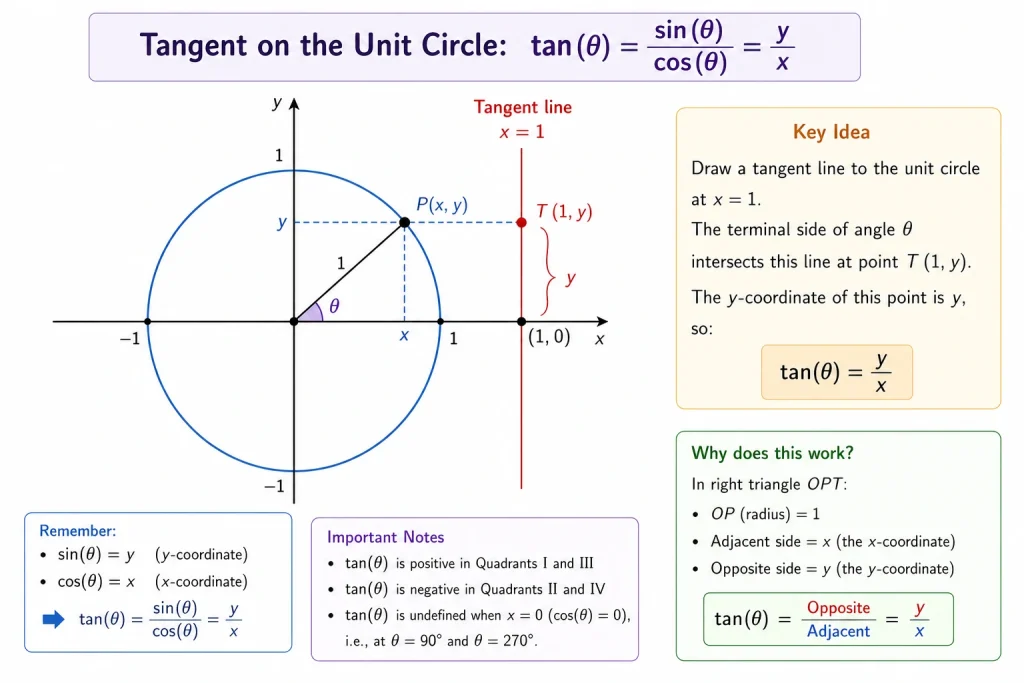
Tangent is where students often get confused. Unlike sin and cos, there’s no single coordinate on the unit circle that directly equals tan. Instead:
Tangent Values for Key Angles
Why Is Tan Undefined at 90° and 270°?
At 90°, the point on the unit circle is (0, 1). So tan(90°) = 1/0, which is undefined (you can’t divide by zero). The same happens at 270°, where the point is (0, −1) and tan = −1/0 — also undefined.
Geometric Meaning of Tangent
There’s actually a beautiful geometric interpretation of tangent. If you draw a vertical line tangent to the unit circle at the point (1, 0) and extend the angle’s terminal ray until it hits that line, the height at which it hits equals the tangent of the angle. This is literally where the name “tangent” comes from — it’s the length of the line tangent to the circle.
Secant, Cosecant, and Cotangent on the Unit Circle
The three “reciprocal” trig functions are derived directly from sin, cos, and tan:
| Function | Definition | From unit circle |
|---|---|---|
| sec(θ) | 1/cos(θ) | 1/x |
| csc(θ) | 1/sin(θ) | 1/y |
| cot(θ) | cos(θ)/sin(θ) | x/y |
Key values to know:
- sec(0°) = 1/cos(0°) = 1/1 = 1
- sec(90°) = 1/cos(90°) = 1/0 = undefined
- csc(90°) = 1/sin(90°) = 1/1 = 1
- csc(0°) = 1/sin(0°) = 1/0 = undefined
- cot(45°) = cos(45°)/sin(45°) = (√2/2)/(√2/2) = 1
Where sec and csc are undefined:
- Secant is undefined wherever cosine = 0: at 90° (π/2) and 270° (3π/2)
- Cosecant is undefined wherever sine = 0: at 0° and 180° (π)
- Cotangent is undefined wherever sine = 0: at 0° and 180° (π)
Complete Unit Circle Values Table
Here is the complete reference table combining all six trig functions for all 16 standard angles:
| θ (deg) | θ (rad) | sin θ | cos θ | tan θ | csc θ | sec θ | cot θ |
|---|---|---|---|---|---|---|---|
| 0° | 0 | 0 | 1 | 0 | undef | 1 | undef |
| 30° | π/6 | 1/2 | √3/2 | √3/3 | 2 | 2√3/3 | √3 |
| 45° | π/4 | √2/2 | √2/2 | 1 | √2 | √2 | 1 |
| 60° | π/3 | √3/2 | 1/2 | √3 | 2√3/3 | 2 | √3/3 |
| 90° | π/2 | 1 | 0 | undef | 1 | undef | 0 |
| 120° | 2π/3 | √3/2 | −1/2 | −√3 | 2√3/3 | −2 | −√3/3 |
| 135° | 3π/4 | √2/2 | −√2/2 | −1 | √2 | −√2 | −1 |
| 150° | 5π/6 | 1/2 | −√3/2 | −√3/3 | 2 | −2√3/3 | −√3 |
| 180° | π | 0 | −1 | 0 | undef | −1 | undef |
| 210° | 7π/6 | −1/2 | −√3/2 | √3/3 | −2 | −2√3/3 | √3 |
| 225° | 5π/4 | −√2/2 | −√2/2 | 1 | −√2 | −√2 | 1 |
| 240° | 4π/3 | −√3/2 | −1/2 | √3 | −2√3/3 | −2 | √3/3 |
| 270° | 3π/2 | −1 | 0 | undef | −1 | undef | 0 |
| 300° | 5π/3 | −√3/2 | 1/2 | −√3 | −2√3/3 | 2 | −√3/3 |
| 315° | 7π/4 | −√2/2 | √2/2 | −1 | −√2 | √2 | −1 |
| 330° | 11π/6 | −1/2 | √3/2 | −√3/3 | −2 | 2√3/3 | −√3 |
| 360° | 2π | 0 | 1 | 0 | undef | 1 | undef |
(undef = undefined)
Instead of memorizing every value manually, you can use this Unit Circle Calculator to verify coordinates and trigonometric values instantly.
How to Memorize the Unit Circle
Should you memorize the unit circle? Yes — but smarter, not harder. You don’t need to memorize all 96+ values. You need to memorize a small set of building blocks and understand the pattern. Here are five proven methods:
Method 1: The “1-2-3” Pattern (The Fastest Method)
For the first quadrant (30°, 45°, 60°), sin and cos values follow this elegant pattern using the numbers 1, 2, and 3:
Sine goes up: sin(30°) = √1/2, sin(45°) = √2/2, sin(60°) = √3/2
Cosine goes down: cos(30°) = √3/2, cos(45°) = √2/2, cos(60°) = √1/2
More elegantly:
| Angle | sin | cos |
|---|---|---|
| 30° | √1/2 = 1/2 | √3/2 |
| 45° | √2/2 | √2/2 |
| 60° | √3/2 | √1/2 = 1/2 |
The numbers under the radical go 1-2-3 for sin (increasing) and 3-2-1 for cos (decreasing). You only need to memorize the numbers 1, 2, and 3 and which direction they go.
Method 2: The Hand Trick
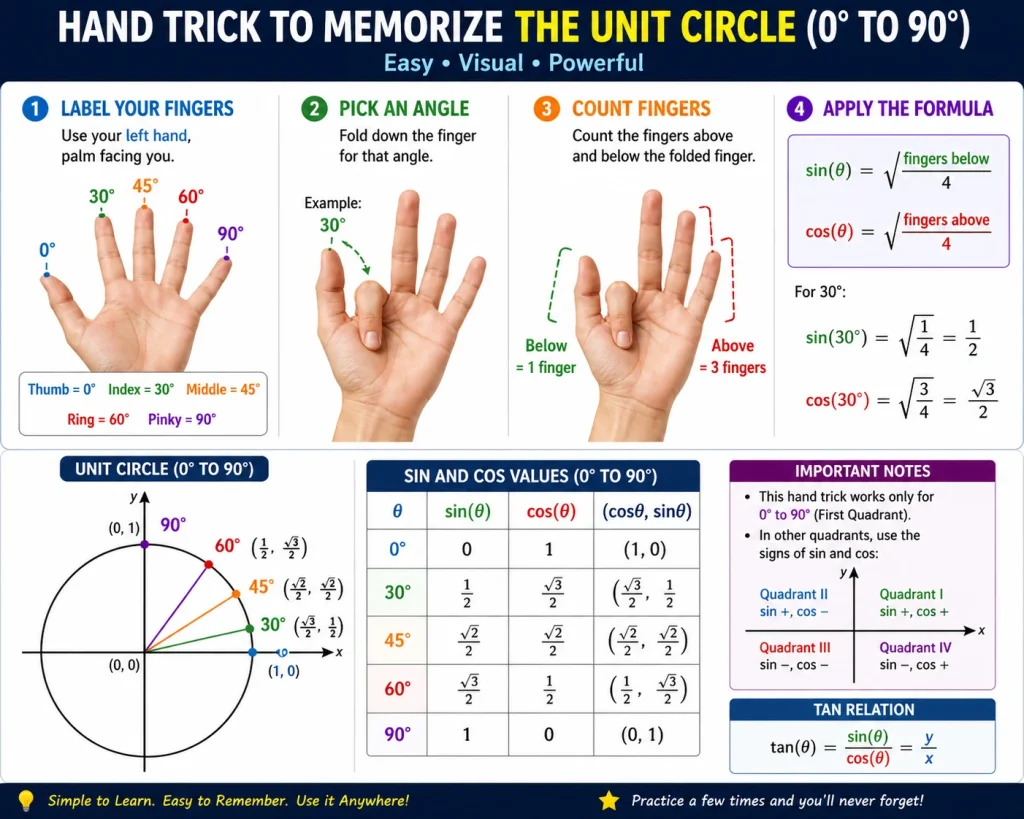
Hold out your left hand, palm facing you.
Each finger represents an angle:
0°, 30°, 45°, 60°, 90° (from thumb to pinky).
To find values:
- Fold the finger for your angle
- Count fingers to the left → sin(θ)
- Count fingers to the right → cos(θ)
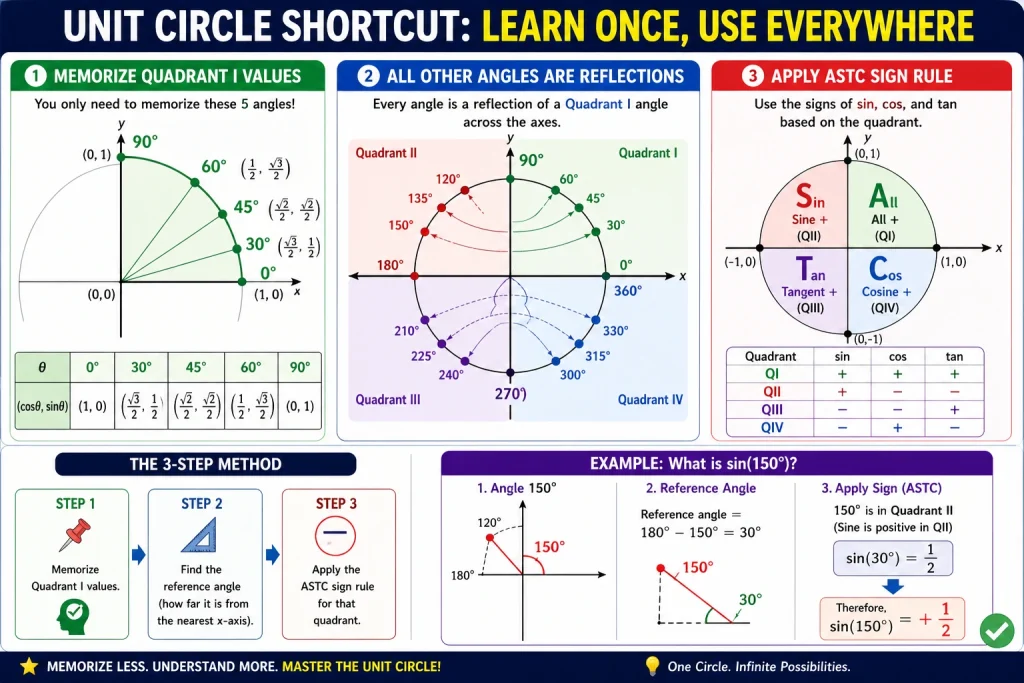
Method 3: Memorize Only Quadrant I, Then Reflect
You only truly need to memorize the 5 angles in Quadrant I (0°, 30°, 45°, 60°, 90°). Every other angle is a reflection of these across the axes, with sign changes based on the quadrant.
Method 4: The “Special Right Triangle” Method
Both the 30-60-90 and 45-45-90 triangles generate all the Quadrant I values.
45-45-90 triangle: If the hypotenuse is 1, the two legs are each √2/2. This is where the √2/2 values for 45° come from.
30-60-90 triangle: If the hypotenuse is 1, the short leg is 1/2 and the long leg is √3/2. Short leg is opposite 30°, so sin(30°) = 1/2 and cos(30°) = √3/2.
Understanding why these values arise from right triangles makes them much harder to forget than rote memorization.
Method 5: Write It Out Daily for One Week
This sounds boring but it works. Every day, draw a blank circle and fill in all 16 angles from memory. Time yourself. By day 5 or 6, most students can complete the full unit circle in under 3 minutes. The active recall of drawing — rather than passive reading — is what cements the memory.
Should You Memorize the Unit Circle?
The honest answer: you should understand it well enough that you could reconstruct it from scratch using the 1-2-3 pattern and right triangles, even if you can’t recite every value instantly. Instructors vary — some allow a reference sheet, some don’t. But the students who truly understand the unit circle rather than just memorize it do far better when trig gets applied in calculus and physics.
Unit Circle Quiz
Test your understanding with this Unit Circle Quiz. Practice important angles, coordinates, and trigonometric values while checking how well you remember the unit circle. The quiz includes fill-in-the-blank and memorization questions to help you review key concepts and prepare for tests and exams.
Unit Circle with Radians Explained
Radians are an alternative way to measure angles, and the unit circle is where they shine. One full revolution = 2π radians = 360°.
Converting Between Degrees and Radians
Radians = Degrees × (π/180) Degrees = Radians × (180/π)
Key Conversions to Memorize
| Degrees | Radians | Shortcut |
|---|---|---|
| 30° | π/6 | Divide 180° by 6 |
| 45° | π/4 | Divide 180° by 4 |
| 60° | π/3 | Divide 180° by 3 |
| 90° | π/2 | Half of π |
| 180° | π | One half revolution |
| 270° | 3π/2 | Three-quarter revolution |
| 360° | 2π | Full revolution |
Where Is 2π on the Unit Circle?
2π radians = 360°, which brings you all the way back to the starting point: the point (1, 0). So 2π is in the same position as 0 — at the rightmost point of the circle on the positive x-axis.
Where Is 5π/2 on the Unit Circle?
5π/2 = 2π + π/2. Since 2π is one full revolution, 5π/2 is the same position as π/2 = 90°. That’s the point (0, 1) at the top of the circle.
The Pattern of Radian Denominators
Here’s a visual pattern that makes radians intuitive:
- Angles with denominator 6 are multiples of 30°: π/6, π/3 (=2π/6), π/2 (=3π/6)…
- Angles with denominator 4 are multiples of 45°: π/4, π/2 (=2π/4)…
- Angles with denominator 3 are multiples of 60°: π/3, 2π/3, π (=3π/3)…
- Angles with denominator 2 are multiples of 90°: π/2, π (=2π/2)…
Trig Identities from the Unit Circle
The unit circle doesn’t just give you values — it proves every fundamental trig identity. Here is the complete set students and teachers need.
1. Pythagorean Identities
These come directly from x² + y² = 1:
| Identity | Derived from |
|---|---|
| sin²θ + cos²θ = 1 | x² + y² = 1 directly |
| tan²θ + 1 = sec²θ | Divide both sides of above by cos²θ |
| 1 + cot²θ = csc²θ | Divide both sides of above by sin²θ |
The first is the most important. The other two are just algebraic restatements of the same geometric fact.
2. Quotient Identities
These define tan and cot as ratios of sin and cos:
- tan θ = sin θ / cos θ
- cot θ = cos θ / sin θ
3. Reciprocal Identities
These connect the six trig functions:
- csc θ = 1 / sin θ
- sec θ = 1 / cos θ
- cot θ = 1 / tan θ
4. Co-Function Identities
These show the relationship between complementary angles (angles that add up to 90°). The sine of an angle equals the cosine of its complement, and vice versa:
- sin(π/2 − θ) = cos θ
- cos(π/2 − θ) = sin θ
- tan(π/2 − θ) = cot θ
- cot(π/2 − θ) = tan θ
- sec(π/2 − θ) = csc θ
- csc(π/2 − θ) = sec θ
This is why sine and cosine are called “co-functions” — the “co” in cosine literally means “complement.”
5. Double Angle Identities
These express trig functions of 2θ in terms of θ:
- sin 2θ = 2 sin θ cos θ
- cos 2θ = cos²θ − sin²θ (also equals 2cos²θ − 1 or 1 − 2sin²θ)
- tan 2θ = (2 tan θ) / (1 − tan²θ)
6. Half Angle Identities
These express trig functions of θ/2 in terms of θ:
- sin(θ/2) = ±√[(1 − cos θ)/2]
- cos(θ/2) = ±√[(1 + cos θ)/2]
- tan(θ/2) = ±√[(1 − cos θ)/(1 + cos θ)]
The ± sign depends on the quadrant of θ/2.
7. Sum and Difference Identities
These let you find trig values for angle sums and differences:
- sin(A + B) = sin A cos B + cos A sin B
- sin(A − B) = sin A cos B − cos A sin B
- cos(A + B) = cos A cos B − sin A sin B
- cos(A − B) = cos A cos B + sin A sin B
- tan(A + B) = (tan A + tan B) / (1 − tan A tan B)
- tan(A − B) = (tan A − tan B) / (1 + tan A tan B)
These are heavily tested in pre-calculus and calculus. For example, sin(75°) = sin(45° + 30°) = sin45°cos30° + cos45°sin30° = (√2/2)(√3/2) + (√2/2)(1/2) = (√6 + √2)/4.
Periodicity: How the Unit Circle Repeats
One of the most powerful properties of trig functions is their periodicity — they repeat the same values at regular intervals. This comes directly from the unit circle’s geometry: going around the circle once returns you to the same point.
The periods of each function:
| Function | Period | Meaning |
|---|---|---|
| sin θ | 2π (360°) | sin(θ + 2π) = sin θ |
| cos θ | 2π (360°) | cos(θ + 2π) = cos θ |
| tan θ | π (180°) | tan(θ + π) = tan θ |
| csc θ | 2π (360°) | csc(θ + 2π) = csc θ |
| sec θ | 2π (360°) | sec(θ + 2π) = sec θ |
| cot θ | π (180°) | cot(θ + π) = cot θ |
Why does tan repeat every π, not 2π? Because tangent = y/x, and the sign of both y and x flips when you move to the opposite quadrant (adding π to any angle). A negative divided by a negative equals a positive — so the ratio is the same. For example, tan(30°) = tan(210°) = √3/3.
Practical use of periodicity: You can find the trig value of any large angle by subtracting full periods. For example, sin(750°) = sin(750° − 2×360°) = sin(30°) = 1/2.
Odd and Even Functions on the Unit Circle
Whether a trig function is “odd” or “even” describes its symmetry — and the unit circle makes this visually obvious.
An even function satisfies f(−θ) = f(θ). Its graph is symmetric about the y-axis. An odd function satisfies f(−θ) = −f(θ). Its graph is symmetric about the origin.
| Function | Type | Identity |
|---|---|---|
| cos θ | Even | cos(−θ) = cos θ |
| sin θ | Odd | sin(−θ) = −sin θ |
| tan θ | Odd | tan(−θ) = −tan θ |
| sec θ | Even | sec(−θ) = sec θ |
| csc θ | Odd | csc(−θ) = −csc θ |
| cot θ | Odd | cot(−θ) = −cot θ |
Why is cosine even? On the unit circle, going clockwise by angle θ (i.e., the angle −θ) lands at the point (x, −y). The x-coordinate (cosine) stays the same. The y-coordinate (sine) flips sign. Hence cos(−θ) = cos θ and sin(−θ) = −sin θ.
Real example: cos(−60°) = cos(60°) = 1/2. But sin(−60°) = −sin(60°) = −√3/2.
These properties are heavily used in calculus — odd functions integrate to zero over symmetric intervals, and even functions simplify many integral calculations.
Inverse Trig Functions and the Unit Circle
The unit circle works in both directions. You can use it to go from angle → trig value, or from trig value → angle (using inverse functions).
The three main inverse functions:
| Function | Notation | Reads as | Range |
|---|---|---|---|
| Inverse sine | arcsin(x) or sin⁻¹(x) | “the angle whose sine is x” | [−π/2, π/2] |
| Inverse cosine | arccos(x) or cos⁻¹(x) | “the angle whose cosine is x” | [0, π] |
| Inverse tangent | arctan(x) or tan⁻¹(x) | “the angle whose tangent is x” | (−π/2, π/2) |
Important: These are not the same as (sin θ)⁻¹ = csc θ. The superscript −1 in sin⁻¹ means “inverse function,” not “reciprocal.”
Reading inverse trig from the unit circle:
- arcsin(1/2) = 30° (π/6) — because sin(30°) = 1/2 and 30° is in the range [−90°, 90°]
- arccos(−1/2) = 120° (2π/3) — because cos(120°) = −1/2 and 120° is in [0°, 180°]
- arctan(1) = 45° (π/4) — because tan(45°) = 1 and 45° is in (−90°, 90°)
Why restricted ranges? Trig functions are not one-to-one over their full domain — the same sin value appears at infinitely many angles. To define an inverse, we must restrict each function to a range where it gives exactly one output. The ranges above are the standard “principal value” conventions.
The Unit Circle and Polar Coordinates
The unit circle is the bridge between Cartesian coordinates (x, y) and polar coordinates (r, θ).
In polar coordinates, a point is described by its distance from the origin (r) and its angle from the positive x-axis (θ), instead of its horizontal and vertical distances.
The connection to Cartesian coordinates is:
- x = r cos θ
- y = r sin θ
On the unit circle specifically, r = 1, so:
- x = cos θ
- y = sin θ
This is exactly the unit circle definition. Every point on the unit circle has polar coordinates (1, θ) and Cartesian coordinates (cos θ, sin θ).
Why this matters: Polar coordinates are naturally suited for describing circular and spiral motion. The equation of the unit circle in polar form is simply r = 1 — far simpler than x² + y² = 1. Many curves that look complicated in Cartesian form become elegant in polar form, and the unit circle is the foundation for understanding that conversion.
What Is the Unit Circle Used For?
The unit circle isn’t just a math classroom exercise — it’s the foundation for an enormous range of applications:
In trigonometry: It defines sine and cosine for all angles — including angles greater than 90° and negative angles — which would be impossible to define using just right triangles (which require angles between 0° and 90°).
In calculus: The derivatives and integrals of trig functions are derived using the unit circle. The limit definition of the derivative of sin(x) relies on geometric properties of the unit circle.
In physics: Circular motion, waves, oscillations, and simple harmonic motion are all described using the unit circle’s coordinates. When you describe the position of a point moving around a circle as a function of time, you get x(t) = cos(t) and y(t) = sin(t).
In engineering: Signal processing, electrical engineering (AC circuits), and Fourier analysis all rely on the trig functions that the unit circle defines. The phase of an AC electrical signal is literally an angle on the unit circle.
In computer graphics and game development: Rotating objects in 2D and 3D uses rotation matrices built from sin and cos — unit circle values directly.
In navigation: Bearing angles and GPS calculations use trigonometry grounded in the unit circle.
Who Invented the Unit Circle?
The unit circle didn’t have a single inventor — it evolved over centuries as mathematicians developed trigonometry.
Ancient Greeks (circa 300–150 BCE), particularly Hipparchus of Nicaea (often called the “father of trigonometry”), built early tables of chords in a circle — the predecessor to the modern sine function. However, their circle had a radius of 60 (in the Babylonian sexagesimal system), not 1.
Indian mathematicians of the Gupta period (around 500 CE), particularly Aryabhata, were the first to define the sine function as we know it today (using a half-chord, equivalent to our sin), and they used a circle of radius 3,438 minutes of arc to tabulate it.
Islamic mathematicians of the 9th and 10th centuries, including Al-Battani and Abū al-Wafā’ Būzjānī, introduced all six trigonometric functions and improved trig tables.
The shift to a unit radius of 1 came with European mathematicians in the late medieval and Renaissance periods, as algebraic notation became standard. By the time Leonhard Euler (1707–1783) established the modern notation for sin and cos in the 18th century, the unit circle was already standard.
So: Hipparchus planted the seed, Indian and Islamic scholars grew the tree, and Euler standardized the notation we use today.
Frequently Asked Questions
What is the unit circle in simple terms?
The unit circle is a circle with a radius of 1, centered at the origin of a coordinate plane. Every point on it gives you the cosine (x-coordinate) and sine (y-coordinate) of the corresponding angle.
Is sin the x or y coordinate on the unit circle?
Sin is the y-coordinate (vertical). Cos is the x-coordinate (horizontal). Memory trick: S comes after C in the alphabet, just as y comes after x — sin = y, cos = x.
Is cos the x or y coordinate on the unit circle?
Cos is the x-coordinate (horizontal axis). Sine is the y-coordinate.
What is the radius of the unit circle?
The radius of the unit circle is exactly 1. That’s what “unit” means — one unit of length.
What is the equation of the unit circle?
The equation is x² + y² = 1. In terms of trig functions: cos²(θ) + sin²(θ) = 1, which is the Pythagorean Identity.
How do you find tangent on the unit circle?
Tangent is not a direct coordinate — it’s the ratio of y to x: tan(θ) = sin(θ)/cos(θ) = y/x. Divide the y-coordinate by the x-coordinate at any point on the unit circle to get the tangent of that angle.
Why is tangent undefined at 90° and 270°?
At 90°, the point on the unit circle is (0, 1), so tan(90°) = 1/0, which is undefined (division by zero). At 270°, the point is (0, −1), and tan(270°) = −1/0 — also undefined.
Should I memorize the unit circle?
Yes, but smartly. Memorize the Quadrant I values using the 1-2-3 pattern (sin goes √1/2, √2/2, √3/2; cos goes in reverse), then use reference angles and ASTC sign rules to derive any other angle. Understanding the pattern beats pure rote memorization every time.
How do I memorize the unit circle fast?
The fastest method is the 1-2-3 trick: for 30°, 45°, 60°, the sin values are √1/2, √2/2, √3/2 and the cos values are those same numbers reversed. Then use the ASTC rule (All Students Take Calculus) to apply signs for other quadrants, using reference angles.
What are the coordinates at 0° on the unit circle?
At 0°, the coordinates are (1, 0) — so cos(0°) = 1 and sin(0°) = 0.
What are the six trig functions on the unit circle?
At any point (x, y) on the unit circle:
- sin(θ) = y
- cos(θ) = x
- tan(θ) = y/x
- csc(θ) = 1/y
- sec(θ) = 1/x
- cot(θ) = x/y
Where is 2π on the unit circle?
2π radians = 360°, which is one complete revolution. It lands at the same point as 0°: the point (1, 0) on the positive x-axis.
What is the unit circle used for in real life?
The unit circle underlies wave analysis, AC circuit design, computer graphics rotation, GPS navigation, signal processing, and any field that deals with periodic or oscillating phenomena.
Can the unit circle be used for inverse trig functions?
Yes. Reading the unit circle “backwards” — from a coordinate value back to an angle — is exactly what inverse trig functions do. arcsin(1/2) = 30° because sin(30°) = 1/2. Each inverse function has a restricted range to ensure a unique answer: arcsin outputs angles in [−90°, 90°], arccos in [0°, 180°], arctan in (−90°, 90°).
How does the unit circle relate to polar coordinates?
The unit circle is the definition of the connection between polar and Cartesian coordinates. In polar coordinates, every point on the unit circle is (1, θ). In Cartesian coordinates, that same point is (cos θ, sin θ). The conversion formulas x = r cos θ and y = r sin θ come directly from the unit circle, with r = 1.
What is the period of sin and cos on the unit circle?
Both sin and cos have a period of 2π radians (360°) — they return to the same value after one full trip around the unit circle. Tangent and cotangent have a shorter period of π radians (180°) because the ratio y/x is the same in opposite quadrants.
Is sin an odd or even function?
Sine is an odd function: sin(−θ) = −sin(θ). On the unit circle, going to the negative angle reflects the point across the x-axis, flipping the y-coordinate (sine) but keeping the x-coordinate (cosine) the same. Therefore cosine is an even function: cos(−θ) = cos(θ).
What are the three Pythagorean identities?
All three come from x² + y² = 1. They are: sin²θ + cos²θ = 1 (the primary identity), tan²θ + 1 = sec²θ (divide by cos²θ), and 1 + cot²θ = csc²θ (divide by sin²θ).
Key Takeaways
- The unit circle is a circle of radius 1 centered at the origin: x² + y² = 1
- Every point on it is (cos θ, sin θ) — cosine is always x, sine is always y
- Tangent = y/x (not a coordinate itself, but a ratio)
- The 16 standard angles use only three values: 1/2, √2/2, and √3/2
- The 1-2-3 pattern (sin increases, cos decreases from 30° to 60°) is the fastest memorization tool
- Use the ASTC rule + reference angles to find values in any quadrant
- The unit circle defines trig functions for all angles, not just 0°–90°
- Sin and cos repeat every 2π; tan and cot repeat every π (periodicity)
- Cosine is even (symmetric about y-axis); sine and tangent are odd (symmetric about origin)
- Every trig identity — Pythagorean, co-function, double angle, sum/difference — derives from the unit circle
- Inverse trig functions read the unit circle backwards: from value to angle
- The unit circle is the foundation of polar coordinates: every point (1, θ) = (cos θ, sin θ)
Master the unit circle once, and you’ve mastered the foundation of all of trigonometry.