
Unit 6 Class 10 Math New Book Solutions
Unit 6 Class 10 Math New Book Solutions provide complete solved exercises, important formulas, and concept explanations from the latest Punjab Textbook Board mathematics syllabus. This chapter introduces students to vectors and vector geometry, helping them understand quantities that have both magnitude and direction. Through the solved exercises, students learn coordinate planes, vector operations, translations, vector proofs, and practical applications of vectors in geometry and motion.
These notes cover all exercises of Unit 6 including Exercise 6.1, Exercise 6.2, Exercise 6.3, and Review Exercise 6. Students can use these solutions to prepare assignments, class tests, and board examinations while strengthening their understanding of vector concepts.
Exercise Wise Solutions of Unit 6
Quick Overview of Unit 6 Class 10 Math New Book Solutions
Unit 6 focuses on vectors and their applications in mathematics. A vector is a quantity that has both magnitude and direction. Unlike ordinary numbers, vectors are used to describe movement, displacement, velocity, and geometric relationships. The chapter begins with basic vector concepts and gradually develops into vector algebra and vector geometry.
Students learn how to locate points on the coordinate plane, represent vectors in component form, calculate magnitudes, determine unit vectors, perform vector operations, and solve practical geometry problems using vector methods. The concepts learned in this chapter are important for higher mathematics, physics, engineering, and computer science.
What Is Unit 6 Class 10 Math New Book About?
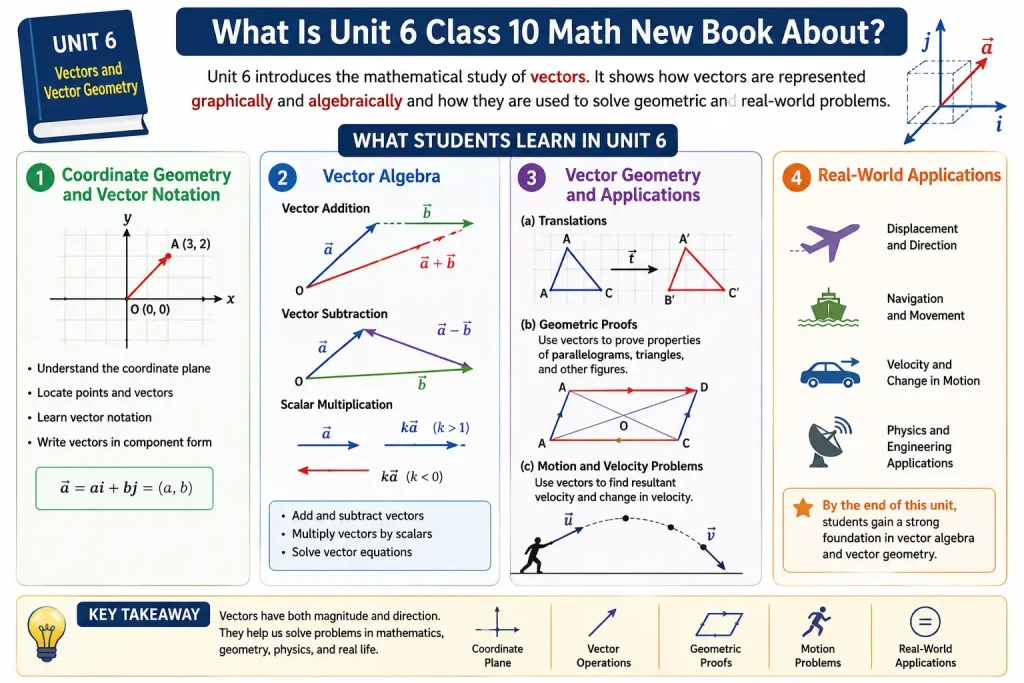
Unit 6 introduces students to the mathematical study of vectors. The chapter explains how vectors are represented graphically and algebraically and how they can be used to solve geometric and real-world problems.
Students begin by learning coordinate geometry and vector notation. They then study vector addition, subtraction, scalar multiplication, and vector equations. In the final part of the chapter, vectors are applied to translations, geometric proofs, and motion-related problems. By the end of the unit, students gain a strong foundation in vector algebra and vector geometry.
Solutions of Exercise 6.1 Class 10 Math New Book
Exercise 6.1 introduces the fundamental concepts of vectors and their representation on the coordinate plane. This exercise helps students understand how vectors are described, measured, and interpreted graphically.
Main Topics Covered
Exercise 6.1 covers quadrants, plotting points, vector notation, vector components, magnitudes, unit vectors, and parallel vectors. These concepts provide the foundation for the entire chapter.
Coordinate Plane and Quadrants
The coordinate plane is divided into four quadrants by the x-axis and y-axis. Students learn how to identify the location of points based on the signs of their coordinates. Understanding quadrants is essential for plotting points and interpreting vector directions correctly.
Vector Components and Magnitude
Every vector can be represented by horizontal and vertical components. Students learn how to write vectors in component form and calculate their magnitude. The magnitude represents the length of a vector and is one of its most important properties.
Unit Vectors and Parallel Vectors
A unit vector has a magnitude of one and represents direction only. Students also learn how to identify parallel vectors and determine whether vectors point in the same or opposite directions. These ideas are used repeatedly throughout the chapter.
Why Exercise 6.1 Is Important
Exercise 6.1 establishes the basic concepts required for all later vector calculations. A strong understanding of coordinate planes, magnitudes, and unit vectors makes the remaining exercises much easier to solve.
Solutions of Exercise 6.2 Class 10 Math New Book
Exercise 6.2 focuses on vector algebra and introduces mathematical operations involving vectors. Students learn how vectors can be combined, compared, and manipulated algebraically.
Main Topics Covered
This exercise includes vector addition, vector subtraction, scalar multiplication, vector magnitudes, and equations involving vector components.
Vector Addition and Subtraction
Vector addition combines two or more vectors to produce a resultant vector. Vector subtraction is performed by adding the negative of a vector. Students practice these operations using component form and algebraic methods.
Scalar Multiplication
Multiplying a vector by a scalar changes its magnitude and may also change its direction. Students learn how scalar multiplication affects vector components and how it is applied in various calculations.
Vector Equations
Many questions in this exercise involve unknown vector components. Students compare corresponding components and solve equations to find missing values. These problems strengthen algebraic reasoning and analytical thinking.
Why Exercise 6.2 Is Important
Exercise 6.2 teaches the algebraic techniques that form the backbone of vector mathematics. The skills learned here are essential for solving advanced vector geometry and physics problems.
Solutions of Exercise 6.3 Class 10 Math New Book
Exercise 6.3 applies vector concepts to geometry and real-world situations. Students learn how vectors can describe movement, transformations, and geometric relationships.
Main Topics Covered
This exercise covers translation vectors, geometric proofs, resultant velocity, and practical applications of vectors.
Translation Vectors
A translation moves every point of a figure by the same vector. Students learn how to translate geometric shapes on the coordinate plane and determine the coordinates of the translated image.
Vector Geometry Proofs
Vectors provide powerful methods for proving geometric properties. Students use vectors to verify relationships in parallelograms, triangles, and other geometric figures. These proofs demonstrate the connection between algebra and geometry.
Resultant Velocity and Motion
Vectors are commonly used to represent velocity because velocity has both magnitude and direction. Students learn how to determine resultant velocity and analyze changes in motion using vector methods.
Why Exercise 6.3 Is Important
Exercise 6.3 demonstrates the practical value of vectors. It shows how vector techniques can simplify geometry, motion problems, and real-life applications involving direction and displacement.
Solutions of Review Exercise 6 Class 10 Math New Book
The review exercise provides a complete revision of all topics covered in Unit 6. Students can use this exercise to assess their understanding and prepare for examinations.
Topics Included
The review exercise contains questions related to coordinate planes, vector magnitudes, unit vectors, vector operations, component equations, translations, geometric proofs, and velocity problems.
Complete Revision
Students encounter a mixture of conceptual and computational questions that test all major ideas from the chapter. Solving the review exercise helps identify weak areas before examinations.
Exam Preparation Value
The review exercise closely reflects the style of questions commonly asked in tests and examinations. Students who complete it carefully usually gain greater confidence and improve their problem-solving speed.
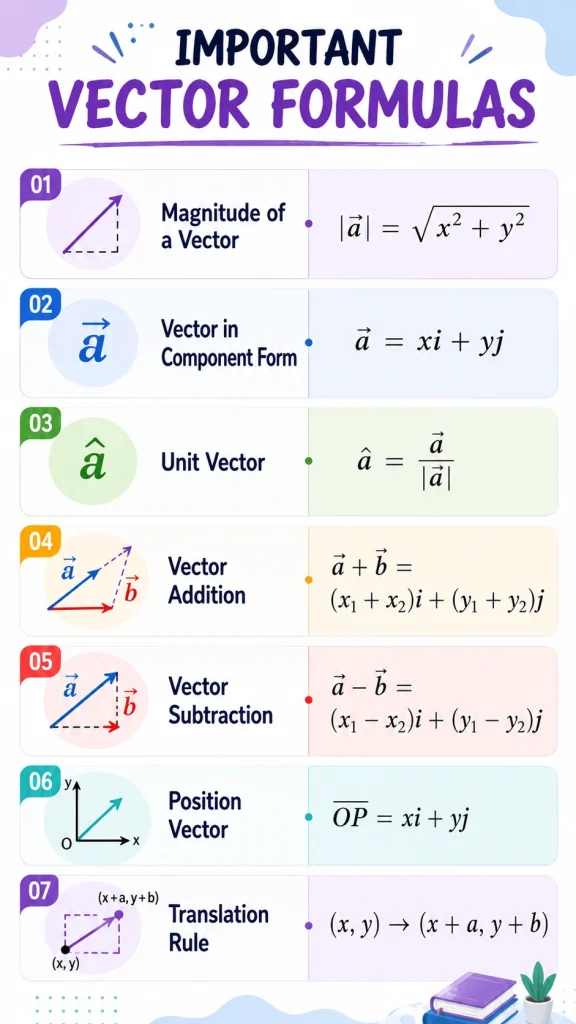
Important Formulas of Unit 6
Magnitude of a Vector
|a| = √(x² + y²)
Vector in Component Form
a = xi + yj
Unit Vector
â = a / |a|
Vector Addition
a + b = (x₁ + x₂)i + (y₁ + y₂)j
Vector Subtraction
a − b = (x₁ − x₂)i + (y₁ − y₂)j
Position Vector
OP = xi + yj
Translation Rule
(x, y) → (x + a, y + b)
Common Mistakes Students Make in Unit 6
Confusing Magnitude with Direction
Many students calculate the magnitude correctly but forget that vectors also require direction. Both properties are important when solving vector problems.
Errors in Vector Components
Students sometimes use incorrect signs while writing vector components. A small sign mistake can produce an entirely incorrect answer.
Mistakes in Unit Vector Calculations
Some students divide only one component by the magnitude instead of dividing the entire vector by its magnitude.
Incorrect Vector Addition
Adding x-components with y-components is a common mistake. Corresponding components should always be combined separately.
Sign Errors in Vector Subtraction
Vector subtraction requires careful attention to negative signs. Many incorrect answers result from sign mistakes.
Mistakes in Translation Questions
Students often add the translation vector incorrectly or forget to apply the translation to every point of the figure.
Weak Understanding of Vector Proofs
Some students memorize proofs without understanding the underlying vector relationships. Understanding the logic behind each step is more important than memorization.
How to Prepare Unit 6 for Exams
Start by mastering the coordinate plane and vector notation. Practice finding magnitudes and unit vectors until the calculations become familiar. Next, focus on vector addition, subtraction, and scalar multiplication because these topics appear frequently in examinations.
After developing confidence in vector algebra, practice translation questions and vector geometry proofs. Solve the review exercise multiple times and pay special attention to mistakes. Regular practice and revision of formulas can significantly improve examination performance.
FAQs About Unit 6 Class 10 Math New Book Solutions
What is Unit 6 of Class 10 Math New Book about?
Unit 6 introduces vectors, vector algebra, vector geometry, and their practical applications.
How many exercises are included in Unit 6?
Unit 6 contains Exercise 6.1, Exercise 6.2, Exercise 6.3, and Review Exercise 6.
Which exercise introduces vectors and the coordinate plane?
Exercise 6.1 introduces coordinate planes, quadrants, vector components, and magnitudes.
Which exercise covers vector algebra?
Exercise 6.2 focuses on vector addition, subtraction, scalar multiplication, and vector equations.
Which exercise explains translation vectors?
Exercise 6.3 contains translation vectors and coordinate plane transformations.
What is a unit vector?
A unit vector is a vector whose magnitude is equal to one.
Why are vectors important?
Vectors are used to represent quantities that have both magnitude and direction, such as velocity and displacement.
Which exercise contains geometry applications of vectors?
Exercise 6.3 contains vector geometry and practical applications.
What is the magnitude of a vector?
The magnitude of a vector represents its length or size.
Which exercise is most important for exam preparation?
All exercises are important, but the review exercise provides the best overall revision of Unit 6.
Disclaimer
These notes are provided for educational purposes only. While every effort has been made to ensure accuracy, students should also consult their official textbook and classroom materials. Notes of Math is not affiliated with any textbook board or examination authority.
Final Words
Unit 6 Class 10 Math New Book Solutions help students understand one of the most important topics in modern mathematics. Vectors play a significant role in geometry, physics, engineering, and many real-world applications. By studying all exercises carefully and practicing regularly, students can develop a strong command of vector concepts and perform confidently in examinations.