Unit 10 Class 10 Math New Book Solutions
Unit 10 Class 10 Math New Book Solutions are available here in PDF form. Students can open each exercise solution and study the complete construction method step by step. This unit is based on practical geometry, construction of circles, and construction of tangents.
Exercise Wise Solutions of Unit 10 Class 10 Math New Book
Open the required exercise below and view the complete PDF solution.
Quick Overview
Unit 10 Class 10 Math New Book Solutions
Unit 10 is about practical geometry. In this unit, students learn how to construct circles and tangents by using a ruler and compass.
The main focus of Unit 10 is:
- Constructing a circle with a given radius
- Verifying the centre of a circle
- Constructing a circle through three non-collinear points
- Completing a circle from a given arc
- Completing a circle without finding its centre
- Constructing tangents to arcs
- Constructing tangents to a circle at a point on the circumference
- Constructing tangents from an external point
- Constructing two tangents that meet at a given angle
- Real-life construction problems based on circular tracks, fountains, Ferris wheels, and flower beds
What Is Unit 10 Class 10 Math New Book About?
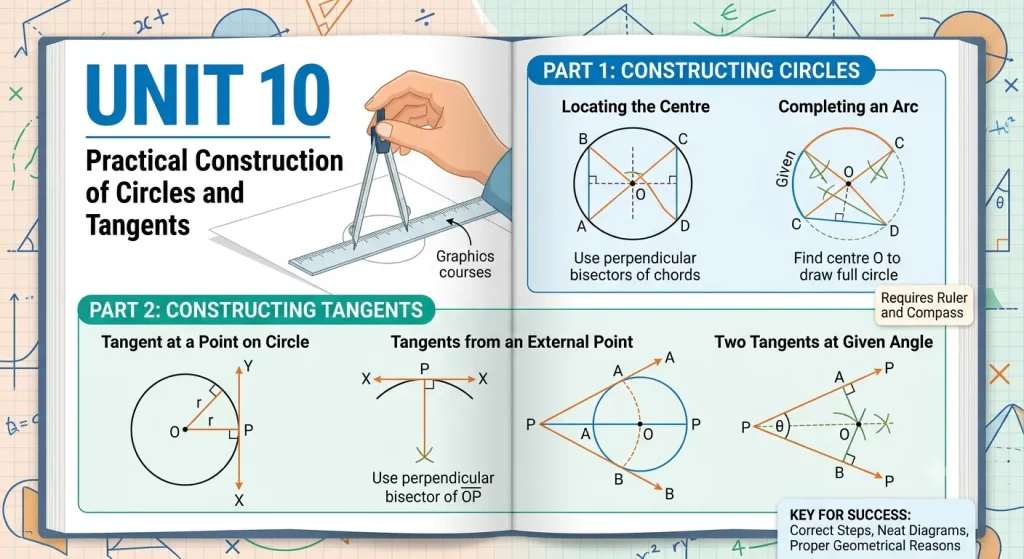
Unit 10 explains the practical construction of circles and tangents. This unit is different from numerical chapters because students do not only solve by calculation. They also need to draw accurate diagrams with a ruler and compass.
In the first part of the unit, students learn how to construct circles. They use perpendicular bisectors of chords to locate the centre of a circle. They also learn how to complete a circle when only an arc is given.
In the second part of the unit, students learn how to construct tangents. They study tangents at a point on the circle, tangents from an external point, and two tangents meeting at a given angle.
This unit is important because construction questions usually require correct steps, neat diagrams, and proper geometrical reasons.
Solutions of Exercise 10.1 Class 10 Math New Book
Exercise 10.1 is about construction of circles. Students learn how to draw circles, locate centres, and complete circles from given arcs.
Main Topics Covered in Exercise 10.1
- Constructing a circle with given radius
- Verifying the centre of a circle
- Using perpendicular bisectors of chords
- Constructing a circle through three non-collinear points
- Constructing the circumcircle of a triangle
- Completing a circle from a given arc by finding its centre
- Completing a circle without finding its centre
- Using equal chords and equal arcs in construction
- Real-life construction questions based on lamp posts, Ferris wheels, and fountains
In this exercise, students should remember that the perpendicular bisector of a chord always passes through the centre of the circle. This rule is used many times to locate the centre of a circle.
For example, when three non-collinear points are given, students join two pairs of points to form chords. Then they construct the perpendicular bisectors of these chords. The point where the perpendicular bisectors meet is the centre of the required circle.
Solutions of Exercise 10.2 Class 10 Math New Book
Exercise 10.2 is about construction of tangents. Students learn different methods for drawing tangents to arcs and circles.
Main Topics Covered in Exercise 10.2
- Drawing a tangent to an arc at its midpoint
- Drawing a tangent to an arc at its endpoint
- Drawing a tangent to an arc from an outside point
- Drawing a tangent to a circle at a point on its circumference
- Drawing tangents from an external point
- Using an auxiliary circle with diameter \(OP\)
- Constructing two tangents meeting at an angle of \(30^\circ\)
- Using the fact that radius is perpendicular to tangent at the point of contact
- Real-life tangent construction questions based on tracks and circular objects
The most important idea in this exercise is that a tangent to a circle is perpendicular to the radius drawn to the point of contact.
So, if (P) is a point on the circle and (OP) is the radius, then the tangent at (P) is drawn perpendicular to (OP).
For tangent construction from an external point, students often use an auxiliary circle. The external point is joined to the centre, the midpoint of this line is found, and a circle is drawn using this midpoint. This helps locate the point of contact of the tangent.
Review Exercise 10 Class 10 Math New Book Solutions
Review Exercise 10 contains MCQs and mixed construction questions from the full unit. It helps students revise both circle construction and tangent construction.
Main Topics Covered in Review Exercise 10
- Tangent and secant identification
- Types of arcs
- Perpendicular bisector of a chord
- Centre of a circle
- Tangents from an external point
- Equal tangents from one external point
- Finding the centre by using chords
- Constructing tangent at the midpoint of an arc
- Constructing tangent at a point on the circumference
- Constructing tangent from an external point
- Constructing two tangents meeting at an angle of \(30^\circ\)
- Real-life construction problems based on flower beds and circular boundaries
The MCQs are useful for revising basic facts. The long questions are useful for practising construction steps and geometrical reasoning.
Important Construction Rules of Unit 10
Perpendicular Bisector of a Chord
The perpendicular bisector of a chord of a circle always passes through the centre of the circle.
This rule is used to find the centre of a circle when chords are given.
Circle Through Three Non-Collinear Points
One and only one circle can pass through three non-collinear points.
To construct it, join the points to form two chords and construct their perpendicular bisectors. Their point of intersection is the centre of the circle.
Completing a Circle from an Arc
To complete a circle from a given arc, choose three points on the arc. Join them to form two chords. Construct the perpendicular bisectors of the chords. Their intersection gives the centre of the circle.
Tangent to a Circle
A tangent touches a circle at exactly one point.
Radius and Tangent Relation
The radius drawn to the point of contact is perpendicular to the tangent.
\[
OP \perp AB
\]
Here \(OP\) is the radius and \(AB\) is the tangent at point \(P\).
Tangents from an External Point
Two tangents can be drawn from an external point to a circle.
These tangents are equal in length.
Auxiliary Circle Method
To draw a tangent from an external point (P), join (P) to the centre (O). Find the midpoint (M) of (OP). Draw a circle with centre (M) and radius (MO). This auxiliary circle helps locate the point of contact.
Angle Between Two Tangents
The angle between two tangents is supplementary to the angle between the two radii drawn to the points of contact.
If two tangents meet at \(30^\circ\), then the angle between the corresponding radii is:
\[
180^\circ – 30^\circ = 150^\circ
\]
Common Mistakes in Unit 10
Many students draw rough diagrams instead of using proper ruler and compass construction. In practical geometry, neatness is very important.
Some students forget to construct the perpendicular bisectors when finding the centre of a circle. The centre is not guessed. It is found by construction.
Students also confuse tangent and chord. A chord cuts the circle at two points, while a tangent touches the circle at only one point.
Another common mistake is drawing a tangent without making it perpendicular to the radius at the point of contact.
In external tangent questions, students sometimes forget to draw the auxiliary circle with diameter (OP). This step is important for finding the correct point of contact.
Exam Preparation Tips for Unit 10
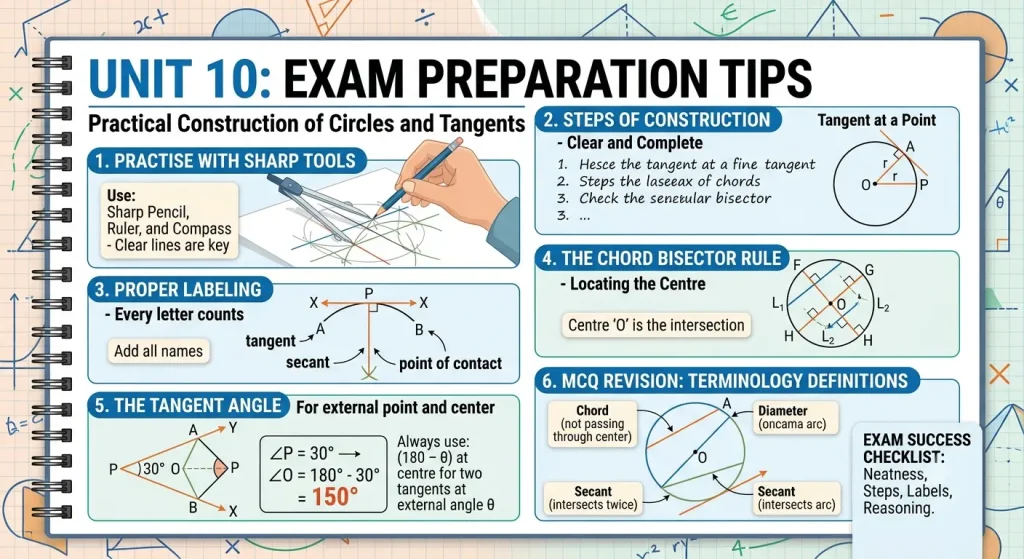
Practise all constructions with a sharp pencil, ruler, and compass.
Write the steps of construction clearly.
Always label the diagram properly.
Do not skip the verification or reason if it is required.
Remember that the perpendicular bisectors of two non-parallel chords meet at the centre.
In tangent questions, always use the rule that radius is perpendicular to tangent at the point of contact.
For questions with two tangents meeting at \(30^\circ\), remember to use \(150^\circ\) at the centre.
Revise MCQs carefully because definitions of tangent, arc, centre, chord, and secant are important.
FAQs About Unit 10 Class 10 Math New Book Solutions
What is Unit 10 Class 10 Math about?
Unit 10 is about practical geometry. It covers construction of circles and construction of tangents by using ruler and compass.
What is Exercise 10.1 about?
Exercise 10.1 is about construction of circles. It includes finding the centre of a circle, drawing a circle through three non-collinear points, and completing a circle from an arc.
What is Exercise 10.2 about?
Exercise 10.2 is about construction of tangents. It includes tangents to arcs, tangents at a point on the circle, tangents from an external point, and two tangents meeting at a given angle.
Which theorem is most important in Exercise 10.1?
The most important theorem is that the perpendicular bisector of a chord always passes through the centre of the circle.
Which rule is most important in Exercise 10.2?
The most important rule is that the tangent to a circle is perpendicular to the radius drawn to the point of contact.
Can a circle pass through three non-collinear points?
Yes, one and only one circle can pass through three non-collinear points.
How many tangents can be drawn from an external point to a circle?
Two tangents can be drawn from an external point to a circle.
What is the angle between radius and tangent?
The angle between the radius and tangent at the point of contact is (90^\circ).
Disclaimer
These solutions are prepared to help students understand Unit 10 of the Class 10 Math New Book. The solutions are written in simple steps and matched with the construction methods where possible. Students should also practise the constructions themselves and follow the method explained by their teacher.
Final Words
Unit 10 Class 10 Math New Book Solutions help students understand practical geometry in an easy way. This unit is important because it teaches accurate construction of circles and tangents. Students should practise each construction step by step and draw clean labelled diagrams for better exam preparation.