
Unit 9 Class 10 Math New Book Solutions
Unit 9 Class 10 Math New Book Solutions are available here for students who want clear and step-by-step solutions of Tangent and Angles of a Circle. This unit explains important circle geometry rules, including tangents, angles in a circle, cyclic quadrilaterals, arc length, radians, and sector area.
Exercise Wise Solutions of Unit 9
Open each exercise below to view or download the complete PDF solutions.
Quick Overview of Unit 9 Class 10 Math New Book Solutions
Unit 9 is about Tangent and Angles of a Circle. In this chapter, students learn how tangents and angles are related to circles. The unit also includes practical questions based on touching circles, ropes, wires, gears, arc length, and sector area.
In Exercise 9.1, students solve questions about tangents, radius and tangent relation, externally and internally touching circles, and basic circle angle theorems.
In Exercise 9.2, students solve questions about cyclic quadrilaterals, angles in the same segment, tangent-chord theorem, radians, arc length, and area of sectors.
In Review Exercise 9, students revise the full unit through MCQs and mixed questions based on tangents, angles, touching circles, semicircles, arc length, and sectors.
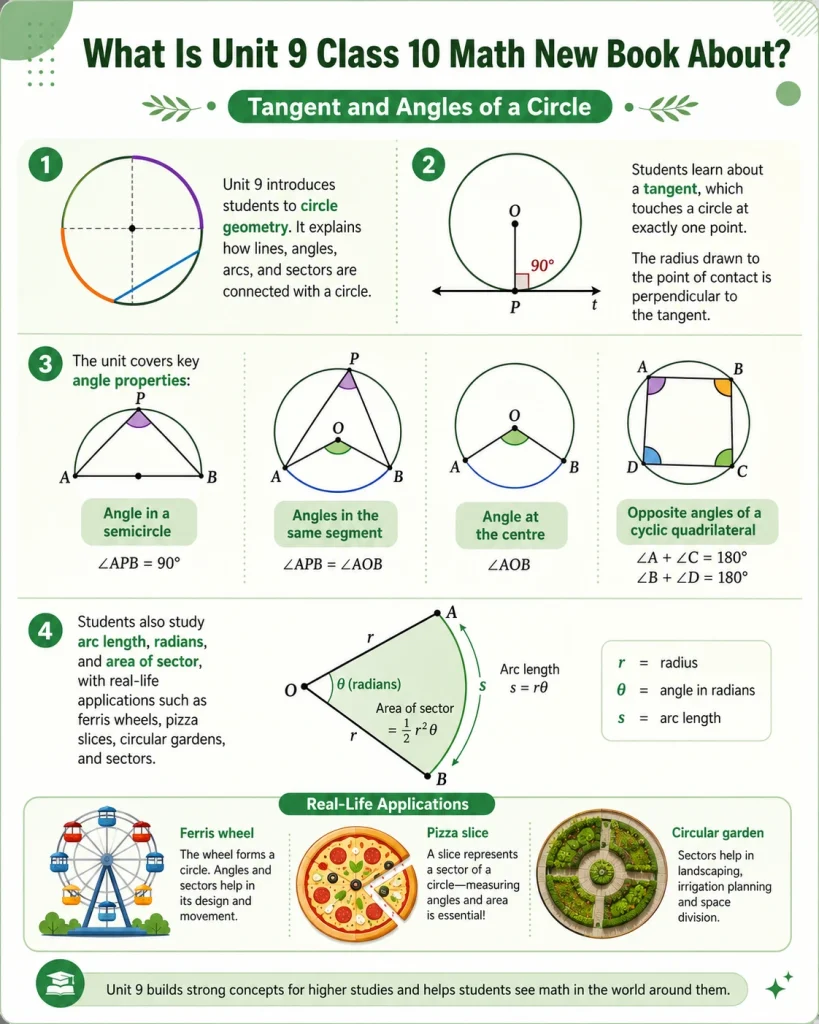
What Is Unit 9 Class 10 Math New Book About?
Unit 9 introduces students to circle geometry. The main focus of this unit is to understand how lines, angles, arcs, and sectors are connected with a circle.
Students first learn about a tangent, which is a line that touches a circle at exactly one point. They also learn that the radius drawn to the point of contact is perpendicular to the tangent.
The unit then explains different angle properties of a circle. These include angles in the same segment, angle in a semicircle, angle at the centre, and opposite angles of a cyclic quadrilateral.
In the later part of the unit, students study arc length, radians, and area of sector. These formulas are used in real-life word problems, such as ferris wheels, pizza slices, circular gardens, and sectors.
Solutions of Exercise 9.1 Class 10 Math New Book
Exercise 9.1 mainly covers the basic theorems of tangents and angles of a circle. Students use these rules to find unknown angles and distances.
Main Topics Covered in Exercise 9.1
Exercise 9.1 includes:
Tangent and radius relation
The radius drawn to the point of contact of a tangent is perpendicular to the tangent. This means the angle between the radius and tangent is always: \(90^\circ\)
This rule is used in questions where a tangent just touches the circle.
Tangents from an external point
Tangents drawn from the same external point to a circle are equal in length. This helps in forming isosceles triangles and finding unknown angles.
Angle at the centre and angle at the circumference
The angle at the centre of a circle is twice the angle at the circumference standing on the same arc.
\[
\text{Angle at centre} = 2 \times \text{Angle at circumference}
\]
Angle in a semicircle
The angle formed in a semicircle is always a right angle. \(90^\circ\)
Externally touching circles
When two circles touch externally, the distance between their centres is equal to the sum of their radii.
\[
d = r_1 + r_2
\]
Internally touching circles
When one circle touches another circle internally, the distance between their centres is equal to the difference of their radii.
\[
d = r_1 – r_2
\]
Exercise 9.1 also includes word problems based on circular fountains, gears, satellite dishes, cylindrical containers, and circular plazas.
Solutions of Exercise 9.2 Class 10 Math New Book
Exercise 9.2 continues circle geometry and introduces questions based on radians, arc length, and area of sector.
Main Topics Covered in Exercise 9.2
Exercise 9.2 includes:
Cyclic quadrilateral
A quadrilateral whose all four vertices lie on a circle is called a cyclic quadrilateral. The opposite angles of a cyclic quadrilateral are supplementary.
\[
\angle A + \angle C = 180^\circ
\]
\[
\angle B + \angle D = 180^\circ
\]
Exterior angle of a cyclic quadrilateral
The exterior angle of a cyclic quadrilateral is equal to the interior opposite angle.
This rule is useful when an angle is given outside the circle.
Angles in the same segment
Angles in the same segment of a circle are equal.
If two angles stand on the same chord and lie on the same side of the chord, then both angles are equal.
Tangent-chord theorem
The angle between a tangent and a chord is equal to the angle in the alternate segment.
This theorem is used in questions where a tangent touches the circle and a chord is drawn from the point of contact.
Arc length
If \(r\) is the radius and \(\theta \) is the central angle in radians, then arc length is:
\[
\ell = r\theta
\]
Area of sector
The area of a sector is:
\[
A = \frac{1}{2}r^2\theta
\]
Here, \(\theta \) must be in radians.
Exercise 9.2 also includes real-life examples based on ferris wheels, pizza slices, circular gardens, and sectors.
Review Exercise 9 Class 10 Math New Book Solutions
Review Exercise 9 is based on the complete unit. It includes MCQs and mixed questions from both Exercise 9.1 and Exercise 9.2.
Main Topics Covered in Review Exercise 9
The review exercise includes:
MCQs about tangents
Students revise that a tangent touches the circle at only one point. They also revise that two tangents can be drawn from a point outside the circle.
MCQs about radius and tangent
The radius and tangent at the point of contact are perpendicular.
\[
\text{Radius} \perp \text{Tangent}
\]
Questions about angles in a semicircle
The angle inscribed in a semicircle is always: \(90^\circ\)
Questions about angles in the same segment
Any two angles in the same segment of a circle are equal.
Questions about touching circles
Students solve questions where two circles touch externally or internally. For external touching, radii are added. For internal touching, radii are subtracted.
Questions about arc length and sector area
Students use formulas for arc length, perimeter of sector, and area of sector.
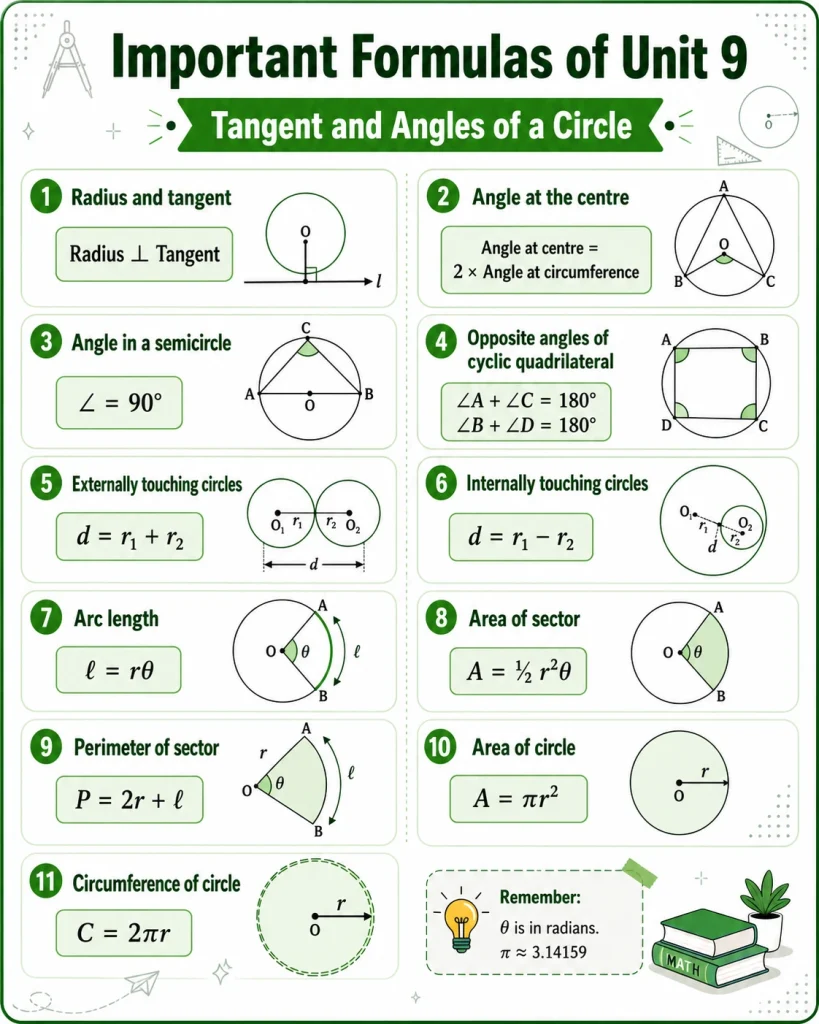
Important Formulas of Unit 9
Radius and tangent:\(\text{ Radius} \perp \text{Tangent}\)
\(\text{Angle at centre} = 2 \times \text{Angle at circumference}\)
Angle in a semicircle: \(\angle = 90^\circ\)
Opposite angles of cyclic quadrilateral:
\(\angle A + \angle C = 180^\circ \text{ & } \angle B + \angle D = 180^\circ\)
Externally touching circles:\(d = r_1 + r_2\)
Internally touching circles:\(d = r_1 – r_2\)
Arc length:\(\ell = r\theta\)
Area of sector:\(A = \frac{1}{2}r^2\theta\)
Perimeter of sector: \(P = 2r + \ell\)
Area of circle:\(A = \pi r^2\)
Circumference of circle:\(C = 2\pi r\)
Common Mistakes in Unit 9
Many students confuse tangent and chord. A tangent touches the circle at only one point, while a chord joins two points on the circle.
Another common mistake is forgetting that the radius is perpendicular to the tangent only at the point of contact.
Students also make mistakes in cyclic quadrilateral questions. They sometimes add adjacent angles instead of opposite angles. In a cyclic quadrilateral, opposite angles are supplementary.
Some students use the sector formulas without converting degrees into radians. The formulas
\[
\ell = r\theta
\]
and
\[
A = \frac{1}{2}r^2\theta
\]
work directly when \(\theta\) is in radians.
In touching circle questions, students sometimes add radii for internal touching. Remember that radii are added only when circles touch externally. For internal touching, subtract the smaller radius from the larger radius.
Exam Preparation Tips for Unit 9
Learn the basic circle theorems first. Most questions in this unit are solved by applying the correct theorem.
Before solving an angle question, identify whether the given angle is at the centre, at the circumference, on a tangent, or inside a cyclic quadrilateral.
For word problems, draw a simple diagram if no diagram is given. Mark the radius, tangent, centre, and point of contact clearly.
For arc length and sector questions, check whether the angle is given in degrees or radians. If it is in degrees, convert it into radians before using the formula.
Practice all MCQs from the review exercise because they revise the basic concepts of the full unit.
FAQs About Unit 9 Class 10 Math New Book Solutions
What is Unit 9 Class 10 Math New Book about?
Unit 9 is about Tangent and Angles of a Circle. It explains tangents, radius and tangent relation, cyclic quadrilaterals, angles in a circle, arc length, radians, and area of sector.
What is a tangent to a circle?
A tangent is a line that touches a circle at exactly one point.
What is the relation between radius and tangent?
The radius drawn to the point of contact is perpendicular to the tangent.
\[
\text{Radius} \perp \text{Tangent}
\]
What is the angle in a semicircle?
The angle in a semicircle is always: \(90^\circ \)
What are angles in the same segment?
Angles in the same segment of a circle are equal.
What is the formula for arc length?
The formula for arc length is:\(\ell = r\theta\)
where \(r\) is the radius and \(\theta\) is the angle in radians.
What is the formula for area of sector?
The formula for area of sector is:
\[
A = \frac{1}{2}r^2\theta
\]
where \(r\) is the radius and \(\theta\) is in radians.
How many exercises are included in Unit 9?
Unit 9 includes Exercise 9.1, Exercise 9.2, and Review Exercise 9.
Disclaimer
These Unit 9 Class 10 Math New Book Solutions are prepared to help students understand the methods and steps. Students should also read their textbook and try solving questions themselves before checking the solutions.
Final Words
Unit 9 Class 10 Math New Book Solutions help students understand Tangent and Angles of a Circle in a simple way. This unit is important because it includes both geometry theorems and practical questions based on circles, tangents, arcs, and sectors.
If students learn the basic theorems and formulas carefully, they can solve most questions of Unit 9 easily.