Unit 21 Class 10 Math Sindh Board Solutions
Unit 21 of Class 10 Mathematics Sindh Board is about Partial Fractions. In this unit, students learn how to break a rational fraction into simpler fractions. These simpler fractions are easier to handle and are also useful in higher classes, especially in algebra and calculus.
On this page, students can find complete Unit 21 Class 10 Math Sindh Board Solutions in PDF format. The PDF includes step-by-step solutions of Exercise 21.1, Exercise 21.2, Exercise 21.3, Exercise 21.4, and Review Exercise 21. The solution file also starts with a student-friendly method for resolving rational fractions before moving to the exercises.
Class 10 Math Unit 21 Partial Fractions Solutions
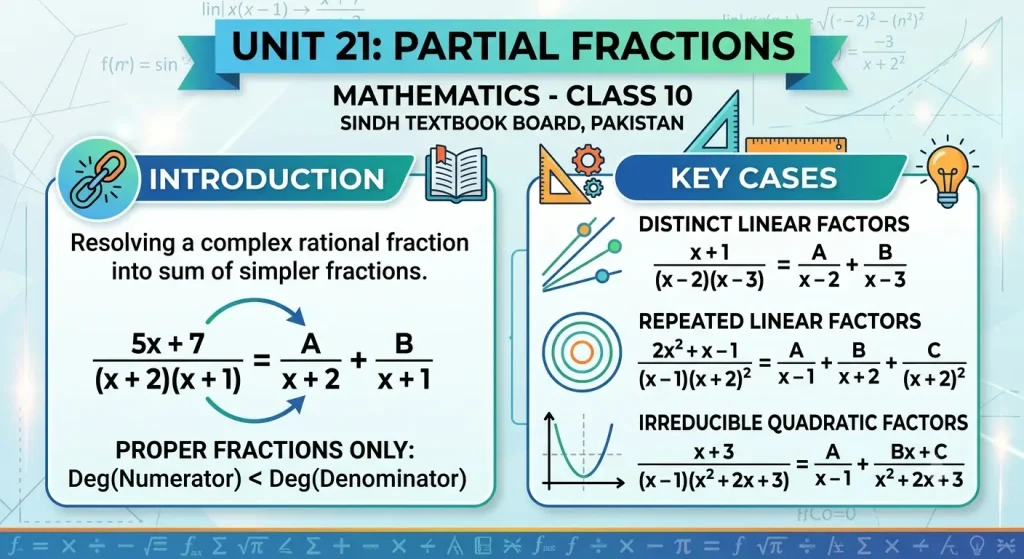
Partial fractions are used when a rational fraction has a denominator that can be factorized. Instead of working with one complicated fraction, we write it as the sum of two or more simpler fractions.
For example, a fraction of the form \(\frac{P(x)}{(x-a)(x-b)}\) can be written as:
\(\frac{P(x)}{(x-a)(x-b)}=\frac{A}{x-a}+\frac{B}{x-b}\)
Here, \(A\) and \(B\) are constants. The main purpose of this unit is to learn how to find these constants correctly.
What is Included in Unit 21 Class 10 Math Sindh Board Solutions?
The PDF of Unit 21 includes solutions of the following exercises:
Exercise 21.1
Exercise 21.2
Exercise 21.3
Exercise 21.4
Review Exercise 21
Each question is solved with proper working. The solutions are written in a way that helps students understand how the denominator is factorized, how the partial fraction form is selected, and how the unknown constants are calculated.
Exercise 21.1 Solutions
Exercise 21.1 focuses on basic partial fractions with distinct linear factors. In this exercise, students learn how to resolve fractions such as:
\(\frac{12}{x^2-9}\)
First, the denominator is factorized:
\(x^2-9=(x-3)(x+3)\)
Then the fraction is written as:
\(\frac{12}{(x-3)(x+3)}=\frac{A}{x-3}+\frac{B}{x+3}\)
After multiplying by the denominator and substituting suitable values of \(x\), the values of \(A\) and \(B\) are found.
This exercise also includes improper rational fractions. For such questions, students must divide first and then resolve the remaining proper fraction into partial fractions.
Exercise 21.2 Solutions
Exercise 21.2 deals with repeated linear factors. A repeated factor means that a factor appears more than once in the denominator.
For example:
\(\frac{4x-3}{(x+1)^2}\)
For this type of denominator, the correct partial fraction form is:
\(\frac{4x-3}{(x+1)^2}=\frac{A}{x+1}+\frac{B}{(x+1)^2}\)
Many students make mistakes in repeated factor questions because they write only one term. In repeated factors, we must write separate terms for each power of the repeated factor.
So, for \((x+1)^2\), we write:
\(\frac{A}{x+1}+\frac{B}{(x+1)^2}\)
For \((x-2)^3\), we write:
\(\frac{A}{x-2}+\frac{B}{(x-2)^2}+\frac{C}{(x-2)^3}\)
This exercise helps students understand this important rule clearly.
Exercise 21.3 Solutions
Exercise 21.3 introduces partial fractions involving irreducible quadratic factors. An irreducible quadratic factor is a quadratic expression that cannot be factorized into real linear factors.
For example:
\(x^2+7\)
When a denominator contains a linear factor and an irreducible quadratic factor, the numerator over the quadratic factor must be linear.
For example:
\(\frac{x^2-x-13}{(x^2+7)(x-2)}\)
is written as:
\(\frac{x^2-x-13}{(x^2+7)(x-2)}=\frac{A}{x-2}+\frac{Bx+C}{x^2+7}\)
This is an important point. Students should not write only \(B\) over a quadratic factor. They must write \(Bx+C\), because the numerator of a quadratic factor in partial fractions should be one degree less than the denominator.
Exercise 21.4 Solutions
Exercise 21.4 is more advanced because it includes repeated irreducible quadratic factors. These questions require more care because the partial fraction form becomes longer.
For example:
\(\frac{x^2}{(x^2+1)^2(1-x)}\)
The correct form is:
\(\frac{x^2}{(x^2+1)^2(1-x)}=\frac{A}{1-x}+\frac{Bx+C}{x^2+1}+\frac{Dx+E}{(x^2+1)^2}\)
This exercise teaches students how to handle repeated quadratic factors. Students should remember that each power of the repeated quadratic factor must be included separately.
So for \((x^2+1)^2\), we write:
\(\frac{Bx+C}{x^2+1}+\frac{Dx+E}{(x^2+1)^2}\)
Review Exercise 21 Solutions
The Review Exercise 21 includes MCQs, definitions, and additional questions based on the whole unit. It helps students revise all important concepts from Unit 21.
The review section includes questions about:
Proper fractions
Improper fractions
Rational fractions
Partial fraction forms
Repeated factors
Quadratic factors
Resolving algebraic fractions into partial fractions
The MCQs are also solved with reasons where needed. This helps students understand why a particular option is correct instead of just memorizing the answer.
Important Concepts in Unit 21
Students should revise the following concepts before solving Unit 21.
A rational fraction is a fraction of the form:
\(\frac{P(x)}{Q(x)}\)
where \(P(x)\) and \(Q(x)\) are polynomials and \(Q(x)\neq 0\).
A proper fraction is a rational fraction in which the degree of the numerator is less than the degree of the denominator.
An improper fraction is a rational fraction in which the degree of the numerator is greater than or equal to the degree of the denominator.
Before resolving an improper rational fraction into partial fractions, polynomial division is required.
General Method of Resolving Partial Fractions
To solve questions from this unit, students can follow this method:
First, check whether the given fraction is proper or improper.
If it is improper, divide first.
Then factorize the denominator completely.
After that, write the correct partial fraction form.
Multiply both sides by the lowest common denominator.
Find the constants by substituting suitable values of \(x\) or by comparing coefficients.
Finally, write the answer in simplified partial fraction form.
Common Mistakes in Partial Fractions
Many students make mistakes because they do not factorize the denominator completely. Without proper factorization, the correct partial fraction form cannot be written.
Another common mistake is writing a constant numerator over a quadratic factor. For an irreducible quadratic factor, the numerator should be linear, such as:
\(Bx+C\)
Some students also forget to divide when the fraction is improper. If the degree of the numerator is equal to or greater than the degree of the denominator, division must be done first.
Students should also be careful with signs while substituting values of \(x\). A small sign mistake can change the final answer.
Why These Solutions Are Helpful
These Unit 21 solutions are useful for students because each question is solved in a step-by-step way. Instead of giving only final answers, the working explains how the constants are found and how the final partial fraction form is obtained.
This is especially helpful for Sindh Board students because partial fractions can seem difficult at first. With enough practice and clear steps, students can solve these questions confidently.
Download Unit 21 Class 10 Math Sindh Board Solutions PDF
Students can download the complete PDF of Unit 21 Class 10 Math Sindh Board Solutions and use it for homework, revision, and exam preparation.
The PDF includes complete solutions of:
Exercise 21.1
Exercise 21.2
Exercise 21.3
Exercise 21.4
Review Exercise 21
These solutions cover the full unit of Partial Fractions according to the Class 10 Mathematics Sindh Board syllabus.