
Unit 7 Class 11 Math Notes – Permutations and Combinations (Punjab Board New Book)
Unit 7 (Chapter 7) Class 11 Math Notes – Permutations and Combinations: step-by-step solutions of Exercise 7.1, Exercise 7.2, Exercise 7.3 and Exercise 7.4 for the Punjab Board new book (1st Year). Tap an exercise below to open its PDF solution, then view it online or download it.
This unit is part of our Class 11 maths notes for the Punjab Board new book, where you can open the solutions of the other units.
Exercise Wise Notes of Unit 7 Class 11 Math
Unit 7 Class 11 Math Notes help students understand permutations and combinations in a simple way. This chapter is about counting arrangements and selections without writing every possible case.
In this unit, students learn factorials, permutations, repeated arrangements, circular permutations, and combinations. Exercise-wise PDF solutions are also added so students can revise each question step by step.
Quick Overview of Unit 7 Class 11 Math
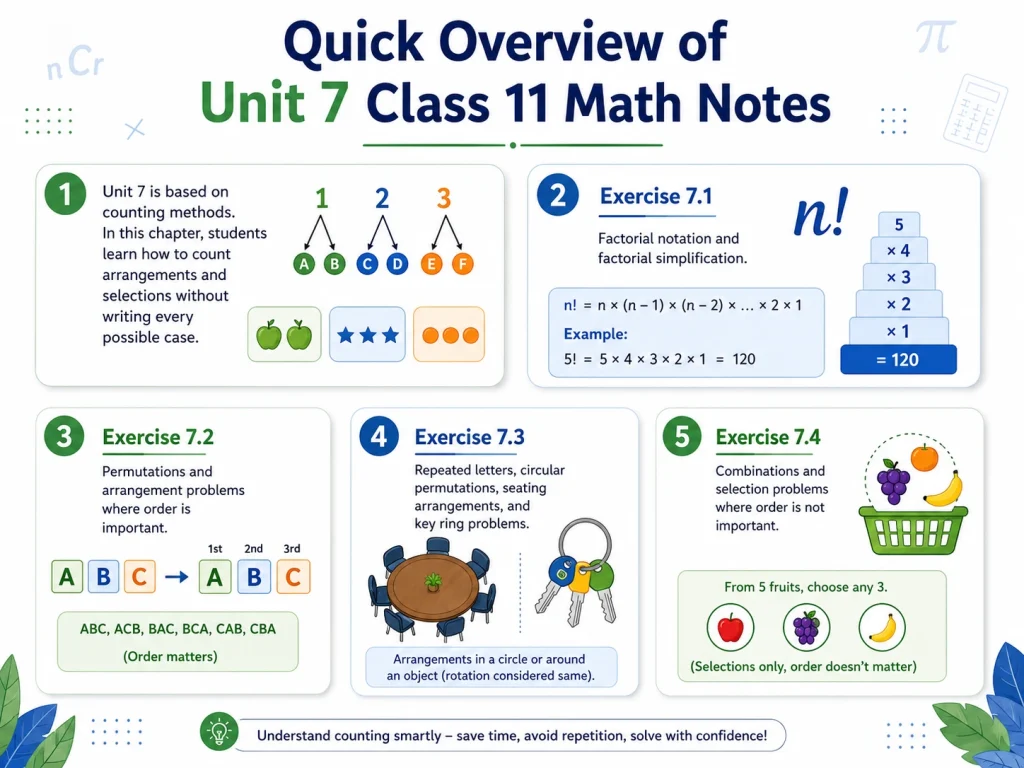
Unit 7 is based on counting methods. In this chapter, students learn how to count arrangements and selections without writing every possible case.
What Is Unit 7 Class 11 Math About?
Unit 7 of Class 11 Mathematics is about Permutations and Combinations. This chapter teaches students how to count different possible arrangements and selections.
In daily life, we often count possibilities. For example, arranging students in a row, making numbers from digits, selecting committee members, arranging letters of a word, choosing dishes, or selecting cards from a deck. Unit 7 gives proper mathematical methods for these types of questions.
The main difference between permutation and combination is simple. In permutations, order matters. In combinations, order does not matter.
For example, arranging three students in a line is a permutation because different orders give different arrangements. Selecting three students for a committee is a combination because the order of selection does not matter.
Exercise 7.1 Class 11 Math Notes
Exercise 7.1 introduces factorial notation and basic counting ideas. Students learn how to simplify expressions involving factorials.
A factorial is written as:
\(\displaystyle n! = n(n-1)(n-2)\cdots 3\cdot2\cdot1\)
Also:
\(\displaystyle 0! = 1\)
A useful factorial rule is:
\(\displaystyle \frac{n!}{(n-r)!}=n(n-1)(n-2)\cdots(n-r+1)\)
This exercise includes factorial simplification, writing products in factorial form, and solving equations involving factorials.
Students should avoid expanding large factorials completely. It is better to cancel common factorial terms first.
Exercise 7.2 Class 11 Math Notes
Exercise 7.2 is about permutations. A permutation is an arrangement of objects in which order is important.
The main formula is:
\(\displaystyle {}^nP_r=\frac{n!}{(n-r)!}\)
Expanded form:
\(\displaystyle {}^nP_r=n(n-1)(n-2)\cdots(n-r+1)\)
This exercise includes evaluating permutations, finding unknown values of \(n\) or \(r\), proving permutation identities, arranging letters, forming numbers from digits, and solving signal problems.
For example:
\(\displaystyle {}^5P_3=\frac{5!}{(5-3)!}\)
\(\displaystyle {}^5P_3=\frac{5!}{2!}\)
\(\displaystyle {}^5P_3=5\cdot4\cdot3=60\)
This exercise is important because many word problems in this unit are based on arrangement.
Exercise 7.3 Class 11 Math Notes
Exercise 7.3 explains special arrangement problems. These include repeated letters, circular permutations, round table seating, and key ring arrangements.
For arrangements with repeated objects, the formula is:
\(\displaystyle \frac{n!}{p!q!r!\cdots}\)
Here \(n\) is the total number of objects, while \(p\), \(q\), and \(r\) are repeated objects.
For circular arrangements of \(n\) persons around a round table, the formula is:
\(\displaystyle (n-1)!\)
For key ring or necklace arrangements, clockwise and anticlockwise arrangements are considered the same. Therefore, the formula is:
\(\displaystyle \frac{(n-1)!}{2}\)
This exercise needs careful reading because students often confuse linear arrangements with circular arrangements.
Exercise 7.4 Class 11 Math Notes
Exercise 7.4 is about combinations. A combination means a selection of objects in which order is not important.
The main formula is:
\(\displaystyle {}^nC_r=\frac{n!}{r!(n-r)!}\)
Another important identity is:
\(\displaystyle {}^nC_r={}^nC_{n-r}\)
This exercise includes combination evaluation, finding \(n\) and \(r\), proving identities, selecting subjects, choosing dishes, selecting cards, forming committees, and solving polygon questions.
For example, selecting 3 students from 8 students is:
\(\displaystyle {}^8C_3=\frac{8!}{3!(8-3)!}\)
\(\displaystyle {}^8C_3=\frac{8!}{3!5!}=56\)
In combination questions, students must remember that changing the order does not make a new selection.
Important Formulas used in Unit 7 Class 11 Math Notes
Factorial notation:
\(\displaystyle n! = n(n-1)(n-2)\cdots 3\cdot2\cdot1\)
Zero factorial:
\(\displaystyle 0! = 1\)
Permutation formula:
\(\displaystyle {}^nP_r=\frac{n!}{(n-r)!}\)
Expanded permutation form:
\(\displaystyle {}^nP_r=n(n-1)(n-2)\cdots(n-r+1)\)
Combination formula:
\(\displaystyle {}^nC_r=\frac{n!}{r!(n-r)!}\)
Relation between permutation and combination:
\(\displaystyle {}^nP_r={}^nC_r\cdot r!\)
Symmetry property of combinations:
\(\displaystyle {}^nC_r={}^nC_{n-r}\)
Pascal identity:
\(\displaystyle {}^nC_r+{}^nC_{r-1}={}^{n+1}C_r\)
Circular permutation of \(n\) persons:
\(\displaystyle (n-1)!\)
Circular key ring arrangement:
\(\displaystyle \frac{(n-1)!}{2}\)
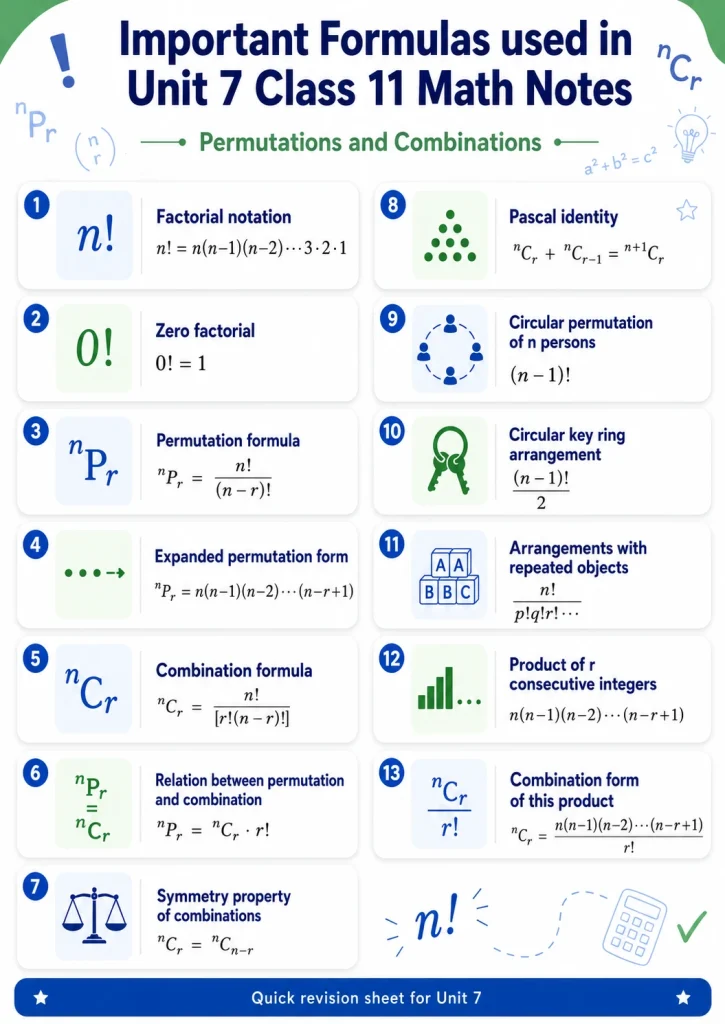
Arrangements with repeated objects:
\(\displaystyle \frac{n!}{p!q!r!\cdots}\)
Product of \(r\) consecutive integers:
\(\displaystyle n(n-1)(n-2)\cdots(n-r+1)\)
Combination form of this product:
\(\displaystyle {}^nC_r=\frac{n(n-1)(n-2)\cdots(n-r+1)}{r!}\)
Difference Between Permutation and Combination
Permutation is used when order is important.
Combination is used when order is not important.
For example, arranging students in a line is a permutation.
Selecting students for a committee is a combination.
Use \({}^nP_r\) for arrangement questions.
Use \({}^nC_r\) for selection questions.
Common Mistakes to avoid in Unit 7
Many students confuse permutations and combinations. Always check whether the question is about arrangement or selection.
Some students forget that \(0! = 1\). This rule is used in many factorial questions.
In factorial simplification, students often expand too much. Cancel common factorial terms first.
In number formation questions, students sometimes repeat digits even when the question says no digit is repeated.
In circular permutation questions, students use \(n!\) instead of \((n-1)!\).
In key ring questions, students forget to divide by 2.
In combination questions, students sometimes count the same selection more than once.
Exam Preparation Tips for Unit 7
Learn the difference between permutation and combination first.
Memorize the formulas of \(n!\), \({}^nP_r\), and \({}^nC_r\).
Practice factorial cancellation regularly.
In word problems, decide first whether order matters or not.
For circular seating, check whether the arrangement is around a table or on a key ring.
For committees, cards, subjects, and dish selection questions, combinations are usually used.
For word arrangement, digit arrangement, and signal questions, permutations are usually used.
Related Class 11 Math Resources
FAQs
What is Unit 7 of Class 11 Math about?
Unit 7 is about permutations and combinations. It teaches students how to count arrangements and selections using formulas.
What is the main difference between permutation and combination?
In permutation, order is important. In combination, order is not important.
What is the formula of permutation?
The formula of permutation is:
\(\displaystyle {}^nP_r=\frac{n!}{(n-r)!}\)
What is the formula of combination?
The formula of combination is:
\(\displaystyle {}^nC_r=\frac{n!}{r!(n-r)!}\)
Which exercise is about permutations?
Exercise 7.2 is mainly about permutations and arrangement problems.
Which exercise is about circular permutations?
Exercise 7.3 includes circular permutations, round table seating, repeated arrangements, and key ring arrangements.
Which exercise is about combinations?
Exercise 7.4 is mainly about combinations and selection problems.
Why is \(0! = 1\) important?
The rule \(0! = 1\) is important because it is used in factorials, permutations, and combinations. It also helps formulas work when all objects are selected or no object is selected.
Disclaimer
These notes and solutions are prepared to help students understand Unit 7 in an easy way. Students should also read their textbook and confirm the exercise questions from the official book.
Final Words
Unit 7 Class 11 Math Notes are useful for learning permutations and combinations step by step. This chapter improves counting skills and prepares students for probability and higher mathematics.
Learn the formulas carefully, understand the difference between arrangement and selection, and practice all exercises regularly.