Unit 1 Class 11 Math Notes and Solutions – Complex Numbers
Unit 1 Class 11 Math Notes and Solutions are available here in easy PDF format. On this page, students can view and download the complete solved notes of Exercise 1.1, Exercise 1.2, Exercise 1.3, Exercise 1.4, and Exercise 1.5.
These notes are prepared for students who want simple, clear, and step-by-step solutions of Unit 1 Complex Numbers. Each exercise is solved in an easy method so that students can understand the complete working, not only the final answer.
This unit is part of our Class 11 maths notes for the new book, where you can open the solutions of the other units.
Unit 1 is about complex numbers. In this unit, students learn about multiplicative inverse, conjugate, modulus, real and imaginary parts, powers of \(i\), square roots of complex numbers, factorization over complex numbers, roots of unity, polar form, Argand plane, argument, loci, and applications of complex numbers.
If you are preparing for a school test, monthly test, final exam, or board exam, these notes can help you revise the full unit in a better way.
PDF Solutions of Unit 1 Class 11 Math
Click on any button below to open the PDF solution of that exercise. You can view the PDF online or download it for later study.
What is Unit 1 Complex Numbers About?
Unit 1 of Class 11 Math introduces students to complex numbers in a deeper way. Students have already studied the basic idea of imaginary numbers, but in Class 11 this topic becomes more detailed and more useful.
A complex number is written in the form:
\(z=a+bi\)
Here, \(a\) and \(b\) are real numbers. The number \(a\) is called the real part, and \(b\) is called the imaginary part.
The imaginary unit is written as:
\(\displaystyle i\)
and it is defined by:
\(\displaystyle i^2=-1\)
This is the basic rule of complex numbers. Many questions in this unit become easy when students remember this rule clearly.
In Unit 1, students learn how to simplify complex expressions, find inverse of complex numbers, use conjugate and modulus, solve complex equations, find square roots, factorize expressions over complex numbers, and use roots of unity.
The last part of the unit explains polar form and Argand plane. Students learn how to write a complex number in polar form:
\(\displaystyle z=r(\cos\theta+i\sin\theta)\)
This form is very useful in multiplication, division, plotting points, finding arguments, and solving application-based questions.
Exercise 1.1 Explanation
Exercise 1.1 is the starting exercise of Unit 1 Class 11 Math. It mainly explains multiplicative inverse, real and imaginary parts, conjugate, modulus, and powers of \(i\).
In this exercise, students learn how to find the multiplicative inverse of a complex number. If a complex number is written as \(a+bi\), then its multiplicative inverse is:
\(\displaystyle \frac{1}{a+bi}\)
To simplify this, we multiply numerator and denominator by the conjugate of the denominator.
The conjugate of \(a+bi\) is:
\(\displaystyle \bar z=a-bi\)
So:
\(\displaystyle \frac{1}{a+bi}=\frac{a-bi}{a^2+b^2}\)
This formula is very important because it is used again in many questions of complex numbers.
Exercise 1.1 also includes questions where students separate a complex expression into real and imaginary parts. The final answer is usually written in the form:
\(\displaystyle a+bi\)
After writing the answer in this form, the real part and imaginary part can be identified easily.
Students also learn important identities such as:
\(\displaystyle z+\bar z=2\operatorname{Re}(z)\)
\(\displaystyle z-\bar z=2i\operatorname{Im}(z)\)
\(\displaystyle z\bar z=|z|^2\)
These identities are useful for proof questions and short questions.
Exercise 1.1 also includes powers of \(i\). The powers of \(i\) repeat after every four powers:
\(\displaystyle i^1=i\)
\(\displaystyle i^2=-1\)
\(\displaystyle i^3=-i\)
\(\displaystyle i^4=1\)
After this, the same cycle starts again.
Exercise 1.1 is important because it builds the base for the whole unit. Students should understand conjugate, modulus, inverse, and powers of \(i\) before moving to the next exercise.
Exercise 1.2 Explanation
Exercise 1.2 is about complex equations and square roots of complex numbers. This exercise is very important because it teaches students how to find unknown values by comparing real and imaginary parts.
If two complex numbers are equal, then their real parts are equal and their imaginary parts are equal.
If:
\(\displaystyle a+bi=c+di\)
then:
\(\displaystyle a=c\)
and:
\(\displaystyle b=d\)
This method is used in many questions of Exercise 1.2. Students simplify both sides of the equation and then compare the real and imaginary parts.
For example, if an equation becomes:
\(\displaystyle (x+2)+i(y-3)=-17+19i\)
then we compare real parts:
\(\displaystyle x+2=-17\)
and imaginary parts:
\(\displaystyle y-3=19\)
This gives the values of \(x\) and \(y\).
Exercise 1.2 also includes square roots of complex numbers. To find the square root of a complex number, we suppose:
\(\displaystyle \sqrt{a+bi}=x+iy\)
Then we square both sides:
\(\displaystyle (x+iy)^2=x^2-y^2+2xyi\)
After this, we compare real and imaginary parts to find \(x\) and \(y\).
This method may look long at first, but it becomes easy with practice. Students should remember that when comparing complex numbers, real parts must be compared with real parts and imaginary parts must be compared with imaginary parts.
Exercise 1.2 is important for exams because it includes equation-based questions and square root questions. These questions often appear as long questions or short questions.
Exercise 1.3 Explanation
Exercise 1.3 is about factorization and roots of equations in complex numbers. This exercise connects complex numbers with algebra.
In real numbers, some expressions cannot be factorized. But in complex numbers, many such expressions can be factorized.
The most important formula used in this exercise is:
\(\displaystyle A^2+B^2=(A+iB)(A-iB)\)
For example:
\(\displaystyle x^2+4=x^2+2^2\)
So:
\(\displaystyle x^2+4=(x+2i)(x-2i)\)
This is the main idea of Exercise 1.3.
Students also factorize expressions like:
\(\displaystyle a^2+4b^2\)
\(\displaystyle 9a^2+16b^2\)
\(\displaystyle z^2+6z+13\)
These expressions are written as a sum of two squares or completed square form. Then they are factorized by using complex numbers.
Exercise 1.3 also includes polynomial equations. Students find roots of equations and then write the polynomial as a product of factors.
For example, if the roots of a polynomial are \(2\), \(-3\), and \(i\), then the factors are:
\(\displaystyle (x-2)\), \(\displaystyle (x+3)\), and \(\displaystyle (x-i)\)
This exercise is important because it shows that complex numbers are not only used for simple calculations. They are also used in factorization, equations, and polynomial roots.
Students should practise this exercise carefully because it contains many algebraic steps.
Exercise 1.4 Explanation
Exercise 1.4 is about roots of unity. This exercise introduces students to cube roots of unity and fourth roots.
The cube roots of unity are:
\(\displaystyle 1,\omega,\omega^2\)
The important properties are:
\(\displaystyle \omega^3=1\)
and:
\(\displaystyle 1+\omega+\omega^2=0\)
These two formulas are the base of Exercise 1.4.
In this exercise, students find cube roots of numbers such as \(8\), \(-8\), \(-27\), \(64\), and \(-125\). If a number is a perfect cube, its three cube roots can be written using \(1\), \(\omega\), and \(\omega^2\).
For example:
\(\displaystyle 8=2^3\)
So the cube roots of \(8\) are:
\(\displaystyle 2,2\omega,2\omega^2\)
Exercise 1.4 also includes fourth roots. If a number is written as \(a^4\), then its four fourth roots are:
\(\displaystyle a,-a,ai,-ai\)
For example:
\(\displaystyle 16=2^4\)
So the fourth roots of \(16\) are:
\(\displaystyle 2,-2,2i,-2i\)
Their sum is:
\(\displaystyle 2+(-2)+2i+(-2i)=0\)
Students also learn how to simplify expressions involving powers of \(\omega\). Since:
\(\displaystyle \omega^3=1\)
the powers of \(\omega\) repeat after every three powers.
For example:
\(\displaystyle \omega^4=\omega\)
\(\displaystyle \omega^5=\omega^2\)
\(\displaystyle \omega^6=1\)
Exercise 1.4 is important for short questions, proof questions, and simplification questions involving roots of unity.
Exercise 1.5 Explanation
Exercise 1.5 is the most detailed exercise of Unit 1. It covers polar form, Argand plane, argument, plotting points, multiplication and division in polar form, loci, and applications of complex numbers.
In this exercise, students learn how to plot polar points. A polar point is written as:
\(\displaystyle (r,\theta)\)
Here, \(r\) is the distance from the origin and \(\theta\) is the angle.
If \(r>0\), the point is plotted in the direction of \(\theta\).
If \(r<0\), the point is plotted in the opposite direction. In that case, we use:
\(\displaystyle \theta+\pi\)
This is an important rule for polar points.
Exercise 1.5 also explains how to convert a complex number from rectangular form to polar form.
A complex number in rectangular form is:
\(\displaystyle z=x+yi\)
The modulus is:
\(\displaystyle r=|z|=\sqrt{x^2+y^2}\)
The argument is found by using:
\(\displaystyle \tan\theta=\frac{y}{x}\)
Then the polar form is:
\(\displaystyle z=r(\cos\theta+i\sin\theta)\)
Students must be careful while finding \(\theta\). The angle depends on the quadrant of the complex number. If the real and imaginary parts have different signs, the angle must be adjusted according to the quadrant.
Exercise 1.5 also includes multiplication and division of complex numbers in polar form.
For multiplication:
\(\displaystyle z_1z_2=r_1r_2[\cos(\theta_1+\theta_2)+i\sin(\theta_1+\theta_2)]\)
For division:
\(\displaystyle \frac{z_1}{z_2}=\frac{r_1}{r_2}[\cos(\theta_1-\theta_2)+i\sin(\theta_1-\theta_2)]\)
This exercise also includes loci. In loci questions, students convert the given complex condition into a Cartesian equation.
For example, questions may involve conditions like distance from a fixed point, argument, or relation between real and imaginary parts.
The last part of Exercise 1.5 includes applications of complex numbers. These include AC circuit examples and simple encryption and decryption questions. These questions show how complex numbers can be used outside ordinary algebra.
Exercise 1.5 is very important for exams because it contains conceptual questions, graph-based questions, and application-based questions.
Important Definitions of Unit 1
Complex Number
A number of the form:
\(\displaystyle z=a+bi\)
is called a complex number, where \(a\) and \(b\) are real numbers and \(i^2=-1\).
Real Part
In the complex number:
\(\displaystyle z=a+bi\)
the number \(a\) is called the real part.
It is written as:
\(\displaystyle \operatorname{Re}(z)=a\)
Imaginary Part
In the complex number:
\(\displaystyle z=a+bi\)
the number \(b\) is called the imaginary part.
It is written as:
\(\displaystyle \operatorname{Im}(z)=b\)
Students should remember that the imaginary part is \(b\), not \(bi\).
Conjugate of a Complex Number
If:
\(\displaystyle z=a+bi\)
then the conjugate of \(z\) is:
\(\displaystyle \bar z=a-bi\)
Only the sign of the imaginary part changes. The real part remains the same.
Modulus of a Complex Number
If:
\(\displaystyle z=a+bi\)
then the modulus of \(z\) is:
\(\displaystyle |z|=\sqrt{a^2+b^2}\)
The modulus is always a non-negative real number.
Multiplicative Inverse
The multiplicative inverse of a non-zero complex number \(z\) is:
\(\displaystyle \frac{1}{z}\)
If:
\(\displaystyle z=a+bi\)
then:
\(\displaystyle \frac{1}{z}=\frac{a-bi}{a^2+b^2}\)
provided \(z\neq0\).
Argument of a Complex Number
The argument of a complex number is the angle made by the line segment of the complex number with the positive real axis.
It is usually denoted by:
\(\displaystyle \arg z\)
Argand Plane
The Argand plane is used to represent complex numbers geometrically. The horizontal axis represents the real part, and the vertical axis represents the imaginary part.
Polar Form
The polar form of a complex number is:
\(\displaystyle z=r(\cos\theta+i\sin\theta)\)
Here, \(r\) is the modulus and \(\theta\) is the argument.
Important Formulas of Unit 1 Complex Numbers
Students should revise these formulas again and again.
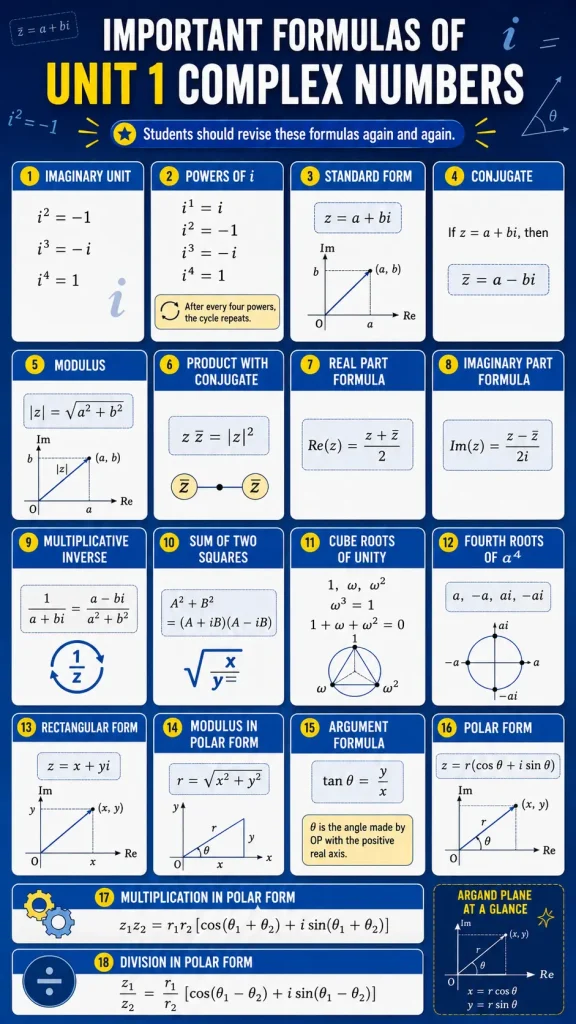
Imaginary Unit
\(\displaystyle i^2=-1\)
\(\displaystyle i^3=-i\)
\(\displaystyle i^4=1\)
Powers of \(i\)
\(\displaystyle i^1=i\)
\(\displaystyle i^2=-1\)
\(\displaystyle i^3=-i\)
\(\displaystyle i^4=1\)
After every four powers, the cycle repeats.
Standard Form
\(\displaystyle z=a+bi\)
Conjugate
If:
\(\displaystyle z=a+bi\)
then:
\(\displaystyle \bar z=a-bi\)
Modulus
\(\displaystyle |z|=\sqrt{a^2+b^2}\)
Product with Conjugate
\(\displaystyle z\bar z=|z|^2\)
Real Part Formula
\(\displaystyle \operatorname{Re}(z)=\frac{z+\bar z}{2}\)
Imaginary Part Formula
\(\displaystyle \operatorname{Im}(z)=\frac{z-\bar z}{2i}\)
Multiplicative Inverse
\(\displaystyle \frac{1}{a+bi}=\frac{a-bi}{a^2+b^2}\)
Sum of Two Squares
\(\displaystyle A^2+B^2=(A+iB)(A-iB)\)
Cube Roots of Unity
\(\displaystyle 1,\omega,\omega^2\)
\(\displaystyle \omega^3=1\)
\(\displaystyle 1+\omega+\omega^2=0\)
Fourth Roots of \(a^4\)
\(\displaystyle a,-a,ai,-ai\)
Rectangular Form
\(\displaystyle z=x+yi\)
Modulus in Polar Form
\(\displaystyle r=\sqrt{x^2+y^2}\)
Argument Formula
\(\displaystyle \tan\theta=\frac{y}{x}\)
Polar Form
\(\displaystyle z=r(\cos\theta+i\sin\theta)\)
Multiplication in Polar Form
\(\displaystyle z_1z_2=r_1r_2[\cos(\theta_1+\theta_2)+i\sin(\theta_1+\theta_2)]\)
Division in Polar Form
\(\displaystyle \frac{z_1}{z_2}=\frac{r_1}{r_2}[\cos(\theta_1-\theta_2)+i\sin(\theta_1-\theta_2)]\)
Short Revision Table of Unit 1
| Concept | Key Rule | Example |
| Complex number | \(a+bi\) | \(5+3i\) |
| Imaginary unit | \(i^2=-1\) | \(i^4=1\) |
| Real part | Number without \(i\) | \(\operatorname{Re}(5+3i)=5\) |
| Imaginary part | Coefficient of \(i\) | \(\operatorname{Im}(5+3i)=3\) |
| Conjugate | Change sign of imaginary part | \(\bar z\) of \(5+3i\) is \(5-3i\) |
| Modulus | `( | z |
| Product with conjugate | `(z\bar z= | z |
| Multiplicative inverse | Use conjugate method | \(\frac{1}{a+bi}=\frac{a-bi}{a^2+b^2}\) |
| Sum of squares | \(A^2+B^2=(A+iB)(A-iB)\) | \(x^2+9=(x+3i)(x-3i)\) |
| Cube roots of unity | \(1,\omega,\omega^2\) | \(\omega^3=1\) |
| Polar form | \(z=r(\cos\theta+i\sin\theta)\) | Used in Exercise 1.5 |
| Argument | \(\tan\theta=\frac{y}{x}\) | Check quadrant before final answer |
Common Mistakes Students Make in Unit 1
Forgetting that \(i^2=-1\)
This is the biggest mistake in Unit 1. Many students forget to replace \(i^2\) by \(-1\). If this step is wrong, the whole answer becomes wrong.
Always remember:
\(\displaystyle i^2=-1\)
Writing the Imaginary Part Incorrectly
In:
\(\displaystyle 3+4i\)
the imaginary part is \(4\), not \(4i\).
This is a common mistake in MCQs and short questions.
Confusing Conjugate with Additive Inverse
The conjugate of:
\(\displaystyle 3+4i\)
is:
\(\displaystyle 3-4i\)
But the additive inverse is:
\(\displaystyle -3-4i\)
These two are different.
Changing the Real Part in Conjugate
In conjugate, only the sign of the imaginary part changes. The real part remains the same.
For example, the conjugate of:
\(\displaystyle 7-5i\)
is:
\(\displaystyle 7+5i\)
not:
\(\displaystyle -7+5i\)
Not Comparing Both Parts
When two complex numbers are equal, students must compare both real and imaginary parts.
If:
\(\displaystyle a+bi=c+di\)
then:
\(\displaystyle a=c\)
and:
\(\displaystyle b=d\)
Do not compare only the real parts.
Forgetting the Formula for Complex Square Root
In square root questions, students should remember:
\(\displaystyle (x+iy)^2=x^2-y^2+2xyi\)
After expanding, compare real and imaginary parts.
Using the Wrong Formula in Factorization
For complex factorization, students should remember:
\(\displaystyle A^2+B^2=(A+iB)(A-iB)\)
This formula is different from the difference of squares formula.
Forgetting the Properties of \(\omega\)
In roots of unity questions, students often forget:
\(\displaystyle \omega^3=1\)
and:
\(\displaystyle 1+\omega+\omega^2=0\)
These two formulas are used again and again in Exercise 1.4.
Choosing the Wrong Quadrant in Polar Form
In polar form, students often find the angle using:
\(\displaystyle \tan\theta=\frac{y}{x}\)
but forget to check the quadrant. Always check the signs of \(x\) and \(y\) before writing the final argument.
Forgetting the Rule for Negative Polar Radius
If a polar point has \(r<0\), then it is plotted in the opposite direction.
Use:
\(\displaystyle \theta+\pi\)
This rule is very important in Exercise 1.5.
How to Use These Unit 1 Class 11 Math Notes
These notes are not only for copying answers. They are prepared to help students understand the method.
First, read the basic explanation of the exercise.
Then try to solve the question yourself.
After that, open the PDF solution and compare your work.
If your answer is wrong, check the exact step where the mistake happened.
Then solve the same question again without looking at the solution.
For best results, students should first revise the formulas, then solve the exercise, then check the PDF solution. This method will help in tests and exams.
Exam Preparation Tips for Unit 1
Unit 1 becomes easy when students practise the basic rules again and again.
For MCQs, revise powers of \(i\), real part, imaginary part, conjugate, modulus, multiplicative inverse, roots of unity, and polar form.
For short questions, learn the definitions clearly. Important definitions include complex number, conjugate, modulus, argument, Argand plane, roots of unity, and polar form.
For long questions, practise complex equations, square roots of complex numbers, factorization, roots of equations, polar form, and loci.
Students should especially focus on these formulas:
\(\displaystyle i^2=-1\)
\(\displaystyle \frac{1}{a+bi}=\frac{a-bi}{a^2+b^2}\)
\(\displaystyle z\bar z=|z|^2\)
\(\displaystyle A^2+B^2=(A+iB)(A-iB)\)
\(\displaystyle \omega^3=1\)
\(\displaystyle 1+\omega+\omega^2=0\)
\(\displaystyle z=r(\cos\theta+i\sin\theta)\)
Before exams, students should revise Exercise 1.1 to Exercise 1.5 in order. Exercise 1.5 should be given extra time because it includes polar form, argument, loci, and applications.
Related Class 11 Math Resources
You may also find these resources helpful:
Class 11 Math Notes and Solutions
Unit 2 Class 11 Math Notes and Solutions
Unit 3 Class 11 Math Notes and Solutions
Matrix Calculator
Scientific Notation, Percentage and Fraction Calculator
FAQs About Unit 1 Class 11 Math Notes and Solutions
What is Unit 1 of Class 11 Math about?
Unit 1 is about complex numbers. It includes multiplicative inverse, conjugate, modulus, powers of \(i\), complex equations, square roots of complex numbers, factorization, roots of unity, polar form, Argand plane, loci, and applications.
Are these solutions according to the updated Class 11 Math book?
Yes, these solutions follow the updated PECTAA textbook version.
Can I download the PDF solutions?
Yes, students can view the PDF solutions online and download them for offline study.
How many exercises are included in Unit 1 Class 11 Math?
Unit 1 includes Exercise 1.1, Exercise 1.2, Exercise 1.3, Exercise 1.4, and Exercise 1.5.
What is the most important rule in Unit 1?
The most important basic rule is:
\(\displaystyle i^2=-1\)
Many questions of complex numbers are based on this rule.
What is the conjugate of a complex number?
If:
\(\displaystyle z=a+bi\)
then the conjugate of \(z\) is:
\(\displaystyle \bar z=a-bi\)
Only the sign of the imaginary part changes.
What is the modulus of a complex number?
If:
\(\displaystyle z=a+bi\)
then the modulus of \(z\) is:
\(\displaystyle |z|=\sqrt{a^2+b^2}\)
What is the multiplicative inverse of a complex number?
If:
\(\displaystyle z=a+bi\)
then:
\(\displaystyle \frac{1}{z}=\frac{a-bi}{a^2+b^2}\)
provided \(z\neq0\).
What are the cube roots of unity?
The cube roots of unity are:
\(\displaystyle 1,\omega,\omega^2\)
They satisfy:
\(\displaystyle \omega^3=1\)
and:
\(\displaystyle 1+\omega+\omega^2=0\)
What is the polar form of a complex number?
The polar form of a complex number is:
\(\displaystyle z=r(\cos\theta+i\sin\theta)\)
Here, \(r\) is the modulus and \(\theta\) is the argument.
Which exercise is most important for exams?
All exercises are important. Exercise 1.2, Exercise 1.3, Exercise 1.4, and Exercise 1.5 are especially important because they include equations, square roots, factorization, roots of unity, polar form, and application-based questions.
How should I prepare Unit 1 for exams?
First revise the formulas. Then solve Exercise 1.1 to Exercise 1.5 in order. After that, revise common mistakes and practise important questions again. Give extra time to roots of unity and polar form because these topics require careful steps.
Disclaimer
These Unit 1 Class 11 Math Notes are prepared by notesofmath.com for educational help only. We are not affiliated with any textbook board or official publisher. Every effort has been made to keep the solutions correct and easy to understand. Students should also consult their official textbook, classroom teacher, and school instructions for final exam preparation.
Final Words
Unit 1 Complex Numbers is an important chapter of Class 11 Math. At first, this unit may look difficult because it includes new ideas such as roots of unity, polar form, and Argand plane. But once students understand the basic rules, the chapter becomes easier.
Use the PDF solutions for step-by-step practice. Revise the formulas daily. Try to solve every question yourself before checking the answer. If you make a mistake, find the wrong step, correct it, and practise again.
With regular practice, students can prepare Unit 1 Complex Numbers completely and confidently.