
Unit 3 Class 11 Math Notes – Theory of Quadratic Functions
Unit 3 Class 11 Math Notes are available here in easy PDF format. This unit is titled Theory of Quadratic Functions. It includes step-by-step solutions of Exercise 3.1 and Exercise 3.2 from the updated PECTAA textbook.
In this unit, students learn how quadratic functions behave, how to find their maximum or minimum values, how to sketch their graphs, how to find domain and range, and how to solve quadratic equations. These notes are helpful for classwork, homework, test preparation, and board exam revision.
This unit is part of our Class 11 maths notes for the new book, where you can open the solutions of the other units.
Exercise-wise Solutions of Unit 3 Class 11 Math
Open the exercise below to view the complete step-by-step PDF solutions.
Quick Overview of Unit 3 Class 11 Math Notes
Unit 3 is about the Theory of Quadratic Functions. In this chapter, students study quadratic functions, their graphs, maximum and minimum points, domain, range, inverse functions, and different types of quadratic equations.
Exercise 3.1 covers completing square, maximum value, minimum value, vertex of a parabola, graph sketching, domain and range, and inverse of restricted quadratic functions.
Exercise 3.2 covers solving equations that lead to quadratic equations. It includes rational equations, radical equations, equations with square roots, factorization, restrictions, and checking rejected values.
What Is Unit 3 Class 11 Math About?
Unit 3 Class 11 Math is about quadratic functions. A quadratic function is a function in which the highest power of the variable is 2.
The general form of a quadratic function is:
\(\displaystyle f(x)=ax^2+bx+c\)
Here, \(a\), \(b\), and \(c\) are constants, and \(a\) must not be zero.\(\displaystyle a\ne 0\)
The graph of a quadratic function is called a parabola. A parabola can open upward or downward. If: \(\displaystyle a>0\)
then the parabola opens upward and the function has a minimum value. If: \(\displaystyle a<0\)
then the parabola opens downward and the function has a maximum value.
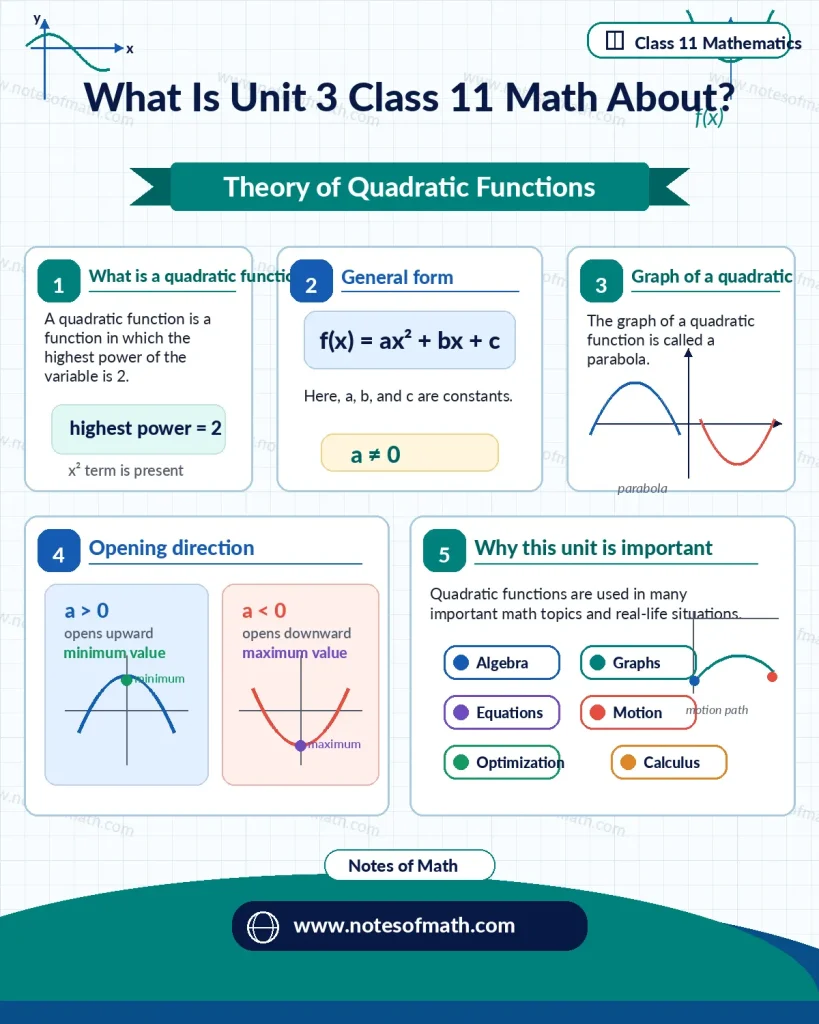
This unit is important because quadratic functions are used in algebra, graphs, equations, motion problems, optimization, and later topics of calculus.
Solutions of Exercise 3.1 Class 11 Math Unit 3
Exercise 3.1 starts with finding maximum or minimum values of quadratic functions by completing square.
Completing square means changing a quadratic expression into a perfect square form.
For example:
\(\displaystyle f(x)=x^2+6x+13\)
To complete the square, take half of 6 and square it:
\(\displaystyle \frac{6}{2}=3\)
\(\displaystyle 3^2=9\)
Now add and subtract 9:
\(\displaystyle f(x)=x^2+6x+9-9+13\)
\(\displaystyle f(x)=(x+3)^2+4\)
Since a square is always non-negative:
\(\displaystyle (x+3)^2\ge 0\)
the minimum value occurs when: \(\displaystyle x+3=0\) resulting \(\displaystyle x=-3\)
So, the minimum value is: \(\displaystyle 4\)
This shows that completing square helps students find the vertex and the maximum or minimum value of a quadratic function.
Exercise 3.1 also includes quadratic functions with a negative coefficient of \(x^2\). For example:
\(\displaystyle f(x)=-x^2+8x+13\)
When the coefficient of \(x^2\) is negative, the parabola opens downward. So the function has a maximum value.
After completing square, it becomes: \(\displaystyle f(x)=-(x-4)^2+29\)
Since: \(\displaystyle -(x-4)^2\le 0\)
the greatest value occurs when: \(\displaystyle x-4=0\) resulting \(\displaystyle x=4\)
So, the maximum value is: \(\displaystyle 29\)
Vertex of a Quadratic Function
The vertex is the turning point of a parabola. It is the point where the quadratic function reaches its maximum or minimum value.
If the quadratic function is written in the form:
\(\displaystyle f(x)=a(x-h)^2+k\)
then the vertex is: \(\displaystyle (h,k)\)
If \(a>0\), the vertex is a minimum point.
If \(a<0\), the vertex is a maximum point.
For example: \(\displaystyle f(x)=x^2-4x\)
Completing square gives: \(\displaystyle f(x)=x^2-4x+4-4\)
\(\displaystyle f(x)=(x-2)^2-4\)
So, the vertex is: \(\displaystyle (2,-4)\)
Since the coefficient of \(x^2\) is positive, this is a minimum point.
Domain and Range of Quadratic Functions
For most quadratic functions, the domain is the set of all real numbers.
So, the domain is: \(\displaystyle \mathbb{R}\)
or: \(\displaystyle (-\infty,\infty)\)
The range depends on whether the parabola opens upward or downward.
If the parabola opens upward and the minimum value is \(k\), then the range is:
\(\displaystyle [k,\infty)\)
If the parabola opens downward and the maximum value is \(k\), then the range is:
\(\displaystyle (-\infty,k]\)
For example, if: \(\displaystyle f(x)=(x-2)^2-4\)
then the minimum value is: \(\displaystyle -4\)
So, the range is: \(\displaystyle [-4,\infty)\)
Graphs of Quadratic Functions
The graph of a quadratic function is a parabola. In Exercise 3.1, students sketch quadratic graphs and identify their maximum or minimum point.
A parabola has the following important parts:
Vertex
Axis of symmetry
Opening direction
Maximum or minimum point
Domain
Range
If the parabola opens upward, it has a lowest point. This point is called the minimum point.
If the parabola opens downward, it has a highest point. This point is called the maximum point.
For example: \(\displaystyle f(x)=-(x-1)^2-7\)
The vertex is: \(\displaystyle (1,-7)\)
Since the parabola opens downward, this point is a maximum point.
The range is: \(\displaystyle (-\infty,-7]\)
Inverse of Quadratic Functions
Exercise 3.1 also includes finding inverse of quadratic functions. A quadratic function does not always have an inverse on all real numbers because it may fail the one-to-one test.
To find the inverse of a quadratic function, the domain is often restricted.
For example: \(\displaystyle f(x)=x^2-3,\quad x\le 0\)
Let: \(\displaystyle y=x^2-3\)
Then: \(\displaystyle y+3=x^2\)
Since the given domain is: \(\displaystyle x\le 0\)
we take the negative square root: \(\displaystyle x=-\sqrt{y+3}\)
Now replace \(y\) by \(x\): \(\displaystyle f^{-1}(x)=-\sqrt{x+3}\)
This shows why domain restriction is important when finding the inverse of a quadratic function.
Solutions of Exercise 3.2 Class 11 Math Unit 3
Exercise 3.2 is about solving equations that lead to quadratic equations. These equations may include fractions, square roots, or algebraic expressions.
The first step is usually to remove fractions or radicals carefully. After simplifying, the equation becomes a quadratic equation.
A quadratic equation is usually written as: \(\displaystyle ax^2+bx+c=0\)
where: \(\displaystyle a\ne 0\)
Students solve these equations by factorization, completing square, or the quadratic formula.
Solving Rational Equations
In Exercise 3.2, many questions include rational expressions. A rational expression has a variable in the denominator.
For example: \(\displaystyle \frac{1}{3x}+\frac{4x}{6}=1\)
Here, \(x\) cannot be zero because it is in the denominator.
So: \(\displaystyle x\ne 0\)
To solve rational equations, students multiply the whole equation by the least common denominator. After simplifying, the equation usually becomes quadratic.
For example, after simplifying, an equation may become:
\(\displaystyle 2x^2-3x+1=0\)
Now factorize: \(\displaystyle 2x^2-2x-x+1=0\)
\(\displaystyle 2x(x-1)-1(x-1)=0\)
\(\displaystyle (2x-1)(x-1)=0\)
So: \(\displaystyle x=\frac{1}{2}\)
or: \(\displaystyle x=1\)
Solving Radical Equations
Exercise 3.2 also includes equations with square roots. These are called radical equations.
For example: \(\displaystyle \sqrt{2x+8}+\sqrt{x+5}=7\)
Before solving, students must find the domain.
For real values: \(\displaystyle 2x+8\ge 0\)
and: \(\displaystyle x+5\ge 0\)
So: \(\displaystyle x\ge -4\)
In radical equations, students often square both sides. But squaring can sometimes produce extra answers. Therefore, every answer must be checked in the original equation.
For example, after solving a radical equation, we may get two possible values:
\(\displaystyle x=284\)
and: \(\displaystyle x=4\)
But after checking in the original equation, \(x=284\) is rejected and only \(x=4\) is accepted.
This is why checking is very important in radical equations.
Using the Quadratic Formula
Some equations cannot be solved easily by factorization. In such cases, students use the quadratic formula.
For a quadratic equation:
\(\displaystyle ax^2+bx+c=0\)
the quadratic formula is:
\(\displaystyle x=\frac{-b\pm\sqrt{b^2-4ac}}{2a}\)
The expression under the square root is called the discriminant.
\(\displaystyle b^2-4ac\)
The quadratic formula is very useful when factorization is difficult.
Important Formulas and Concepts of Unit 3
General quadratic function:
\(\displaystyle f(x)=ax^2+bx+c,\quad a\ne 0\)
Standard quadratic equation:
\(\displaystyle ax^2+bx+c=0,\quad a\ne 0\)
Vertex form:
\(\displaystyle f(x)=a(x-h)^2+k\)
Vertex:
\(\displaystyle (h,k)\)
Axis of symmetry:
\(\displaystyle x=h\)
Quadratic formula:
\(\displaystyle x=\frac{-b\pm\sqrt{b^2-4ac}}{2a}\)
Discriminant:
\(\displaystyle D=b^2-4ac\)
If \(a>0\), the parabola opens upward.
If \(a<0\), the parabola opens downward.
If the minimum value is \(k\), then the range is:
\(\displaystyle [k,\infty)\)
If the maximum value is \(k\), then the range is:
\(\displaystyle (-\infty,k]\)
Domain of most quadratic functions:
\(\displaystyle (-\infty,\infty)\)
Domain rule for rational equations:
\(\displaystyle \text{Denominator}\ne 0\)
Domain rule for radical equations:
\(\displaystyle \text{Expression inside square root}\ge 0\)
Common Mistakes in Unit 3
Many students make mistakes while completing square. Always take half of the coefficient of \(x\) and then square it.
For example, in: \(\displaystyle x^2+6x+13\)
half of 6 is: \(\displaystyle 3\)
and its square is: \(\displaystyle 9\)
Some students forget to add and subtract the same number while completing square. If you add a number, you must also subtract it to keep the expression unchanged.
Another common mistake is confusing maximum and minimum values. If the coefficient of \(x^2\) is positive, the parabola opens upward and has a minimum value. If the coefficient of \(x^2\) is negative, the parabola opens downward and has a maximum value.
Students also forget to write the domain and range after finding the vertex. In graph questions, domain and range are important parts of the answer.
In inverse function questions, students sometimes forget the domain restriction. A quadratic function needs a restricted domain to have an inverse.
In rational equations, students forget to exclude values that make the denominator zero.
In radical equations, students sometimes forget to check the final answers in the original equation. This can lead to wrong answers because squaring may introduce extra roots.
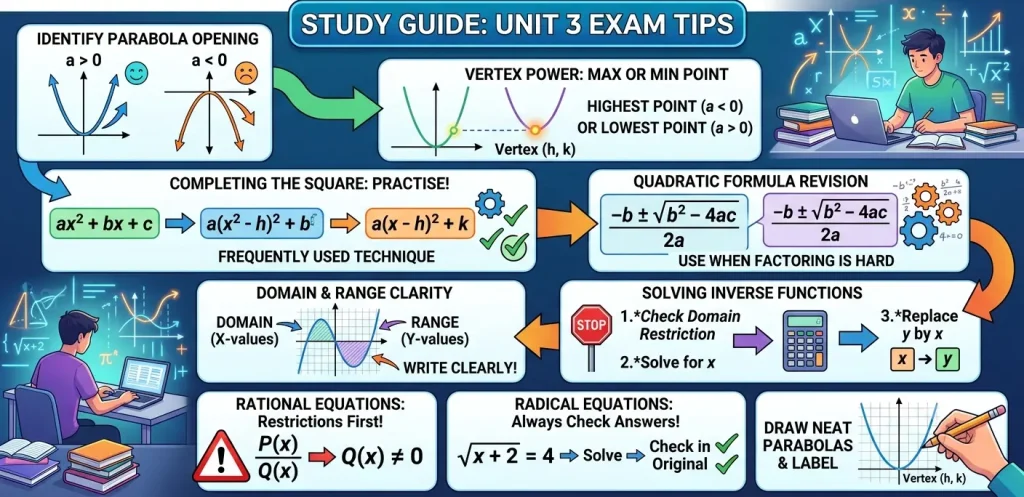
Exam Preparation Tips for Unit 3
Related Class 11 Math Resources
You may also find these resources helpful:
Class 11 Math Notes
FAQs
What is Unit 3 Class 11 Math about?
Unit 3 Class 11 Math is about the Theory of Quadratic Functions. It explains quadratic functions, maximum and minimum values, graphs, vertex, domain, range, inverse functions, and quadratic equations.
What is the title of Unit 3 Class 11 Math?
The title of Unit 3 Class 11 Math is Theory of Quadratic Functions.
How many exercises are included in Unit 3 Class 11 Math Notes?
The uploaded notes include Exercise 3.1 and Exercise 3.2.
What is Exercise 3.1 about?
Exercise 3.1 is about completing square, maximum and minimum values, vertex, graph sketching, domain, range, and inverse of quadratic functions.
What is Exercise 3.2 about?
Exercise 3.2 is about solving equations that lead to quadratic equations. It includes rational equations, radical equations, factorization, quadratic formula, and checking rejected values.
What is a quadratic function?
A quadratic function is a function whose highest power of the variable is 2. It is usually written as: \(\displaystyle f(x)=ax^2+bx+c\)
where: \(\displaystyle a\ne 0\)
What is the graph of a quadratic function called?
The graph of a quadratic function is called a parabola.
When does a quadratic function have a minimum value?
A quadratic function has a minimum value when the coefficient of \(x^2\) is positive. \(\displaystyle a>0\)
When does a quadratic function have a maximum value?
A quadratic function has a maximum value when the coefficient of \(x^2\) is negative. \(\displaystyle a<0\)
What is the quadratic formula?
The quadratic formula is: \(\displaystyle x=\frac{-b\pm\sqrt{b^2-4ac}}{2a}\)
Why do we check answers in radical equations?
We check answers in radical equations because squaring both sides can sometimes produce extra answers that do not satisfy the original equation.
Disclaimer
These Class 11 Math notes are prepared to help students understand Unit 3 in an easy way. Students should also read their textbook and follow the instructions of their teacher for complete exam preparation.
Final Words
Unit 3 Class 11 Math Notes help students understand the Theory of Quadratic Functions step by step. This unit is important because quadratic functions are used in graphs, equations, optimization, and many later topics in mathematics. Students should practise completing square, finding vertex, drawing graphs, solving equations, and checking answers carefully for better exam preparation.