
Unit 2 Class 11 Math Notes – Functions and Graphs
Unit 2 Class 11 Math Notes are available here in easy PDF format. This unit is titled Functions and Graphs. It includes step-by-step solutions of Exercise 2.1 and Exercise 2.2 from the updated PECTAA textbook.
In this unit, students learn how functions are written, evaluated, simplified, and represented by graphs. These notes are useful for homework, test preparation, board exam revision, and understanding the basic idea of functions before moving to advanced topics.
This unit is part of our 1st year math notes for the new book, where you can open the solutions of the other units.
Exercise-wise Solutions of Unit 2 Class 11 Math
Open the exercise below to view the complete step-by-step PDF solutions.
Quick Overview of Unit 2 Class 11 Math Notes
Unit 2 is about Functions and Graphs. In this chapter, students learn how to find the value of a function, how to simplify function expressions, how to find domain and range, and how to draw graphs of different functions.
Exercise 2.1 covers function values, substitution, difference quotient, domain, range, one-to-one functions, onto functions, and real-life examples of functions.
Exercise 2.2 covers graphs of functions, x-intercepts, y-intercepts, points of intersection, linear graphs, quadratic graphs, square root graphs, and cube root graphs.
What Is Unit 2 Class 11 Math About?
Unit 2 Class 11 Math is about Functions and Graphs. A function is a rule that assigns exactly one output to each input.
A function is usually written as: \(\displaystyle y=f(x)\)
Here, \(x\) is the input and \(f(x)\) is the output.
For example, if: \(\displaystyle f(x)=2x+3\)
then to find \(f(4)\), we put \(x=4\): \(\displaystyle f(4)=2(4)+3\)
\(\displaystyle f(4)=8+3\) and \(\displaystyle f(4)=11\)
So, the value of the function at \(x=4\) is \(11\).
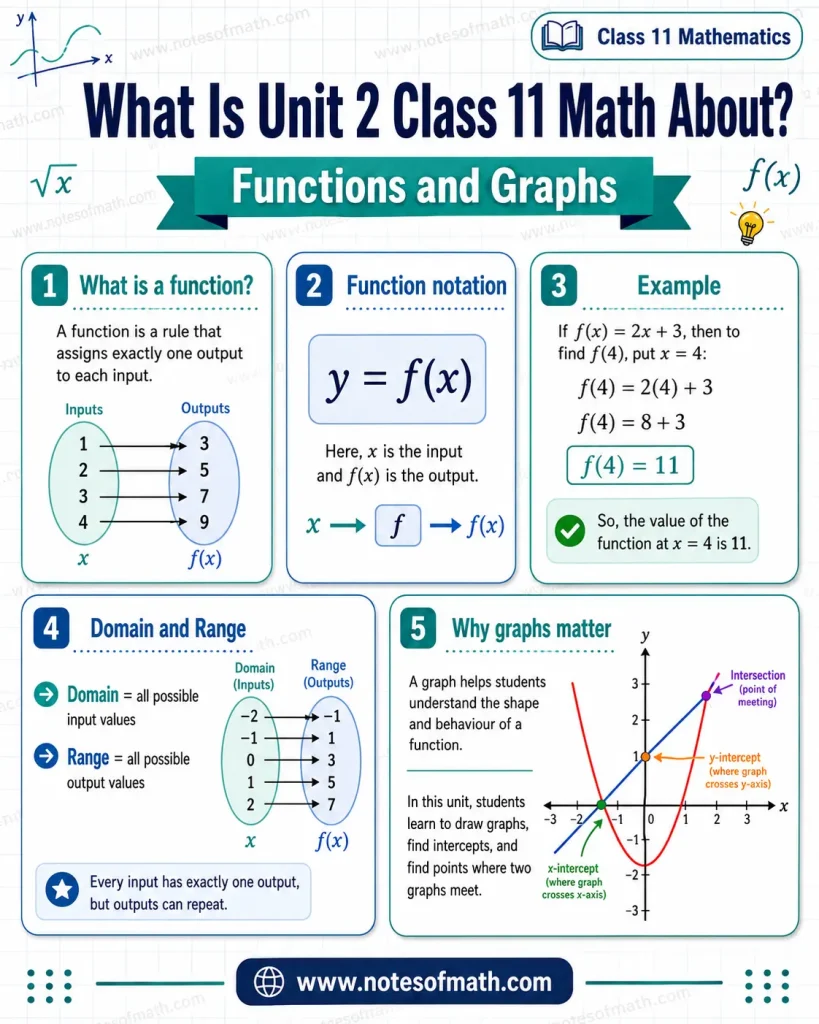
This unit also explains domain and range. The domain is the set of all possible input values of a function. The range is the set of all possible output values of a function.
Graphs are also an important part of this unit. A graph helps students understand the shape and behaviour of a function. In this unit, students learn how to draw graphs, find intercepts, and find points where two graphs meet.
Solutions of Exercise 2.1 Class 11 Math Unit 2
Exercise 2.1 starts with finding values of functions. In these questions, students are given a function and asked to find values such as:
\(\displaystyle f(-3)\) , \(\displaystyle f(0)\) , \(\displaystyle f(x-2)\), \(\displaystyle f(x^2+3)\)
For example, if:
\(\displaystyle f(x)=x^2-1\) then: \(\displaystyle f(-3)=(-3)^2-1\)
\(\displaystyle f(-3)=9-1\)= \(\displaystyle f(-3)=8\)
This type of question teaches students how to replace \(x\) with a number or expression.
Exercise 2.1 also includes square root functions. In square root functions, students must remember that the expression inside the square root cannot be negative when we are working in real numbers.
For example, if: \(\displaystyle f(x)=\sqrt{2x+3}\)
then the expression inside the square root is: \(\displaystyle 2x+3\)
For real values, it must satisfy: \(\displaystyle 2x+3\ge 0\)
This idea is very important when finding the domain of square root functions.
Another important topic in Exercise 2.1 is the difference quotient. It is written as:
\(\displaystyle \frac{f(a+h)-f(a)}{h}\)
Students simplify this expression for different functions. This topic is important because it gives the basic idea used later in calculus.
Exercise 2.1 also includes real-life function examples. Students learn how to express one quantity as a function of another quantity.
For example, the area of a square can be written as a function of its perimeter.
If the perimeter of a square is \(P\), then its side is: \(\displaystyle s=\frac{P}{4}\)
The area of the square is: \(\displaystyle A=s^2\)
So: \(\displaystyle A=\left(\frac{P}{4}\right)^2\) \(\displaystyle =\frac{P^2}{16}\)
Therefore, the area of a square as a function of its perimeter is:
\(\displaystyle A=\frac{P^2}{16}\)
The circumference of a circle can also be written as a function of its area.
If the area of a circle is: \(\displaystyle A=\pi r^2\)
then: \(\displaystyle r=\sqrt{\frac{A}{\pi}}\)
The circumference is: \(\displaystyle C=2\pi r\)
So: \(\displaystyle C=2\pi\sqrt{\frac{A}{\pi}}\)
\(\displaystyle C=2\sqrt{\pi A}\)
Therefore: \(\displaystyle C=2\sqrt{\pi A}\)
The surface area of a cube can also be written as a function of its volume.
If the volume of a cube is: \(\displaystyle V=a^3\)
then: \(\displaystyle a=V^{\frac{1}{3}}\)
The surface area of the cube is: \(\displaystyle S=6a^2\)
So: \(\displaystyle S=6\left(V^{\frac{1}{3}}\right)^2\)
\(\displaystyle S=6V^{\frac{2}{3}}\)
Exercise 2.1 also covers domain and range. Students learn how to find the allowed values of \(x\) and the possible values of \(y\). Linear functions usually have all real numbers as domain and range, but square root functions and rational functions have restrictions.
For rational functions, the denominator must not be zero.
For example, in a function like: \(\displaystyle g(x)=\frac{x+2}{3-x}\)
the denominator is: \(\displaystyle 3-x\)
So: \(\displaystyle 3-x\ne 0\)
\(\displaystyle x\ne 3\)
Therefore, \(x=3\) is not included in the domain.
Exercise 2.1 also explains one-to-one and onto functions. A function is one-to-one if different inputs give different outputs. A function is onto if every element of the co-domain is covered by the function.
For example, a linear function such as:
\(\displaystyle f(x)=3x-5\)
is one-to-one because different values of \(x\) give different values of \(f(x)\). If the co-domain is the set of all real numbers, this function is also onto because every real value of \(y\) can be obtained from some real value of \(x\).
Solutions of Exercise 2.2 Class 11 Math Unit 2
Exercise 2.2 focuses on graphs of functions. Students learn how to find intercepts, draw graphs, and find points of intersection.
The x-intercept is the point where the graph cuts the x-axis. To find the x-intercept, put:
\(\displaystyle y=0\)
The y-intercept is the point where the graph cuts the y-axis. To find the y-intercept, put:
\(\displaystyle x=0\)
For example, consider the linear function:
\(\displaystyle y=-5x+10\)
To find the x-intercept, put \(y=0\):
\(\displaystyle 0=-5x+10\)
\(\displaystyle -5x=-10\)
\(\displaystyle x=2\)
So, the x-intercept is:
\(\displaystyle (2,0)\)
To find the y-intercept, put \(x=0\):
\(\displaystyle y=-5(0)+10\)
\(\displaystyle y=10\)
So, the y-intercept is:
\(\displaystyle (0,10)\)
Exercise 2.2 also includes finding the point of intersection of two functions. At the point of intersection, both functions have the same value. Therefore, we put:
\(\displaystyle f(x)=g(x)\)
Then we solve the equation to find \(x\). After finding \(x\), we put its value in any one function to find \(y\).
For example, if:
\(\displaystyle f(x)=2x+5\)
and: \(\displaystyle g(x)=-x+5\)
then at the point of intersection: \(\displaystyle 2x+5=-x+5\)
\(\displaystyle 3x=0\) so \(\displaystyle x=0\)
Now put \(x=0\) in one function: \(\displaystyle y=2(0)+5\)
\(\displaystyle y=5\)
So, the point of intersection is: \(\displaystyle (0,5)\)
Exercise 2.2 also includes intersections of linear and quadratic functions. Sometimes there are two points of intersection. Sometimes there is only one point of intersection.
For example, if: \(\displaystyle f(x)=x-1\)
and: \(\displaystyle g(x)=x^2-4x+3\)
then at the point of intersection:
\(\displaystyle x-1=x^2-4x+3\)
\(\displaystyle x^2-5x+4=0\)
\(\displaystyle (x-1)(x-4)=0\)
So: \(\displaystyle x=1\)
or: \(\displaystyle x=4\)
When \(x=1\): \(\displaystyle y=1-1=0\)
When \(x=4\): \(\displaystyle y=4-1=3\)
So, the points of intersection are: \(\displaystyle (1,0)\)
and: \(\displaystyle (4,3)\)
The exercise also includes graphing square root and cube root functions. For these questions, students make a table of values, plot the points on the graph, and then draw the curve.
For square root functions, it is better to choose values of \(x\) that make the square root easy. For cube root functions, it is better to choose values that give perfect cubes.
Important Formulas and Concepts of Unit 2
Function notation:
\(\displaystyle y=f(x)\)
Here, \(x\) is the input and \(f(x)\) is the output.
Difference quotient:
\(\displaystyle \frac{f(a+h)-f(a)}{h}\)
x-intercept: \(\displaystyle y=0\)
y-intercept: \(\displaystyle x=0\)
Point of intersection of two functions:
\(\displaystyle f(x)=g(x)\)
Area of a square as a function of perimeter:
\(\displaystyle A=\frac{P^2}{16}\)
Domain rule for rational functions:
\(\displaystyle \text{Denominator}\ne 0\)
For one-to-one function:
\(\displaystyle f(x_1)=f(x_2)\Rightarrow x_1=x_2\)
For onto function:
Every element of the co-domain must have a pre-image in the domain.
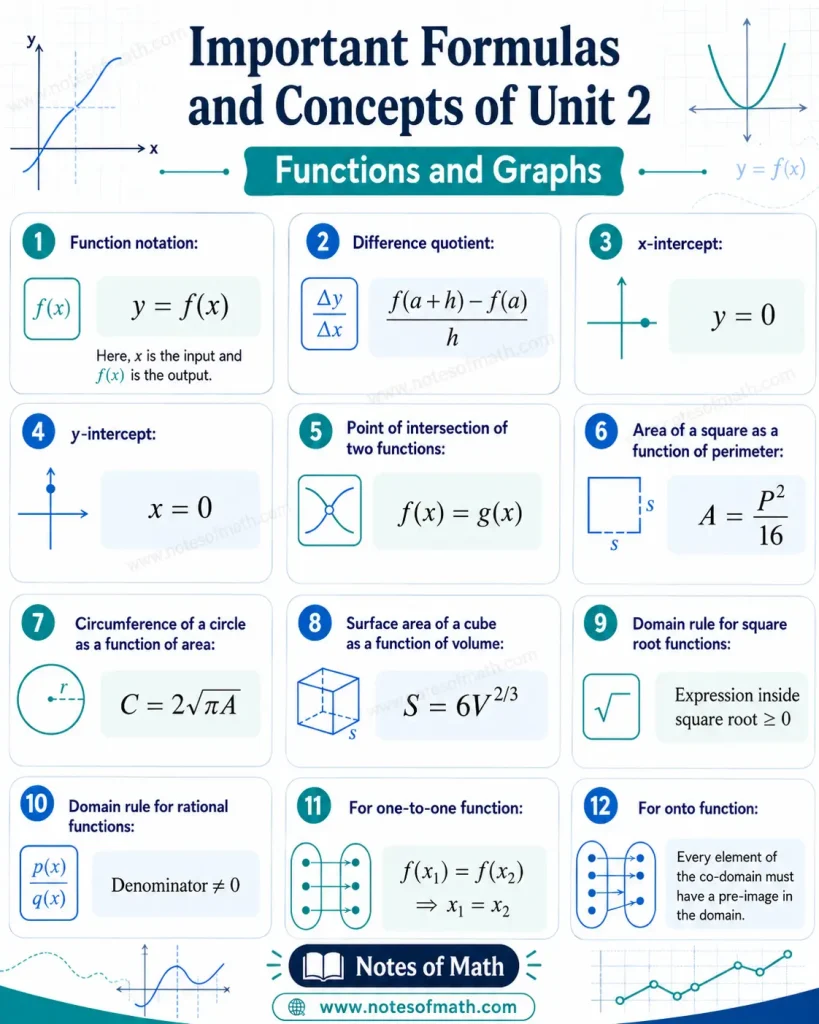
Circumference of a circle as a function of area:
\(\displaystyle C=2\sqrt{\pi A}\)
Surface area of a cube as a function of volume:
\(\displaystyle S=6V^{\frac{2}{3}}\)
Domain rule for square root functions:
\(\displaystyle \text{Expression inside square root}\ge 0\)
Common Mistakes in Unit 2
Many students make mistakes while substituting values in functions. Always replace every \(x\) carefully with the given value.
Some students forget to use brackets when substituting negative values.
For example, if:
\(\displaystyle f(x)=x^2-1\)
then \(f(-3)\) should be written as:
\(\displaystyle f(-3)=(-3)^2-1\)
It should not be written as:
\(\displaystyle f(-3)=-3^2-1\)
Another common mistake is ignoring the domain of square root functions. In real numbers, the expression inside a square root must not be negative.
Students also make mistakes in rational functions by forgetting that the denominator cannot be zero.
For example, in: \(\displaystyle g(x)=\frac{x+2}{3-x}\)
the denominator is: \(\displaystyle 3-x\)
So, students must write: \(\displaystyle 3-x\ne 0\)
In graph questions, many students confuse x-intercept and y-intercept. Remember:
For x-intercept: \(\displaystyle y=0\)
For y-intercept: \(\displaystyle x=0\)
In point of intersection questions, some students find only \(x\) and forget to find \(y\). A point of intersection must always be written as an ordered pair:
\(\displaystyle (x,y)\)
Some students also draw graphs without making a table of values. This can make the graph inaccurate. A small table of values helps students plot the graph correctly.
Exam Preparation Tips for Unit 2
Practise function substitution carefully. Many questions in this unit are based on replacing \(x\) with a number or expression.
Revise the difference quotient because it is an important concept and may appear in exams.
Learn the domain rules for square root and rational functions. These rules help students solve domain and range questions quickly.
For graph questions, always make a table of values before drawing the graph. Mark the important points clearly.
For x-intercept and y-intercept questions, remember the basic rules:
\(\displaystyle y=0\)
\(\displaystyle x=0\)
For intersection questions, first solve:
\(\displaystyle f(x)=g(x)\)
Then find the value of \(y\).
Do not skip graph practice. Graphs are an important part of Unit 2, and students should practise drawing neat and clear graphs.
Related Class 11 Math Resources
You may also find these resources helpful:
Class 11 Math Notes
Unit 1 Class 11 Math Notes
Unit 3 Class 11 Math Notes
Quadratic Equation Solver
Simultaneous Equations Solver
FAQs
What is Unit 2 Class 11 Math about?
Unit 2 Class 11 Math is about Functions and Graphs. It explains function notation, function values, domain, range, intercepts, points of intersection, and graphs of different functions.
What is the title of Unit 2 Class 11 Math?
The title of Unit 2 Class 11 Math is Functions and Graphs.
How many exercises are included in Unit 2 Class 11 Math Notes?
The notes include Exercise 2.1 and Exercise 2.2.
What is Exercise 2.1 about?
Exercise 2.1 is about function values, substitution, difference quotient, domain, range, real-life functions, one-to-one functions, and onto functions.
What is Exercise 2.2 about?
Exercise 2.2 is about graphs, x-intercepts, y-intercepts, points of intersection, linear graphs, quadratic graphs, square root graphs, and cube root graphs.
How do we find the x-intercept of a graph?
To find the x-intercept, put:
\(\displaystyle y=0\)
Then solve for \(x\).
How do we find the y-intercept of a graph?
To find the y-intercept, put:
\(\displaystyle x=0\)
Then solve for \(y\).
How do we find the point of intersection of two functions?
To find the point of intersection of two functions, put:
\(\displaystyle f(x)=g(x)\)
Then solve for \(x\). After that, put the value of \(x\) in any one function to find \(y\).
What is the domain rule for square root functions?
For square root functions, the expression inside the square root must be non-negative.
\(\displaystyle \text{Expression inside square root}\ge 0\)
What is the domain rule for rational functions?
For rational functions, the denominator must not be zero.
\(\displaystyle \text{Denominator}\ne 0\)
Why is Unit 2 important?
Unit 2 is important because functions and graphs are used in many later topics of mathematics, including trigonometry, limits, derivatives, and calculus.
Disclaimer
These Class 11 Math notes are prepared to help students understand Unit 2 in an easy way. Students should also read their textbook and follow the instructions of their teacher for complete exam preparation.
Final Words
Unit 2 Class 11 Math Notes help students understand Functions and Graphs step by step. This unit is important because it builds the foundation for many future topics in mathematics. Students should practise function values, domain, range, intercepts, intersections, and graphs carefully to prepare well for exams.