
Unit 4 Class 11 Math Notes – Matrices and Determinants
Unit 4 Class 11 Math Notes are available here in easy PDF format. This unit is named Matrices and Determinants. It includes step-by-step solutions of Exercise 4.1, Exercise 4.2, and Exercise 4.3 from the updated PECTAA textbook.
In this unit, students learn matrix operations, determinants, transpose of a matrix, inverse of a matrix, rank of a matrix, Cramer’s rule, and solving systems of linear equations. These notes are useful for homework, class tests, board exam preparation, and quick revision.
This unit is part of our 1st year math notes for the new book, where you can open the solutions of the other units.
Exercise-wise Solutions of Unit 4 Class 11 Math
Open the exercise below to view the complete step-by-step PDF solutions.
Quick Overview of Unit 4 Class 11 Math Notes
Unit 4 is about Matrices and Determinants. In this chapter, students learn how matrices are written, added, subtracted, multiplied, transposed, and used to solve systems of linear equations.
Exercise 4.1 covers identity matrices, matrix addition, matrix subtraction, matrix multiplication, associative property, distributive property, transpose of a matrix, and important matrix properties.
Exercise 4.2 covers evaluation of determinants, determinant properties, determinants without expansion, row and column operations, cofactors, adjoint, inverse matrix, singular matrices, and transpose verification.
Exercise 4.3 covers inverse of matrices by row operations, rank of matrices, Cramer’s rule, matrix inversion method, echelon form, reduced echelon form, transformations, and coding messages using matrices.
What Is Unit 4 Class 11 Math About?
Unit 4 Class 11 Math is about Matrices and Determinants. A matrix is a rectangular arrangement of numbers, symbols, or expressions written in rows and columns.
A matrix is usually written as:
\(\displaystyle A=[a_{ij}]\)
Here, \(a_{ij}\) represents the element of the matrix in the \(i\)th row and \(j\)th column.
For example, a matrix with 2 rows and 3 columns is called a \(2\times 3\) matrix.
A matrix of order \(m\times n\) has \(m\) rows and \(n\) columns.
Matrices are important because they help us arrange data and solve mathematical problems in a short form. They are used in algebra, systems of linear equations, transformations, computer graphics, engineering, physics, economics, and coding.
Determinants are also an important part of this unit. A determinant is a number associated with a square matrix. Determinants help us find inverse matrices, solve linear equations, and check whether a matrix is singular or non-singular.
Solutions of Exercise 4.1 Class 11 Math Unit 4
Exercise 4.1 starts with basic properties of matrices. Students first learn how identity matrices work with other matrices.
If \(A\) is a matrix of order \(3\times 4\), then multiplying it by a suitable identity matrix gives the same matrix.
For example: \(\displaystyle I_3A=A\)
and: \(\displaystyle AI_4=A\)
Here, \(I_3\) is the identity matrix of order 3, and \(I_4\) is the identity matrix of order 4.
This means that an identity matrix works like the number 1 in matrix multiplication.
Exercise 4.1 also includes addition and subtraction of matrices. To add or subtract two matrices, we add or subtract their corresponding entries.
If: \(\displaystyle A=[a_{ij}]\)
and: \(\displaystyle B=[b_{ij}]\)
then: \(\displaystyle A+B=[a_{ij}+b_{ij}]\)
and: \(\displaystyle A-B=[a_{ij}-b_{ij}]\)
Matrix addition and subtraction are possible only when both matrices have the same order.
For example, two matrices of order \(3\times 3\) can be added or subtracted. But a \(2\times 3\) matrix and a \(3\times 2\) matrix cannot be added.
Exercise 4.1 also includes matrix multiplication. Matrix multiplication is different from ordinary multiplication. The entry in the product matrix is found by multiplying a row of the first matrix with a column of the second matrix.
If \(A\) is of order \(m\times n\) and \(B\) is of order \(n\times p\), then the product \(AB\) is defined.
The order of \(AB\) is: \(\displaystyle m\times p\)
Matrix multiplication is possible only when the number of columns of the first matrix is equal to the number of rows of the second matrix.
Exercise 4.1 also explains that matrix multiplication is associative.
\(\displaystyle (AB)C=A(BC)\)
It also explains the distributive property:
\(\displaystyle A(B+C)=AB+AC\)
These properties help students simplify matrix expressions and prove matrix results.
Matrix Multiplication Is Not Always Commutative
One of the most important ideas in Exercise 4.1 is that matrix multiplication is not always commutative.
In ordinary algebra: \(\displaystyle ab=ba\)
But in matrices, generally: \(\displaystyle AB\ne BA\)
Because of this, some familiar algebraic identities do not work in the same way for matrices.
For example: \(\displaystyle (A+B)^2\ne A^2+2AB+B^2\)
Actually: \(\displaystyle (A+B)^2=(A+B)(A+B)\)
\(\displaystyle (A+B)^2=A^2+AB+BA+B^2\)
This is equal to \(A^2+2AB+B^2\) only when:
\(\displaystyle AB=BA\)
But in general, matrices do not commute.
Similarly: \(\displaystyle (A-B)^2\ne A^2-2AB+B^2\)
and: \(\displaystyle (A+B)(A-B)\ne A^2-B^2\)
These questions are important because they show the difference between ordinary algebra and matrix algebra.
Transpose of a Matrix
Exercise 4.1 also includes transpose of a matrix. The transpose of a matrix is obtained by changing rows into columns and columns into rows.
If: \(\displaystyle A=[a_{ij}]\)
then the transpose of \(A\) is written as: \(\displaystyle A^t\) or: \(\displaystyle A^T\)
If we take the transpose twice, we get the original matrix again.
\(\displaystyle (A^t)^t=A\)
Exercise 4.1 includes questions such as:
\(\displaystyle A+A^t\) , \(\displaystyle A-A^t\)
\(\displaystyle AA^t\) , \(\displaystyle A^tA\)
These questions help students practise transpose, matrix addition, matrix subtraction, and matrix multiplication at the same time.
Solutions of Exercise 4.2 Class 11 Math Unit 4
Exercise 4.2 is mainly about determinants and their properties. In this exercise, students learn how to evaluate determinants, simplify determinants without full expansion, use determinant properties, find cofactors, find inverse matrices, and verify transpose results.
A determinant is a number associated with a square matrix. Determinants are written using vertical bars.
For a \(2\times 2\) matrix: \(\displaystyle A=\begin{bmatrix}a&b\\c&d\end{bmatrix}\)
the determinant is: \(\displaystyle |A|=\begin{vmatrix}a&b\\c&d\end{vmatrix}=ad-bc\)
For a \(3\times 3\) determinant, students usually expand along a row or column. The sign pattern used in the first row is:
\(\displaystyle +, -, +\)
This sign pattern is very important when expanding determinants.
Exercise 4.2 also explains how determinant properties can make calculations easier. Instead of expanding a determinant directly, students can use row or column operations to create zeros, proportional rows, or dependent columns.
One important property is that if two rows or two columns are proportional, then the determinant is zero.
So, if two rows are proportional: \(\displaystyle \Delta=0\)
Similarly, if two columns are proportional: \(\displaystyle \Delta=0\)
This idea is used many times in Exercise 4.2 to prove determinants without full expansion.
Exercise 4.2 also uses row and column operations such as:
\(\displaystyle R_2\to R_2-R_1\)
\(\displaystyle R_3\to R_3-R_1\)
\(\displaystyle C_1\to C_1+C_2+C_3\)
These operations help simplify determinants and make the solution shorter.
Another important topic in Exercise 4.2 is determinant identities. In these questions, students simplify the left hand side until it becomes the required right hand side.
Some questions use the Vandermonde determinant form.
A common Vandermonde type result is:
\(\displaystyle \begin{vmatrix}1&1&1\\x&y&z\\x^2&y^2&z^2\end{vmatrix}=(x-y)(y-z)(z-x)\)
This type of determinant is useful in questions involving variables such as \(x\), \(y\), and \(z\).
Exercise 4.2 also includes determinants where values of \(x\) are found from a given determinant equation. In these questions, students expand the determinant, simplify it into an equation, and then solve the resulting equation.
For example, after simplifying a determinant equation, we may get:
\(\displaystyle 4x^2-4x+1=0\)
Then: \(\displaystyle (2x-1)^2=0\)
So: \(\displaystyle x=\frac{1}{2}\)
Exercise 4.2 also includes singular matrices. A square matrix is singular if its determinant is zero.
If: \(\displaystyle |A|=0\) then \(A\) is singular.
If: \(\displaystyle |A|\ne 0\) then \(A\) is non-singular and its inverse exists.
This exercise also covers cofactors. Cofactors are used to find the adjoint of a matrix. To find the cofactor of an element, delete its row and column, find the minor determinant, and apply the correct sign.
The cofactor sign pattern is:
\(\displaystyle \begin{bmatrix}+&-&+\\-&+&-\\+&-&+\end{bmatrix}\)
Cofactors are important because they are used to find the adjoint matrix.
The inverse of a matrix is also studied in Exercise 4.2. If \(A\) is a square matrix and its determinant is not zero, then the inverse exists.
The inverse formula is:
\(\displaystyle A^{-1}=\frac{1}{|A|}\operatorname{adj}(A)\)
Here, \(|A|\) is the determinant of \(A\), and \(adj(A)\) is the adjoint of \(A\).
Exercise 4.2 also includes transpose verification. Students use transpose rules to prove matrix results.
Important transpose rules include:
\(\displaystyle (A^t)^t=A\)
\(\displaystyle (A+B)^t=A^t+B^t\)
\(\displaystyle (AB)^t=B^tA^t\)
The last formula is especially important because the order changes when taking the transpose of a product.
Solutions of Exercise 4.3 Class 11 Math Unit 4
Exercise 4.3 includes advanced applications of matrices and determinants. Students learn how to find inverse matrices by row operations, how to find rank, and how to solve systems of linear equations using Cramer’s rule and matrix inversion method.
The first topic in Exercise 4.3 is finding inverse of a matrix by row operations.
To find the inverse of a matrix \(A\), we write: \(\displaystyle [A\mid I]\)
Then we apply elementary row operations until the left side becomes the identity matrix.
When the left side becomes \(I\), the right side becomes \(A^{-1}\).
So: \(\displaystyle [A\mid I]\to [I\mid A^{-1}]\)
This method is useful for finding the inverse of \(3\times 3\) matrices.
Rank of a Matrix
Exercise 4.3 also includes rank of a matrix. The rank of a matrix is the number of non-zero rows in its echelon form.
To find the rank, students use elementary row operations to convert the matrix into echelon form.
Then they count the number of non-zero rows.
For example, if the echelon form has three non-zero rows, then:
\(\displaystyle \text{Rank}(A)=3\)
If the echelon form has four non-zero rows, then:
\(\displaystyle \text{Rank}(A)=4\)
Rank is important because it tells us about the independence of rows or columns. It is also useful when solving systems of linear equations.
Cramer’s Rule
Exercise 4.3 also covers Cramer’s rule. Cramer’s rule is used to solve systems of linear equations using determinants.
For three unknowns, Cramer’s rule is:
\(\displaystyle x=\frac{\Delta_x}{\Delta}\) , \(\displaystyle y=\frac{\Delta_y}{\Delta}\) ,\(\displaystyle z=\frac{\Delta_z}{\Delta}\)
Here, \(\Delta\) is the determinant of the coefficient matrix.
To find \(\Delta_x\), replace the \(x\) column by the constants column.
To find \(\Delta_y\), replace the \(y\) column by the constants column.
To find \(\Delta_z\), replace the \(z\) column by the constants column.
Cramer’s rule is used when: \(\displaystyle \Delta\ne 0\)
If \(\Delta\ne 0\), then the system has a unique solution.
Matrix Inversion Method
Exercise 4.3 also includes solving systems of linear equations by the matrix inversion method.
First, write the system in matrix form:
\(\displaystyle AX=B\)
If the inverse of \(A\) exists, then:
\(\displaystyle X=A^{-1}B\)
The inverse of \(A\) can be found by:
\(\displaystyle A^{-1}=\frac{1}{|A|}\operatorname{adj}(A)\)
This method is useful when solving three linear equations in three unknowns.
Students must first check that:
\(\displaystyle |A|\ne 0\)
If \(|A|=0\), then the inverse does not exist.
Echelon Form and Reduced Echelon Form
Exercise 4.3 also includes solving systems by reducing augmented matrices to echelon form and reduced echelon form.
An augmented matrix is formed by writing the coefficients and constants of a system in one matrix.
For example, a system of equations can be written in the form:
\(\displaystyle [A\mid B]\)
Then row operations are applied to simplify the system.
In echelon form, the matrix becomes easier to solve by back substitution.
In reduced echelon form, the leading entries are made equal to 1 and the entries above and below each leading 1 are made zero.
This method is useful when solving systems with more than one variable.
Transformations Using Matrices
Exercise 4.3 also includes transformations using matrices. A transformation matrix can be used to reflect, rotate, stretch, or change points in the coordinate plane.
For example, reflection over the y-axis changes:
\(\displaystyle (x,y)\to (-x,y)\)
The transformation matrix for reflection over the y-axis is:
\(\displaystyle R_y=\begin{bmatrix}-1&0\\0&1\end{bmatrix}\)
If a point is written as a column matrix, the transformation matrix can be multiplied by that point to get the new point.
This shows how matrices are used in geometry and coordinate transformations.
Coding Messages Using Matrices
Exercise 4.3 also includes an application of matrices in coding messages. Letters are first converted into numbers. Then the numbers are arranged in matrices and multiplied by a given coding matrix.
For example, letters may be assigned numbers from 1 to 26:
\(\displaystyle A=1,\quad B=2,\quad C=3,\quad \ldots,\quad Z=26\)
The message is divided into groups, arranged in columns, and then multiplied by the given matrix.
This type of question helps students understand how matrices can be used in coding and communication.
Important Formulas and Concepts of Unit 4
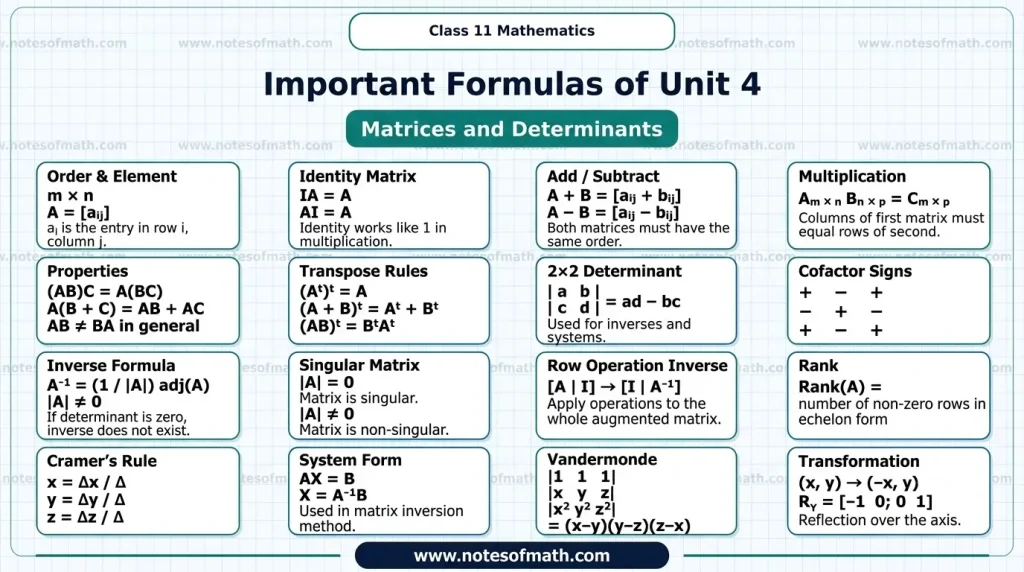
Order of a matrix: \(\displaystyle m\times n\)
General element of a matrix: \(\displaystyle A=[a_{ij}]\)
Identity matrix property:
\(\displaystyle IA=A\) , \(\displaystyle AI=A\)
Matrix addition: \(\displaystyle A+B=[a_{ij}+b_{ij}]\)
Matrix subtraction: \(\displaystyle A-B=[a_{ij}-b_{ij}]\)
Matrix multiplication condition:
\(\displaystyle A_{m\times n}B_{n\times p}=C_{m\times p}\)
Associative property of matrix multiplication: \(\displaystyle (AB)C=A(BC)\)
Distributive property: \(\displaystyle A(B+C)=AB+AC\)
Matrix multiplication is not commutative in general: \(\displaystyle AB\ne BA\)
Transpose of a matrix: \(\displaystyle A^t\)
Transpose of transpose: \(\displaystyle (A^t)^t=A\)
Transpose of sum: \(\displaystyle (A+B)^t=A^t+B^t\)
Transpose of product: \(\displaystyle (AB)^t=B^tA^t\)
Determinant of a \(2\times 2\) matrix:
\(\displaystyle \begin{vmatrix}a&b\\c&d\end{vmatrix}=ad-bc\)
Cofactor sign pattern:
\(\displaystyle \begin{bmatrix}+&-&+\\-&+&-\\+&-&+\end{bmatrix}\)
Inverse by adjoint method:
\(\displaystyle A^{-1}=\frac{1}{|A|}\operatorname{adj}(A)\)
Condition for inverse: \(\displaystyle |A|\ne 0\)
Singular matrix condition: \(\displaystyle |A|=0\)
Non-singular matrix condition: \(\displaystyle |A|\ne 0\)
Row operation inverse method:
\(\displaystyle [A\mid I]\to [I\mid A^{-1}]\)
Rank of a matrix:
\(\displaystyle \text{Rank}(A)=\text{number of non-zero rows in echelon form}\)
Cramer’s rule:
\(\displaystyle x=\frac{\Delta_x}{\Delta},\quad y=\frac{\Delta_y}{\Delta},\quad z=\frac{\Delta_z}{\Delta}\)
Matrix form of a system: \(\displaystyle AX=B\)
Solution by inverse method: \(\displaystyle X=A^{-1}B\)
Vandermonde determinant form:
\(\displaystyle \begin{vmatrix}1&1&1\\x&y&z\\x^2&y^2&z^2\end{vmatrix}=(x-y)(y-z)(z-x)\)
Reflection over the y-axis: \(\displaystyle (x,y)\to (-x,y)\)
Reflection matrix over the y-axis: \(\displaystyle R_y=\begin{bmatrix}-1&0\\0&1\end{bmatrix}\)
Common Mistakes in Unit 4
Many students make mistakes in matrix multiplication. Always check the order of the matrices before multiplying.
If the first matrix is of order \(m\times n\) and the second matrix is of order \(p\times q\), then multiplication is possible only when:
\(\displaystyle n=p\)
Some students add or subtract matrices of different orders. Matrix addition and subtraction are possible only when both matrices have the same order.
Students often forget that matrix multiplication is not commutative. In general:
\(\displaystyle AB\ne BA\)
Because of this, identities such as \((A+B)^2\) and \((A-B)^2\) must be handled carefully.
Another common mistake is in transpose questions. Students sometimes change only one row or one column. The whole matrix must be transposed.
In determinant questions, students may forget the sign pattern. The cofactor sign pattern is: \(\displaystyle +,-,+\)
in the first row.
Students also make mistakes when using determinant properties. Row and column operations must be applied carefully.
In inverse questions, students forget to check whether \(|A|\) is zero or not. If:
\(\displaystyle |A|=0\)
then the inverse does not exist.
In row operation questions, students sometimes apply the operation only to the left side of \([A\mid I]\). The same row operation must be applied to the whole augmented matrix.
In Cramer’s rule, students often make mistakes while forming \(\Delta_x\), \(\Delta_y\), and \(\Delta_z\). Remember to replace only the required column with the constants column.
In rank questions, some students count zero rows also. Only non-zero rows are counted in echelon form.
In transformation questions, students sometimes write points as rows instead of columns. Usually points are written as column matrices for transformation multiplication.
Exam Preparation Tips for Unit 4
Practise matrix addition and subtraction first because they build the base for later questions.
Learn matrix multiplication carefully. Always multiply row by column.
Revise identity matrix properties:
\(\displaystyle IA=A\) , \(\displaystyle AI=A\)
Do not treat matrix algebra exactly like ordinary algebra. Remember that usually:
\(\displaystyle AB\ne BA\)
Practise transpose questions and learn both notations: \(\displaystyle A^t\)
and: \(\displaystyle A^T\)
For determinant questions, write each step clearly and avoid sign mistakes.
For determinant properties, try to create zeros in a row or column before expansion.
For inverse questions, practise both methods: adjoint method and row operation method.
For rank questions, convert the matrix into echelon form and count non-zero rows.
For Cramer’s rule, make \(\Delta\), \(\Delta_x\), \(\Delta_y\), and \(\Delta_z\) carefully.
For matrix inversion method, write the system in the form: \(\displaystyle AX=B\)
Then use: \(\displaystyle X=A^{-1}B\)
For transformation questions, write the transformation matrix first and then multiply it with each point.
Related Class 11 Math Resources
You may also find these resources helpful:
Class 11 Math Notes
Unit 5 Class 11 Math Notes
Simultaneous Equations Solver
FAQs
What is Unit 4 Class 11 Math about?
Unit 4 Class 11 Math is about Matrices and Determinants. It explains matrix operations, transpose, determinants, inverse matrices, rank, Cramer’s rule, matrix inversion method, and transformations.
What is the title of Unit 4 Class 11 Math?
The title of Unit 4 Class 11 Math is Matrices and Determinants.
How many exercises are included in Unit 4 Class 11 Math Notes?
Unit 4 Class 11 Math Notes include Exercise 4.1, Exercise 4.2, and Exercise 4.3.
What is Exercise 4.1 about?
Exercise 4.1 is about matrix operations, identity matrices, matrix addition, matrix subtraction, matrix multiplication, transpose, and matrix properties.
What is Exercise 4.2 about?
Exercise 4.2 is about determinants, determinant properties, cofactors, adjoint, inverse matrix, singular matrices, and transpose verification.
What is Exercise 4.3 about?
Exercise 4.3 is about inverse matrices by row operations, rank of matrices, Cramer’s rule, matrix inversion method, echelon form, transformations, and matrix applications.
What is a matrix?
A matrix is a rectangular arrangement of numbers, symbols, or expressions written in rows and columns.
What is the order of a matrix?
The order of a matrix is written as: \(\displaystyle m\times n\)
where \(m\) is the number of rows and \(n\) is the number of columns.
What is an identity matrix?
An identity matrix is a square matrix whose diagonal entries are 1 and all other entries are 0.
Is matrix multiplication commutative?
No, matrix multiplication is not commutative in general. Usually:
\(\displaystyle AB\ne BA\)
What is the transpose of a matrix?
The transpose of a matrix is obtained by changing rows into columns and columns into rows.
What is a determinant?
A determinant is a number associated with a square matrix. It is used to find inverses, solve systems of equations, and check whether a matrix is singular or non-singular.
When does a matrix inverse exist?
A matrix inverse exists when the determinant of the matrix is not zero.
\(\displaystyle |A|\ne 0\)
What is a singular matrix?
A square matrix is singular if its determinant is zero. \(\displaystyle |A|=0\)
What is the rank of a matrix?
The rank of a matrix is the number of non-zero rows in its echelon form.
What is Cramer’s rule?
Cramer’s rule is a method used to solve systems of linear equations by using determinants.
For three unknowns: \(\displaystyle x=\frac{\Delta_x}{\Delta},\quad y=\frac{\Delta_y}{\Delta},\quad z=\frac{\Delta_z}{\Delta}\)
What is the matrix inversion method?
The matrix inversion method is used to solve a system of linear equations written as: \(\displaystyle AX=B\)
The solution is: \(\displaystyle X=A^{-1}B\)
Disclaimer
These Class 11 Math notes are prepared to help students understand Unit 4 in an easy way. Students should also read their textbook and follow the instructions of their teacher for complete exam preparation.
Final Words
Unit 4 Class 11 Math Notes help students understand Matrices and Determinants step by step. This unit is important because matrices and determinants are used in algebra, systems of equations, transformations, engineering, computer graphics, coding, and higher mathematics. Students should practise matrix operations, determinants, inverse matrices, rank, Cramer’s rule, and row operations carefully for better exam preparation.