
Unit 12 Class 10 Math New Book Solutions
Unit 12 Class 10 Math New Book Solutions are available here in PDF form. Students can open each exercise solution and study complete step-by-step working. This unit is about probability, sample spaces, tree diagrams, possibility diagrams, addition law of probability, and multiplication law of probability.
Exercise Wise Solutions of Unit 12 Class 10 Math New Book
Open the required exercise below and view the complete PDF solution.
Quick Overview
Unit 12 Class 10 Math New Book Solutions
Unit 12 is about probability. In this unit, students learn how to list possible outcomes, make sample spaces, use tree diagrams, and calculate the probability of different events.
The main focus of Unit 12 is:
- Sample space
- Tree diagrams
- Possibility diagrams
- Probability of an event
- Complement of an event
- Impossible event and sure event
- Mutually exclusive events
- Addition law of probability
- Multiplication law of probability
- Independent and dependent events
- Probability questions based on coins, dice, cards, numbers, letters, and marbles
What Is Unit 12 Class 10 Math New Book About?
Unit 12 explains probability in a simple and practical way. Probability tells us how likely an event is to happen.
Students first learn how to write a sample space. A sample space is the set of all possible outcomes of an experiment. For example, when one coin is tossed, the sample space is:
\[
S = {H, T}
\]
Students also learn how to use tree diagrams and possibility diagrams. These diagrams help students list all possible outcomes clearly.
The unit then explains probability formulas, complement of an event, addition law, and multiplication law. These rules are used in questions based on coins, dice, cards, numbers, and marbles.
Solutions of Exercise 12.1 Class 10 Math New Book
Exercise 12.1 is about probability and sample spaces. Students learn how to make sample spaces by using tree diagrams and possibility diagrams.
Main Topics Covered in Exercise 12.1
- Sample space
- Tree diagram
- Possibility diagram
- Tossing coins
- Rolling dice
- Selecting boys and girls
- Finding number of outcomes
- Probability of simple events
- Complement of an event
- Probability of consecutive outcomes
- Questions based on coin and die together
Solutions of Exercise 12.2 Class 10 Math New Book
Exercise 12.2 is about the addition law of probability. Students learn how to find the probability of event \(A\) or event \(B\).
Main Topics Covered in Exercise 12.2
- Addition law of probability
- Union of two events
- Intersection of two events
- Mutually exclusive events
- Complement of an event
- Probability of even numbers and perfect squares
- Probability questions based on dice
- Probability questions based on playing cards
- At least one head
- Two heads or two tails
- Left or right turn probability
Solutions of Exercise 12.3 Class 10 Math New Book
Exercise 12.3 is about the multiplication law of probability. Students learn how to solve questions where two events happen one after another.
Main Topics Covered in Exercise 12.3
- Multiplication law of probability
- Independent events
- Dependent events
- With replacement
- Without replacement
- Probability of two selections
- Probability using numbers from 1 to 10
- Probability using letters from words
- Probability using dice
- Probability using playing cards
- Probability using marbles
Review Exercise 12 Class 10 Math New Book Solutions
Review Exercise 12 contains MCQs and mixed questions from the complete unit. It helps students revise all important probability concepts.
Main Topics Covered in Review Exercise 12
- Impossible event
- Sure event
- Probability of getting head on a coin
- Sum of probabilities of all outcomes
- Complement of an event
- Mutually exclusive events
- Sample points
- Deck of cards
- Possibility diagram
- Tree diagram
- Addition law of probability
- Multiplication law of probability
- Cards drawn with and without replacement
- Dice probability questions
- Marble probability questions
Important Formulas and Concepts of Unit 12
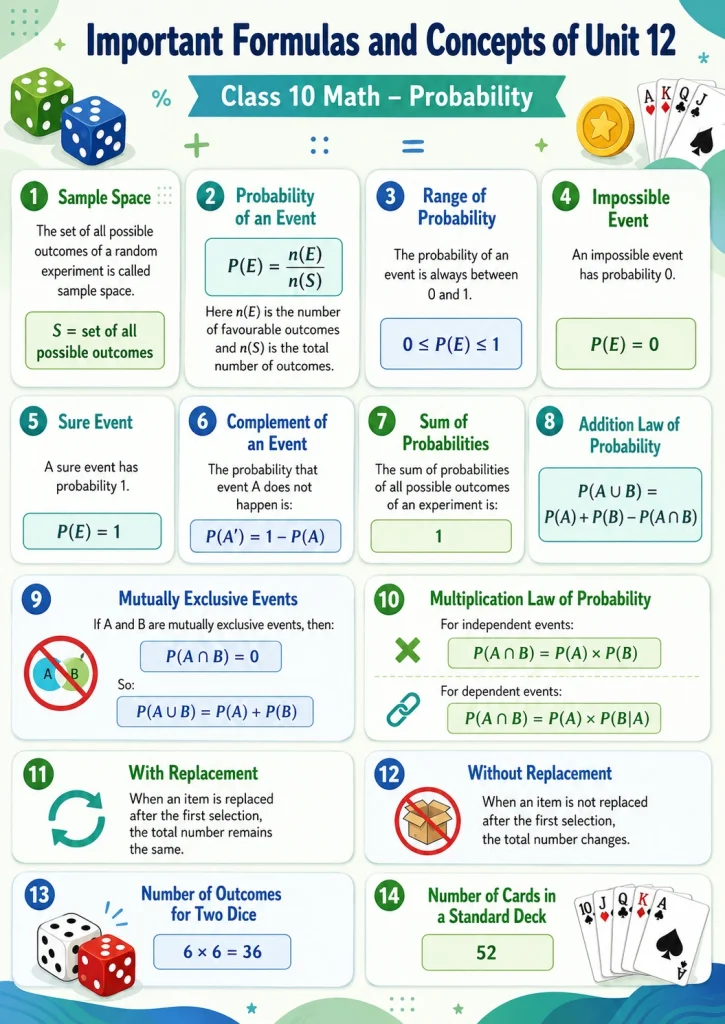
Sample Space
The set of all possible outcomes of a random experiment is called sample space.
\[
S = \text{set of all possible outcomes}
\]
Probability of an Event
\[
P(E)=\frac{n(E)}{n(S)}
\]
Here \(n(E)\) is the number of favourable outcomes and \(n(S)\) is the total number of outcomes.
Range of Probability
The probability of an event is always between 0 and 1.
\[
0 \leq P(E) \leq 1
\]
Impossible Event
An impossible event has probability 0.
\[
P(E)=0
\]
Sure Event
A sure event has probability 1.
\[
P(E)=1
\]
Complement of an Event
The probability that event \(A\) does not happen is:
\[
P(A’)=1-P(A)
\]
Sum of Probabilities
The sum of probabilities of all possible outcomes of an experiment is:
\[
1
\]
Addition Law of Probability
\[
P(A \cup B)=P(A)+P(B)-P(A \cap B)
\]
Mutually Exclusive Events
If \(A\) and \(B\) are mutually exclusive events, then:
\[
P(A \cap B)=0
\]
So:
\[
P(A \cup B)=P(A)+P(B)
\]
Multiplication Law of Probability
For independent events:
\[
P(A \cap B)=P(A)\times P(B)
\]
For dependent events:
\[
P(A \cap B)=P(A)\times P(B|A)
\]
With Replacement
When an item is replaced after the first selection, the total number remains the same.
Without Replacement
When an item is not replaced after the first selection, the total number changes.
Number of Outcomes for Two Dice
\[
6 \times 6 = 36
\]
Number of Cards in a Standard Deck
\[
52
\]
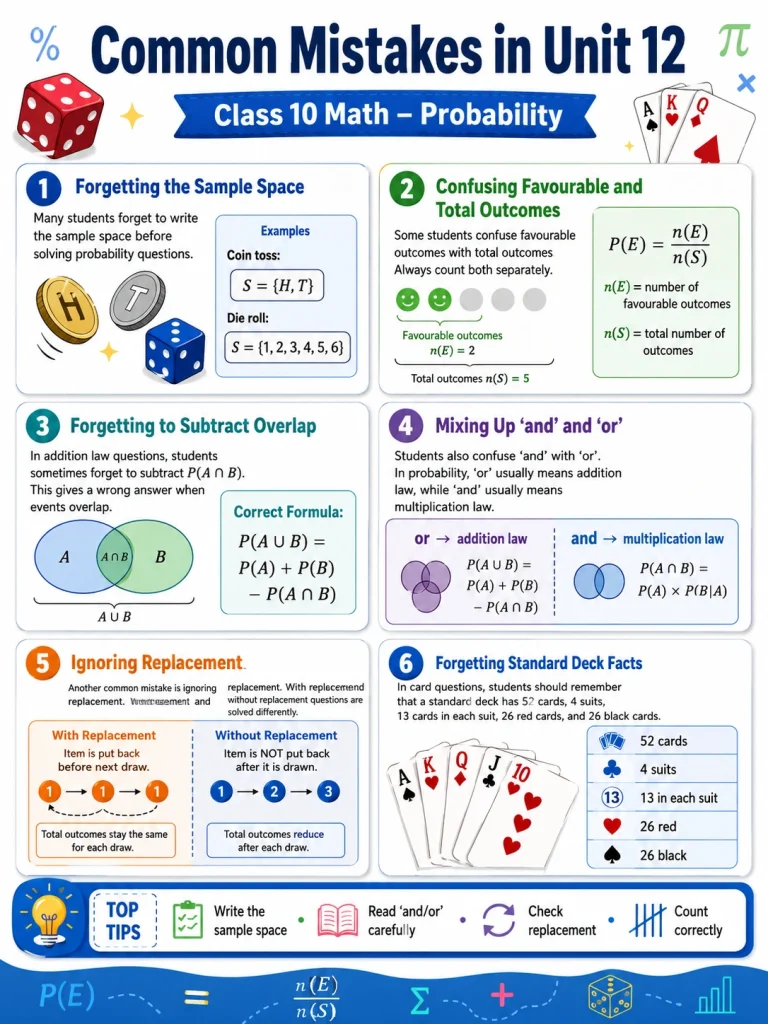
Common Mistakes in Unit 12
Many students forget to write the sample space before solving probability questions.
Some students confuse favourable outcomes with total outcomes. Always count both separately.
In addition law questions, students sometimes forget to subtract \(P(A \cap B)\). This gives a wrong answer when events overlap.
Students also confuse “and” with “or”. In probability, “or” usually means addition law, while “and” usually means multiplication law.
Another common mistake is ignoring replacement. With replacement and without replacement questions are solved differently.
In card questions, students should remember that a standard deck has 52 cards, 4 suits, 13 cards in each suit, 26 red cards, and 26 black cards.
Exam Preparation Tips for Unit 12
Learn the basic probability formula first.
Always write the sample space when possible.
Use a tree diagram when there are two or more stages.
Use a possibility diagram when two choices are combined.
Read the question carefully and decide whether it uses “or” or “and”.
Use addition law for “or” questions.
Use multiplication law for “and” questions.
Check whether the experiment is with replacement or without replacement.
For dice questions, remember that two dice have 36 ordered outcomes.
For card questions, revise basic facts about a standard deck of 52 cards.
FAQs About Unit 12 Class 10 Math New Book Solutions
What is Unit 12 Class 10 Math about?
Unit 12 is about probability. It covers sample space, tree diagrams, possibility diagrams, addition law, multiplication law, and probability questions based on coins, dice, cards, and marbles.
What is Exercise 12.1 about?
Exercise 12.1 is about probability and sample spaces. It includes tree diagrams, possibility diagrams, coin tosses, dice rolls, and simple probability questions.
What is Exercise 12.2 about?
Exercise 12.2 is about the addition law of probability. It covers union of events, intersection of events, mutually exclusive events, and complement of events.
What is Exercise 12.3 about?
Exercise 12.3 is about the multiplication law of probability. It includes independent events, dependent events, with replacement, and without replacement questions.
What is the formula of probability?
The formula of probability is:
\[
P(E)=\frac{n(E)}{n(S)}
\]
What is the probability of an impossible event?
The probability of an impossible event is 0.
What is the probability of a sure event?
The probability of a sure event is 1.
What does mutually exclusive mean?
Two events are mutually exclusive if they cannot happen at the same time.
When do we use addition law of probability?
Addition law is used when the question asks for event \(A\) or event \(B\).
When do we use multiplication law of probability?
Multiplication law is used when the question asks for event \(A\) and event \(B\).
Disclaimer
These solutions are prepared to help students understand Unit 12 of the Class 10 Math New Book. The solutions are written in simple steps and matched with the answer key where possible. Students should also read their textbook and follow the method explained by their teacher.
Final Words
Unit 12 Class 10 Math New Book Solutions help students understand probability in an easy way. This unit is important because it includes sample spaces, diagrams, formulas, and real-life probability questions. Students should practise coins, dice, cards, and marble questions carefully to prepare well for exams.