
Unit 11 Class 10 Math New Book Solutions
Unit 11 Class 10 Math New Book Solutions are available here in PDF form. Students can open each exercise solution and study complete step-by-step working. This unit is about information handling and statistics. It includes ogives, quartiles, box-and-whisker plots, scatter diagrams, range, variance, and standard deviation.
Exercise Wise Solutions of Unit 11 Class 10 Math New Book
Open the required exercise below and view the complete PDF solution.
Quick Overview
Unit 11 Class 10 Math New Book Solutions
Unit 11 is about statistics and information handling. In this unit, students learn how to organize data, draw graphs, find quartiles, measure spread, and compare consistency.
The main focus of Unit 11 is:
- Cumulative frequency tables
- Ogives and cumulative frequency graphs
- Median, quartiles, deciles, and percentiles
- Interquartile range
- Box-and-whisker plots
- Scatter diagrams and correlation
- Range of data
- Variance and standard deviation
- Comparing performance and consistency
- Real-life statistics questions based on scores, sales, rainfall, workers, machines, and students
What Is Unit 11 Class 10 Math New Book About?
Unit 11 explains how data can be studied and interpreted. It teaches students how to find central values, spread, and patterns in data.
In the first part of the unit, students learn about cumulative frequency graphs, also called ogives. These graphs are used to find median, quartiles, deciles, percentiles, and interquartile range graphically.
Students also study box-and-whisker plots. These plots show minimum value, first quartile, median, third quartile, and maximum value in one diagram.
Another important topic is scatter diagrams. A scatter diagram is used to show the relationship between two variables. It can show positive correlation, negative correlation, or no correlation.
In the second part of the unit, students learn about range, variance, and standard deviation. These topics help students understand how spread out the data values are.
Solutions of Exercise 11.1 Class 10 Math New Book
Exercise 11.1 is about ogives, box-and-whisker plots, and correlation. Students learn how to draw cumulative frequency graphs and read important values from them.
Main Topics Covered in Exercise 11.1
- Ogives
- Cumulative frequency tables
- Upper class boundaries
- Median from graph
- Lower quartile and upper quartile
- Deciles and percentiles
- Interquartile range
- Box-and-whisker plots
- Minimum and maximum values
- Scatter diagrams
- Line of best fit
- Positive, negative, and no correlation
This exercise is graph-based. Students should draw graphs carefully and mark all readings clearly. In ogive questions, the total frequency \(N\) is used to find the positions of median, quartiles, deciles, and percentiles.
For example:
\[
Q_1 = \frac{N}{4}
\]
\[
Median = \frac{N}{2}
\]
\[
Q_3 = \frac{3N}{4}
\]
After finding these positions, students read the corresponding values from the cumulative frequency graph.
Solutions of Exercise 11.2 Class 10 Math New Book
Exercise 11.2 is about range, variance, and standard deviation. Students learn how to calculate the spread of data.
Main Topics Covered in Exercise 11.2
- Range of data
- Highest and lowest values
- Range of grouped data
- Mean of data
- Variance
- Standard deviation
- Population variance formula
- Frequency tables
- Comparing performance using mean
- Comparing consistency using standard deviation
- Real-life questions based on workers, visitors, rainfall, machines, sales, and athletes
In this exercise, students should remember that range is the difference between the highest and lowest values.
\[
Range = Highest\ value – Lowest\ value
\]
Variance and standard deviation are used to measure dispersion. A smaller standard deviation means the data is more consistent.
For comparison questions, mean is used to compare performance, while standard deviation is used to compare consistency.
Review Exercise 11 Class 10 Math New Book Solutions
Review Exercise 11 contains MCQs and mixed questions from the complete unit. It is useful for exam preparation because it includes both graph-based and calculation-based questions.
Main Topics Covered in Review Exercise 11
- Cumulative frequency
- Median and quartiles
- Range
- Variance
- Standard deviation
- Measures of dispersion
- Scatter diagrams
- Cumulative frequency polygon
- Interquartile range
- Box-and-whisker plots
- Line of best fit
- Correlation
- Real-life data interpretation questions
The MCQs help students revise definitions and formulas. The long questions help students practise graphs, calculations, and data interpretation.
Important Formulas and Concepts of Unit 11
Important Formulas and Concepts of Unit 11
Cumulative Frequency
Cumulative frequency is found by adding frequencies successively.
Median
Used to locate the middle value on an ogive.
First Quartile
The lower quartile of the data.
Third Quartile
The upper quartile of the data.
Interquartile Range
Shows the spread of the middle 50% of data.
Decile
Used to divide data into ten equal parts.
Percentile
Used to divide data into hundred equal parts.
Range
Difference between the highest and lowest values.
Mean
Sum of values divided by number of values.
Mean for Frequency Data
Used when values and frequencies are given.
Variance
Measures how spread out the data values are.
Alternative Variance Formula
Useful when using sum of squares.
Variance for Frequency Data
Used with frequency tables.
Standard Deviation
Positive square root of variance.
Common Mistakes in Unit 11
Many students forget to arrange data in ascending order before finding quartiles and median.
Some students confuse \(Q_1\), median, and \(Q_3\). Remember that \(Q_1\) is the lower quartile, median is the middle value, and \(Q_3\) is the upper quartile.
In ogive questions, students sometimes use simple frequencies instead of cumulative frequencies. This gives wrong graph readings.
Another common mistake is using the wrong position formula for deciles and percentiles. Deciles use \(\frac{kN}{10}\), while percentiles use \(\frac{kN}{100}\).
In variance questions, students often forget to square the deviations.
In comparison questions, students may compare consistency by using the mean. This is wrong. Mean compares performance, while standard deviation compares consistency.
Exam Preparation Tips for Unit 11
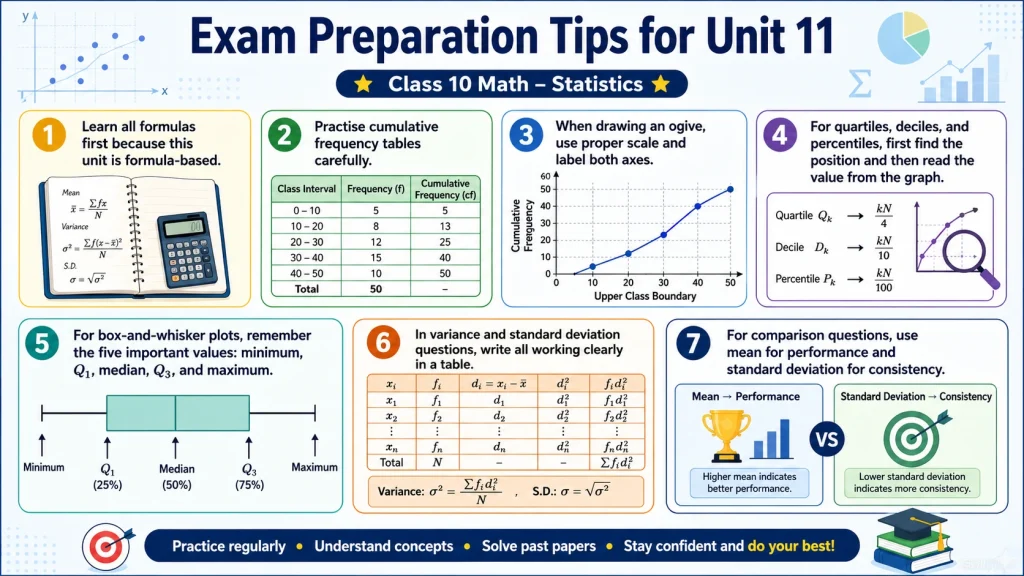
Learn all formulas first because this unit is formula-based.
Practise cumulative frequency tables carefully.
When drawing an ogive, use proper scale and label both axes.
For quartiles, deciles, and percentiles, first find the position and then read the value from the graph.
For box-and-whisker plots, remember the five important values: minimum, \(Q_1\), median, \(Q_3\), and maximum.
In variance and standard deviation questions, write all working clearly in a table.
For comparison questions, use mean for performance and standard deviation for consistency.
FAQs About Unit 11 Class 10 Math New Book Solutions
What is Unit 11 Class 10 Math about?
Unit 11 is about information handling and statistics. It covers ogives, quartiles, box plots, scatter diagrams, range, variance, and standard deviation.
What is Exercise 11.1 about?
Exercise 11.1 is about ogives, box-and-whisker plots, scatter diagrams, and correlation.
What is Exercise 11.2 about?
Exercise 11.2 is about range, variance, standard deviation, and comparing consistency.
What is an ogive?
An ogive is a cumulative frequency graph. It is used to find median, quartiles, deciles, percentiles, and interquartile range graphically.
What is interquartile range?
Interquartile range is the difference between the third quartile and first quartile.
\[
IQR = Q_3 – Q_1
\]
What does standard deviation show?
Standard deviation shows how spread out the data values are from the mean.
Which data is more consistent?
The data with smaller standard deviation is more consistent.
What is used to compare performance?
Mean is used to compare performance.
What is used to compare consistency?
Standard deviation is used to compare consistency.
Disclaimer
These solutions are prepared to help students understand Unit 11 of the Class 10 Math New Book. The solutions are written in simple steps and matched with the answer key where possible. Students should also read their textbook and follow the method explained by their teacher.
Final Words
Unit 11 Class 10 Math New Book Solutions help students understand statistics in an easy way. This unit is important because it includes graphs, formulas, and real-life data questions. Students should practise cumulative frequency graphs, box-and-whisker plots, variance, and standard deviation carefully for better exam preparation.