
Unit 6 Class 11 Math Notes – Sequences and Series (Punjab Board New Book)
Unit 6 (Chapter 6) Class 11 Math Notes – Sequences and Series: step-by-step solutions of Exercise 6.1, Exercise 6.2, Exercise 6.3, Exercise 6.4, Exercise 6.5, Exercise 6.6, Exercise 6.7, Exercise 6.8, Exercise 6.9, Exercise 6.10 and Exercise 6.11 for the Punjab Board new book (1st Year). Tap an exercise below to open its PDF solution, then view it online or download it.
This unit is part of our 1st year math notes for the Punjab Board new book, where you can open the solutions of the other units.
Exercise Wise Solutions of Unit 6 Class 11 Math
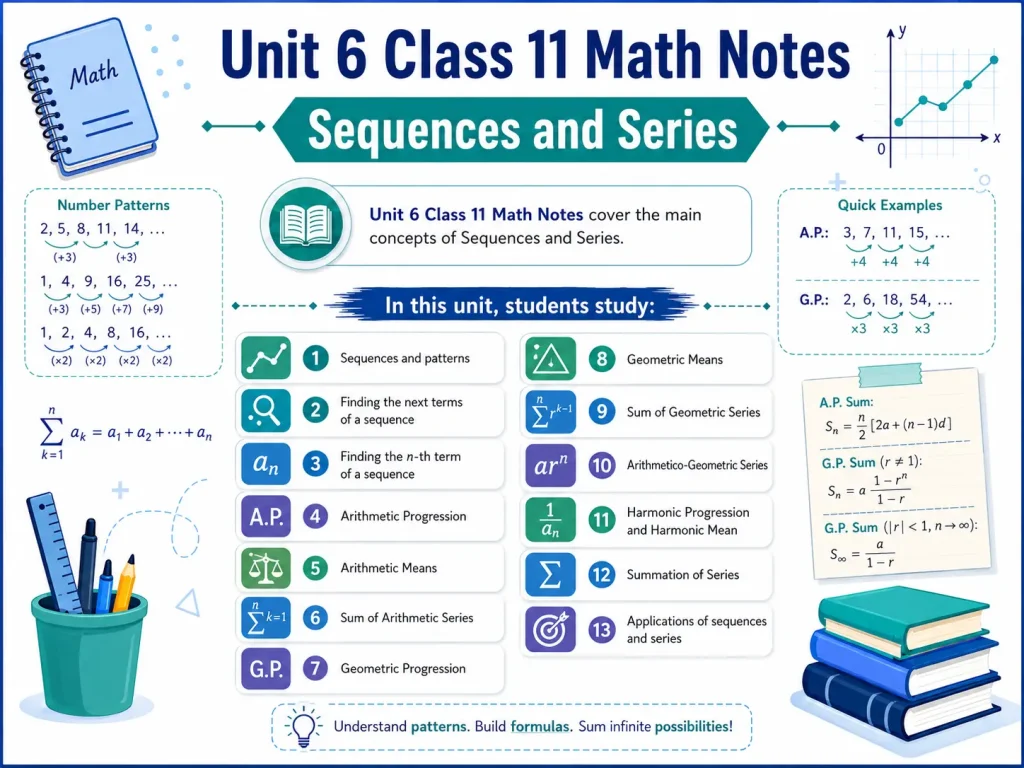
Unit 6 Class 11 Math Notes are provided here for students who want simple and step-by-step solutions of Sequences and Series. This unit explains sequences, arithmetic progressions, geometric progressions, harmonic progressions, means, summation of series, and applications of sequences.
These notes include Exercise 6.1 to Exercise 6.11 solutions. Each PDF is prepared with clear working so students can understand the method, formulas, and final answers easily.
Quick Overview of Unit 6
Unit 6 Class 11 Math Notes cover the main concepts of Sequences and Series.
What Is Unit 6 Class 11 Math About?
Unit 6 of Class 11 Math is about Sequences and Series. A sequence is an ordered list of numbers or terms that follow a pattern. A series is formed when the terms of a sequence are added.
For example: \(\displaystyle 2,4,6,8,\ldots\)
is a sequence.
But: \(\displaystyle 2+4+6+8+\cdots\)
is a series.
In this unit, students learn how to find missing terms, common difference, common ratio, arithmetic mean, geometric mean, harmonic mean, and sums of different types of series.
Solutions of Exercise 6.1
Exercise 6.1 introduces sequences, terms, and the \(n\)th term. Students learn how to identify patterns and write the general term of a sequence.
Main Topics Covered in Exercise 6.1
This exercise includes:
Finding the next terms of a sequence.
Writing the first terms from a given formula.
Using recurrence relations.
Finding triangular numbers.
Writing the \(n\)th term of different patterns.
Important Idea of Exercise 6.1
A sequence is an ordered list. To solve sequence questions, first check the pattern between the terms.
For example:
\(\displaystyle 12,16,20,\ldots\)
The difference is:
\(\displaystyle 16-12=4\)
\(\displaystyle 20-16=4\)
So the sequence increases by 4 each time.
Solutions of Exercise 6.2
Exercise 6.2 is based on Arithmetic Progression, also called A.P. In an arithmetic progression, the difference between consecutive terms is constant.
Main Topics Covered in Exercise 6.2
This exercise includes:
Finding common difference.
Writing next terms of an A.P.
Finding the \(n\)th term.
Finding a required term of an A.P.
Solving word problems based on A.P.
Proof questions related to arithmetic progression.
Important Formula of A.P.
The \(n\)th term of an A.P. is:
\(\displaystyle a_n=a_1+(n-1)d\)
Here:
\(\displaystyle a_1\) is the first term.
\(\displaystyle d\) is the common difference.
\(\displaystyle n\) is the term number.
Solutions of Exercise 6.3
Exercise 6.3 is based on Arithmetic Means. Arithmetic mean is used to find the middle value between two numbers in an arithmetic pattern.
Main Topics Covered in Exercise 6.3
This exercise includes:
Finding arithmetic mean between two numbers.
Inserting arithmetic means between two given terms.
Using common difference to form an A.P.
Solving questions involving real and complex numbers.
Arithmetic Mean Formula
The arithmetic mean between two numbers \(a\) and \(b\) is:
\(\displaystyle A.M.=\frac{a+b}{2}\)
If \(n\) arithmetic means are inserted between \(a\) and \(b\), then:
\(\displaystyle d=\frac{b-a}{n+1}\)
Solutions of Exercise 6.4
Exercise 6.4 focuses on Arithmetic Series. In this exercise, students learn how to find the sum of arithmetic progressions.
Main Topics Covered in Exercise 6.4
This exercise includes:
Sum of an A.P.
Finding the last term.
Using first and last terms to find the sum.
Proof questions related to arithmetic series.
Word problems based on arithmetic series.
Sum of A.P. Formulas
The sum of first \(n\) terms of an A.P. is:
\(\displaystyle S_n=\frac{n}{2}\{2a+(n-1)d\}\)
If the last term is known, then:
\(\displaystyle S_n=\frac{n}{2}(a+l)\)
Here \(l\) is the last term.
Solutions of Exercise 6.5
Exercise 6.5 is based on Geometric Progression, also called G.P. In a G.P., the ratio of consecutive terms remains constant.
Main Topics Covered in Exercise 6.5
This exercise includes:
Finding common ratio.
Finding the \(n\)th term of a G.P.
Finding required terms of a G.P.
Writing first terms of a geometric sequence.
Proof questions related to G.P.
Important Formula of G.P.
The \(n\)th term of a G.P. is:
\(\displaystyle T_n=ar^{n-1}\)
Here:
\(\displaystyle a\) is the first term.
\(\displaystyle r\) is the common ratio.
\(\displaystyle n\) is the term number.
Solutions of Exercise 6.6
Exercise 6.6 is based on Geometric Mean and related problems. Students learn how to find one or more geometric means between two numbers.
Main Topics Covered in Exercise 6.6
This exercise includes:
Finding geometric mean between two numbers.
Inserting geometric means.
Comparing A.M. and G.M.
Proof questions involving geometric mean.
Geometric Mean Formula
The geometric mean between \(a\) and \(b\) is:
\(\displaystyle G.M.=\pm\sqrt{ab}\)
For positive real numbers:
\(\displaystyle G.M.=\sqrt{ab}\)
A useful result is:
\(\displaystyle G.M. < A.M.\)
for two positive distinct real numbers.
Solutions of Exercise 6.7
Exercise 6.7 is based on the sum of geometric series. Students learn how to add finite and infinite geometric series.
Main Topics Covered in Exercise 6.7
This exercise includes:
Sum of finite G.P.
Sum of geometric series up to \(n\) terms.
Infinite geometric series.
Finding values using G.P. sum formulas.
Sum of G.P. Formula
For a finite G.P.:
\(\displaystyle S_n=\frac{a(r^n-1)}{r-1}\)
when \(r\neq 1\).
Another form is:
\(\displaystyle S_n=\frac{a(1-r^n)}{1-r}\)
For an infinite G.P., when \(|r|<1\):
\(\displaystyle S_\infty=\frac{a}{1-r}\)
Solutions of Exercise 6.8
Exercise 6.8 is based on Arithmetico-Geometric Series. This type of sequence is formed by multiplying an arithmetic pattern with a geometric pattern.
Main Topics Covered in Exercise 6.8
This exercise includes:
Finding terms of arithmetico-geometric sequences.
Finding the \(n\)th term.
Sum of arithmetico-geometric series.
Infinite series.
Product and proof-type questions.
Important Idea of Arithmetico-Geometric Series
If the arithmetic part is:
\(\displaystyle A_n\)
and the geometric part is:
\(\displaystyle G_n\)
then the term of the arithmetico-geometric sequence is:
\(\displaystyle T_n=A_nG_n\)
For example, if:
\(\displaystyle A_n=3n-2\)
and:
\(\displaystyle G_n=5\cdot 2^{n-1}\)
then:
\(\displaystyle T_n=(3n-2)5\cdot 2^{n-1}\)
Solutions of Exercise 6.9
Exercise 6.9 is based on Harmonic Progression and Harmonic Mean. A harmonic progression is connected with arithmetic progression through reciprocals.
Main Topics Covered in Exercise 6.9
This exercise includes:
Finding terms of harmonic sequences.
Inserting harmonic means.
Using reciprocals to solve H.P. questions.
Relationship between A.P., G.P., H.P., A.M., G.M., and H.M.
Proof questions based on harmonic mean.
Harmonic Progression Rule
If:
\(\displaystyle a,b,c\)
are in H.P., then:
\(\displaystyle \frac{1}{a},\frac{1}{b},\frac{1}{c}\)
are in A.P.
Harmonic Mean Formula
The harmonic mean between \(a\) and \(b\) is:
\(\displaystyle H.M.=\frac{2ab}{a+b}\)
Solutions of Exercise 6.10
Exercise 6.10 is based on Summation of Series. Students learn how to write the general term and then use standard summation formulas.
Main Topics Covered in Exercise 6.10
This exercise includes:
Writing the \(r\)th term.
Summing polynomial series.
Using formulas for \(\sum r\), \(\sum r^2\), and \(\sum r^3\).
Simplifying answers in terms of \(n\).
Standard Summation Formulas
\(\displaystyle \sum_{r=1}^{n} r=\frac{n(n+1)}{2}\)
\(\displaystyle \sum_{r=1}^{n} r^2=\frac{n(n+1)(2n+1)}{6}\)
\(\displaystyle \sum_{r=1}^{n} r^3=\left[\frac{n(n+1)}{2}\right]^2\)
These formulas are very important in Exercise 6.10.
Solutions of Exercise 6.11
Exercise 6.11 is based on applications of sequences and series. This exercise connects the formulas of A.P. and G.P. with practical problems.
Main Topics Covered in Exercise 6.11
This exercise includes:
Application questions of A.P.
Application questions of G.P.
Compound interest.
Depreciation.
Growth and decrease problems.
Real-life use of sequences and series.
Important Idea of Exercise 6.11
In application questions, first decide whether the situation forms an A.P. or a G.P.
If the change is by addition or subtraction, it is usually an A.P.
If the change is by multiplication, percentage growth, or percentage decrease, it is usually a G.P.
Important Formulas of Unit 6 Class 11 Math
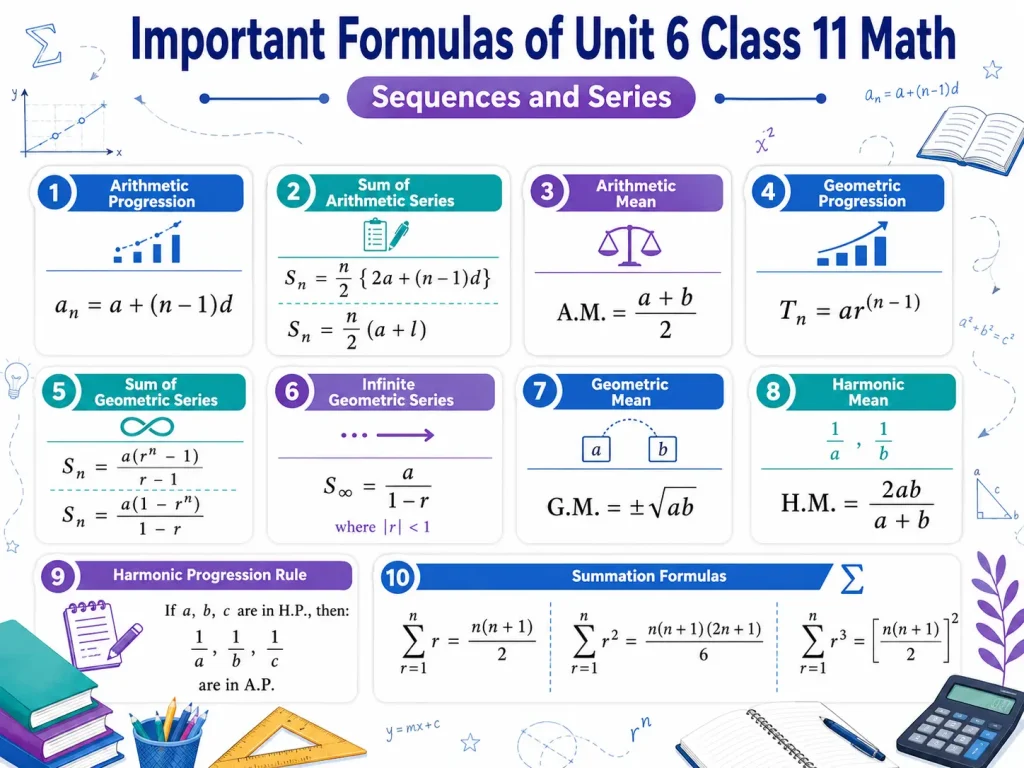
Arithmetic Progression
\(\displaystyle a_n=a+(n-1)d\)
Sum of Arithmetic Series
\(\displaystyle S_n=\frac{n}{2}\{2a+(n-1)d\}\)
\(\displaystyle S_n=\frac{n}{2}(a+l)\)
Arithmetic Mean
\(\displaystyle A.M.=\frac{a+b}{2}\)
Geometric Progression
\(\displaystyle T_n=ar^{n-1}\)
Sum of Geometric Series
\(\displaystyle S_n=\frac{a(r^n-1)}{r-1}\)
\(\displaystyle S_n=\frac{a(1-r^n)}{1-r}\)
Infinite Geometric Series
\(\displaystyle S_\infty=\frac{a}{1-r}\)
where \(|r|<1\).
Geometric Mean
\(\displaystyle G.M.=\pm\sqrt{ab}\)
Harmonic Mean
\(\displaystyle H.M.=\frac{2ab}{a+b}\)
Harmonic Progression Rule
If \(a,b,c\) are in H.P., then:
\(\displaystyle \frac{1}{a},\frac{1}{b},\frac{1}{c}\)
are in A.P.
Summation Formulas
\(\displaystyle \sum_{r=1}^{n} r=\frac{n(n+1)}{2}\)
\(\displaystyle \sum_{r=1}^{n} r^2=\frac{n(n+1)(2n+1)}{6}\)
\(\displaystyle \sum_{r=1}^{n} r^3=\left[\frac{n(n+1)}{2}\right]^2\)
Common Mistakes to avoid in Unit 6
Many students confuse sequence and series. A sequence is a list of terms, while a series is the sum of terms.
Some students use the A.P. formula in G.P. questions. Always check whether the pattern has a common difference or a common ratio.
In A.P., the common difference is found by subtraction:
\(\displaystyle d=a_2-a_1\)
In G.P., the common ratio is found by division:
\(\displaystyle r=\frac{a_2}{a_1}\)
Another common mistake is using the wrong sum formula. For A.P., use \(S_n\) of arithmetic series. For G.P., use the geometric sum formula.
In harmonic progression, students often forget to take reciprocals first. H.P. questions become easier after converting them into A.P. questions.
In summation questions, many students do not write the \(r\)th term clearly. Always write \(T_r\) first, then apply summation formulas.
Exam Preparation Tips for Unit 6 Class 11 Math Notes
Learn the difference between A.P., G.P., and H.P.
Memorize the main formulas of A.P. and G.P.
Practice arithmetic mean, geometric mean, and harmonic mean questions.
In application questions, first identify the type of sequence.
For summation questions, write the general term before applying formulas.
Keep final answers simplified.
Revise Exercise 6.10 carefully because summation questions need accurate algebraic simplification.
Why Unit 6 Class 11 Math Notes Are Important
Unit 6 Class 11 Math Notes are important because Sequences and Series are used in many areas of mathematics. This chapter builds the foundation for higher topics such as calculus, binomial series, mathematical induction, and financial mathematics.
The unit also helps students improve pattern recognition, formula usage, algebraic simplification, and problem-solving skills.
Related Resources
Solutions of Unit 5 Class 11 Math
Solution of Unit 4 Class 11 Math
FAQs About Unit 6 Class 11 Math Notes
What is the topic of Unit 6 Class 11 Math Notes?
The topic of Unit 6 Class 11 Math Notes is Sequences and Series.
How many exercises are included in Unit 6?
Unit 6 includes Exercise 6.1 to Exercise 6.11.
What is an arithmetic progression?
An arithmetic progression is a sequence in which the difference between consecutive terms is constant.
What is a geometric progression?
A geometric progression is a sequence in which the ratio of consecutive terms is constant.
What is a harmonic progression?
A harmonic progression is a sequence whose reciprocals form an arithmetic progression.
Which exercise covers summation formulas?
Exercise 6.10 covers summation of series using formulas such as \(\sum r\), \(\sum r^2\), and \(\sum r^3\).
Which exercise covers applications of sequences and series?
Exercise 6.11 covers applications of sequences and series, including A.P., G.P., compound interest, and depreciation.
Are these Unit 6 Class 11 Math Notes useful for exam preparation?
Yes, these notes are useful for homework, revision, and exam preparation because they include step-by-step solutions and important formulas.
Disclaimer
These Unit 6 Class 11 Math Notes are prepared for educational help. Students should use them to understand the method and check their solutions. Always follow the method recommended by your teacher and textbook.
Final Words
Unit 6 Class 11 Math Notes help students understand Sequences and Series in a simple way. This unit becomes easier when students learn the formulas of A.P., G.P., H.P., arithmetic mean, geometric mean, harmonic mean, and summation. Practice each exercise step by step and focus on identifying the correct type of sequence before solving.