
Unit 5 Class 11 Math Notes – Partial Fractions (Punjab Board New Book)
Unit 5 (Chapter 5) Class 11 Math Notes – Partial Fractions: step-by-step solutions of Exercise 5.1 and Exercise 5.2 for the Punjab Board new book (1st Year). Tap an exercise below to open its PDF solution, then view it online or download it.
This unit is part of our Class 11 maths notes for the Punjab Board new book, where you can open the solutions of the other units.
Exercise Wise Solutions of Unit 5 Class 11 Math
Unit 5 Class 11 Math Notes are provided here for students who want simple and step-by-step help with Partial Fractions. This unit explains how to break one rational expression into simpler fractions. These notes include Exercise 5.1 and Exercise 5.2 solutions with clear working.
Partial fractions are an important part of algebra. Students learn how to factor denominators, assume constants, compare coefficients, and write the final answer in proper partial fraction form.
Quick Overview of Unit 5 Class 11 Math Notes
Unit 5 Class 11 Math covers the basic and advanced methods of resolving rational expressions into partial fractions.
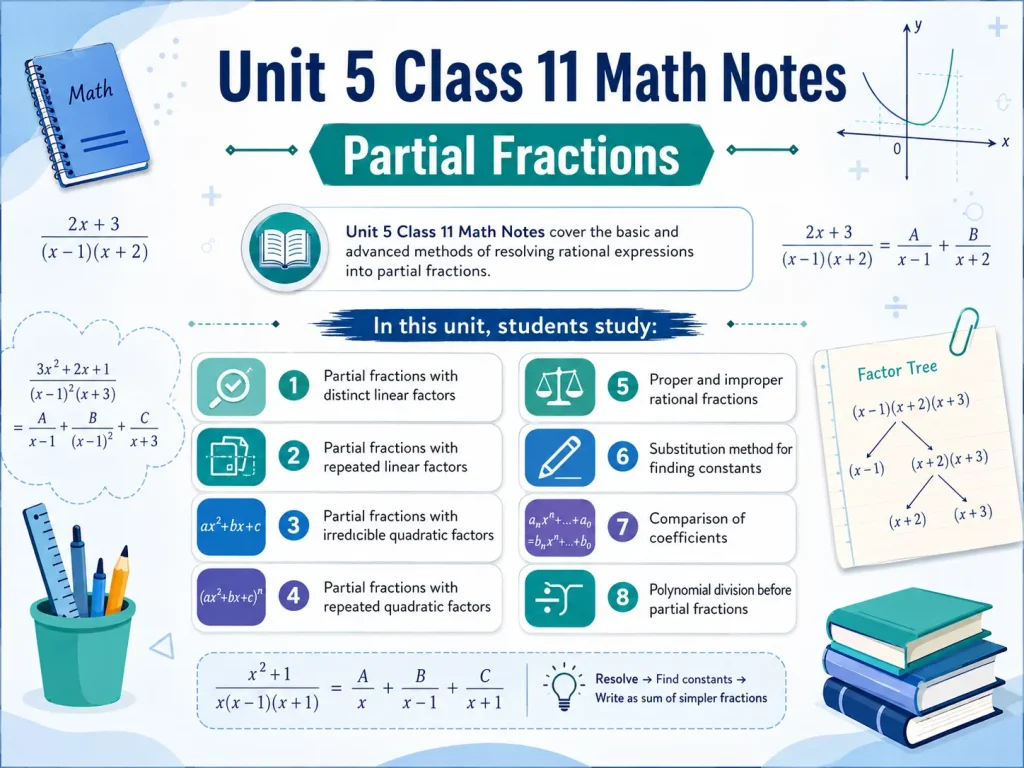
In this unit, students study:
Partial fractions with distinct linear factors.
Partial fractions with repeated linear factors.
Partial fractions with irreducible quadratic factors.
Partial fractions with repeated quadratic factors.
Proper and improper rational fractions.
Substitution method for finding constants.
Comparison of coefficients.
Polynomial division before partial fractions.
What Is Unit 5 Class 11 Math About?
Unit 5 of Class 11 Math is about Partial Fractions. A rational expression is often given as one fraction. In partial fractions, we split that expression into two or more simpler fractions.
For example: \(\frac{2}{x^2-1}\)
can be written as: \(\frac{1}{x-1}-\frac{1}{x+1}\)
This method is useful because smaller fractions are easier to simplify and use in later topics.
The first step is always to factor the denominator. After that, we assume constants such as \(A\), \(B\), \(C\), and find their values by substitution or by comparing coefficients.
Solutions of Exercise 5.1 Class 11
Exercise 5.1 of Unit 5 Class 11 Math Notes mostly deals with linear factors. Students learn how to resolve rational expressions when the denominator has simple or repeated linear factors.
Main Topics Covered in Exercise 5.1
Exercise 5.1 includes questions with denominators such as:
\((x-1)(x+1)\)
\((x+1)(x+2)(x+3)\)
\((x-1)^2\)
\((x-1)^3\)
Some questions also contain improper rational fractions. In such questions, students must divide the numerator by the denominator first. After division, the remaining proper fraction is resolved into partial fractions.
Method Used in Exercise 5.1
For distinct linear factors, use:
\(\frac{A}{x-a}+\frac{B}{x-b}\)
For three distinct linear factors, use:
\(\frac{A}{x-a}+\frac{B}{x-b}+\frac{C}{x-c}\)
For repeated linear factors such as \((x-a)^3\), use:
\(\frac{A}{x-a}+\frac{B}{(x-a)^2}+\frac{C}{(x-a)^3}\)
After writing the correct form, multiply both sides by the denominator. Then find the constants by putting suitable values of \(x\) or by comparing coefficients.
Solutions of Exercise 5.2 Class 11 Math
Exercise 5.2 of Unit 5 Class 11 Math Notes focuses on quadratic factors. This exercise is more advanced because the denominator may contain irreducible quadratic expressions.
Main Topics Covered in Exercise 5.2
Exercise 5.2 includes questions with factors such as:
\((x+1)(x^2+1)\)
\((x-2)(x^2+3x+5)\)
\((x-2)(x^2+2)^2\)
\((x+1)(x^2-x+1)\)
These questions require careful use of linear numerators above quadratic factors.
Method Used in Exercise 5.2
For a linear factor, use: \(\frac{A}{x-a}\)
For an irreducible quadratic factor, use: \(\frac{Bx+C}{x^2+px+q}\)
For a repeated quadratic factor, use: \(\frac{Bx+C}{x^2+px+q}+\frac{Dx+E}{(x^2+px+q)^2}\)
This rule is very important. For a quadratic factor, the numerator should not be only a constant. It should usually be a linear expression such as \(Bx+C\).
Important Rules of Unit 5 Class 11 Math
Proper Rational Fraction
A rational fraction is proper if the degree of the numerator is less than the degree of the denominator.
Example: \(\frac{2x+3}{(x+1)(x+2)(x+3)}\)
Improper Rational Fraction
A rational fraction is improper if the degree of the numerator is equal to or greater than the degree of the denominator.
In this case, divide first. Then resolve the remaining proper fraction into partial fractions.
Distinct Linear Factors
If the denominator has: \((x-a)(x-b)\)
then use: \(\frac{A}{x-a}+\frac{B}{x-b}\)
Repeated Linear Factors
If the denominator has: \((x-a)^3\)
then use: \(\frac{A}{x-a}+\frac{B}{(x-a)^2}+\frac{C}{(x-a)^3}\)
Irreducible Quadratic Factor
If the denominator has: \((x^2+px+q)\)
then use: \(\frac{Ax+B}{x^2+px+q}\)
Repeated Quadratic Factor
If the denominator has: \((x^2+px+q)^2\)
then use: \(\frac{Ax+B}{x^2+px+q}+\frac{Cx+D}{(x^2+px+q)^2}\)
Common Mistakes to avoid in Unit 5
Many students start solving without factoring the denominator completely.
Some students write only \(A\) above a quadratic factor. This is wrong. For a quadratic factor, write \(Ax+B\) or \(Bx+C\).
In repeated factors, students often forget to write all powers. For example, for \((x-1)^2\), write:
\(\frac{A}{x-1}+\frac{B}{(x-1)^2}\)
Another common mistake is forgetting polynomial division when the given rational fraction is improper.
Students also make sign mistakes while putting values such as \(x=-1\), \(x=1\), \(x=2\), or \(x=-2\). These values should be substituted carefully.
Exam Preparation Tips
Learn the correct form of partial fractions first.
Always factor the denominator before assuming constants.
For linear factors, use constant numerators.
For quadratic factors, use linear numerators.
For repeated factors, include all powers.
Check whether the given fraction is proper or improper.
Use substitution when simple values of \(x\) are available.
Practice comparison of coefficients because it is used often in Exercise 5.2.
Write the final answer clearly after finding all constants.
Why these Notes Are Important
Unit 5 Class 11 Math Notes are important because partial fractions are used in higher mathematics. This topic becomes very useful in integration and other advanced algebraic methods.
This unit also improves basic algebra skills. Students revise factorization, polynomial division, substitution, expansion, and coefficient comparison while solving partial fraction questions.
Related Notes and Resources
Solutions of Unit 1: Complex Numbers
Solutions of Unit 2: Functions and Graphs
Solutions of Unit 3: Theory of Quadratic Functions
Solutions of Unit 4: Matrices and Determinants
FAQs About Unit 5
What is the topic of Unit 5?
The topic of Unit 5 Class 11 Math Notes is Partial Fractions.
How many exercises are included in Unit 5 Partial Fractions?
This unit includes Exercise 5.1 and Exercise 5.2.
What is the first step in partial fractions?
The first step is to factor the denominator completely.
What numerator is used for a linear factor?
For a linear factor such as \(x-a\), use a constant numerator such as \(A\).
What numerator is used for a quadratic factor?
For a quadratic factor such as \(x^2+px+q\), use a linear numerator such as \(Ax+B\).
What should we do if the rational fraction is improper?
If the rational fraction is improper, divide first. Then resolve the remaining proper fraction into partial fractions.
Are these Unit 5 Class 11 Math Notes useful for exam preparation?
Yes, these notes are useful for revision, homework, and exam preparation because they explain the method step by step.
Disclaimer
These Unit 5 Class 11 Math Notes are prepared for educational help. Students should use them to understand the method and check their work. Always follow the method recommended by your teacher and textbook.
Final Words
Unit 5 Class 11 Math Notes help students understand Partial Fractions in a simple way. If students learn the correct form for linear, repeated linear, quadratic, and repeated quadratic factors, this unit becomes much easier. Practice Exercise 5.1 and Exercise 5.2 step by step, and focus on factoring, substitution, and comparison of coefficients.