
Unit 25 Class 10 Math Sindh Board Solutions | Free PDF
Unit 25 of Class 10 Mathematics Sindh Board is titled Chords of a Circle. In this unit, students learn about chords, diameters, perpendicular bisectors, congruent chords, circumcircles, and the relationship between chords and the centre of a circle.
On this page, students can download complete Unit 25 Class 10 Math Sindh Board Solutions in PDF format. The PDF includes student-friendly and step-by-step solutions of Exercise 25.1, Exercise 25.2, Exercise 25.3, and Review Exercise 25.
The solution file also includes essential circle theorems, ruler-and-compass constructions, complete geometrical proofs, numerical calculations, labelled diagrams, and solved multiple-choice questions.
Class 10 Math Unit 25 Chords of a Circle Solutions
A chord is a line segment whose endpoints lie on a circle. A circle can have many chords, but the diameter is its longest chord because it passes through the centre.
Unit 25 explains several important relationships between the centre of a circle and its chords. Students learn how a perpendicular from the centre bisects a chord and how the perpendicular bisector of a chord passes through the centre.
The unit also introduces theorems about congruent chords and the intersecting-chords theorem. These results are used in geometrical proofs as well as numerical questions.
What Is Included in Unit 25 Class 10 Math Sindh Board Solutions?
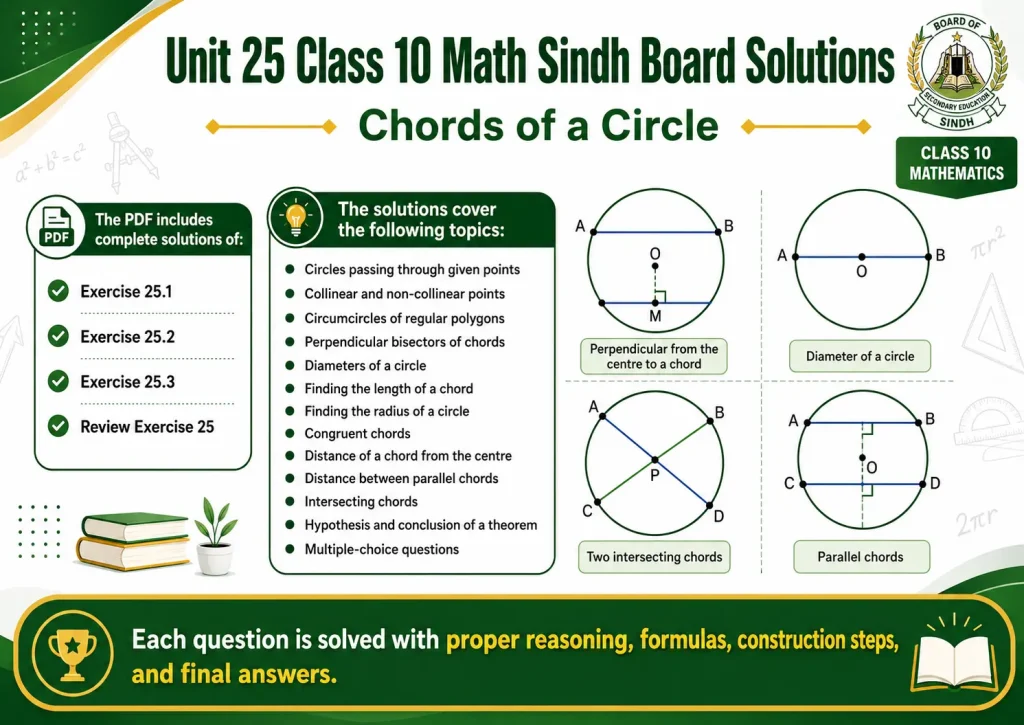
The PDF includes complete solutions of:
- Exercise 25.1
- Exercise 25.2
- Exercise 25.3
- Review Exercise 25
The solutions cover the following topics:
- Circles passing through given points
- Collinear and non-collinear points
- Circumcircles of regular polygons
- Perpendicular bisectors of chords
- Diameters of a circle
- Finding the length of a chord
- Finding the radius of a circle
- Congruent chords
- Distance of a chord from the centre
- Distance between parallel chords
- Intersecting chords
- Hypothesis and conclusion of a theorem
- Multiple-choice questions
Each question is solved with proper reasoning, formulas, construction steps, and final answers.
Exercise 25.1 Solutions
Exercise 25.1 focuses on circles passing through given points and the construction of circumcircles.
Students learn that a circle cannot pass through three distinct collinear points. The centre of a circle passing through two points must lie on the perpendicular bisector of the line segment joining them.
If three points lie on the same straight line, the required perpendicular bisectors are parallel and do not meet. Therefore, no common centre can be found.
However, one and only one circle passes through three non-collinear points. The centre of this circle is obtained by constructing the perpendicular bisectors of two sides of the triangle formed by the points.
Circle Through Four Non-Collinear Points
A circle cannot always be drawn through any four non-collinear points.
Three non-collinear points determine one circle. The fourth point lies on the same circle only when all four points are concyclic.
For a quadrilateral \(ABCD\), a pair of opposite angles must be supplementary:
\[\angle A+\angle C=180^\circ\]
or:
\[\angle B+\angle D=180^\circ\]
If this condition is not satisfied, the four points do not lie on one circle.
Circumcircle of a Square
Exercise 25.1 also asks students to prove that one and only one circle passes through the vertices of a square.
Let \(ABCD\) be a square whose diagonals \(AC\) and \(BD\) intersect at \(O\).
The diagonals of a square bisect each other:
\[AO=OC\]
and:
\[BO=OD\]
The diagonals of a square are also equal:
\[AC=BD\]
Therefore, their halves are equal:
\[AO=BO=CO=DO\]
Since all four vertices are at the same distance from \(O\), a circle with centre \(O\) and radius \(OA\) passes through all four vertices.
Circumcircle of a Regular Pentagon
One and only one circle also passes through the five vertices of a regular pentagon.
The perpendicular bisectors of two adjacent sides meet at a point \(O\). Because the pentagon is regular, all its vertices are at the same distance from this point:
\[OA=OB=OC=OD=OE\]
Therefore, a circle with centre \(O\) and radius \(OA\) passes through all five vertices.
Equal-Distance Location of a Mosque
One practical question asks students to locate a mosque at an equal distance from three villages.
Village \(B\) is \(6\) km east of village \(A\), while village \(C\) is \(8\) km north of village \(B\). Therefore:
\[\angle ABC=90^\circ\]
Using the Pythagorean theorem:
\[AC^2=AB^2+BC^2\]
\[AC^2=6^2+8^2\]
\[AC^2=36+64\]
\[AC^2=100\]
\[AC=10\text{ km}\]
The circumcentre of a right-angled triangle is the midpoint of its hypotenuse. Therefore:
\[MA=MB=MC=\frac{AC}{2}\]
\[MA=MB=MC=\frac{10}{2}\]
\[MA=MB=MC=5\text{ km}\]
The mosque should be placed at the midpoint of \(AC\), and its distance from each village will be \(5\) km.
Exercise 25.2 Solutions
Exercise 25.2 focuses on diameters, chords, perpendicular distances, radius, circumference, and area.
The exercise includes questions about:
- Proving that two diameters bisect each other
- Proving that the line joining the centre to the midpoint of a chord is perpendicular to the chord
- Finding the radius of a circle
- Finding the length of a chord
- Calculating circumference and area
Diameters Bisect Each Other
Suppose diameters \(AB\) and \(CD\) intersect at the centre \(O\).
All radii of a circle are equal:
\[OA=OB=OC=OD\]
Therefore:
\[OA=OB\]
and:
\[OC=OD\]
Hence, \(O\) is the midpoint of both diameters. Therefore, the diameters bisect each other.
Centre Joined to the Midpoint of a Chord
Let \(AB\) be a chord, \(M\) its midpoint, and \(O\) the centre of the circle.
Join \(OA\), \(OB\), and \(OM\).
We have:
\[OA=OB\]
because both are radii.
Also:
\[AM=MB\]
because \(M\) is the midpoint of the chord.
Further:
\[OM=OM\]
because it is common to both triangles.
Therefore:
\[\triangle OMA\cong\triangle OMB\]
by the SSS congruence rule.
Hence:
\[\angle OMA=\angle OMB\]
The two angles form a straight angle:
\[\angle OMA+\angle OMB=180^\circ\]
Since they are equal:
\[\angle OMA=\angle OMB=90^\circ\]
Therefore:
\[OM\perp AB\]
Finding Radius, Circumference and Area
Suppose a chord is \(8\) cm long and its perpendicular distance from the centre is \(3\) cm.
The perpendicular from the centre bisects the chord:
\[AM=\frac{8}{2}=4\text{ cm}\]
Using the Pythagorean theorem:
\[r^2=OM^2+AM^2\]
\[r^2=3^2+4^2\]
\[r^2=9+16\]
\[r^2=25\]
\[r=5\text{ cm}\]
The circumference is:
\[C=2\pi r\]
\[C=2\pi(5)\]
\[C=10\pi\text{ cm}\]
The area is:
\[A=\pi r^2\]
\[A=\pi(5)^2\]
\[A=25\pi\text{ cm}^2\]
Exercise 25.3 Solutions
Exercise 25.3 covers congruent chords, distances between parallel chords, and chords intersecting inside a circle.
Students learn and prove the following theorems:
- Congruent chords of congruent circles are equidistant from their centres.
- Chords that are equidistant from the centres of congruent circles are congruent.
- The products of the segments of two intersecting chords are equal.
Congruent Chords Are Equidistant from the Centres
Suppose \(AB\) and \(CD\) are congruent chords of two congruent circles with centres \(O\) and \(O’\).
Given:
\[AB=CD\]
Draw:
\[OM\perp AB\]
and:
\[O’N\perp CD\]
The perpendiculars from the centres bisect the chords:
\[AM=\frac{AB}{2}\]
and:
\[CN=\frac{CD}{2}\]
Since:
\[AB=CD\]
therefore:
\[AM=CN\]
The circles are congruent, so their radii are equal:
\[OA=O’C\]
Also:
\[\angle OMA=\angle O’NC=90^\circ\]
Therefore:
\[\triangle OMA\cong\triangle O’NC\]
by the RHS congruence rule.
Hence:
\[OM=O’N\]
Therefore, congruent chords of congruent circles are equidistant from their centres.
Converse of the Congruent-Chords Theorem
Suppose two chords of congruent circles are equidistant from their centres:
\[OM=O’N\]
The radii of the circles are equal:
\[OA=O’C\]
Also:
\[\angle OMA=\angle O’NC=90^\circ\]
Therefore:
\[\triangle OMA\cong\triangle O’NC\]
by the RHS congruence rule.
Hence:
\[AM=CN\]
Since the perpendiculars bisect the chords:
\[AB=2AM\]
and:
\[CD=2CN\]
Therefore:
\[AB=CD\]
Thus, chords equidistant from the centres of congruent circles are congruent.
Intersecting-Chords Theorem
If two chords \(AB\) and \(CD\) intersect at an interior point \(P\), then:
\[AP\cdot PB=CP\cdot PD\]
This theorem is used to calculate an unknown chord segment when the other three segments are given.
For example, suppose:
\[4(5)=x(x)\]
Then:
\[20=x^2\]
\[x=\sqrt{20}\]
\[x=\sqrt{4\times5}\]
\[x=2\sqrt{5}\]
Only the positive value is accepted because \(x\) represents a length.
Review Exercise 25 Solutions
Review Exercise 25 tests the main concepts and theorems studied in Chords of a Circle.
It includes multiple-choice questions about:
- Similar and congruent circles
- Finding chord length
- Circles through non-collinear points
- Hypothesis of a theorem
- Conclusion of a theorem
- Simple and closed curves
The PDF provides the correct option for each question and includes explanations where necessary.
Important Formulas of Unit 25
Students should revise these formulas before solving the exercises.
Chord-Length Formula
If \(c\) is the chord length, \(r\) is the radius, and \(d\) is the perpendicular distance from the centre, then:
\[\frac{c}{2}=\sqrt{r^2-d^2}\]
Therefore:
\[c=2\sqrt{r^2-d^2}\]
Radius from Chord Length and Distance
\[r^2=d^2+\left(\frac{c}{2}\right)^2\]
Therefore:
\[r=\sqrt{d^2+\left(\frac{c}{2}\right)^2}\]
Distance of a Chord from the Centre
\[d=\sqrt{r^2-\left(\frac{c}{2}\right)^2}\]
Distance Between Congruent Parallel Chords
If two equal parallel chords lie on opposite sides of the centre, then:
\[D=2\sqrt{r^2-\left(\frac{c}{2}\right)^2}\]
Distance Between Unequal Parallel Chords
If chords of lengths \(\alpha\) and \(\beta\) lie on opposite sides of the centre, then:
\[D=\sqrt{r^2-\left(\frac{\alpha}{2}\right)^2}+\sqrt{r^2-\left(\frac{\beta}{2}\right)^2}\]
Intersecting-Chords Formula
\[AP\cdot PB=CP\cdot PD\]
Circumference of a Circle
\[C=2\pi r\]
Area of a Circle
\[A=\pi r^2\]
Important Concepts in Unit 25
Students should understand the following results before attempting the exercises:
- A circle cannot pass through three distinct collinear points.
- One and only one circle passes through three non-collinear points.
- A perpendicular from the centre to a chord bisects the chord.
- The perpendicular bisector of a chord passes through the centre.
- Congruent chords are equidistant from the centre.
- Chords equidistant from the centre are congruent.
- A diameter is the longest chord of a circle.
- The products of the segments of intersecting chords are equal.
- All circles are similar.
- Circles with equal radii are congruent.
Common Mistakes in Chords of a Circle
Many students use the complete chord length in the Pythagorean theorem. The perpendicular from the centre bisects the chord, so half of the chord must be used.
For example, if:
\[AB=10\text{ cm}\]
then:
\[AM=\frac{AB}{2}=5\text{ cm}\]
Another common mistake is subtracting the distances of two chords that lie on opposite sides of the centre. In this case, the two perpendicular distances must be added.
Students should also be careful when applying the intersecting-chords theorem. The two segments belonging to one chord must be multiplied together:
\[AP\cdot PB\]
and this product is equal to the product of the segments of the other chord:
\[CP\cdot PD\]
Why These Solutions Are Helpful
These Unit 25 Class 10 Math Sindh Board Solutions explain both geometrical proofs and numerical calculations in a step-by-step manner.
The labelled diagrams help students understand the positions of the centre, radius, chord, midpoint, perpendicular distance, and point of intersection. The complete working also helps students understand which theorem or formula should be applied in each question.
Students can use these solutions for:
- Completing homework
- Checking textbook answers
- Learning geometrical proofs
- Practising ruler-and-compass constructions
- Revising important formulas
- Preparing for school tests
- Preparing for Sindh Board examinations
Download Unit 25 Class 10 Math Sindh Board Solutions PDF
Students can download the complete PDF of Unit 25 Class 10 Math Sindh Board Solutions from this page and use it for homework, revision, and examination preparation.
The PDF includes complete solutions of:
- Exercise 25.1
- Exercise 25.2
- Exercise 25.3
- Review Exercise 25
These solutions cover the complete unit Chords of a Circle according to the Class 10 Mathematics Sindh Board textbook.
Students should attempt each textbook question independently before consulting the solutions. This will help them identify their mistakes, understand the required theorems, and improve their preparation for board examinations.