
Triangle Congruence Worksheet
Practise triangle congruence on free printable worksheets. They cover naming the right postulate from the given parts, working out what further information would complete a proof, reading congruence from a diagram, writing two-column proofs, and using CPCTC correctly.
Download the worksheet
Four pages of practice and a three-page worked answer key, with the reasoning spelled out for each.
What is on the worksheet
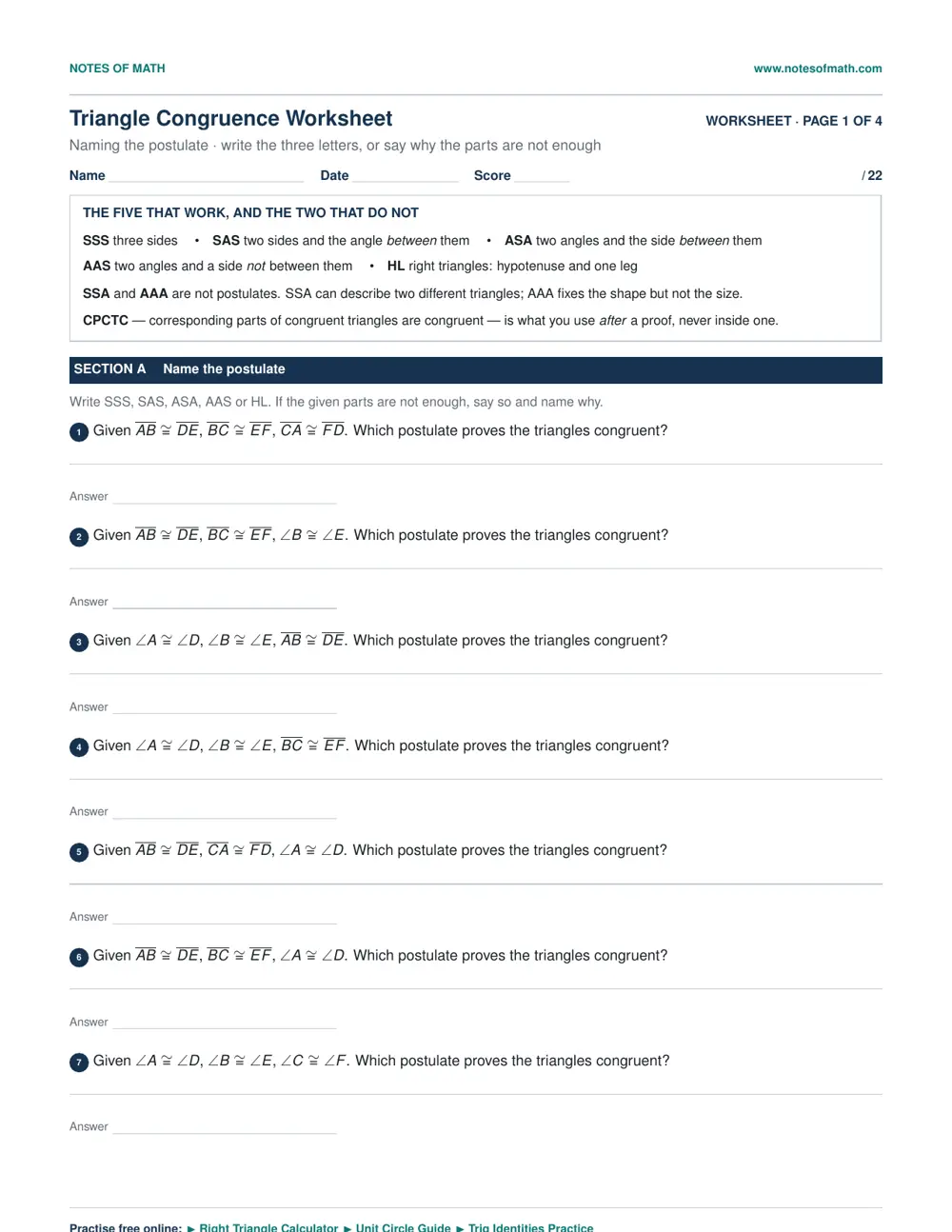
- Section A — name the postulate (8 questions). From the given congruent parts, including one that is not enough and one HL case.
- Section B — what else do you need? (6 questions). Each pair is one fact short of a proof.
- Section C — must they be congruent? (6 questions). Yes or no, with a postulate or a counter-example.
- Section D — explain your reasoning (2 questions). Why HL works when SSA does not, and why CPCTC cannot be used to prove the triangles themselves congruent.
- Answer key (3 pages). Each postulate named with the reason it applies.
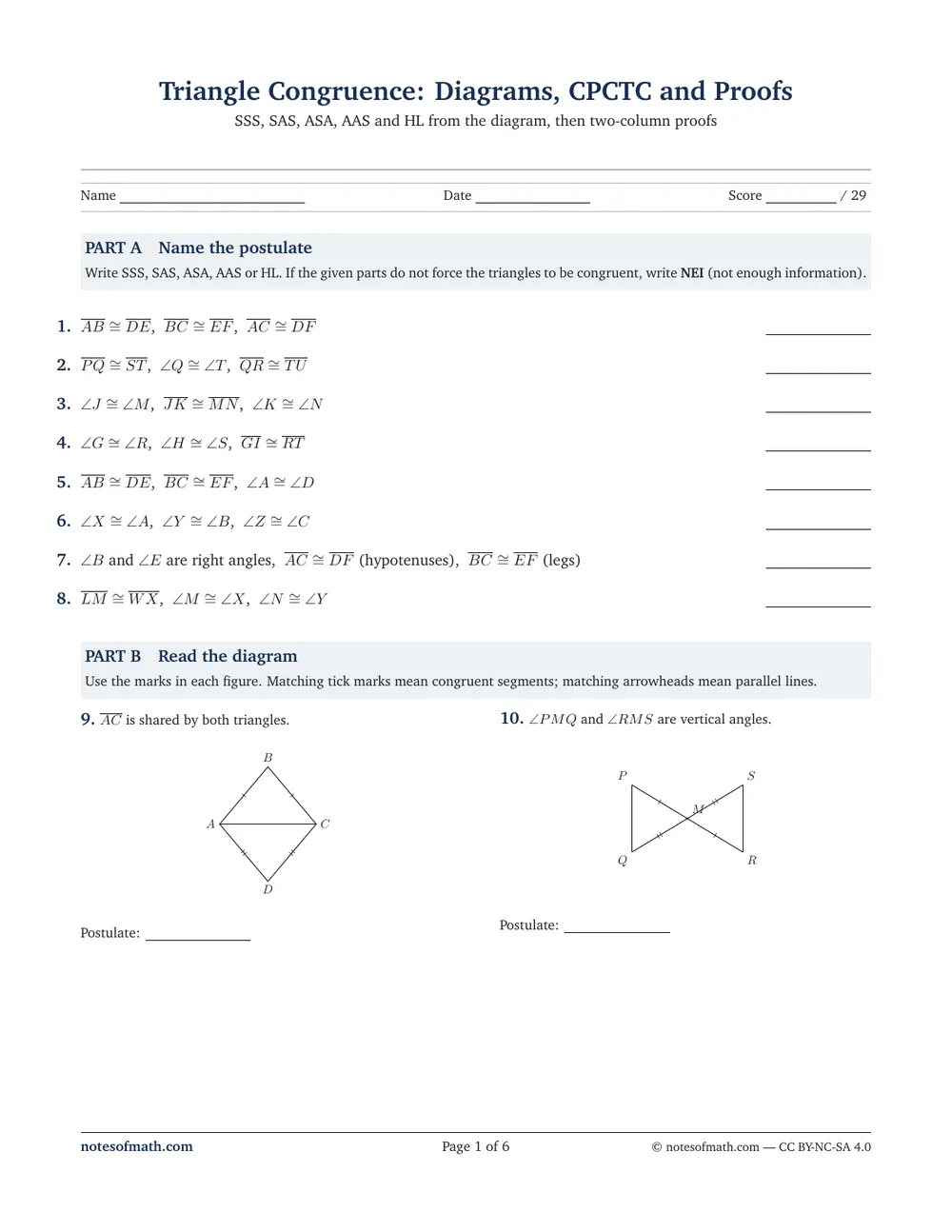
- Second worksheet — diagrams, CPCTC and proofs (29 marks). Marked diagrams, CPCTC questions and four two-column proofs. Download it in the proofs section.
The five triangle congruence postulates
Five combinations of corresponding parts are enough to prove two triangles congruent. Two combinations that look similar are not. In each case the order of the letters describes the order of the parts around the triangle, so the middle letter is the part between the other two.
SSS — side, side, side
If all three sides of one triangle are congruent to the three sides of another, the triangles are congruent. Three side lengths fix a triangle completely: there is only one way to join them up.
Example: AB ≅ DE, BC ≅ EF and AC ≅ DF, so △ABC ≅ △DEF by SSS.
SAS — side, angle, side
Two sides and the angle between them. The included angle sets the gap between the two sides, which fixes the length of the third side.
Example: PQ ≅ ST, ∠Q ≅ ∠T and QR ≅ TU. ∠Q sits between PQ and QR, so △PQR ≅ △STU by SAS.
ASA — angle, side, angle
Two angles and the side between them. The side is the shared arm of both angles, so the other two arms can only meet at one point.
Example: ∠J ≅ ∠M, JK ≅ MN and ∠K ≅ ∠N, so △JKL ≅ △MNO by ASA.
AAS — angle, angle, side
Two angles and a side that is not between them. Two angles fix the third angle (the three always add up to 180°), so AAS can always be turned into ASA — which is why it works.
Example: ∠G ≅ ∠R, ∠H ≅ ∠S and GI ≅ RT. GI is not between ∠G and ∠H, so △GHI ≅ △RST by AAS.
HL — hypotenuse, leg
For right triangles only: if the hypotenuses are congruent and one pair of legs is congruent, the triangles are congruent. You must state that both triangles are right triangles before you can use it. Why it works is explained below.
SSA and AAA: the two that do not work
SSA (two sides and an angle that is not between them) can describe two different triangles, so it proves nothing. AAA fixes the shape but not the size — that is similarity, not congruence, and it is practised on the similar triangles worksheet.
Worked example: Given two sides and an angle, the position of the angle decides everything. Between the two sides it is SAS and the triangles are congruent. Opposite one of them it is SSA, and two different triangles can fit the same three facts.
Why HL works when SSA does not
HL is a right triangle with two sides and a non-included angle — which looks exactly like the SSA case that fails in general. The right angle is what rescues it.
In a right triangle the right angle is the largest, so every other angle must be acute, and the ambiguity disappears. With the hypotenuse and one leg known, Pythagoras forces the third side — which makes HL really SSS in disguise.
Triangle congruence proofs
A congruence proof is usually written as a two-column proof: statements on the left, and the reason each one is true on the right. Every statement must be either given or follow from a definition, a property or a theorem. The last line names the congruence and the postulate that proves it.
How to write a two-column proof
- Mark the diagram. Put tick marks and arcs on everything the question gives you.
- Look for the free facts. A side shared by both triangles, vertical angles where two lines cross, alternate interior angles between parallel lines, and anything that follows from the definition of a midpoint or a bisector.
- Match three pairs to a postulate. Check where the angle sits before you write SAS or ASA.
- Write the statements in order, one fact per line, each with its reason. Finish with the congruence statement and the postulate.
- Only then use CPCTC if the question asks you to prove something about another pair of sides or angles.
Reasons you will use most
- Given — stated in the question.
- Reflexive property — a segment or angle is congruent to itself. Use it for a side shared by both triangles.
- Vertical angles are congruent — the opposite angles where two lines cross.
- Definition of midpoint — a midpoint splits a segment into two congruent segments.
- Definition of angle bisector — a bisector splits an angle into two congruent angles.
- Alternate interior angles are congruent — when a line crosses two parallel lines.
- Definition of perpendicular — perpendicular lines meet at right angles, and all right angles are congruent.
- SSS, SAS, ASA, AAS, HL — to conclude the triangles are congruent.
- CPCTC — for any other pair of corresponding parts, after the triangles are proved congruent.
Worked proof 1: SSS with a shared side
Given: M is the midpoint of WX, and WY ≅ XY. Prove: △WMY ≅ △XMY, and then that YM bisects ∠WYX.
| Statement | Reason |
|---|---|
| M is the midpoint of WX | Given |
| WM ≅ XM | Definition of midpoint |
| WY ≅ XY | Given |
| YM ≅ YM | Reflexive property |
| △WMY ≅ △XMY | SSS |
| ∠WYM ≅ ∠XYM | CPCTC |
| YM bisects ∠WYX | Definition of angle bisector |
The shared side YM is the step most students miss. Without the reflexive property there are only two pairs of sides, and no postulate applies.
Worked proof 2: SAS with vertical angles
Given: M is the midpoint of PR and of QS. Prove: △PMQ ≅ △RMS, and then that PQ ≅ RS.
| Statement | Reason |
|---|---|
| M is the midpoint of PR and of QS | Given |
| PM ≅ RM | Definition of midpoint |
| ∠PMQ ≅ ∠RMS | Vertical angles are congruent |
| QM ≅ SM | Definition of midpoint |
| △PMQ ≅ △RMS | SAS |
| PQ ≅ RS | CPCTC |
The angle comes from the diagram, not the question: where two segments cross, the opposite angles are always congruent. It sits between the two marked sides, so this is SAS.
Triangle congruence proofs worksheet (PDF)
Name the postulate, read congruence from six marked diagrams, answer four CPCTC questions and complete four two-column proofs ending in SSS, SAS, ASA and HL. The answer key shows every proof filled in.
Using CPCTC the right way round
CPCTC stands for “corresponding parts of congruent triangles are congruent”. Once two triangles are known to be congruent, every pair of corresponding sides and angles is congruent too.
It is a consequence of congruence, never evidence for it. You cannot use CPCTC to prove that two triangles are congruent — that would assume what you are trying to show. Prove the triangles congruent first with SSS, SAS, ASA, AAS or HL, and then use CPCTC as a reason in the lines that follow, as in both worked proofs above.
Reading the parts from a congruence statement
The order of the letters tells you which parts match. In △ABC ≅ △DEF, A matches D, B matches E and C matches F, so:
- Sides: AB ≅ DE, BC ≅ EF, AC ≅ DF
- Angles: ∠A ≅ ∠D, ∠B ≅ ∠E, ∠C ≅ ∠F
If you are told △PQR ≅ △XYZ and asked for the angle congruent to ∠R, match the third letters: the answer is ∠Z. Never read the matching parts off the diagram by eye — the triangles may be drawn turned or flipped.
The mistake to watch for
Writing SAS when the angle is not between the two sides. The order of the letters is the whole point: S-A-S means side, included angle, side. If the angle sits outside the pair, you have SSA and no proof.
Frequently asked questions
What are the five triangle congruence postulates?
SSS, SAS, ASA, AAS and HL. HL applies only to right triangles.
Why is SSA not a congruence postulate?
Because two sides and a non-included angle can describe two different triangles. The angle opposite a known side could be acute or obtuse, and both may give a valid triangle — the same ambiguity that appears in the law of sines.
Is AAA a congruence postulate?
No. Three equal angles make triangles similar, not congruent. They have identical shapes but can be any size. One pair of corresponding sides is needed to fix the scale.
What does CPCTC mean?
Corresponding parts of congruent triangles are congruent. It is used after the triangles have been proved congruent, to justify statements about their remaining sides and angles. It cannot be used to prove the triangles congruent in the first place.
How do you write a two-column proof for congruent triangles?
List the given facts, add any free facts from the diagram (a shared side, vertical angles, alternate interior angles), and give a reason for every line. When you have three matching pairs that fit SSS, SAS, ASA, AAS or HL, write the congruence statement with that postulate as its reason.
Can you use CPCTC in a proof?
Yes, as long as the triangles have already been proved congruent earlier in the same proof. It is the usual reason for proving that two segments or two angles are congruent once their triangles are.