Law of Sines Worksheet
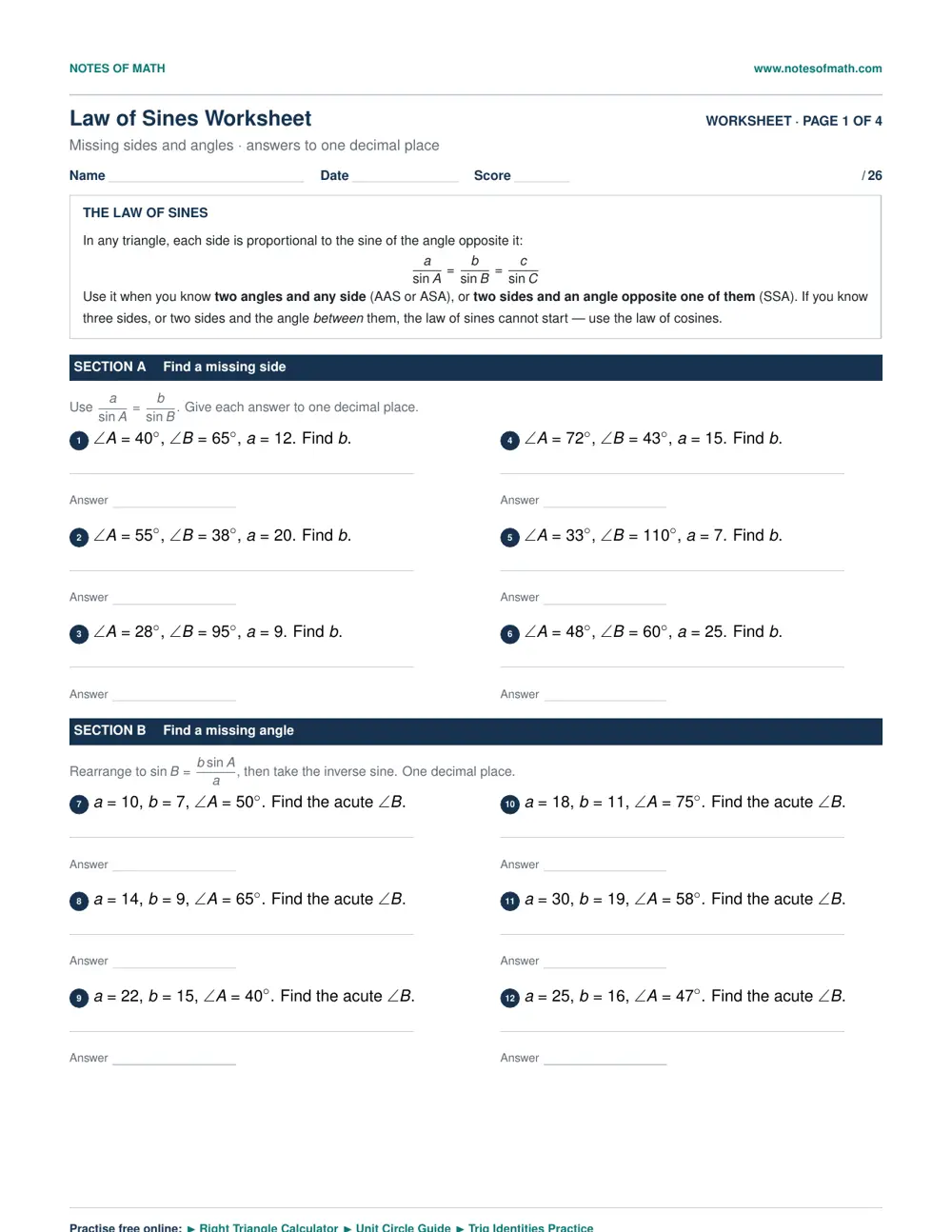
Practise the law of sines on one free printable worksheet. It covers finding missing sides and angles, the ambiguous SSA case — including the triangles that have no solution — triangle area from two sides and the included angle, and four applied problems.
Download the worksheet
Four pages of practice and a three-page worked answer key, with the full ratio set up for each question.
What is on the worksheet
- Section A — find a missing side (6 questions). Two angles and a side, answers to one decimal place.
- Section B — find a missing angle (6 questions). Two sides and an angle opposite one of them.
- Section C — the ambiguous case (4 questions). Decide whether the given parts give two triangles, one, or none at all.
- Section D — triangle area (4 questions). Using ½ab·sin C.
- Section E — applied problems (4 questions). Observers sighting a balloon, a surveyed plot, and a ramp.
- Section F — explain your reasoning (2 questions). Why SSA can give two triangles, and when to reach for the law of cosines instead.
- Answer key (3 pages). Every ratio written out and evaluated.
When the law of sines applies
In any triangle each side is proportional to the sine of the angle opposite it: a ÷ sin A = b ÷ sin B = c ÷ sin C.
- Use it for AAS or ASA — two angles and any side. The third angle comes free from the 180° sum.
- Use it for SSA — two sides and an angle opposite one of them — but check the ambiguous case before trusting a single answer.
- Do not use it for SSS or SAS. Every ratio needs an angle paired with the side opposite it, and neither case gives you one. Use the law of cosines.
- Set up one ratio with both knowns and one with the unknown, then cross-multiply.
Worked example: With ∠A = 40°, ∠B = 65° and a = 12, the side b is 12 × sin 65° ÷ sin 40° = 16.9 to one decimal place.
The ambiguous case, explained
Your calculator’s inverse sine only ever returns an angle between 0° and 90° for a positive sine. But sin θ = sin(180° − θ), so an obtuse angle has exactly the same sine.
In the SSA case that means a second triangle may exist. Work out the acute angle, then check whether its obtuse partner still leaves a positive third angle. If it does, there are two valid triangles. If sin B comes out greater than 1, no triangle exists at all.
When to use the law of cosines instead
If you know all three sides (SSS), or two sides and the angle between them (SAS), the law of sines cannot start — there is no angle paired with its opposite side.
Use c² = a² + b² − 2ab·cos C instead, rearranged for cos C if you need an angle. Once one angle is known, the law of sines can finish the triangle.
The mistake to watch for
Trusting the inverse sine to give the only answer. In the SSA case the obtuse partner 180° − B may also be valid, so always check whether it leaves a positive third angle before ruling it out.
Frequently asked questions
When do you use the law of sines instead of the law of cosines?
Use the law of sines when you know an angle together with the side opposite it — AAS, ASA or SSA. Use the law of cosines for SSS or SAS, where no such pair is available.
What is the ambiguous case?
The SSA situation, where two sides and a non-included angle are known. Because an acute and an obtuse angle can share the same sine, the given facts may describe two different triangles, one, or none.
How do you know there is no triangle?
If the calculation gives sin B greater than 1, no angle has that sine and no triangle exists with those measurements.
Does this worksheet cover the law of cosines?
The reasoning section asks when the law of cosines is needed and why, but the practice questions are all law of sines. The law of cosines is a separate skill.