Similar Triangles Worksheet
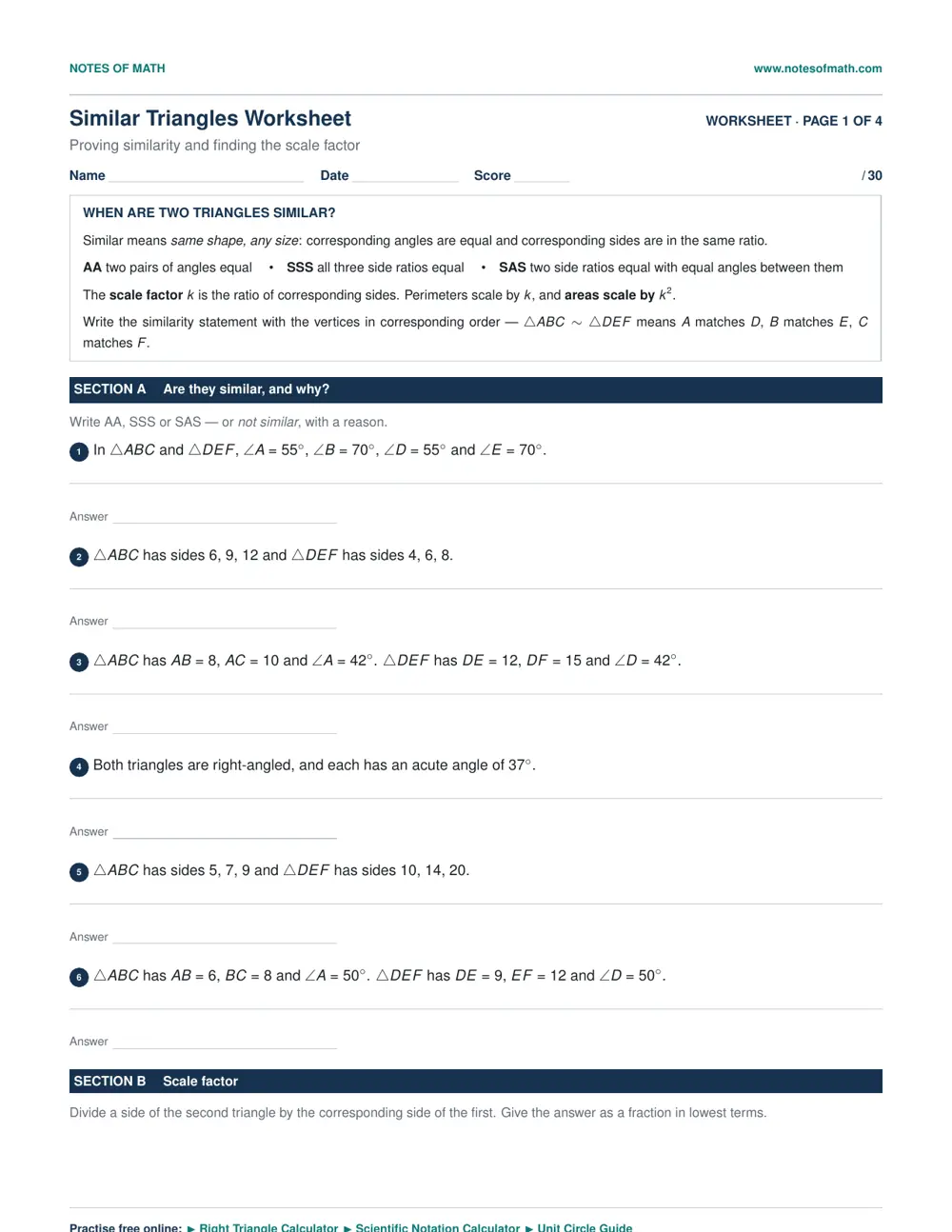
Practise similar triangles on one free printable worksheet. It covers proving similarity by AA, SSS and SAS, finding the scale factor, solving for missing sides by proportion, perimeter and area ratios, and applied shadow problems.
Download the worksheet
Six pages of practice and a three-page worked answer key, with the proportion written out for every question.
What is on the worksheet
- Section A — are they similar, and why? (6 questions). Name AA, SSS or SAS, or identify a pair that is not similar.
- Section B — scale factor (6 questions). From a pair of corresponding sides, as a fraction in lowest terms.
- Section C — missing sides (8 questions). Set up a proportion and solve it exactly.
- Section D — perimeter and area ratios (4 questions). Lengths scale by k, areas by k².
- Section E — applied problems (4 questions). Shadows, a scale model, and a sighting problem.
- Section F — explain your reasoning (2 questions). How similarity relates to congruence, and why area scales by the square.
- Answer key (3 pages). Each proportion written out and solved.
When are two triangles similar?
Similar means same shape, any size: corresponding angles are equal and corresponding sides are in the same ratio. Three tests establish it.
- AA. Two pairs of angles equal. The third pair then matches automatically, because angles in a triangle sum to 180°.
- SSS. All three pairs of sides in the same ratio.
- SAS. Two pairs of sides in the same ratio, with the equal angles between those sides.
- Then use the scale factor. Perimeters scale by k; areas scale by k².
Worked example: Triangles with sides 6, 9, 12 and 4, 6, 8 are similar by SSS: 6/4 = 9/6 = 12/8 = 3/2. The scale factor is 3/2, so the perimeters are in the ratio 3:2 and the areas in the ratio 9:4.
Why does area scale by the square of the scale factor?
Area depends on two dimensions. Doubling the base doubles the area, and doubling the height doubles it again, so the total factor is 2 × 2 = 4.
In general a scale factor of k multiplies area by k² — and volume, which depends on three dimensions, by k³. This is why a model at half scale has a quarter of the surface area and an eighth of the volume.
Similar or congruent?
Congruent triangles are always similar, with scale factor 1 — congruence is the special case where the sizes match as well as the shapes.
The reverse does not hold. Similar triangles share a shape but may differ in size, like a photograph and its enlargement. This is exactly why AAA proves similarity but never congruence.
The mistake to watch for
Applying the scale factor to area. If lengths are in the ratio 2:3, areas are in the ratio 4:9, not 2:3. The other common slip is pairing the wrong sides — read the similarity statement and match vertex to vertex before writing the proportion.
Frequently asked questions
What does the similarity symbol mean?
The symbol ∼ means “is similar to”. In △ABC ∼ △DEF the order of the vertices matters: A corresponds to D, B to E and C to F.
Is AA enough to prove similarity?
Yes. Two pairs of equal angles force the third pair to be equal as well, since the angles of a triangle sum to 180°. AA is the quickest of the three tests.
What is the scale factor?
The ratio of a side in one triangle to its corresponding side in the other. A scale factor of 3 means every length in the second triangle is three times the first.
Can two triangles be similar if they face different directions?
Yes. Similarity depends only on angles and side ratios, not on orientation. A triangle that has been rotated, flipped or both is still similar.